Senate votes 62-33 to make data centres pay their grid costs
The Senate passed a bill making data centres above 20 MW pay for grid upgrades and existing grid use, an estimated US$35 billion more over ten years. The House still has to pass it and FERC still has to write the rules before anyone is billed.
WIRE · AI DATA CENTERS · UNITED STATES · Senate vote 19 Nov 2026 (Bipartisan American Affordability and Jobs Act)
The US Senate on Thursday passed a bill that would make large data centres pay for the grid they use, by 62 votes to 33. Under the bill, the power regulator FERC would make utilities charge data centres above 20 MW for the upgrades they need and for their share of the existing grid. One consulting firm puts the extra bill at US$35 billion over ten years. But a Senate vote is not a charge on anyone's invoice. The House still has to pass it, and FERC still has to write the rules. On the AI Data Centers layer, the money moves only when a utility can bill it.
What happened
The vote
62 to 33 in the Senate on 19 November, with 14 Democrats in favour
The 495-page bill is expected to go to the House after the Thanksgiving break; some Democratic opponents want it held until January
The data centre rule
FERC must make utilities charge data centres above 20 MW for upgrades and for existing grid use
The charges are mandatory, apply to new and existing sites, and states may use the money to cut bills for homes and small firms
The money
US$35 billion more in transmission costs over ten years, US$55 billion in total
An estimate by consulting firm Grid Strategies, cited by the bill's supporters; it is not a government score
The rest of the bill
Faster permits for power plants, transmission lines and pipelines, and shorter environmental reviews
It also widens FERC's power to permit some interstate transmission lines and makes utilities report electricity sales to data centres
Why cash cares
Today, utilities usually spread the cost of grid upgrades across all their customers. Current FERC policy also generally stops a utility from charging one customer both for its share of the existing grid and for the new upgrades built to serve it. The bill flips that for large data centres. They would pay both, on top of the normal price of electricity.
The sums are big, but they are spread thin. Grid Strategies' US$35 billion of extra cost over ten years is about US$3.5 billion a year, on our arithmetic. Its US$55 billion total implies about US$20 billion that data centres would pay anyway on today's rules. So the bill would make the ten-year transmission bill about 2.75 times what it is on the current path, on our arithmetic.
Why now: the grid is where the wait is. On the same day as the vote, the International Energy Agency said data centre electricity use could double to about 1,000 TWh a year by 2030. It said that in several regions, including Texas and Virginia, the data centres waiting to connect add up to more than today's peak demand. A Federal Reserve Bank of Dallas working paper, cited in the Senate fact sheet, estimates data centre demand has already pushed US wholesale power prices up 6.9%, and could push them up 12.3% by 2028.
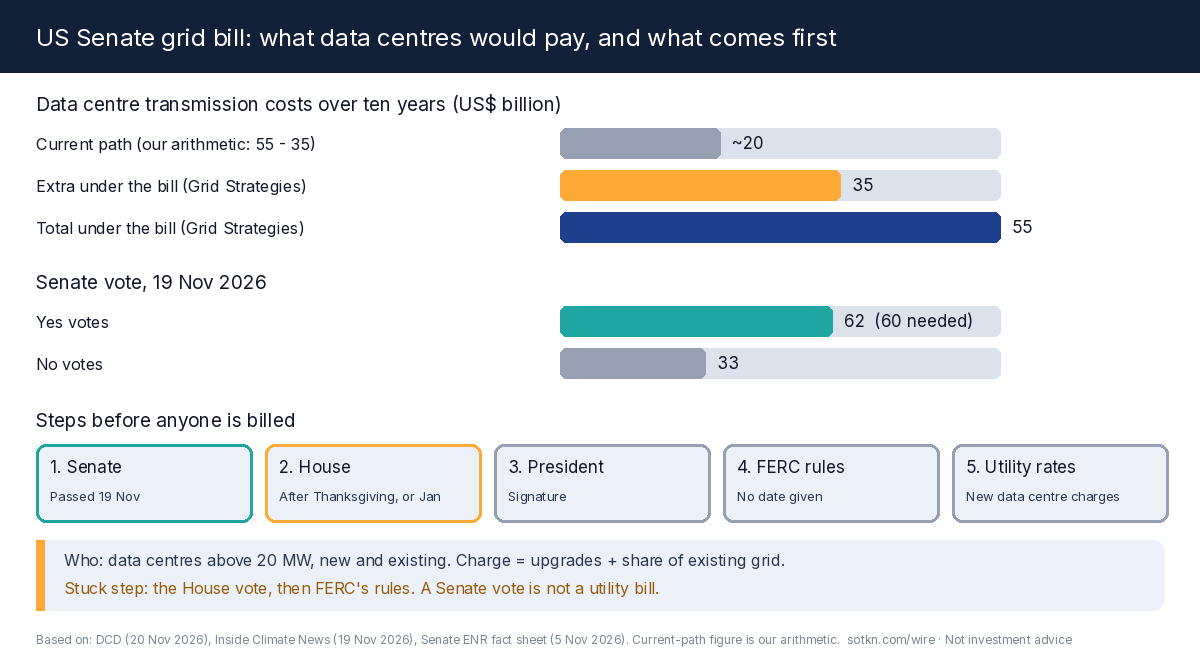
Figure: the Senate has voted; the House, the President and FERC still stand between the vote and a utility bill. Vote count and timing from DCD and Inside Climate News (19 and 20 November 2026). Ten-year transmission cost estimate from Grid Strategies, as reported by Inside Climate News. The current-path figure, yearly amounts and the 2.75 times ratio are our arithmetic.
The step that is still open
The stuck step is law, then rules. The Senate vote is step one of five. The House has to pass the same text, after the Thanksgiving break at the earliest. The President has to sign it. Then FERC has to write the rules, and utilities have to file new rates under them. None of our sources gives a date for FERC's rules.
The House clock matters more than usual. Democrats won both chambers in the midterms. Some Democratic opponents want the bill held until January, when they argue they would have more pull to rewrite it. If the House changes the text, it goes back to the Senate. The margin there was thin: 62 votes against the 60 needed, two spare.
The data centre charge itself has wide support. The House passed a separate Ratepayer Protection Pledge 417 to 3 in September. The fight is over the rest of the bill: permits, pipelines and environmental reviews.
The second-order read
Who gets paid. Utilities that own transmission. A data centre that pays for its own upgrades takes that cost out of the shared rate base, so the utility can build for it without asking every household to fund it first. Grid equipment makers sit behind them: the IEA says copper, cables and transformers are already tight. Households and small firms come last, if their state chooses to pass the new money back to them.
Who pays. Owners of data centres above 20 MW, new and old. That means hyperscalers that own their own campuses and the landlords who rent space to them. For a colocation landlord, the question is whether its leases let it pass the new grid charge on to tenants. The Data Center Coalition, whose members include Microsoft, Google and Amazon, said it was still reviewing the latest text.
Who waits. Projects in the connection queue. The bill does not make a substation arrive sooner. It changes who pays for it. Faster transmission permits could help later, but only once lines are actually built.
The bill also leaves a side door open. It does not cover power plants built on the data centre site, behind the meter. A McKinsey survey found 60% of North American data centre players plan permanent on-site plants. BloombergNEF counts about 100 GW of gas capacity planned at US data centres. If the grid gets dearer, more builders may go off-grid, and that moves the pressure from the power bill to the gas price. Anthropic's IPO prospectus already names competition for gas supply as a risk.
Cautions
The US$35 billion is a consultant's estimate quoted by supporters, not an official cost score. The real figure depends on rules FERC has not written.
Environmental groups say the bill's authors may have added an exemption this week for data centres used mainly for internet or cable. How wide that is will shape who actually pays.
The House can change the text. A rewrite in January could look quite different from what the Senate passed.
What would change the view
The House passing the Senate text unchanged, and a signature soon after, would move this from "voted" to "law". A FERC rulemaking with a schedule would move it closer to "billed". A hold until January, or a rewrite that sends the bill back to the Senate, would push the charge out and leave today's cost-sharing rules in place for longer.
What to watch
- After the Thanksgiving break (US Thanksgiving is 26 November 2026): whether the House takes up the Senate text as is.
- January 2027: whether opponents succeed in holding the bill for the new Congress.
- After any signing: FERC's rulemaking docket and the date it sets for utilities to file new data centre rates.
- Utility filings: the first EIA survey that splits out electricity sales to data centres, which the bill would require.
Read: the AI Data Centers layer, What Is Behind-the-Meter Power?, PJM's 6,831 MW power backstop, Kentucky's 1 GW data centre on borrowed power and how NSW makes data centres pay for the grid
Get the Wire. A free brief every day, here and in your inbox. Subscribe free →
If this Wire saved you a search, tip Second Order → sotkn.com/support
Not investment advice. Do your own research. The ten-year current-path cost, the yearly amounts, the 2.75 times ratio and the vote margin are our arithmetic on the sources below.
References
- DCD, "US Senate passes bill requiring data centers to pay more for grid infrastructure", 20 Nov 2026. Vote, 20 MW threshold, FERC powers and next step in the House.
- Inside Climate News, "Data Center Impact Hotly Contested in Federal Permitting Fight", 19 Nov 2026. Democratic votes, House timing, Grid Strategies estimate, exemption, on-site gas figures and industry response.
- US Senate Committee on Energy and Natural Resources, Heinrich fact sheet on the Bipartisan American Affordability and Jobs Act, 5 Nov 2026. How the data centre charge works, state use of the money, EIA reporting, Dallas Fed estimate.
- CNBC, "Data center electricity use could double by 2030, IEA says", 19 Nov 2026. IEA World Energy Outlook 2026 data centre demand, connection queues and tight grid supplies.