Two Years on Borrowed Power: Who Gets Paid While Kentucky’s 1 GW Data Campus Waits for Its Gas Plant
On 13 November Kentucky Power asked regulators to approve a 769 MW gas plant, a new substation and a two-year bridge so it can serve TeraWulf’s 1 GW Muskie campus. The campus starts drawing power in October 2028. The plant is due in spring 2031. The stuck step is the plant.

One data campus in eastern Kentucky now needs its own gas power plant. On 13 November the local utility asked state regulators to approve a $2.81 billion plant, a new substation and a two-year stopgap so it can serve TeraWulf’s planned 1 GW campus. The campus can start drawing power in October 2028. The plant is due in spring 2031. In between, the utility plans to lean on borrowed capacity. TeraWulf commits to pay charges and post $756 million of security. The stuck step is the plant.
US PULSE · UTILITIES · AI DATA CENTERS · POWER · Data as at 20 Nov 2026 (filings of 13 Nov; commission staff acceptance and Attorney General order 18 Nov) · Next update: the commission’s procedural schedule and the 13 December contract date
Affects: AI Data Centers · TeraWulf — Markets: US
Education only, not advice to buy or sell any security. Money is in US dollars. A megawatt (MW) is a unit of power; 1,000 MW is one gigawatt (GW). A utility is the local company that sells and delivers power. PJM is the grid manager for 13 states and Washington DC, including Kentucky Power’s area, and it runs the auctions that set what “capacity” costs, meaning the promise that power will be there on the hottest and coldest days. The earlier Wire on this desk covered the campus power deal and the missing tenant (TeraWulf doubles Kentucky power to 1 GW). This note covers what the utility filed this month to deliver that power.
The numbers that matter this week
The ask
769 MW
Gas plant at Big Sandy · filed 13 Nov
NewPlant cost
$2.81bn
Utility estimate · substation adds about $285m
PaidTeraWulf security
$756m
Letter of credit, expected to rise as the load ramps
PaidBridge deal
693 MW
1 Jun 2029 to 31 May 2031, bought from an AEP affiliate
WaitsCampus load starts
Oct 2028
Earliest ramp date in the contract
WaitsThe gate
Spring 2031
Plant in service, second quarter
Stuck stepKentucky Power filings to the Kentucky Public Service Commission, 13 Nov 2026 (cases 2026-00323 and 2026-00324). Status chips are Second Order’s read. The 693 MW is our sum of 262.9 MW and 430.3 MW.
On this page: Why it matters · What was filed · The contract · Plant and bridge · Our math · Who gets paid · Other customers · What is stuck? · Dates next · FAQ
Why does one data campus need its own power plant?
Think of a small town bakery that gets one order as big as the whole town eats. The oven is fine. The flour is fine. What is short is the electricity to run a second kitchen. The baker has two choices: buy power off the open market at whatever the price is that day, or build a generator and have the new customer help pay for it.
That is close to what Kentucky Power faces. It is a small utility. It serves about 162,000 customers across 20 counties in eastern Kentucky, and it owns 1,075 MW of power plants: one 295 MW gas plant and half of a 1,560 MW coal station. The Muskie Data Campus would add 1,000 MW of demand. In the company’s words, that doubles the size of its load.
The filing says what the utility tried first. It asked other companies in Kentucky to offer power plants. It sent out a formal request for proposals for in-state, on-demand generation. No one responded. It then looked at being what the filing calls a “price taker” in the PJM market, buying capacity and energy at market prices for demand this big. The company says that is “not a viable option” and not a reasonable long-term answer given the state of that market. So it chose to build.
This is the same pressure our desk has tracked from other angles: PJM short of capacity (PJM’s capacity shortfall), gas turbine makers sold out for years (GE Vernova’s turbine slots), and utilities asking big power users to carry the bill before the power exists (utilities bill data centers before power). Here all three meet on one site.
For anyone following AI infrastructure, the question is not whether the campus wants power. It is who pays for the power plant, who gets paid for building it, and how long the campus waits for it.
What did Kentucky Power file on 13 November?
Two cases, filed the same day with the Kentucky Public Service Commission, the state body that approves what a utility builds and charges.
- Case 2026-00323 asks the commission to approve the electric service agreement with TeraWulf. The company asks for it to take effect on 13 December 2026.
- Case 2026-00324 asks for a certificate to build a 769 MW gas power plant at the Big Sandy site near Louisa, in Lawrence County, plus the gas and power connections it needs.
- The same case asks for a certificate to build a new 765/345 kilovolt substation in Boyd County, called the Venator substation, and asks for that certificate no later than 1 March 2027.
- It also asks the commission to approve a two-year capacity purchase from AEP Generation Resources, an AEP sister company, called the Bridge Capacity Agreement.
- And it asks for a site compatibility certificate for the plant.
The company ties the pieces together. It says the benefits it promises existing customers depend on the requests being approved together “without significant modification”. That is a signal to the commission: change one part and the rest may need reworking.
On 18 November the commission’s staff told the company the plant filing meets the minimum requirements and was accepted. The same day, the commission granted the Attorney General’s request to join the case as a full party. A press summary on 19 November reports that commission decisions could come by mid-2027. We did not find a decision date in the pages we read, so treat that as reported, not set.
The story did not start on 13 November. Kentucky Power and TeraWulf began talking in March 2026. In May they signed a first agreement for 500 MW. In August they began talking about 500 MW more. The two companies announced the doubled deal on 5 October. What is new this month is the paperwork for the hard part: the plant, the substation and the stopgap.
What has TeraWulf agreed to pay?
The campus will sit in Boyd and Greenup Counties. The contract has two phases. Phase One is 500 MW for 20 years, with the power ramp starting no earlier than 13 October 2028 and reaching the full 500 MW in April 2029. Phase Two is another 500 MW for 15 years, with the ramp starting no earlier than 31 July 2029 and reaching full level in October 2029. TeraWulf, or whoever it signs as the end user, is the only customer served.
Kentucky Power already had a rule for loads of 150 MW or more, set in its industrial tariff and approved by the commission in 2025. It says the rule exists to keep other customers safe from the cost of serving a giant new user. It has five parts:
- A 20-year contract, with five years’ notice before ending it.
- A minimum monthly bill of at least 90% of the customer’s highest demand, whether or not it uses the power.
- Collateral equal to 24 times the largest monthly bill for power, before fuel charges.
- If the customer closes for good early, a one-time payment equal to five years of minimum bills.
- Five years’ notice before cutting the contract size, with some exceptions.
The TeraWulf deal sits on top of that rule and adds five terms of its own. TeraWulf pays the full tariff rate with no discounts. It pays up to $465 million of carrying charges, meaning the financing cost, while the plant is being built. It funds $100 million of winter bill credits for homes. There is a special energy price during the early ramp, before the plant exists. And there are two loosened terms for TeraWulf: the 15-year term on Phase Two, and a limited right to cut capacity during the term.
The cut-capacity right has fences. TeraWulf cannot use it in the first 10 years, must give 42 months’ notice, and must pay an exit fee. The security is a letter of credit of $756,013,200, covering the service agreement and a separate letter of agreement on building the transmission. The filing says that amount is expected to rise as the load ramps.
The early-ramp energy price matters for the waiting period. From the first power in October 2028 until the plant starts, TeraWulf’s energy is priced through a separate PJM account. The point, the filing says, is that the campus does not push up fuel costs for existing customers by forcing extra market purchases. TeraWulf also pays $17,000 a month to cover the cost of running that account. The company estimates the fuel savings to other customers at about $195 million over the life of the contract.
One more piece of background. The commission approved a separate TeraWulf power agreement on 21 August 2026, for a different campus served by Big Rivers Electric, and Kentucky Power’s filing points to that order’s test. So the regulator has seen a contract like this before, and it passed. This one is bigger and carries a power plant.
What do the plant and the bridge cost, and when do they arrive?
The plant is a combined-cycle gas plant. It burns gas in two turbines, then uses the waste heat to make steam for a third machine, so it squeezes more power from the same fuel. It will be 769 MW, built at the old Big Sandy site, with an expected 40-year life. The initial construction cost is about $2.81 billion, and the new substation is about $285 million. Together that is about $3.1 billion (our arithmetic). The company says it will pay for it with a mix of internal cash, debt and possible equity from its parent, AEP, in line with its investment-grade rating.
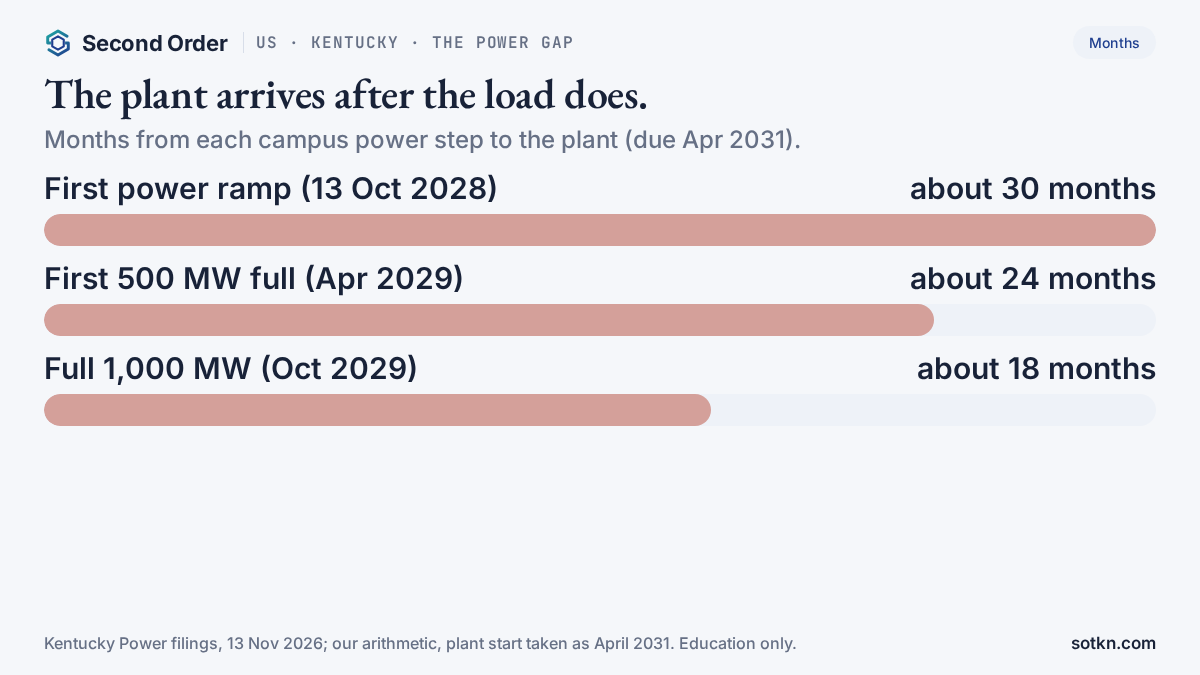
The plant is expected to enter service in the second quarter of 2031. The filing uses April 2031 as the date the special energy pricing ends, so we use April 2031 as the planning date. If the plant starts in June, add two months to every gap below.
Now the gap. The campus can start drawing power from 13 October 2028. From that date to April 2031 is about 30 months. The first 500 MW is at full level by April 2029, which leaves about 24 months before the plant. The full 1,000 MW arrives in October 2029, which leaves about 18 months. These are our counts from the contract dates and the plant’s expected start. The chart shows them.
The bridge fills part of that gap. Under the Bridge Capacity Agreement, Kentucky Power buys 262.9 MW from the Wolf Hills gas plant in Virginia and 430.3 MW from AEP’s share of two plants, one in Ohio and one in Indiana, that are run by a utility joint venture. That adds up to 693.2 MW (our arithmetic). It runs from 1 June 2029 to 31 May 2031. The price follows the PJM capacity auction price for each plant’s zone. The filing calls that the market price and “the lower of cost or market”. All the plants sit inside AEP’s part of the grid, so the power can be delivered.
Notice what the bridge does not do. It starts in June 2029, after the first half of the campus has reached full power. And the filing says the plant and the bridge together do not meet the full capacity obligation under the TeraWulf contract. To cover the rest, AEP’s commercial team has lined up more capacity purchases, to be added year by year as the load grows. We did not find in the pages we read a separate plan for the first months of the ramp, from October 2028 to May 2029, beyond that general approach and the special energy pricing.
The bridge also ends on 31 May 2031. If the plant starts on time in the second quarter, the bridge ends right as the plant begins. If the plant is late by even a few months, Kentucky Power needs another contract to fill the hole.
The company also explains why a combined-cycle plant and not a simpler, cheaper gas turbine. A data campus runs all hours. The company says it wants a plant that makes more energy from each unit of fuel. It tested the choice: market energy prices would have to average about $8 per megawatt-hour over 40 years to make the extra cost of the combined-cycle plant not worth it. It says energy prices have averaged about $60 per megawatt-hour so far this year in its area. That is the company’s test, not ours, and the commission will examine it.
It also explains the substation. The local 138 kV and 69 kV lines cannot carry 1,000 MW without breaking grid reliability rules. The only fix, it says, is to connect to the 765 kV line nearby. The next alternative sources are more than 13 miles away over rough terrain. It looked at eight possible sites, visited them on 30 July 2026, and dropped six.
How big are TeraWulf’s payments next to the bill?
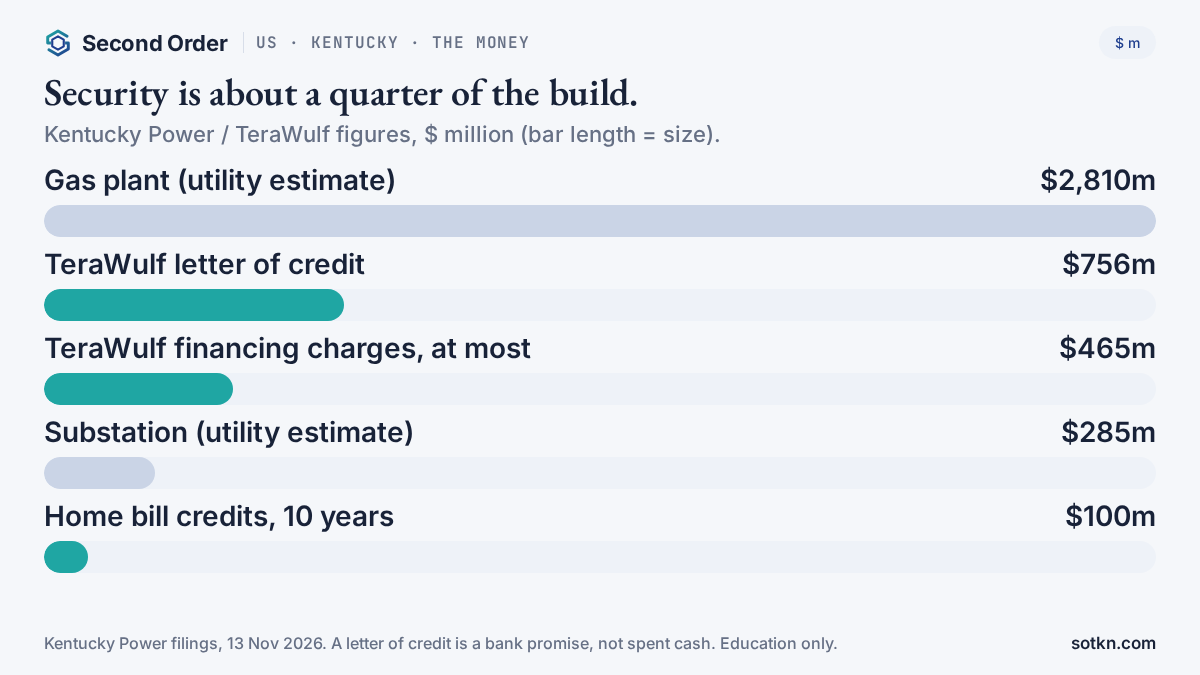
Put the cash side by side. The plant is about $2.81 billion and the substation about $285 million. TeraWulf’s letter of credit is $756 million, up to $465 million of financing charges, and $100 million of bill credits spread over 10 years. The letter of credit is a promise from a bank to pay if TeraWulf does not. It is not cash spent.
The $465 million is real money, though, and the company argues it is worth much more than its face. If the utility had added the financing cost to the plant’s price, the way utilities usually do, every customer would pay a share of it over the plant’s 40-year life. The company says avoiding that is worth about $1.3 billion of revenue that would otherwise be collected from customers. That is the utility’s estimate.
What does the arithmetic say?
A few simple sums help size the story. All of these are our arithmetic from the filings’ figures, rounded.
The build bill
What TeraWulf puts up
Power in, power out (MW)
The clock (plant at April 2031)
The utility’s own benefit claims
Kentucky Power filings, 13 Nov 2026. Benefit figures, the $2.81bn cost and the revenue-cut percentages are the utility’s estimates and the filing says class allocation is not finished, so the percentages are not a specific rate decrease. The 1,462 MW line adds plant and bridge capacity, which are different kinds of capacity and not all of it meets the contract obligation. The plant start is taken as April 2031. The 24% and 17% are our division.
Read the table this way. TeraWulf’s promised security is about a quarter of the build bill. That is large for a customer that, so far, has no named tenant, and it is the reason the utility is comfortable building. But the bill comes due years before the campus can pay for itself: the plant’s cost is spent while the load is still ramping.
The utility’s own benefit table is the other half of the story. It says the contract will cut other customers’ bills because the fixed costs of the system are spread over about double the sales. The filing’s table puts the saving to existing customers at about $44 million in 2029 and $62 million in 2030, or 6.0% and 8.4% of today’s $735 million of yearly revenue. Those are estimates at full contract capacity. They depend on the campus actually using the power. A campus that stalls would shrink every one of them.
The campus itself is a large claim. The filing says Muskie will bring about $8.5 billion of investment, about 3,500 construction jobs, 350 to 500 permanent jobs and more than $200 million a year in state and local taxes once running, and that TeraWulf did not ask for tax incentives. These are the company’s estimates and they leave out the billions of dollars of computers the end user would install.
Who gets paid, and who waits?
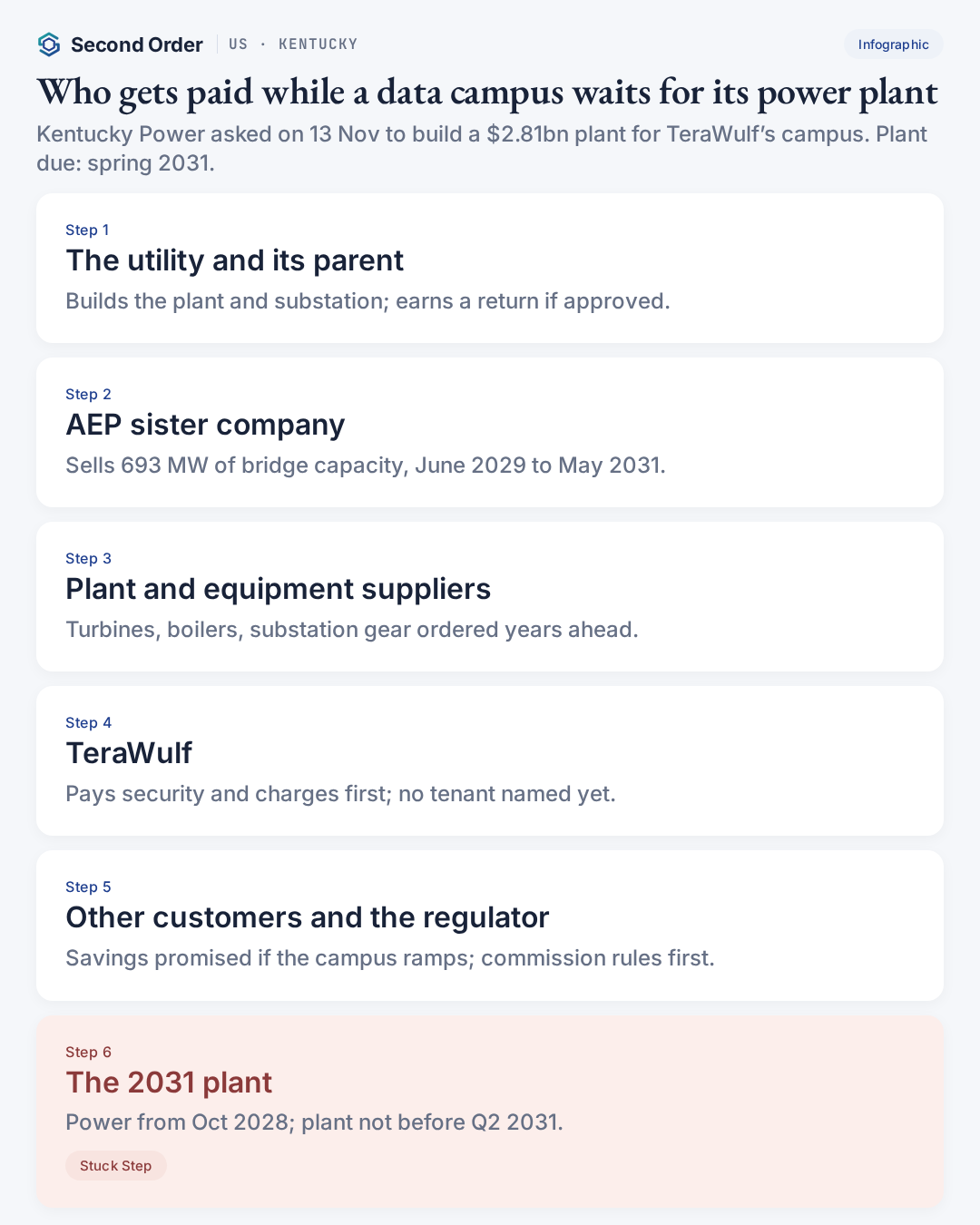
1 · The utility and its parent
Who: Kentucky Power and AEP
Paid: Builds and owns a $2.81bn plant and a $285m substation; earns a return if approved
2 · The AEP sister company
Who: AEP Generation Resources
Paid: Sells 693 MW of capacity for two years at the market price
3 · Plant builders and equipment makers
Who: Turbine, boiler and substation suppliers, builders
Paid: Orders for a plant that does not run until 2031
4 · TeraWulf
Who: Pays charges and posts security first
Paid: Letter of credit, up to $465m of charges, $100m of credits, before any tenant is named
5 · Other Kentucky Power customers and the regulator
Who: Homes and businesses; the commission
Paid: Promised savings only if the campus ramps; the commission rules first
6 · The 2031 plant
Who: 769 MW at Big Sandy, second quarter 2031
Paid: Sets how long steps 4 and 5 live on borrowed capacity
First paid, the utility and its parent. If the commission approves, Kentucky Power gets to build about $3.1 billion of equipment and earn a return on it. The filing says the plant would be a “steel in the ground” asset for decades. That is how regulated utilities make money: they grow the base they are allowed to earn on. The contract and the security are meant to make that growth safe.
Next, the AEP sister company that sells the bridge. It sells 693 MW of capacity for two years at the PJM auction price. That is a normal market sale, but it is one affiliate selling to another, and the filing asks the commission to approve it. The commission will want to see that the price is fair.
Third, the people who build and equip the plant. A combined-cycle plant needs turbines, boilers, a steam machine, switchgear and a gas connection. A new 765 kV substation needs big transformers and breakers. Whoever sells these gets orders years before the plant makes a kilowatt-hour. The filing does not name suppliers, and we do not guess.
Who waits? TeraWulf. It pays first: security, financing charges, bill credits and a minimum bill that applies whether or not its halls are full. Its own tenant, whoever it will be, waits for the power to arrive. The October Wire on this desk found no tenant named, and the filing repeats that the customer is TeraWulf “or its future end-user(s)”.
The other group that waits is other Kentucky Power customers. They are promised savings, but the first savings arrive in 2029, and the plant’s cost enters the rate base when it starts in 2031. The regulator also waits: it has to decide on a package that is built to be approved as one piece.
What does this mean for everyone else on the grid?
The central worry about data campuses is cost-shifting: the campus uses the grid, the utility builds for it, and ordinary households end up paying if the campus leaves or never fills. Kentucky Power’s filing is built to answer that worry, and it does so with five tools: the 20-year minimum bills, collateral worth 24 monthly bills, the exit payment, the security, and the financing charges paid by TeraWulf.
It also points to a federal pledge on ratepayer protection that Kentucky Power and other AEP companies signed, and to the Kentucky governor’s August 2026 order on data centers. We did not read those documents for this note, so we only note that the company cites them.
Other utilities are writing similar rules. Elsewhere, a North Carolina settlement filed by Duke Energy has new data centers of 50 MW or more pay 75% of demand charges whether they use the power or not (Duke’s 75% minimum bill). The Kentucky terms go further: 90% minimum bills, collateral and a five-year exit payment. The question for investors is not whether protections exist. It is whether they are strong enough if the tenant, the chips or the financing slip. Collateral held against a campus that never fills only covers so much.
What the filing cannot protect against is time. If the plant is late, the bridge runs out, and the cost of extra capacity has to land somewhere. The filing says TeraWulf pays the carrying charges during construction and fuel costs are ring-fenced through the special account. We did not see in the pages we read a stated rule on who pays for extra capacity if the plant slips past May 2031. That would be a good question for the commission’s hearing.
What is stuck, exactly?
The stuck step is the plant. Not demand: the company says the contract is signed for 1,000 MW. Not money for the utility: TeraWulf pays charges and posts security, and AEP can fund the rest. Not the grid connection: the company wants the substation certificate by March 2027, well before the first power. It is the time it takes to get approval, order the equipment, build a gas plant and start it up. The company’s own plan puts that in the second quarter of 2031.
The clock has four parts. First, approval: the commission has to decide on both cases. Second, ordering and building: turbines, boilers and the steam machine must be bought and installed. Third, the substation, which the company wants certified by March 2027 so it can be ready before the first power in October 2028. Fourth, starting up. Each can slip, and money cannot skip any of them. What money can buy is a stopgap, and the stopgap is what the bridge is.
There are honest reasons for caution. First, the campus has no named tenant, and a first customer could change the ramp dates either way. Second, the filings are requests, not approvals. Third, the benefit figures are the utility’s own. Fourth, the 2031 date has no public contractor schedule that we found, and gas turbine makers are booking more orders than they can ship in a quarter (how long it takes to build an AI data center). Fifth, the bridge leaves little room: it ends 31 May 2031, the same quarter the plant is due. The pattern our Analysis desk keeps returning to still applies: the slow step sets the timing, and money gathers around whoever is not stuck behind it (where the stuck step moves).
Which dates test the read?
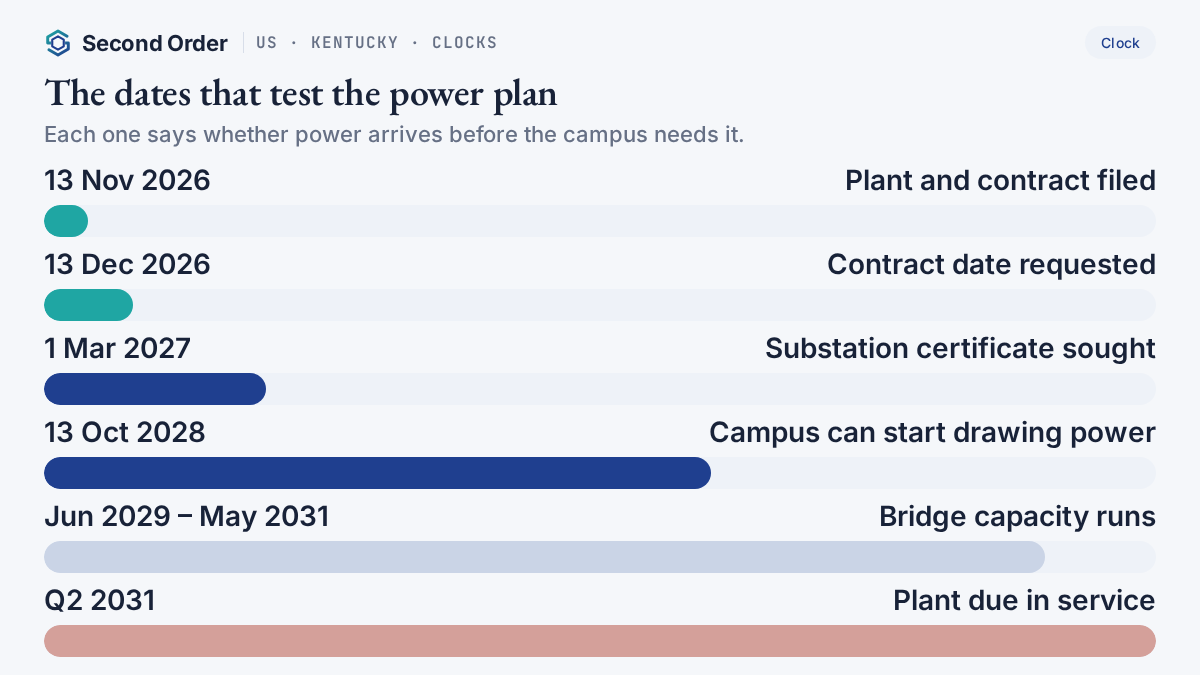
- 13 November 2026 — Kentucky Power filed cases 2026-00323 and 2026-00324.
- 18 November 2026 — commission staff accepted the plant filing as complete; the Attorney General was granted party status.
- 13 December 2026 — the date the company asks for the TeraWulf contract to take effect.
- 1 March 2027 — the date by which the company asks for the substation certificate.
- Mid-2027 — reported timing for commission decisions (press report, not confirmed in the docket).
- 13 October 2028 — earliest date the campus can begin drawing power.
- April 2029 and October 2029 — Phase One and Phase Two reach full contract capacity.
- 1 June 2029 to 31 May 2031 — the bridge capacity runs.
- Second quarter 2031 — the plant is due to enter service.
Dates from Kentucky Power’s filings and the commission docket. The mid-2027 line is from a press summary and is not in the filings we read.
How does this look next to other US power stories?
It is one of many places where a data campus is pulling a utility into building. In the Mid-Atlantic, PJM is already short of capacity (PJM capacity shortfall). In turbine supply, the biggest US maker booked three times more turbines than it shipped last quarter (GE Vernova turbine slots). In the campus itself, the same company’s other sites show what a signed tenant changes (what TeraWulf does). And on the money side, the way these campuses are financed decides who carries the wait (data center financing explained). For all of our US notes, see US Markets.
How we check this. Every contract term, date, megawatt figure and dollar amount comes from Kentucky Power’s own filings with the Kentucky Public Service Commission, dated 13 November 2026 (cases 2026-00323 and 2026-00324), which we read directly. The commission’s docket page gives the 18 November events. The October dates come from Kentucky Power’s and TeraWulf’s releases of 5 October. Benefit figures and cost estimates in the filings are the utility’s own estimates and are labelled that way. The reported mid-2027 decision timing comes from a press summary and is not in the pages we read. Every sum we worked out is labelled “our arithmetic”. We did not read the confidential exhibits, so we do not state the bridge price or the plant’s running costs. The references we used are listed at the end. Our editorial standards →
FAQ
What did Kentucky Power ask for on 13 November?
It filed two cases with the Kentucky Public Service Commission. One asks to approve its electric service agreement with TeraWulf. The other asks for a certificate to build a 769 MW gas power plant at Big Sandy near Louisa, a new 765/345 kilovolt substation in Boyd County, and a two-year deal to buy backup capacity from an AEP affiliate. The commission staff accepted the plant filing as complete on 18 November.
When does the campus need power, and when is the plant due?
The agreement lets TeraWulf start ramping power no earlier than 13 October 2028, with the first 500 MW at full level by April 2029 and the second 500 MW at full level by October 2029. The plant is expected to start in the second quarter of 2031. The gap is about two years for the first half of the campus and about a year and a half for the whole campus (our arithmetic).
What is the bridge deal?
It is a two-year capacity contract, from 1 June 2029 to 31 May 2031, with an AEP affiliate. Kentucky Power buys 262.9 MW from the Wolf Hills gas plant in Virginia and 430.3 MW from AEP’s share of two coal plants in Ohio and Indiana. The price follows the PJM capacity auction price for each location. The filing says it does not cover the whole need, so more annual purchases are planned.
Who pays for what?
TeraWulf pays the full tariff rate, up to $465 million of financing charges during construction, $100 million of bill credits for homes over the first ten years, and posts a $756 million letter of credit as security. Kentucky Power builds and owns the plant and substation and recovers their cost in rates. Whether that mix protects other customers is for the commission to decide.
Is there a tenant for the campus?
None has been named. The filing says TeraWulf, or its future end-users, will be the only customer. TeraWulf’s October release named no tenant, and we found none in later company statements. The October Wire on this desk made the tenant the stuck step. This note is about the power plant behind it.
Is this investment advice?
No. Education only. It maps who gets paid and which step is stuck. It is not a recommendation to buy or sell any security, and we leave out price targets and ratings on purpose.
References
Outbound links below are nofollow. We list only the sources actually used. Internal sotkn.com links in the body are separate.
- Kentucky Public Service Commission, Case 2026-00324, Kentucky Power application for a certificate to build the 769 MW Big Sandy combined-cycle plant, the Venator substation and the Bridge Capacity Agreement, 13 Nov 2026. psc.ky.gov — plant size, cost, 2031 start, bridge megawatts and dates, RFP result, break-even test, substation need and cost.
- Kentucky Public Service Commission, Case 2026-00324, Case Summary filed by Kentucky Power, 13 Nov 2026. psc.ky.gov — the company’s case for benefits to existing customers and its customer-protection description.
- Kentucky Public Service Commission, Case 2026-00323, Kentucky Power application to approve the TeraWulf electric service agreement, 13 Nov 2026. psc.ky.gov — contract phases, ramp dates, security, carrying charges, bill credits, tariff terms, benefit tables and project estimates.
- Kentucky Public Service Commission, Case 2026-00324 docket page (Commission staff no-deficiency letter and Attorney General intervention order), 18 Nov 2026. psc.ky.gov — the filing being accepted as complete and the Attorney General joining as a party.
- Kentucky Power, Kentucky Power, TeraWulf Finalize Expanded Agreement Providing for $100 Million in Customer Benefits, 5 Oct 2026. kentuckypower.com — the utility’s description of the amended agreement, bill credits and collateral.
- TeraWulf, TeraWulf Expands Contracted Power Capacity at its Muskie Data Campus to 1 GW, 5 Oct 2026. investors.terawulf.com — the second phase moving from 2030 to 2029, and the statement that no tenant was named.
- TeraWulf, TeraWulf Reports Third Quarter 2026 Results, Nov 2026. investors.terawulf.com — the Muskie status line and the company’s liquidity.
- Benderson Media, The Benderson Brief: Kentucky Power wants a $2.85 billion gas plant for one data center, 19 Nov 2026. bendersonmedia.com — press summary of the filings, including a reported commission-decision timing of mid-2027 that we have not confirmed in the docket.
- Wikimedia Commons, Big Sandy Power Plant After Conversion.jpg, photo by FunksBrother, CC BY-SA 4.0, 2019 photo. commons.wikimedia.org — the site photograph behind the featured image, which we cropped, darkened and colour-graded.
Not investment advice. Do your own research. Education only. Map of who gets paid and which step is stuck — not a buy list.
More on this desk: US Markets · AI Data Centers · the October Muskie Wire · data center financing explained · all Markets.