SpaceX pledges $74B for two AI campuses that face votes on 9 December
SpaceX plans more than $74 billion for two AI supercomputing campuses, a 6 GW site in Cochise County, Arizona and a gas-powered site at Starbase, Texas. Grid work and land get paid first; both sites face public votes on 9 December before a hall can earn.
WIRE · AI DATA CENTERS · UNITED STATES · Reported 12 Nov 2026 (Starbase, Texas and Cochise County, Arizona)
SpaceX said on Thursday 12 November that it plans to invest more than US$74 billion in two supercomputing campuses: more than US$24 billion at its Starbase site in Texas and about US$50 billion in Cochise County, Arizona, where it says the campus could draw up to 6 GW. On the AI Data Centers layer, the money is promised but the permission is not. Both sites face a public vote on the same day, 9 December, and the Arizona power deal still has to clear the state regulator.
What happened
The pledge
More than US$74bn across two AI campuses
About US$50bn in Arizona and more than US$24bn in Texas; SpaceX's AI segment made more than half its third-quarter revenue
Arizona
Up to 6 GW in nine buildings, built in four 1.5 GW phases
747 acres near the Willcox Playa, a 24 GWh battery, dry cooling; construction could start in March 2027 if zoning is approved
Texas
A gas-fired power plant and supercompute site on 444 acres
It makes its own power instead of drawing from the state grid; Starbase weighs a property tax break on 9 December
The vote
Cochise County planning hearing, 9 December
Special use application SU26-22; a petition with 2,400 signatures asks the county to deny the permit
Why cash cares
A campus announcement is a spending plan, not a revenue line. SpaceX earns from these halls only when racks are powered and running its own models or a customer's job. Until then the cash moves one way: out, to landowners, contractors, power companies and equipment makers. Thursday's statement, and the filings behind it, say a lot about who gets that money first.
Start with the size. On our arithmetic, US$50 billion for up to 6 GW is about US$8.3 billion per gigawatt, or US$8.3 million per megawatt. SpaceX did not say how much of that is buildings, power gear or chips, so the ratio is a rough guide only. If the four 1.5 GW phases cost the same, each would be about US$12.5 billion. The full 6 GW would equal about 19% of Arizona's 32 GW of net generating capacity in 2024, the federal figure cited by Data Center Dynamics. The 24 GWh battery could carry the campus at full load for about four hours.
The power money flows early. SpaceX says it will pay for US$3.6 billion of grid upgrades and hand them to the Arizona Electric Power Cooperative (AEPCO) at no cost to its members. Its application puts about US$500 million of that on the work needed for phase one, or about 14% of the total, on our arithmetic. At full build, SpaceX says it would pay up to US$260 million a year for Sulphur Springs Valley Electric Cooperative (SSVEC) members and up to US$200 million a year to AEPCO, about US$460 million a year combined. It also estimates US$34 million to US$103 million a year in new county property tax and a one-time county sales tax benefit of up to US$250 million.
In Texas, part of the bill is already paid. SpaceX committed US$220 million to Brownsville's water and wastewater systems when the city agreed to release the 444-acre tract from its limits. The city of Starbase, which SpaceX built around its launch site, then annexed the land.
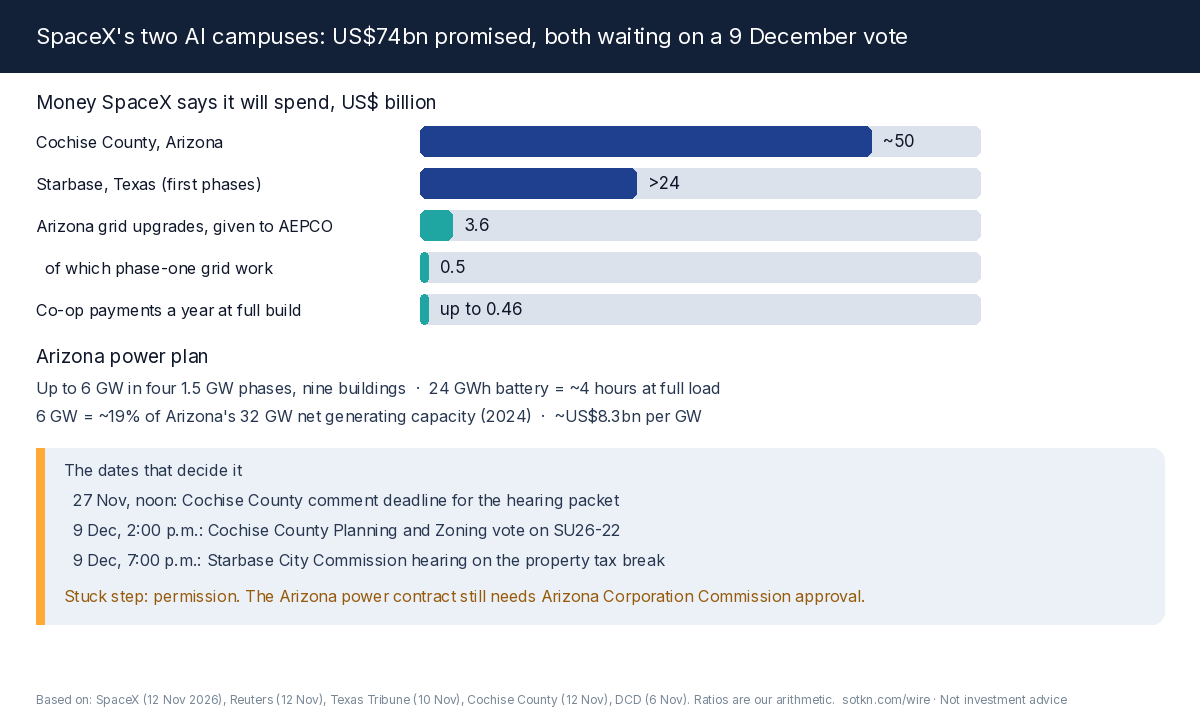
Figure: promised before permitted. Investment, power and site figures from SpaceX's statement and Cochise County project page of 12 November 2026, its county application as reported by Data Center Dynamics on 6 November, and Starbase's notice as reported by the Texas Tribune on 10 November. Per-gigawatt cost, phase size, battery hours and share of Arizona capacity are our arithmetic.
The step that is still open
The stuck step is permission, and in Arizona it comes in two parts.
The first is zoning. Cochise County does not allow data centers by right; they need a special use permit. The county's Planning and Zoning Commission will hear application SU26-22 on Wednesday 9 December, moved up to 2:00 p.m. because so many people want to speak. The commission can approve, approve with conditions or deny, and its decision is final unless appealed to the Board of Supervisors. Written comments received by noon on 27 November go into the meeting packet. The application was filed under the name Tombstone Resources LLC on 30 October, and SpaceX's role became public at a town hall on 4 November.
The second is power. SSVEC says it neither backs nor opposes the project. Any final electric service agreement must go to the Arizona Corporation Commission under a large-load review process the commission approved in August. That review checks that the costs of serving the campus fall on the project and that no other customers subsidise it. SSVEC says it is negotiating financial safeguards in case the project closes or uses less power than it asked for. No final agreement has been reached. SpaceX's own application, as reported by Data Center Dynamics, says when the compute arrives depends on the grid upgrades being finished.
Texas takes a different route around the same problem. Brownsville's 90-day moratorium on data centers took effect in early November, and in August Governor Greg Abbott directed grid operators to pause data center connection requests pending audits, the Texas Tribune reported. Governor-elect Gina Hinojosa has said she would stop all data center approvals until lawmakers pass new rules. A gas plant on SpaceX's own land avoids the grid queue. It does not avoid local politics: the Starbase City Commission will consider the tax break at a public hearing at 7:00 p.m. on 9 December. From today, both votes are 26 days away.
The second-order read
Who gets paid. The landowners and the power companies first. The Arizona land is owned today by AEPCO and Southline Transmission, and AEPCO stands to receive US$3.6 billion of grid assets. Brownsville has its US$220 million commitment. Next come the contractors behind about 5,500 construction jobs in Arizona and more than 3,000 already at Starbase, and the suppliers of transformers, switchgear, batteries, dry coolers and, in Texas, gas generation. Chip and server makers are paid last, once there is a powered hall to put their hardware in.
Who funds the wait. SpaceX's shareholders, who have owned a listed company since June. Grid work and land are paid for before any hall earns, and the safeguards SSVEC is seeking mean SpaceX, not the co-op's members, carries the cost if the campus is built smaller or not at all.
Who waits. SpaceX's AI business, which already makes more than half the group's revenue and needs the compute. The co-op members wait too: the bill cuts and annual payments arrive only as the campus is built and used.
Stuck step. A county permit and a state-approved power contract in Arizona, and a city tax vote in Texas. Money is not the constraint.
Three cautions
The US$74 billion is SpaceX's own figure, and none of it is contracted capacity or revenue. Texas's US$24 billion covers only the first phases, the Arizona plan runs in four phases with no dates past the first, and SpaceX gave no split between buildings, power and chips.
The benefits to co-op members are subject to final negotiation, and the numbers do not all agree. SpaceX's project page projects bill cuts of 10% to 40% for SSVEC members, while its statement, as reported by Reuters, said up to 20%. SSVEC says none of the benefits is guaranteed.
The per-gigawatt cost, phase size, battery hours, share of Arizona capacity, phase-one share of grid spending and combined annual payments are our arithmetic on reported figures, not company disclosures.
What to watch
- 27 November, noon: the comment deadline for the Cochise County meeting packet, then the county staff report about a week before the hearing.
- 9 December, 2:00 p.m.: the Cochise County Planning and Zoning Commission vote on SU26-22, and any appeal to the Board of Supervisors.
- 9 December, 7:00 p.m.: the Starbase City Commission hearing on the property tax break.
- The electric service agreement for SSVEC and AEPCO, once it is filed with the Arizona Corporation Commission.
- March 2027: the earliest Arizona construction start SpaceX has given.
Read: the AI Data Centers layer, What does SpaceX do in AI?, SpaceX takes a $40B Apollo lease on GPUs due in 2027 and Where are AI data centers located?
Get the Wire. A free brief every day, here and in your inbox. Subscribe free →
If this Wire saved you a search, tip Second Order → sotkn.com/support
Not investment advice. Do your own research. The per-gigawatt cost, phase size, battery hours, share of Arizona capacity, phase-one share of grid spending, combined annual payments and days to the votes are our arithmetic on reported figures.
References
- SpaceX, "Cochise County, AZ", project page, accessed 12 Nov 2026. Investment, power, battery, grid upgrades, co-op payments, tax estimates and jobs.
- Reuters, "SpaceX plans over $74 billion investment in Texas, Arizona AI campuses", 12 Nov 2026. The two investment figures, AI segment revenue share, petition and Starbase hearing date.
- San Antonio Express-News, "Elon Musk's SpaceX is building a $24 billion data center in South Texas", 12 Nov 2026. Starbase site, jobs, Brownsville water commitment and moratorium.
- Texas Tribune, "SpaceX to build $24 billion data center in South Texas, sidestepping moratorium", 10 Nov 2026. Gas-fired plant notice, de-annexation and state data center policy.
- Cochise County, "Data Centers", updated 12 Nov 2026. SU26-22 hearing time, comment deadline and decision process.
- Cochise County, "Cochise County announces special use application for proposed data center and battery energy storage", 2 Nov 2026. Filing date, applicant and zoning.
- Data Center Dynamics, "SpaceXAI plans data center in Arizona, Musk's firm claims it will have 6GW capacity", 6 Nov 2026. Phases, March 2027 start, phase-one grid spending and Arizona capacity.
- Sulphur Springs Valley Electric Cooperative, "SSVEC Outlines Its Role, Member Protections in Proposed Data Center Talks", 10 Nov 2026. Commission review process and status of the power agreement.