Marvell agrees to buy Lumentum for $115B to own the AI laser
Marvell agreed to buy Lumentum in an all-stock deal valuing it at $115 billion, which puts the scarce indium phosphide laser fabs behind AI optics inside one chip company and leaves rival module makers buying lasers from a competitor.
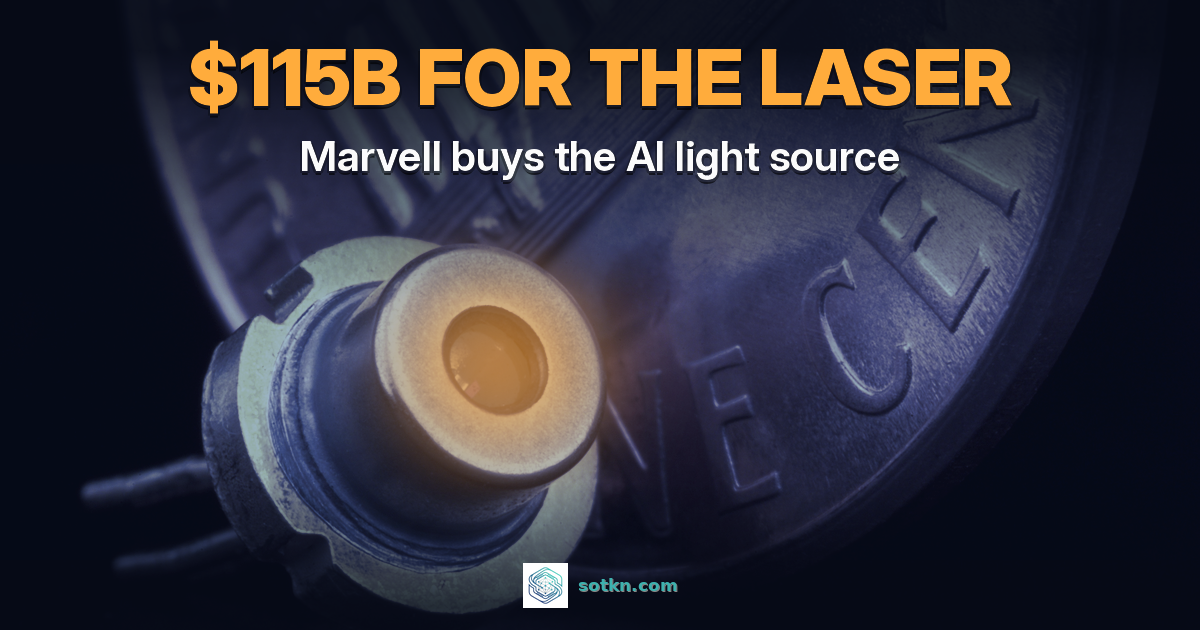
Marvell has agreed to buy Lumentum in an all-stock deal that values the laser maker at $115 billion, which puts the indium phosphide laser fabs that AI optics depend on inside the same company that sells the signal chips, switches and custom silicon around them.
What happened?
- The deal: On 2 November 2026 Marvell and Lumentum announced a definitive agreement for Marvell to acquire Lumentum. Lumentum holders get a fixed 4.5 Marvell shares for each Lumentum share. The companies put the implied enterprise value at $115 billion. Marvell holders will own about 67% of the combined company and Lumentum holders about 33%.
- The timing: Both boards approved the deal unanimously. It needs both sets of shareholders and regulators to sign off, and the companies expect it to close in the first half of calendar 2028. Matt Murphy stays chairman and CEO, and three Lumentum directors, including CEO Michael Hurlston, join Marvell's seven-member board.
- The pitch: The companies expect more than $1 billion a year in run-rate cost savings, mostly in cost of goods, and say the deal adds to Marvell's adjusted earnings per share in the first year after closing. They put the combined addressable market at $550 billion by 2030, about $60 billion more than the two would chase alone, mostly in scale-up and later scale-in interconnect.
- The same-day numbers: Lumentum reported fiscal first-quarter revenue of $1.26 billion, up 136.5% from a year earlier, and guided the next quarter to $1.575 billion to $1.625 billion. It said it had won its second major near-packaged or co-packaged optics deal, backed by purchase commitments above $5 billion. Marvell said its third-quarter revenue would land in line with guidance, narrowing the range to plus or minus 2%.
Why does it matter?
The direct signal: the laser is the part nobody can design around. A laser turns an electrical signal into light so data can move through fibre. Pluggable modules, near-packaged optics and co-packaged optics all need one. Lumentum's CEO said on the deal call that Lumentum owns the world's largest indium phosphide manufacturing footprint, and that making these lasers is not practical for a fabless company. Marvell, which designs chips but owns no fabs, has the signal processors, switches and silicon photonics, but not the light source.
The second-order signal: scarcity is now being bought, not just booked. Lumentum's CEO said in October that its AI data center optics were sold out to early 2029, which we covered in our Wire on Lumentum's sold-out optics. On the deal call an analyst asked how much of the near-term revenue rests on indium phosphide supply staying tight. Murphy answered that supply constraints run across the whole hyperscaler ecosystem and put indium phosphide in the same category as memory and leading-edge chips. When a step is that tight, the buyer of the fab gets first call on the output.
Rivals now buy from a competitor. TrendForce notes that Chinese module makers lead in 800G and 1.6T transceivers and rely on Marvell's signal chips and on lasers from suppliers such as Lumentum, which also owns the module maker Cloud Light. After closing, those module makers would buy both key parts from a company that also sells modules. TrendForce expects that to be the central question in China's review.
What does it change?
Near term (to the first half of 2028)
- Nothing changes in the supply chain until closing. The two remain separate companies until closing, each selling under its own customer contracts. Our arithmetic: Lumentum's guidance midpoint of $1.6 billion is about $337 million above the first quarter, close to the roughly $350 million step the company described.
- Customers will hedge. Our arithmetic: with about 14 to 20 months to closing, module makers and hyperscalers have time to qualify second sources for lasers and signal chips. TrendForce notes that Broadcom already sells switch chips, signal processors and its own lasers, which makes it the obvious alternative; our explainer on who makes AI cluster networking maps the field.
- A large order book is already tied to the next design shift. Our arithmetic: the more than $5 billion of purchase commitments behind Lumentum's second co-packaged optics win is about four times its first-quarter revenue.
Longer term (2028 and beyond)
- The fight moves to the package. As co-packaged optics put the optical engine next to the switch or accelerator, the laser has to be designed alongside the chip. That is the co-design case Marvell is making. Our silicon photonics explainer covers why the laser stays the stuck step even when the rest moves onto silicon.
- Scale on paper. Marvell said the two businesses together show $17.7 billion of annualized revenue at a 39% adjusted operating margin, and more than $21 billion annualized one quarter further out, using Lumentum's guidance and analyst forecasts for Marvell. Murphy said Marvell will keep investing multiple billions of dollars with its supply partners to secure capacity.
- Market share. TrendForce estimates the combined company would hold nearly 7% of the wired communications chip market, third behind Nvidia and Broadcom.
| Metric | Value | Source name | Date |
|---|---|---|---|
| Implied enterprise value of Lumentum | $115 billion, all stock | Marvell and Lumentum | 2 Nov 2026 |
| Exchange ratio and ownership | 4.5 Marvell shares per Lumentum share; about 67% / 33% | Marvell and Lumentum | 2 Nov 2026 |
| Expected close | First half of calendar 2028 | Marvell and Lumentum | 2 Nov 2026 |
| Run-rate cost savings | More than $1 billion a year | Marvell and Lumentum | 2 Nov 2026 |
| Combined addressable market | $550 billion by 2030 | Marvell and Lumentum | 2 Nov 2026 |
| Lumentum fiscal Q1 2027 revenue | $1.26 billion, up 136.5% | Lumentum | 2 Nov 2026 |
| Lumentum fiscal Q2 2027 guidance | $1.575 billion to $1.625 billion | Lumentum | 2 Nov 2026 |
| Second co-packaged optics win | Purchase commitments above $5 billion | Lumentum | 2 Nov 2026 |
| Pro forma annualized revenue | $17.7 billion, 39% adjusted operating margin | Marvell deal call (SEC filing) | 2 Nov 2026 |
What should we watch next?
- The Form S-4 registration. Marvell said it will file a registration statement with the joint proxy statement. It will carry the merger agreement's terms, including any break fee and the regulatory conditions. No filing date has been given.
- China's review. TrendForce expects China's regulator to focus on whether the combined company could restrict access to lasers, bundle lasers with signal chips or put its own module unit first. Conditions that require supply to all customers would keep the laser available; a long delay or a block would leave the two as separate suppliers.
- Customer qualification moves. Watch module makers and hyperscalers for new laser and signal-chip suppliers over the next few quarters. That shows whether customers see the combined company as a partner or a competitor.
- What would weaken the catalyst: new indium phosphide capacity from other makers arriving faster than expected, a shift that cuts the number of lasers per link, or a slowdown in AI cluster builds that ends the sold-out position before closing.
Also on the tape
- 1 Nov: KB Kookmin Bank won the mandate to lead about ₩10.7 trillion of loans for a ₩12.6 trillion Brookfield project that buys GPUs and supplies them to Naver Cloud under a long-term contract, which the bank called Korea's first GPU financing (The Korea Times).
- 2 Nov: Samsung SDS broke ground on an AI data center in Gumi with 60 MW of initial power, expandable to 120 MW, due for completion at the end of 2028 (Samsung SDS).
- 2 Nov: Vultr opened its Chennai cloud region with a supercluster starting at 20 MW of AMD Instinct MI355X GPUs, with expansion planned for 2027 (Vultr).
FAQ
What does Lumentum make?
Lasers, optical transceivers, optical circuit switches and other optical parts. Its indium phosphide fabs make the lasers that turn electrical signals into light inside data center optical links.
Why does Marvell want a laser maker?
Marvell already sells the signal processors, switches and silicon photonics in optical links, but not the light source. As optics move closer to the chip, the laser has to be designed together with the rest, and Lumentum's fabs are hard to copy.
When does the deal close?
The companies expect closing in the first half of calendar 2028, after shareholder votes and regulatory approvals, including in China according to TrendForce.
Does this change AI optics supply now?
Not directly. Until closing the two are separate companies. The near-term effect is on customers, who have time to line up other laser and signal-chip suppliers.
Takeaway: Marvell's $115 billion bid for Lumentum shows that the AI laser is now scarce enough to buy the fab rather than book the output, and China's review will decide how much of that supply stays open to rivals.
References
- Marvell, Marvell and Lumentum to combine, creating a category leader in AI connectivity, 2 Nov 2026.
- Marvell, Form 425 filing with the joint conference call transcript, 2 Nov 2026.
- Lumentum, Lumentum announces first quarter of fiscal year 2027 financial results, 2 Nov 2026.
- TrendForce, Marvell's acquisition of Lumentum to unite optical and electronic capabilities, 3 Nov 2026.
- The Korea Times, KB Kookmin Bank to lead $9.45 bil. AI infrastructure financing, 1 Nov 2026.
- Samsung SDS, Gumi AI data center groundbreaking, 2 Nov 2026.
- Vultr, Vultr announces 34th cloud data center region in Chennai, India, 2 Nov 2026.