
Besi books €343m of orders as HBM still uses bumps
Besi printed €342.6 million of third-quarter orders and said hybrid-bonding demand more than doubled versus 2025. Fourth-quarter revenue is guided flat into H1 2027, and HBM volume still uses bumps.
WIRE · SEMICONDUCTORS · PACKAGING · Data as at 22 Oct 2026
Besi said on 22 October 2026 that third-quarter orders were €342.6 million, up 17.0% from the second quarter and 96.1% from a year earlier, and that year-to-date hybrid-bonding orders had more than doubled versus all of fiscal 2025. Fourth-quarter revenue is guided flat, plus or minus 5%, versus €283.4 million, because some customers want those tools delivered against H1 2027 line plans — not because orders were cancelled. On the Semiconductors layer the cash is booking the bonder. The stuck step is still the HBM cube: a leading memory customer ordered both hybrid bonders and TC Next, and Besi still puts hybrid bonding on HBM over the next two years, not this quarter's stack.
What happened
| Figure | Source / date | |
|---|---|---|
| Q3-26 revenue | €283.4 million, +13.4% vs Q2-26, +113.6% vs Q3-25 | Besi, 22 Oct 2026 |
| Q3-26 orders | €342.6 million, +17.0% vs Q2-26, +96.1% vs Q3-25 | Besi, 22 Oct 2026 |
| Q3-26 net income / net margin / gross margin | €107.2 million; 37.8%; 65.2% (above prior guide) | Besi, 22 Oct 2026 |
| YTD-26 revenue / orders / net income | €718.1 million; €905.2 million; €247.8 million | Besi, 22 Oct 2026 |
| Last-twelve-month orders | €1.2 billion | Besi, 22 Oct 2026 |
| Hybrid bonding, 2026 | YTD orders more than doubled vs FY2025; 23 customers; more than 215 systems. Q3 orders from logic, co-packaged optics and memory | Besi, 22 Oct 2026 |
| Named memory print | A leading memory customer ordered both hybrid bonding and TC Next, for current and next-generation HBM | Besi, 22 Oct 2026 |
| Q4-26 guide | Revenue flat ±5% vs €283.4 million, deliveries aligned with H1-27; gross margin 63–65%; opex +5–10% vs €55.1 million | Besi, 22 Oct 2026 |
| Net cash / buyback | €246.6 million at 30 Sep; new €100 million buyback from 27 Oct 2026 | Besi, 22 Oct 2026 |
The second-quarter guide for this quarter was revenue up 10–15% versus €249.9 million. Our arithmetic: 249.9 × 1.10 = €274.9 million; × 1.15 = €287.4 million. Thursday's €283.4 million sits inside that band. Orders are the number that moved: €342.6 million against €292.9 million in Q2-26. Our arithmetic: 342.6 − 292.9 = €49.7 million, the same add the release prints.
Richard Blickman: hybrid-bonding orders rose on HBM applications, more logic-chiplet programmes entering production, co-packaged optics expanding faster than expected, and edge-AI devices starting production. Four doors. Only one of them is the cube beside an AI GPU.
Why cash cares
An order is cash that has not yet become revenue. Our arithmetic on the third-quarter book-to-bill: 342.6 ÷ 283.4 = 1.21. Year to date: 905.2 ÷ 718.1 = 1.26. Last-twelve-month orders of €1.2 billion are the same point at a longer window. Besi is being paid to build bonders faster than it is recognising the shipment.
The fourth-quarter guide is the clock on that gap. Flat to plus or minus 5% versus €283.4 million is, on our arithmetic, €269 million to €298 million. Blickman on the call: it is not a customer push-out. Some of the €342.6 million booked in Q3 ships in Q4, some in Q1, some in Q2, because the bonder is one machine in a line and the hall has to be ready. The release dates that hall as H1 2027 production capacity. Cash has reserved the tool. The line that uses it has not switched on.
NVIDIA's Tuesday note paid OSATs and substrate houses for 2027–28 seats. Thursday Besi is collecting the tool order those seats still need, then waiting until the customer's floor can take delivery. The €100 million buyback from 27 October is a capital-return print. It does not move the HBM join.
What hybrid bonding is — and what it is not
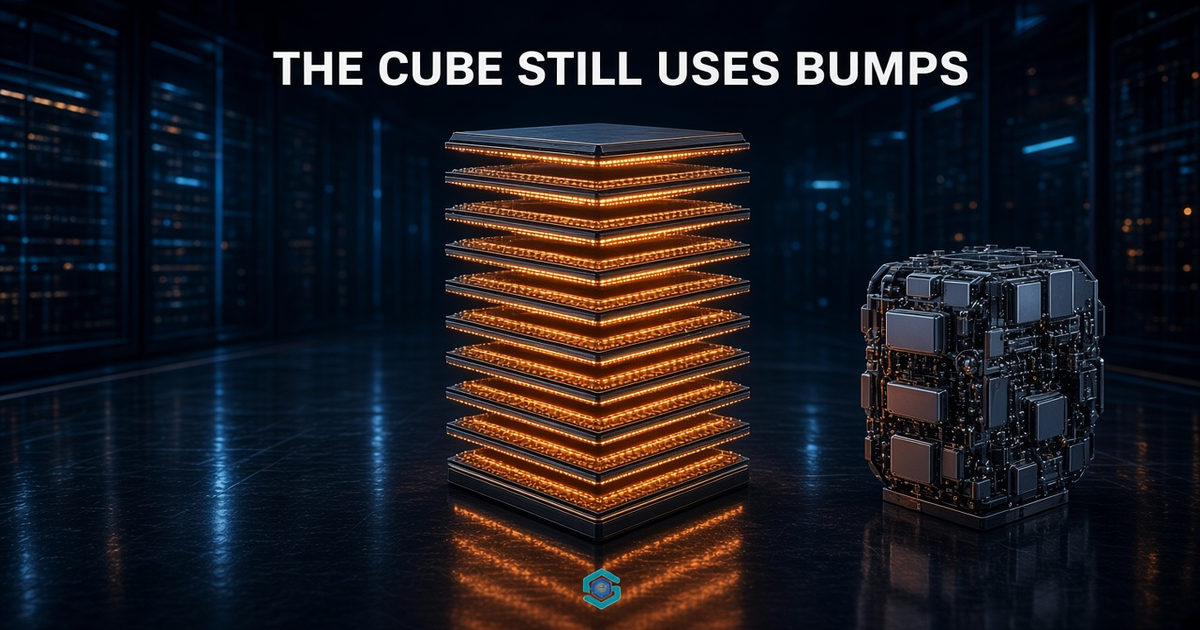
A conventional stack joins dies with solder microbumps. Hybrid bonding removes the bump: copper pads in a dielectric field are planarised, aligned and bonded, so electrical contact and mechanical hold are the same step. Hybrid bonding is that join. CoWoS is still the package that parks an HBM cube beside a compute die. They are neighbour clocks. One can fill without the other moving.
Besi's Q2-26 print, on 23 July, counted 21 hybrid-bonding customers, up from 15 at year-end 2025, and still called HBM hybrid bonding an evaluation. Thursday takes customers to 23 and cumulative demand past 215 systems. The new colour is a named memory order for both hybrid bonding and TC Next — two road maps at one house, Blickman said, not a choice of one tool over the other. TC Next is the workhorse for pitches below the current market, with seven customers, most of them logic. It can run reflow or hybrid bonding. It is the machine you buy when the cube has not switched.
The volume HBM stack has not switched. Blickman: memory shortages this year have extended lower stack heights in current HBM production beyond prior expectations. Interest in hybrid bonding for HBM has still increased, and Besi expects it across a range of stack heights over the next two years. Direct bonding of DRAM onto accelerator chips is a decade-end line. That is a roadmap, not a Q3 invoice.
The second-order read
Who gets paid. Besi, when a hybrid-bonding or TC Next system is ordered and then recognised. Applied Materials, on the prep line around the bonder. Asian subcontractors, on the datacenter and photonics demand Blickman said remains strong.
Who pays. Logic houses, OSATs and the unnamed leading memory customer, from capex that has to land before an HBM cube or a chiplet stack ships. Hyperscalers do not buy the bonder. They buy the module after the join yields.
Upstream. Die-prep, plasma activation, overlay, die-stress. Besi said it does not view ASML as a hybrid-bonding competitor: to its knowledge ASML is on a decade-scale roadmap for 3D transistor stacking inside the chip, and the two are working on die-stress to improve placement accuracy. That is Besi's statement. ASML has not confirmed a rival tool in a company release we can cite today.
Downstream. Finished accelerators, then hyperscalers and neoclouds that bill hours. They get a faster cube only if hybrid bonding clears high-volume memory. Until then they get today's HBM, on bumps, at whatever stack height the shortage allows.
Stuck step. The HBM interface. Logic chiplets, co-packaged optics and edge AI can fill a bonder queue — and Thursday they did — without the cube beside a GPU changing join.
Two cautions
Hybrid-bonding orders are not HBM volume. Besi did not disclose unit shipments, the split of the €342.6 million by tool type, or the name of the memory customer. “More than doubled versus fiscal 2025” has no euro base. Cumulative demand of more than 215 systems is a lifetime count, not Q3 units, and not a statement that HBM4 cubes are copper-bonded.
The Q4 guide can be read as soft. It is dated to H1 2027 readiness, and Blickman repeated that it is not a delay. If those halls slip past the first half, the 1.21 book-to-bill sits in backlog longer.
What would change the view
A memory house naming hybrid bonding as the production method for HBM4E or HBM5, with a dated high-volume start, would move the stuck step off the bump. A Besi quarter that splits hybrid-bonding units into memory versus logic and CPO would tell us which door is paying. If Q1 or Q2 2027 revenue does not catch the Q3 order spike, the H1-27 alignment was hope. If SK hynix, Samsung or Micron describe next year's HBM as still on TC / reflow, Thursday's memory order stays a development tool.
What to watch
- SK hynix Q3 results, 28 Oct 2026: whether HBM4 is still the current stack, not a hybrid-bonding product.
- Samsung full Q3, 29 Oct 2026: memory split, and any named join for 2027 HBM.
- Besi Q4-26 print, with the H1-27 delivery mix: revenue versus the €269–€298 million band on our arithmetic, and whether hybrid-bonding customers stay at 23 or rise.
- 27 Oct 2026: the €100 million buyback window opens; it does not date a cube.
- Memory-house high-volume hybrid bonding: a dated HVM start, not another evaluation.
Read: Semiconductors and hybrid bonding.
Get the Wire. A free brief every day, here and in your inbox. Subscribe free →
Sources: Besi, “BE Semiconductor Industries N.V. Announces Q3-2026 Results”, filed Euronext Amsterdam 22 Oct 2026, 07:00 CEST (Q3 revenue €283.4m, orders €342.6m, net income €107.2m, YTD hybrid-bonding orders more than doubled vs FY2025, 23 customers, >215 systems, Q4 revenue flat ±5% vs €283.4m aligned with H1-27, €100m buyback from 27 Oct); Besi Q3-2026 conference call, 22 Oct 2026, 16:00 CET (Blickman: not a customer push-out; HBM hybrid bonding over the next two years; DRAM-on-accelerator by decade end; ASML not a die-to-wafer competitor; TC Next seven customers; first 50 nm Generation 2 tools this quarter); Besi, Q2-26 and H1-26 results, 23 Jul 2026 (revenue €249.9m, orders €292.9m, 15→21 hybrid-bonding customers, Q3 revenue guide +10–15%); AFM inside-information register, Besi Q3-2026 results, 22 Oct 2026, 06:53.
Not investment advice. Do your own research. The €274.9–€287.4 million Q3 band, 1.21 and 1.26 book-to-bill, and €269–€298 million Q4 band are our arithmetic.


