Asian banks pause data centre loans after new US chip rule
Banks have slowed or dropped data centre loans tied to Chinese tech firms since a new US chip licence rule took effect on 19 November. A loan buys chips and halls. It is not a billed GPU hour.
WIRE · AI DATA CENTERS · FINANCE · Reported 26 Nov 2026 (Singapore, Malaysia, Thailand)
Banks across Asia have slowed or dropped data centre loans linked to Chinese tech firms. The trigger is a new US rule, in force since 19 November, that puts a licence in front of advanced AI chips bound for Singapore, Malaysia, Indonesia, Thailand and Brazil. Bloomberg, in a report carried by The Straits Times on 26 November, named four loans worth about US$7.75 billion that are delayed, passed on or under review. This is the money that buys the chips and builds the halls. It is not revenue. Cash arrives only when a customer uses a working GPU and pays for that hour, and the lenders are now asking who that customer is. See our AI Data Centers layer for the map.
What happened
The rule
The US Commerce Department's rule took effect on 19 November 2026. Advanced AI chips going to five countries now need a US licence
The five are Singapore, Malaysia, Indonesia, Thailand and Brazil. Buyers headquartered in the US are exempt if reporting conditions are met
The clock
Data centres that already supply significant compute to China-headquartered firms have 90 days to get a licence, which runs to 17 February 2027
The 17 February date is our count of 90 days from 19 November. Without a licence they face future export limits
The loans
A US$6.6 billion loan for Bridge Data Centres is delayed. A US$372 million loan for Digital Halo lost one bank. A US$480 million loan for Aolani is under review
Bloomberg's sources say Bridge's Malaysian halls serve ByteDance, Digital Halo's Malaysian hall serves Alibaba, and Aolani, a Singapore neocloud, gets business from ByteDance. The firms declined to comment
The chip loan
At least one fund has stepped out of a US$300 million loan to GMI Cloud, which would pay for chips in a Thai data centre used by Tencent
Per a person familiar with the matter, cited by Bloomberg. GMI Cloud and Tencent did not respond
The banks
Citigroup, Standard Chartered and Singapore's big banks are reviewing their data centre clients. UOB is seeking a deal of about US$1 billion to move some of that risk off its books
UOB declined to comment. Bloomberg says details are not firm and could change
Why cash cares
Think of a data centre loan as a bridge. The bank pays for the chips and the building now. The customer pays back, through rent or GPU hours, over the next several years. The bridge only holds if the customer is allowed to use the chips and keeps paying.
The new rule puts a question mark on both. It says a data centre that sells a lot of compute to China-headquartered firms needs a licence, and that this is checked by who ultimately owns the customer. Law firm Baker McKenzie, in a 20 November note, put the threshold at more than 12,000,000 "aggregate TPP" of computing power. It also says a licence is needed wherever a restricted company is the main user of more than half the capacity. If a customer's contract is suspended while the power, lease and chip bills keep running, Baker McKenzie says, the project is left with stranded cost.
That is why lenders are pausing. The four loans Bloomberg named add up to about US$7.75 billion (US$6.6 billion, US$372 million, US$480 million and US$300 million), on our arithmetic. Bloomberg also says Asia-Pacific data centre loans grew from almost nothing in 2023 to more than US$49 billion by now. That money arrived fast, and many of the lenders had not yet had to answer a licence question.
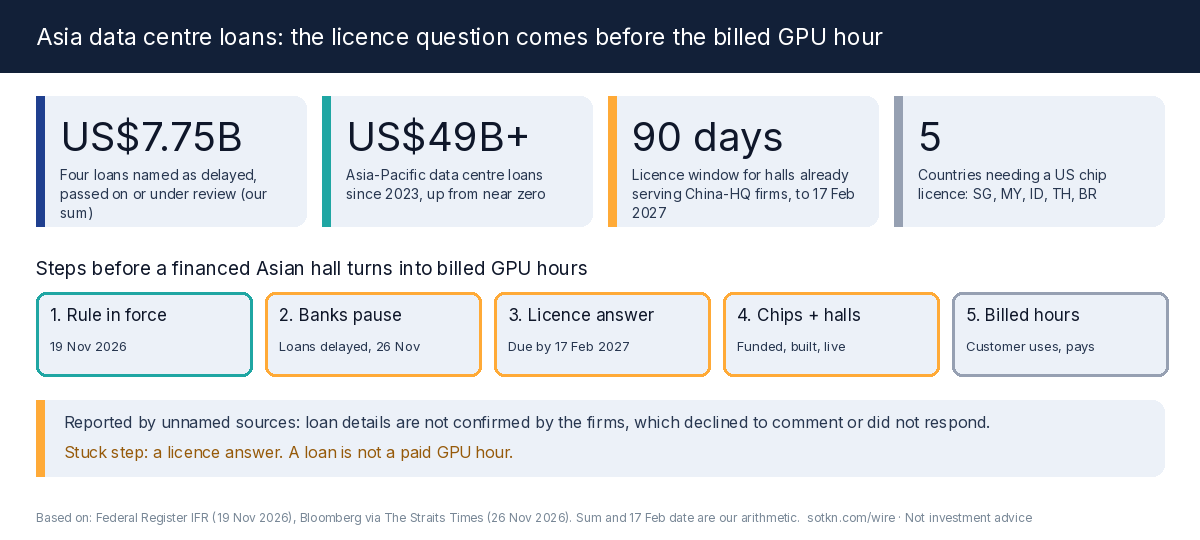
Figure: Banks are asking who the customer is before they lend for chips and halls. Rule date and 90-day window from the Federal Register (19 November 2026). Loan names and sizes from Bloomberg via The Straits Times (26 November 2026). The US$7.75 billion total and the 17 February date are our arithmetic.
The stuck step
The stuck step is a licence answer.
A bank cannot lend against chips until it knows whether those chips can lawfully reach the hall and serve the customer. A hall cannot bill GPU hours until the chips arrive. Neither side can answer yet. More than a dozen bankers told Bloomberg their teams were waiting to hear how the rule will treat their borrowers, and that this would at the very least delay deals.
The collateral problem is subtle. Baker McKenzie notes that GPU collateral is worth only what it can lawfully be used and sold for. Selling seized chips can itself need a licence. So a lender who cannot resell the chips values them lower, and lends less against them.
The pause is also a sorting step. Projects anchored by US-headquartered tenants can use the exemption, with monthly reporting. Projects that rely on regional or China-linked tenants face a very different path. Our 23 November Catalyst on the 90-day licence gate and our 25 November Malaysia read on tenant checks cover the rule itself. This Wire is about what happens next: the loans that were supposed to fund the builds.
Who gets paid, who pays and who waits
Who gets paid today. Lawyers and compliance teams. Banks are adding licence questions to their checks, and Baker McKenzie advises lenders to make licence evidence a condition before any money is drawn.
Who pays. Borrowers, through delay and, if the pause drags on, a higher price for the loan. Bloomberg says some banks want to cut AI and data centre debt through loan sales and risk transfers, but buyers are hard to find.
Who waits. Bridge Data Centres, Digital Halo, Aolani and GMI Cloud wait for money. Their suppliers wait for orders. Their customers wait for capacity. And Singapore's lenders wait for the answer too: UOB's roughly US$1 billion risk transfer is slowing down, one person told Bloomberg.
The same story reaches beyond debt. Bloomberg's sources say DayOne Data Centers, whose biggest customer is ByteDance, has put a US listing on hold. They also say a group including BlackRock may lower its offer for a portfolio of Asia-Pacific data centres. Both are reported, not confirmed.
Our leases not yet commenced explainer shows the same idea in a different place: a signed number is a promise, not cash.
Cautions
Most of the loan details come from unnamed people. Bloomberg's sources are "people familiar with the matter", and every firm named declined to comment or did not respond. We have not seen the loan papers.
The rule is an interim final rule. Baker McKenzie says it may change after the comment period. Comments are due 60 days after publication, which we count as about 18 January 2027.
Not every Asian project is hit. The rule has an exemption for US-headquartered buyers, and it does not cover recommender systems of the kind used by shops and social media.
A pause is not a stop. Hogan Lovells Cadwalader trade lawyer Ben Kostrzewa told Bloomberg the rule "won't stop all these data centres being built", only slow them.
What would change the view
Better: banks publish clear licence conditions and sign the delayed loans, licences are issued before 17 February 2027, and the Commerce Department softens the rule after comments.
Worse: licences are refused or slow, the 90-day window ends with customers cut off, more banks drop deals, or lenders write down chip collateral.
What to watch
About 18 January 2027: comment deadline on the rule, by our count.
17 February 2027: end of the 90-day window for data centres that already serve China-headquartered firms.
Bridge Data Centres: whether the US$6.6 billion loan closes, and on what terms.
UOB: whether the roughly US$1 billion risk transfer prices.
Licence decisions: the first public licence grants or refusals for Singapore, Malaysia and Thailand halls.
Get the Wire. A free brief every day, here and in your inbox. Subscribe free →
If this Wire saved you a search, tip Second Order → sotkn.com/support
Not investment advice. Do your own research. The US$7.75 billion total, the 17 February date and the 18 January date are our arithmetic on the sources below.
References
- The Straits Times (Bloomberg), "Billions in data centre deals grind to halt after AI chip curbs", 26 Nov 2026. Loans, lenders, banks, listings and quotes.
- Federal Register, Commerce Department, "Addressing Remote Access to Advanced Semiconductors" (interim final rule), 19 Nov 2026. Licence rules, five countries, 90-day window, exemption.
- Baker McKenzie, "Asia Pacific: New US Rules Reshape Digital Infrastructure Financings", 20 Nov 2026. Threshold, collateral and stranded-cost points, comment period.