Microsoft pays for the wires to three Wyoming data centres
Microsoft will pay Cheyenne Light to build the lines and substations for three planned Wyoming data centres. The utility's all-time peak is 439 MW; its plan already holds 600 MW of Microsoft and Meta load. Paying for the wires is not a billed GPU hour.
WIRE · HYPERSCALERS · POWER · FERC filing 24 Nov 2026 (Cheyenne, Wyoming)
Microsoft has agreed to pay for the power lines and substations that will feed three planned data centres in Wyoming. The local utility, Cheyenne Light, Fuel and Power, filed the three deals with the US energy regulator, FERC, on 24 November. Under them, Microsoft pays the utility to build the wires up front. That is one of the first bills in any AI build, and it comes long before anyone rents a GPU. On the Hyperscalers layer, this is the order to keep in mind: signed is not built, and built is not paid. Cash comes only when a customer uses a working GPU in those halls and pays for the hour. The deals do not say how many megawatts Microsoft will draw, or when the power arrives.
What happened
The filing
Three load facility expansion agreements, FERC docket ER27-634, filed 24 November 2026, asked to take effect on 24 December 2026
The utility says FERC may not even have a say over these retail deals, but filed them anyway after FERC's recent comments on who pays for wires built for big users
Who pays
Microsoft pays for the new wires through "contribution in aid of construction" payments
That pays for the connection, not the electricity. The amounts, the megawatts and the power-on dates are blacked out
The grid
The utility's all-time peak is 439 MW, set on 20 July 2026. Its plan already holds 600 MW of data centre load, mostly Microsoft and Meta
Black Hills, the utility's parent, said on 5 November that Meta's new AI campus is now expected to start taking power in early 2027
The neighbour
Google's planned Cheyenne campus is separate: up to 590 MW of grid service, backed by a US$1.8 billion, 564 MW gas plant to be built in 2027 to 2029
Microsoft has also bought more than 3,200 acres near Cheyenne, which the utility still calls an early-stage opportunity
Why cash cares
Start with the size of the grid. Cheyenne Light's highest-ever demand was 439 MW, on 20 July 2026. A year earlier the record was 379 MW. That is a jump of about 16% in one year, on our arithmetic, and the utility says data centres drove it.
Now the plan. The 600 MW of Microsoft and Meta load already in the utility's plan is about 1.4 times that all-time peak, on our arithmetic. The wider pipeline the utility talks about, about 3 GW, is close to seven times the peak. A small grid is being asked to grow several times over, fast.
That is why Microsoft is paying for the wires itself. A utility with about 46,000 retail customers would struggle to put the cost of new lines for one giant user on everyone's bill. So the giant user pays first. Black Hills said on 5 November that the Microsoft and Meta projects need only "minimum capital investment" from the utility.
Then look at Microsoft's side. At 30 September 2026, Microsoft had US$364.6 billion of signed leases, mostly for data centres, that had not started yet. They begin between fiscal 2027 and fiscal 2034. In the July to September quarter alone it paid US$39.4 billion in cash for property and equipment. Wires in Wyoming are a small line in that spend. But every one of those leases needs a wire like this before a single GPU hour can be billed.
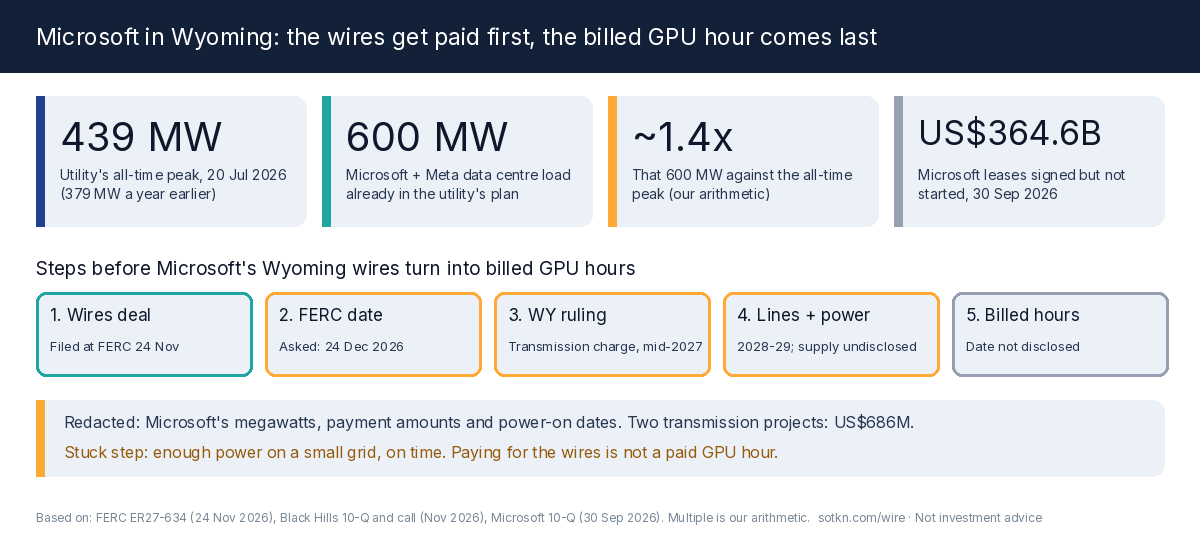
Figure: Microsoft pays for the connection first; regulators, power supply and filled halls come before the cash. Filing and effective date from FERC docket ER27-634 (24 November 2026). Peak demand, pipeline and transmission from Black Hills' third-quarter 10-Q and 5 November 2026 call. Microsoft leases and spend from its 10-Q for the quarter to 30 September 2026. The growth rate and the multiples of peak are our arithmetic.
The stuck step
The stuck step is getting enough power onto a small grid, on time.
Paying for the wires does not make the power. The deals cover the connection. They say nothing in public about where Microsoft's electricity comes from, how much it needs, or when it switches on. Google, next door, had to line up a new gas plant and about 2.1 GW of outside supply run as a private grid. We covered that build in our Google and Crusoe Wyoming Catalyst. Microsoft's supply plan is not yet public.
There are also two approvals in the way. First, FERC has to let the deals take effect, or agree it has no say. The utility asked for 24 December. Second, the Wyoming regulator must rule on a new charge that makes big users pay their share of new transmission. Black Hills expects that ruling by mid-2027. Two transmission projects worth US$686 million wait on that charge. Black Hills expects its new Cheyenne transmission to come into service in 2028 through 2029.
So the order runs: pay for wires, get approvals, build lines, find power, fill halls, sell hours. Microsoft has started paying at step one.
Who gets paid, who pays and who waits
Who gets paid first. Cheyenne Light and the crews who build its lines and substations. Microsoft's payments cover that work, and it is done before any hall runs.
Who pays. Microsoft, up front, for the connection. Then it pays again for the electricity once it flows. The utility's 46,000 retail customers are meant to pay nothing extra, by design of the tariffs.
Who waits. Microsoft waits on approvals, transmission and power. Its cloud customers wait for capacity. The utility waits on the Wyoming ruling to get its transmission money back. And the US$364.6 billion of unstarted leases waits on hundreds of steps like this one. Our leases not yet commenced explainer shows why those numbers are promises, not cash yet.
Cautions
The agreements are redacted. We do not know how much Microsoft is paying, how many megawatts each site needs, or the dates.
The 600 MW figure covers Microsoft and Meta together. The utility has not split it.
The 3,200 acres Microsoft bought is, in the utility's own words, an early-stage opportunity. It is not a signed deal.
Black Hills has warned that data centre demand forecasts carry "significant uncertainty", and that its protections may not fully cover a big customer pulling back.
The utility's parent, Black Hills, merged with NorthWestern Energy on 13 November and is now called Bright Horizon Energy. Plans can shift under new ownership.
What would change the view
Better: a public number for Microsoft's load and a firm power-on date, a clear energy supply deal, and the Wyoming transmission charge approved on time.
Worse: FERC pushes back on the filing, the Wyoming ruling slips past mid-2027, the transmission lines slip past 2029, or Microsoft slows its Wyoming build.
What to watch
24 December 2026: the date the utility asked FERC to let the deals take effect.
Early 2027: Meta's new campus is due to start taking power on the same grid. It is the first test of whether the plan runs on time.
Late January 2027: Microsoft's next 10-Q, and whether the unstarted lease total keeps rising.
February 2027: the utility's parent is due to share its 2027 to 2031 plan, which should add Google.
Mid-2027: the Wyoming ruling on the transmission charge.
Get the Wire. A free brief every day, here and in your inbox. Subscribe free →
If this Wire saved you a search, tip Second Order → sotkn.com/support
Not investment advice. Do your own research. The peak growth rate, the multiples of peak and the 3 GW comparison are our arithmetic on the sources below.
References
- FERC eLibrary, Docket ER27-634-000, Cheyenne Light, Fuel and Power Company, Filing of Load Facility Expansion Agreements, 24 Nov 2026. Filing and requested effective date.
- Utility Dive, "Bright Horizon utility lands Microsoft data center deals amid Wyoming buildout", 25 Nov 2026. Microsoft as customer, payment type, redaction, jurisdiction.
- Black Hills Corp., Form 10-Q for the quarter ended 30 September 2026. Peak demand records, transmission projects, customer risk.
- Black Hills third-quarter 2026 earnings call transcript, 5 Nov 2026. 600 MW plan, Google supply, Microsoft land, timing.
- Microsoft, Form 10-Q for the quarter ended 30 September 2026. Leases not yet commenced, property and equipment spend.