Oracle says its OpenAI build is fully funded after $20B raise
Oracle says its OpenAI contract is fully funded after a $20 billion stock and bond sale, but that uses up its whole capital-markets budget to fiscal 2030, so the build now rests on vendor financing, OpenAI and racks handed over on time.
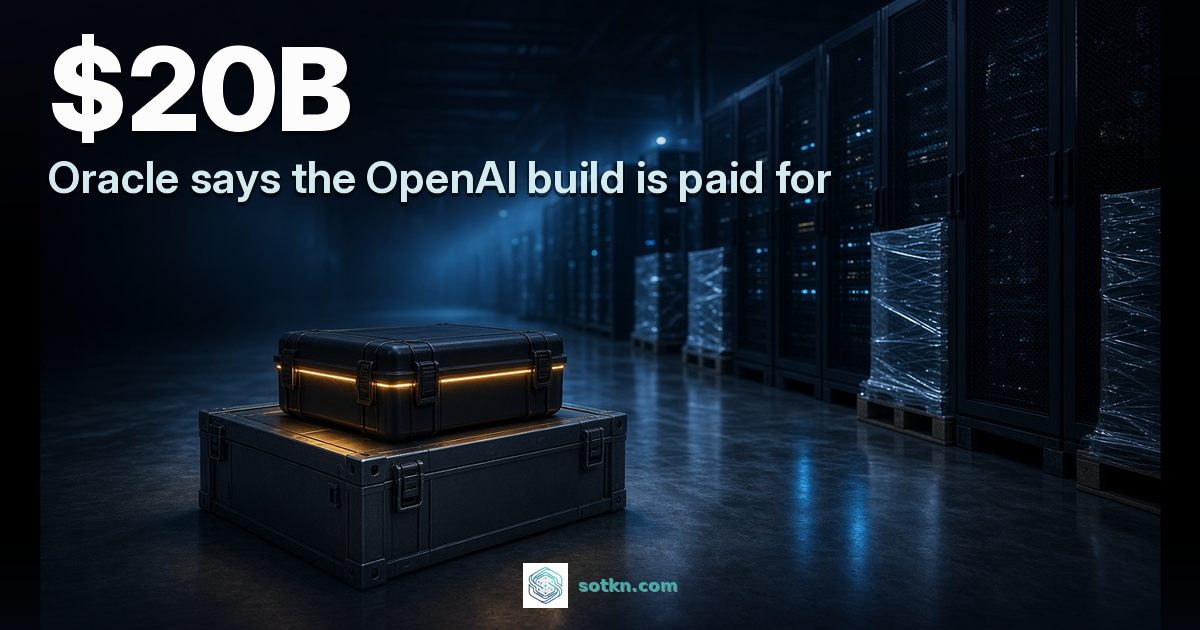
Is Oracle's OpenAI build fully funded? Oracle said on 20 November 2026 that it has all the money it needs for its OpenAI contract after a $20 billion stock and bond sale earlier this month, but that raise uses up the whole capital-markets budget it set for fiscal 2027 to 2030, so any gap from here has to be closed by vendors, by OpenAI itself or by Oracle's own cash, and the next test is racks handed over, not money raised.
What happened?
- 20 November 2026 (Austin, Texas). Oracle put out a short statement: "Oracle has secured all the funding we need to fulfill our contract with OpenAI." It said it is "the first hyperscaler fully funded for this investment cycle", that the vendor financing it outlined at its Investor Day is "in place", and that any further private talks with vendors are "just additional options". It called media reports saying otherwise "incorrect and wrong".
- The build. In the same statement Oracle said its Abilene campus, where OpenAI's Astra-6 model was trained, is nearly complete. Shackelford, its next gigawatt-scale campus, is fully permitted, and the handover of Nvidia Vera Rubin racks in its data halls is "on track for the coming weeks". Reuters added that Oracle and OpenAI plan 4.5 gigawatts of further US capacity on top of Abilene.
- The money behind it (2 to 4 November 2026). Oracle sold 86,206,897 new shares and $10 billion of notes in five parts, from 7.000% notes due 2029 to 8.650% notes due 2046. Oracle put net proceeds at about $9.9 billion from the shares and about $10.0 billion from the notes. Both closed on 4 November, according to its 8-K.
- The cash outlook, repeated. Oracle still expects positive free cash flow in the second half of fiscal 2028, targets more than $30 billion of free cash flow in fiscal 2029, and expects to fund its own growth from that year.
Why does it matter?
The question hanging over Oracle since its 28 October Investor Day has been simple: who pays for the build before OpenAI's money comes in? At Investor Day Oracle capped new capital-markets funding for the fiscal 2027 to 2030 cycle at $20 billion, split $10 billion equity and $10 billion debt, on top of a $20 billion at-the-market share sale already done in the first quarter of fiscal 2027. It said vendor financing, customer-provided hardware and customer prepayments would cover the rest of the upfront cash.
The November sale is that $20 billion. On our arithmetic, Oracle has now raised about $40 billion from stock and bond buyers in this fiscal year, and the Investor Day cap leaves no room for a second capital-markets raise before fiscal 2030 unless Oracle breaks its own promise. That is why the 20 November statement leans so hard on vendor financing being "in place". If the plan comes up short, the lenders of last resort are now Oracle's suppliers and its customer, not the bond market.
That is the second-order point. A hyperscaler that says "fully funded" is also saying where the risk now sits:
- Suppliers carry more of it. Vendor financing means a supplier ships equipment now and gets paid later, or helps arrange the money. We explain how that works, and who ends up holding the credit, in vendor financing explained. Oracle has not named the vendors in this statement.
- The customer carries some of it. "Customer-provided hardware" and "customer prepayments" are Oracle's words for OpenAI paying up front or bringing its own kit. Both shift cash need from Oracle to OpenAI.
- Bondholders carry a fixed cost. On our arithmetic, the five note coupons weighted by size average about 7.77%, or roughly $780 million of interest a year on the $10 billion. That bill starts now; the free cash flow Oracle points to starts in the second half of fiscal 2028.
What does it change?
Near term (the next few weeks): the stuck step moves from money to delivery. Oracle has said the Vera Rubin rack handover at Shackelford is on track for "the coming weeks". A rack that is handed over, powered and accepted by the customer is where a contract starts to look like billed hours. Until then the $20 billion pays for steel, chips and power gear that earn nothing.
Near term (the next filing): Oracle's second fiscal quarter ends on 30 November 2026. Its next results and 10-Q are the first place to see how much vendor financing is actually on the balance sheet. Oracle's own Investor Day footnote counts vendor financing inside net debt, alongside borrowings and lease liabilities, and its target is net debt below 3.5 times adjusted EBITDA in fiscal 2029.
Longer term: with the capital-markets budget spent, the plan depends on three things landing on time: Abilene finishing, Shackelford filling, and the 4.5 gigawatts of further capacity getting power. We have covered how power, not GPUs, has been Oracle's stuck step before, from the Project Jupiter force majeure to trucked-in gas at four times pipeline cost. For how Oracle's capacity model works end to end, see What Does Oracle Do?.
Evidence table
| Metric | Value | Source | Date |
|---|---|---|---|
| New shares sold | 86,206,897 | Oracle 8-K | 4 Nov 2026 |
| Notes sold | $10.0B in five parts, 7.000% (2029) to 8.650% (2046) | Oracle 8-K | 4 Nov 2026 |
| Net proceeds | ~$9.9B shares + ~$10.0B notes | Oracle pricing release | 2 Nov 2026 |
| Capital-markets cap, FY27 to FY30 | $20B ($10B equity, $10B gross debt) | Oracle Investor Day release | 28 Oct 2026 |
| Earlier share sale | $20B at-the-market, Q1 FY27 | Oracle Investor Day release | 28 Oct 2026 |
| Raised from markets this fiscal year | ~$40B (our arithmetic) | Oracle releases | Nov 2026 |
| Interest on the new notes | ~7.77% average, ~$780M a year (our arithmetic) | Oracle 8-K | 4 Nov 2026 |
| Free cash flow | Positive 2H FY28; >$30B target FY29 | Oracle statement | 20 Nov 2026 |
| Further capacity planned with OpenAI | 4.5 GW in the US beyond Abilene | Reuters | 20 Nov 2026 |
What should we watch next?
- Shackelford rack handover. Oracle says "the coming weeks". A dated handover or a first-revenue mention would confirm the build is turning into billed hours. A slip would put the stuck step back on power or delivery.
- Oracle's fiscal Q2 results and 10-Q. The quarter ends 30 November 2026. Oracle had not announced a results date when we checked. Look for vendor financing balances, customer prepayments and capex.
- Who the vendors are. If suppliers are named in the 10-Q or in their own filings, the credit risk Oracle has moved off its books becomes visible on theirs.
- What would weaken the claim: a new capital-markets raise before fiscal 2030 beyond refinancing, a delay at Shackelford, or a change to the fiscal 2028 free cash flow timing.
Also on the tape
- 19 Nov 2026: The International Energy Agency said data centres will use twice as much electricity by 2030 as today, with AI adding about 350 terawatt-hours a year (The Guardian, on the IEA World Energy Outlook 2026).
- 19 Nov 2026: South Korea's exports passed $1 trillion for the first time, with chip exports of $397 billion in January to October, 43% of the total (Yonhap, citing the trade ministry).
- 18 Nov 2026: Palo Alto Networks agreed to buy Applied Compute, an open-weight AI training and inference platform, in an all-stock deal worth $4.5 billion (Palo Alto Networks).
FAQ
Is Oracle's OpenAI contract fully funded?
Oracle says yes. Its 20 November statement says the November $20 billion raise and the vendor financing it described at Investor Day cover the OpenAI contract.
How much did Oracle raise in November 2026?
$20 billion: 86,206,897 new shares (about $9.9 billion net) and $10 billion of notes due between 2029 and 2046 (about $10.0 billion net). Both closed on 4 November.
Can Oracle raise more money?
It can, but at Investor Day it committed to limit new capital-markets funding for fiscal 2027 to 2030 to $20 billion, not counting refinancing. The November raise is that $20 billion.
What is vendor financing here?
Suppliers helping pay for the equipment they sell, for example by letting Oracle pay later. Oracle counts vendor financing inside its net debt measure.
Takeaway: Oracle has spent its whole $20 billion market budget, so the OpenAI build now rests on vendors, OpenAI and racks handed over on time.
More: Nvidia's 10-Q checklist, Senate votes to make data centres pay their grid costs and the Catalyst calendar.
References
- Oracle, Oracle Statement, 20 Nov 2026
- Oracle, Form 8-K (issuance of common stock and notes), filed 4 Nov 2026
- Oracle, Oracle announces pricing of $20 billion of common stock and senior notes, 2 Nov 2026
- Oracle, Oracle Investor Day 2026: Accelerating Value Creation, 28 Oct 2026
- Reuters (via Investing.com), Oracle says OpenAI infrastructure deal is fully funded after final capital raise, 20 Nov 2026
- The Guardian, Datacentres to create 70% more carbon emissions by 2030, IEA report warns, 19 Nov 2026
- Yonhap, S. Korea's exports top US$1 tln for 1st time on strong chip demand, 19 Nov 2026
- Palo Alto Networks, Palo Alto Networks to acquire Applied Compute, 18 Nov 2026