SoftBank books $3.7B loss on AI data center power equipment
SoftBank Group booked a $3.73 billion loss on non-refundable advances and contract changes for US AI data center power equipment, showing that reserving turbines years ahead has a real cost when the campus plan changes before the gear arrives.
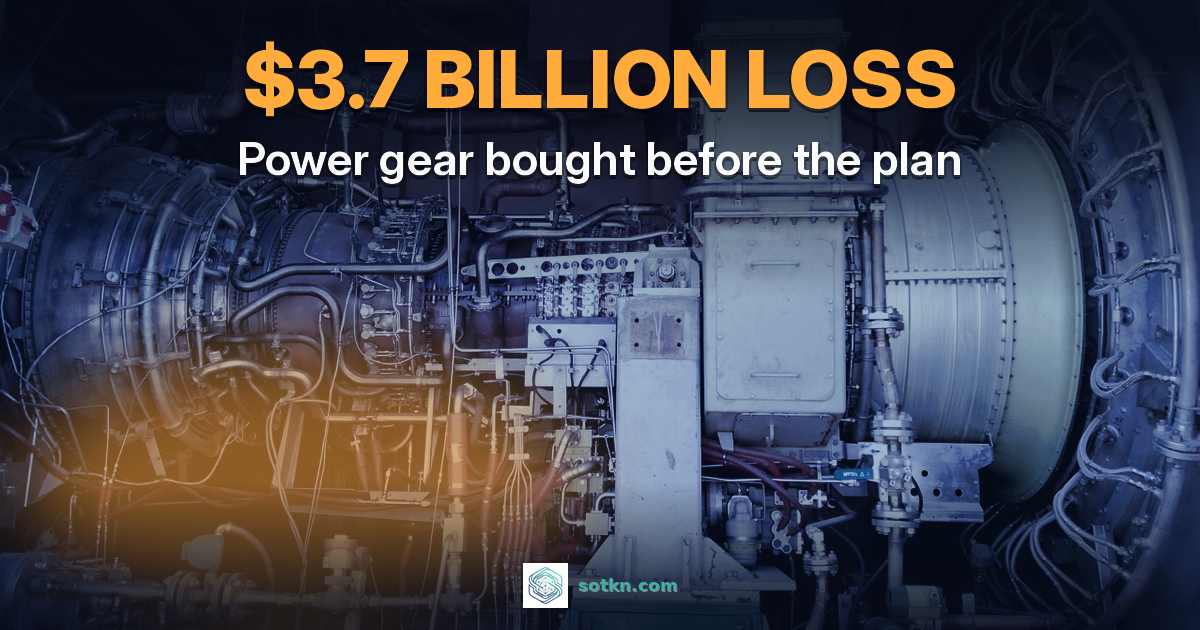
SoftBank Group booked a $3.73 billion loss after one of its subsidiaries changed how it buys power-generation equipment for US AI data centers, which shows that reserving turbines years ahead is not free: the advance payments that secure a place in the queue can be lost when the build plan changes before the equipment arrives.
What happened?
- The loss: On 10 November 2026 SoftBank Group reported a loss of ¥597.2 billion, or $3.73 billion, for the six months to 30 September 2026, arising from what it called the realignment of procurement plans for power generation-related equipment for AI data center projects in the US. Of that, $2.85 billion was non-refundable advance payments made to secure manufacturing capacity and buy equipment, and $0.88 billion was contract modifications and settlements.
- Who paid: The buyer is Silver Bands 7, a subsidiary in which SoftBank Group and its second Vision Fund have invested, and which SoftBank describes as a separate entity from SB Energy. Silver Bands 7 signed manufacturing capacity reservation agreements, equipment purchase contracts and other arrangements for power gear. Its cumulative payments from the previous fiscal year through 30 September 2026 came to $9.48 billion.
- What is left: SoftBank's presentation shows a balance of $6.6 billion of advance payments after the write-off, and says the remaining equipment will be used for the PORTS-Pike power generation project and others. It also says the $3.7 billion loss is "completely unrelated to PORTS-Pike", the 8.0 gigawatt campus in Ohio that OpenAI has leased for 20 years. Several news reports linked the loss to that campus; the company's own slide says otherwise, so we follow the filing.
- The partial offset: Silver Bands 7 became entitled to rebates of up to $2.1 billion over the next 10 years on future equipment purchases, subject to conditions. SoftBank did not book those rebates as an asset because the amount could not be determined at 30 September.
- The quarter: The charge helped push SoftBank to a net loss of ¥1,115.3 billion, about $7.0 billion, in the July to September quarter, and ¥768.0 billion for the six months. Finance costs for the half rose to ¥790.7 billion from ¥340.0 billion a year earlier.
Why does it matter?
The direct signal: a reservation is a bet on a design that is not final yet. Large gas turbines and other generation equipment have long manufacturing queues, so developers pay to hold a slot before they know exactly what each campus will need. SoftBank's chief financial officer Yoshimitsu Goto told a press briefing in Tokyo that intense competition for power equipment led to buying before long-term specifications were finalised, Reuters reported. Its chief accounting officer Kazuko Kimiwada said the payments could not be refunded when cancelled and also incurred fees. SoftBank's own slide puts it more simply: it made "bridge investments in advance to secure power generation equipment in anticipation of shortages," and expects to recoup the investment through project financing.
The second-order signal: the cost of holding a slot moves to whoever changes plans. Our arithmetic: the $3.73 billion loss equals about 39% of the $9.48 billion Silver Bands 7 had paid, and the $2.85 billion of non-refundable advances alone is about 30%. That is the price of flexibility in a tight equipment market. It is a useful number for anyone reading a "power secured" headline at another campus. Secured often means reserved and part-paid, not delivered, and the reservation terms decide who carries the loss if the campus changes. Our purchase commitment explainer covers why money goes out before a rack is live, and take-or-pay vs purchase commitment covers who is on the hook when plans change.
Why the turbine maker says nothing changes for it. CNBC reported that GE Vernova is the supplier of the natural gas turbines for the Ohio project's behind-the-meter power, and that its shares fell on 10 November after the SoftBank news. GE Vernova told CNBC that customers are securing slots further into the 2030s, that it has sold slots for 2032 delivery and expects all slots through 2030 to be mostly sold by the end of 2026, and that "SoftBank's announcement has no impact on that." It said there is "no negative or positive financial impact" from what SoftBank disclosed. Its own third-quarter numbers back the point that demand is deep: gas power equipment backlog plus slot reservation agreements grew from 116 to 122 gigawatts in the quarter, and it expects at least 130 gigawatts by the end of 2026. Our GE Vernova turbine slots piece has the detail.
The pattern. This is the other side of a trade reported the same day, when Anthropic agreed to pay $3.4 billion to take over existing generator orders for 1.7 gigawatts of capacity (see our Anthropic generators piece). In a queue this long, one buyer stepping back tends to mean another buyer stepping forward. The equipment does not go unsold; the early payer absorbs the cost of the change.
What does it change?
Near term (the next two quarters): for the power step itself, probably little. If GE Vernova is right that released slots are resold to waiting customers, total turbine output for data centers does not fall. What changes is the queue order. Developers that were behind SoftBank in line may get earlier delivery dates, which is a small easing for them, not for the market as a whole.
For SoftBank's own build: the remaining $6.6 billion of advances is tied to PORTS-Pike and other projects, and SoftBank says PORTS-Pike is preparing for construction, with OpenAI as the 20-year offtaker for 8.0 gigawatts of IT capacity and Nvidia providing credit support for the initial 4.25 gigawatts. Its Milam County campus in Texas, 753 megawatts of IT capacity on a 15-year OpenAI contract, is under construction. The plan to fund these through project finance that is non-recourse to SoftBank Group means lenders will look closely at what equipment is already paid for and what is still reserved.
Longer term (2027 and after): the episode makes reservation terms a real variable in AI campus economics. A developer that reserves generation equipment for a campus that later changes design can lose a large share of what it paid. That cost has to be priced somewhere: in higher rents, in larger equity cheques, or in tighter terms from equipment makers who know buyers are queuing. The rebates of up to $2.1 billion, about 56% of the loss by our arithmetic, only come back if Silver Bands 7 keeps buying over the next decade, which ties SoftBank more closely to the same suppliers.
What the numbers do not tell us. SoftBank did not name the suppliers whose contracts were changed, the projects that dropped out of the plan, or the megawatts of equipment released. It did not say whether the rebates are with one supplier or several. So the filing shows the cost of the change, not how much power-generation capacity moved back into the queue.
| Metric | Value | Source name | Date |
|---|---|---|---|
| Loss on power generation-related equipment | ¥597.2 billion ($3.73 billion), six months to 30 Sep 2026 | SoftBank Group | 10 Nov 2026 |
| Of which non-refundable advance payments | $2.85 billion | SoftBank Group | 10 Nov 2026 |
| Of which contract modifications and settlements | $0.88 billion | SoftBank Group | 10 Nov 2026 |
| Silver Bands 7 cumulative payments for power gear | $9.48 billion through 30 Sep 2026 | SoftBank Group | 10 Nov 2026 |
| Advance payments left after the write-off | $6.6 billion | SoftBank Group (presentation) | 10 Nov 2026 |
| Possible rebates on future purchases | Up to $2.1 billion over 10 years, not booked | SoftBank Group | 10 Nov 2026 |
| Loss as a share of payments | About 39% (our arithmetic) | SoftBank Group figures | 10 Nov 2026 |
| SoftBank net loss, July to September quarter | ¥1,115.3 billion (about $7.0 billion) | SoftBank Group | 10 Nov 2026 |
| GE Vernova gas backlog plus slot reservations | 116 to 122 GW in Q3; at least 130 GW expected by end-2026 | GE Vernova | 28 Oct 2026 |
What should we watch next?
- 27 January 2027: GE Vernova reports fourth-quarter 2026 results, per its investor events page. Whether gas backlog plus slot reservations reaches the 130 gigawatt target it set is the clearest test of its claim that SoftBank's change has no impact.
- SoftBank's third-quarter results (date not yet posted): watch whether the $6.6 billion advance balance shrinks further, whether any more loss is booked on power equipment, and whether any of the $2.1 billion of rebates is recognised.
- PORTS-Pike construction start: SoftBank lists the campus as preparing for construction. A start date, or project financing for its power plant, would show the remaining equipment is being used as planned.
- What would weaken the catalyst: a second write-down at SoftBank, another large developer cutting reserved power equipment, or GE Vernova reporting cancellations it cannot refill. Any of these would mean the turbine queue is shorter than it looks.
Also on the tape
- 10 Nov: Norway said data centers with 9,100 MW of demand sit in the grid connection queue, against peak national demand of just over 25,000 MW, as Statnett paused new grid reservations for data centers until no later than 1 August 2027 (Norwegian Government).
- 11 Nov: BloombergNEF said data center electricity demand could almost quadruple to 2,354 terawatt-hours by 2035 and counted 181 GW of gas generation proposed alongside data centers, more than 90% of it in the US (BloombergNEF).
- 11 Nov: Microsoft and other companies pressed the US administration to drop a planned ban on imports of Chinese optical transceivers used inside data centers, three people familiar with the matter said (Reuters).
FAQ
What exactly did SoftBank write off?
Mostly money it had already paid to hold manufacturing capacity and buy power-generation equipment for US AI data centers: $2.85 billion of non-refundable advance payments, plus $0.88 billion for changing and settling contracts, for a total of $3.73 billion.
Is the Ohio PORTS-Pike campus cancelled?
No. SoftBank's presentation says the loss is unrelated to PORTS-Pike, that the campus is preparing for construction under a 20-year OpenAI lease for 8.0 gigawatts of IT capacity, and that the remaining equipment will be used for the PORTS-Pike power project and others.
Does this free up gas turbines for other data centers?
Possibly some, but the size is not disclosed. GE Vernova says demand for its slots runs into the 2030s and that SoftBank's change has no financial impact on it, which suggests any released slots would be taken by other customers.
Why would anyone pay for equipment before a design is final?
Because the wait for large generation equipment is long. Paying early secures a place in the queue; the risk is that the campus changes and the payment cannot be recovered.
Takeaway: In AI power, a reserved turbine is a bet on a campus plan, and SoftBank has just shown what it costs when the plan moves first.
References
- SoftBank Group, Consolidated Financial Report for the six-month period ended September 30, 2026, 10 Nov 2026.
- SoftBank Group, Earnings presentation for Q2 FY2026, 10 Nov 2026.
- CNBC, SoftBank swings to $7 billion loss after U.S. data center hit and Intel share decline, 10 Nov 2026.
- Reuters via CNBC TV18, SoftBank books $7 billion quarterly loss on US data centre hit, financing costs, 11 Nov 2026.
- CNBC Investing Club, GE Vernova statement on SoftBank's announcement, 10 Nov 2026.
- GE Vernova, third quarter 2026 results press release, 28 Oct 2026.
- GE Vernova, investor events (fourth quarter 2026 earnings webcast, 27 January 2027), accessed 11 Nov 2026.
- Norwegian Government, Government seeks controlled growth of data centres in Norway, 10 Nov 2026.
- BloombergNEF, Data Center Power Demand Is Set to Surge, Raising New Climate Challenges, 11 Nov 2026.
- Reuters via The Japan Times, Microsoft presses Trump to scuttle ban on Chinese data center tech, 11 Nov 2026.