
Hyperscalers
What Does Oracle Do? The Hyperscaler Capacity Model
Oracle books AI cloud contracts, delivers halls and GPUs, and gets paid as that capacity is accepted — delivery, not the backlog print, is the stuck step.
Writes Second Order by TKN — a plain-English map of AI infrastructure and semiconductors for non-specialist investors. Focus: who gets paid, where money sticks, and which step is stuck. Not investment advice.
Hyperscalers
Oracle books AI cloud contracts, delivers halls and GPUs, and gets paid as that capacity is accepted — delivery, not the backlog print, is the stuck step.
US
September 2026 in one line: FERC kept a 1.8 GW Joliet TSA alive over a $1 letter of credit. Who gets paid is the thick-credit book. The stuck step is still interconnection paper.
Explained
Who makes AI chips is the map of roles along the stack — designers, foundries, packaging attach, and HBM. Roles only. No tip sheet.
Wire
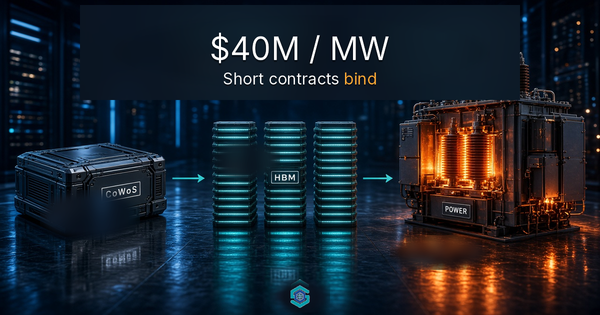
CoreWeave’s Q3 short-dated AI contracts clear near $40m per MW as contracted power rises to 4.2 GW — who gets paid while near-term capacity attaches.
Analysis
ASE sits at the packaging stuck step as OSAT overflow and LEAP/test behind TSMC CoWoS. At roughly NT$3.10 trillion, the question is what LEAP growth and capacity clocks that price already assumes.
HBM
SK hynix builds HBM stacks, sells them under long agreements to a short customer list, and gets paid when those stacks ship — allocation is the stuck step.
Korea
September 2026 in one line: Korea shipped $34.128bn of chips in the first 20 days — 47.8% of all exports. Who gets paid is SK hynix and Samsung. The stuck step is still HBM allocation.
Explained
GPU as a service is billed accelerator time: a cloud operator puts GPUs in a power-ready hall and sells hours — on-demand, reserved, or as a dated capacity block — instead of the customer buying the cards.
Wire
Oracle delivered 850 MW of AI capacity in Q1 FY27 — GPU fleet still 97.9% full. Capacity delivery still sets the short clock.
Analysis
CoWoS-L is expected to stay the mainstream AI packaging path through 2028. The money question is who clears the tool and material validation gate before those lines can run.

Neoclouds
CoreWeave buys accelerators, funds them with debt, and sells AI compute on multi-year contracts — why the model loses money while growing.
Taiwan
September 2026 in one line: Baipu breaks ground as a CoWoS tool-and-materials validation hub — modular Mini-Loop, not another volume fab — with a stated 25–50% efficiency aim and expected operations in Q4 2029.