ARR vs Revenue: Why an AI Company’s Run-Rate Is Not What It Earned
ARR is a pace a company calculates for itself. Revenue is what accounting rules say it has earned. In AI the gap between them is set by usage, customer acceptance and, for some GPU deals, lease accounting.
EXPLAINED · Versus · Last reviewed: 12 Nov 2026 · Next review: after Nebius’s third-quarter 2026 results (12 Nov 2026), IREN’s January 2027 ARR milestone and Anthropic’s next reported quarter
ARR is a yearly pace a company calculates from a short recent window; revenue is what it has actually earned, under accounting rules, over a past period.
In short. Revenue is set by accounting rules: under ASC 606 and IFRS 15 a company books it only when, or as, it delivers what it promised. ARR is set by the company: a short recent window multiplied up to a year. In AI the two drift apart for three reasons. Usage grows faster than the averages catch up; some GPU deals are leases, which follow different rules; and capacity contracts generally earn nothing until the customer accepts the cluster. Anthropic’s run-rate was about 2× its revenue for the last four quarters, and only about 15% of it was covered by contracted amounts due within a year, by our arithmetic. Our read: the stuck step between the two numbers is customer acceptance, and the hardware behind it is paid for long before.
Why an investor cares: in AI, the run-rate is often the headline and revenue arrives a quarter later in the filing. Knowing which rule produced each number tells you how much of a company’s story is already earned, how much is contracted, and how much is pace. Our ARR Explained covers how each company builds its run-rate. This page starts from the other side: how revenue gets booked, and why the two numbers part.
What is the difference between ARR and revenue?
ARR measures speed; revenue measures distance already covered. ARR, short for annual recurring revenue, takes the latest short window of revenue, often one month or 28 days, and scales it to a year. Revenue is the money a company has earned over a past quarter or year, under accounting standards, and checked by auditors.
Think of a car dashboard. The speedometer tells you how fast you are going right now. The odometer tells you how far you have actually driven. A car doing 100 kilometres an hour has not yet covered 100 kilometres. A company with $1 billion of ARR has not yet earned $1 billion.
| ARR | Revenue | |
|---|---|---|
| What it measures | Speed: the yearly pace of the latest window | Distance: what was earned over a past period |
| Rule book | The company’s own footnote | ASC 606 (US) or IFRS 15; leases under ASC 842 |
| Checked by | Not audited | Auditors, in the financial statements |
| Window | 28 days to one month, or a price on a date, scaled to 12 months | The full quarter or year |
| When a GPU starts to count | When it is commissioned or billing on the measurement date | When service is delivered, generally after customer acceptance |
| Cash paid in advance | Ignored | Held as deferred revenue until delivered |
| In a fast ramp | Runs ahead | Lags |
| If usage falls | Drops at the next reading | Past quarters stay booked; the fall shows next period |
| Best used for | Spotting speed and turning points | Measuring what was actually earned |
Second Order summary of FASB Topic 606, IFRS 15 and company definitions.
Both numbers are useful. They answer different questions. The mistake is reading one as the other, or adding them together.
How is revenue recognised under ASC 606?
Under ASC 606, revenue is recognised when, or as, a company transfers the promised good or service to the customer. The rule comes from the FASB’s Topic 606, issued in May 2014. IFRS 15, issued the same month and used outside the US, follows the same five steps.
- 1. Identify the contract. An agreement that creates enforceable rights and obligations, with payment terms and commercial substance.
- 2. Identify the performance obligations. Each distinct promise, such as access to a model, a block of GPU-hours or a support service.
- 3. Set the transaction price. What the company expects to be entitled to, including estimates for variable amounts such as usage.
- 4. Allocate the price. Split across the promises in proportion to what each would sell for on its own.
- 5. Recognise revenue when, or as, each promise is met. At a point in time for goods, typically. Over time for services, using a measure of progress.
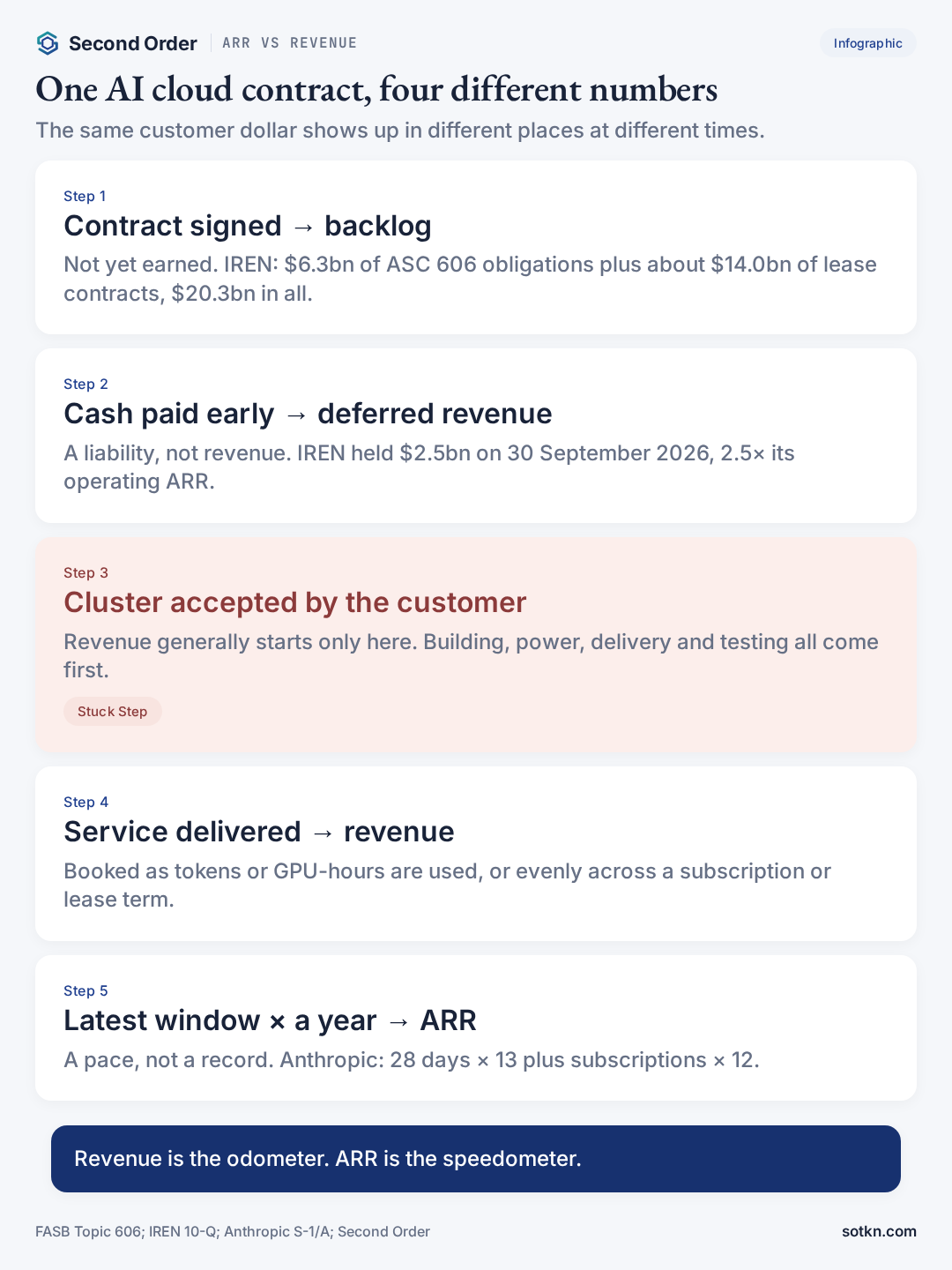
For an AI company the fifth step does most of the work. Cloud compute and model access are services, so they are recognised over time, as they are delivered. A signed contract is step one. The cash may arrive at any step. Revenue arrives only at step five.
That is why the signature, the cash and the revenue can sit in three different quarters. Our cloud commitment Explained covers the customer’s side of the same promise: a commitment to spend is not yet revenue for the provider.
When does an AI company actually book revenue?
An AI company books revenue when the customer uses the service, spread over the term for fixed fees, and only after delivery for capacity deals. Recent filings show four patterns.
- Usage, by the token. Anthropic’s registration statement says revenue is recognised when customers use its service, based on the quantity of tokens consumed. A token used in September is September revenue. Our AI tokens Explained covers the unit.
- Subscriptions, spread evenly. Anthropic’s subscriptions are generally prepaid monthly or annually, with usage limits that reset over short periods. That makes revenue ratable: an annual plan paid in January is booked one-twelfth a month. Until it is earned, the prepaid cash sits as deferred revenue.
- GPU capacity as a service. IREN books its AI Cloud Services under ASC 606. Its quarterly report says revenue generally begins only upon customer acceptance, after the data centre is built and energised, GPUs and networking are installed, the cluster is tested against the contract, and the customer signs off.
- GPU capacity as a lease. Some deals give the customer control of identified equipment for a period. IREN accounts for those as leases under ASC 842, not under ASC 606. In the quarter to 30 September 2026, $65 million of its $200 million AI cloud revenue was lease revenue, or 32.5%, by our arithmetic.
The lease split matters for the reader of a backlog number, too. IREN reports its lease contracts separately from its remaining performance obligations, which cover only ASC 606 contracts. Our finance lease vs operating lease page covers how the two kinds of lease are booked.
How is ARR calculated, and why does it run ahead?
ARR is calculated by multiplying a short recent window up to a year, on a formula each company writes itself. Three examples:
- Nebius: AI cloud revenue in the last month of the quarter × 12. ARR was $3.0 billion at the end of June 2026, against $575 million of AI cloud revenue for the whole quarter.
- IREN: the contracted GPU-hour price for GPUs commissioned on the date × 8,760 hours, plus storage and extras. Operating ARR was $1.0 billion at 30 September 2026.
- Anthropic: usage fees over the trailing 28 days × 13, plus monthly subscriptions × 12. Run-rate revenue was about $81 billion at 31 October 2026, up $10 billion from 30 September.
In a business that is growing fast, the newest window is the biggest one. Scaling it to a year puts the whole year at the newest pace. Revenue, by contrast, adds up every month in the period, including the slower early ones. So ARR runs ahead of revenue in a ramp and behind it in a slowdown.
The SEC does not forbid such metrics. Its January 2020 guidance asks a company that uses one to define it clearly, say how it is calculated and how management uses it, and disclose any change in method. That is why the formulas above sit in footnotes.
How far apart are ARR and revenue right now?
At the latest reporting dates, ARR stood between 1.05× and 2.01× the revenue it was set against, by our arithmetic. Which revenue figure you use matters as much as the ARR.
Anthropic is the widest case. Its run-rate was about $71 billion at 30 September 2026, working back from the $81 billion and $10 billion in its filing. Its revenue for the four quarters to that date was $35,282 million: $2,040 million, $4,731 million, $11,555 million and $16,956 million. That puts the run-rate at about 2.01× trailing revenue. Against the September quarter alone, multiplied by four, it is only 1.05×.
At Nebius, $3.0 billion of ARR was 1.30× its June-quarter AI cloud revenue multiplied by four. At IREN, $1.0 billion of operating ARR was 1.25× its September-quarter AI cloud revenue multiplied by four. Both readings are taken at the end of the quarter, so they include capacity that was running for only part of it.
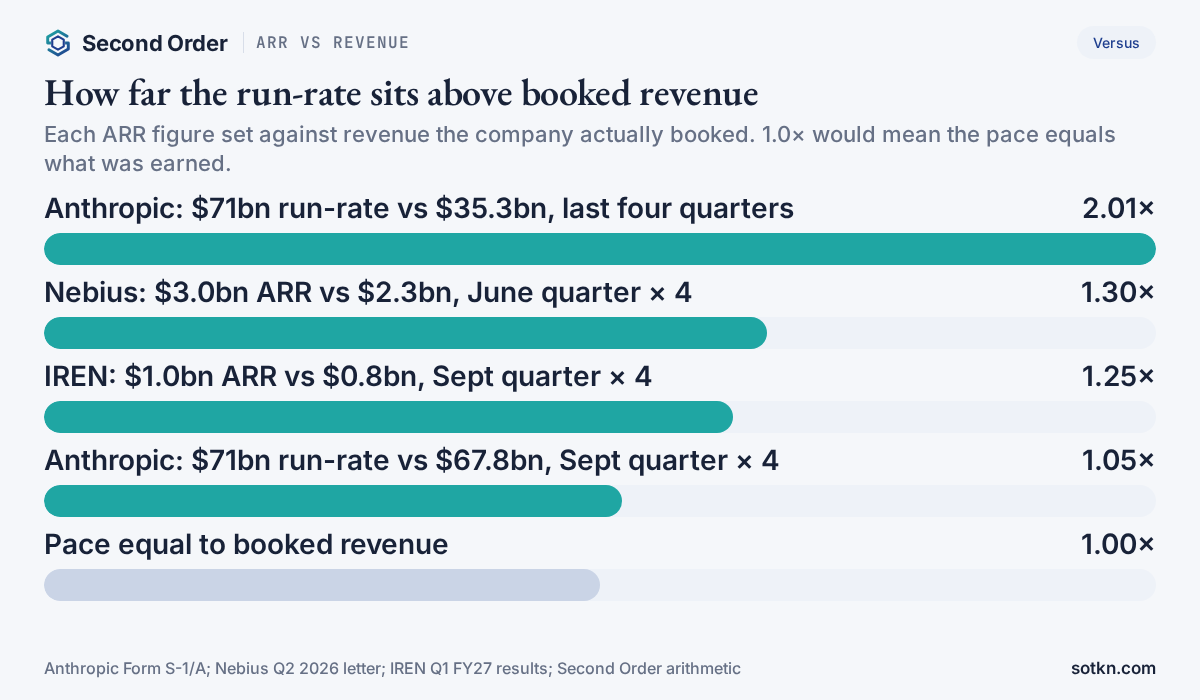
A gap is not a warning in itself. It says the business sped up during the period. The test comes in the next filing: if quarterly revenue lands near the last ARR divided by four, the pace held.
Where do backlog and deferred revenue fit?
Backlog and deferred revenue sit on either side of revenue: one counts contracts not yet earned, the other cash received before delivery. Neither is ARR. Our remaining performance obligation Explained and deferred revenue Explained cover each one. Set side by side, the four numbers show how much of a company’s pace is locked in.
| Number | What it counts | Anthropic, 30 Sept 2026 | IREN, 30 Sept 2026 |
|---|---|---|---|
| Backlog / RPO | Contracted, not yet earned | $13.8bn RPO; about 75% within 12 months | $6.3bn ASC 606 RPO plus about $14.0bn of lease contracts = $20.3bn backlog |
| Deferred revenue | Billed or paid, not yet delivered | $2.0bn current | $2.5bn ($0.1bn current, $2.4bn non-current) |
| Revenue | Delivered and earned in the quarter | $17.0bn (July–Sept) | $200m AI cloud ($135m services, $65m lease) |
| ARR / run-rate | Latest window × a year | About $71bn (about $81bn at 31 Oct) | $1.0bn operating ARR |
From Anthropic’s Form S-1/A and IREN’s results release and Form 10-Q. Sums and splits are Second Order arithmetic.
Anthropic’s remaining performance obligations, covering deferred revenue and non-cancellable commitments, were $13.8 billion at 30 September 2026, and it expects to recognise about 75% within 12 months. That is about $10.4 billion of contracted revenue for the next year, against a run-rate of about $71 billion: roughly 15%, by our arithmetic. Most of the run-rate depends on customers continuing to use the service, not on contracts already signed.
IREN shows the opposite shape. Its ASC 606 remaining performance obligations were $6,347 million: $1,529 million due within 12 months, $1,652 million in months 13 to 24, and $3,166 million in months 25 to 60, by subtraction. The 12-month amount alone is about 1.5× its $1.0 billion operating ARR. Add about $13,957 million of lease contracts and you get the $20.3 billion backlog in its results release.
Deferred revenue tells you where the cash got ahead. IREN held $2,544 million of deferred revenue at 30 September 2026, up $702 million in the quarter and about 2.5× its operating ARR, by our arithmetic. Anthropic’s current deferred revenue rose from $269 million at the end of 2025 to $1,971 million, about 7.3×. In both cases customers paid before the service was delivered.
Which number should you use?
Use revenue to measure what a company has earned, and ARR to measure how fast it is moving. Use backlog to see how much of the future is contracted, and deferred revenue to see how much cash arrived early.
- For margins and cash, use revenue. Costs are booked against revenue, not against ARR. Anthropic’s compute and infrastructure costs were $9,863 million in the September quarter, set against $16,956 million of revenue.
- For momentum, use ARR, and compare each company only with its own past readings. Three formulas give three different meanings to the same three letters.
- For durability, set ARR beside the 12-month backlog. A run-rate mostly covered by contracts behaves differently from one that depends on next month’s usage.
- For early cash, watch deferred revenue. It rises when customers prepay and falls as the service is delivered.
Our Analysis on when the headline bill is not the earned bill follows the same gap through the stack.
Who gets paid?
Our read: the hardware sellers get paid first, the AI cloud gets paid as it delivers, and ARR describes the pace in between.
- Chip, server and data centre suppliers. They are paid when the equipment is bought and the hall is built, before any revenue exists. IREN said that after the quarter it signed a five-year contract in which the customer prepaid 90% of the related GPU spending. That prepayment funds the suppliers; for IREN it is deferred revenue, not revenue.
- AI clouds and neoclouds. They earn revenue as the service runs, after acceptance. Their ARR is paid largely by model labs and hyperscalers. Our neocloud Explained covers who they are.
- Model labs. Their revenue comes from tokens and subscriptions, and much of it moves on to the clouds as compute costs. The same dollar can sit in a lab’s run-rate and a cloud’s ARR at the same time.
- Investors and lenders. They fund the gap between paying suppliers and booking revenue. IREN listed $9 billion of cash, committed GPU financing and prepayments toward $15 billion of remaining planned capital spending for its fiscal 2027.
Where is the stuck step?
Our read: customer acceptance. For an AI cloud, revenue under ASC 606 generally begins only once the customer accepts the cluster, and ARR on IREN’s formula counts only commissioned GPUs. Everything before that day is cost and contracts, not revenue.
IREN’s quarterly report lists what has to happen first: the data centre built and energised; GPUs, servers, storage and networking delivered and installed; the cluster configured and tested against the contract; and the customer’s sign-off. A delay at any step can push back the start of revenue and trigger delay credits, while costs keep running. Our GPU cluster acceptance Explained walks through the testing.
IREN’s own target shows the clock. Its more than $4 billion of contracted ARR, four times its operating ARR, moved from the end of 2026 to January 2027, possibly February, after a customer-requested design change and supplier timing. Until that equipment is accepted, the money is in backlog and deferred revenue, not in revenue.
What would change the view?
- Revenue catches up. If next quarter’s revenue lands near the last ARR divided by four, the pace held. A quarter well below that would mean the window that set the ARR was unusually strong.
- Acceptance slips. If IREN’s more than $4 billion target moves past February 2027, backlog and deferred revenue keep growing while revenue waits.
- Usage turns. Anthropic’s filing warns that run-rate measured in a seasonally busy or quiet stretch can differ a lot from revenue, and that it can include usage from customers later cut off.
- A formula changes. A switch in window or basis can move ARR with no change in the business. The SEC guidance expects that to be disclosed.
The clocks: Nebius reports third-quarter results on 12 November 2026 at 21:00 Singapore time, which will show whether its ARR kept running ahead of revenue; IREN’s more than $4 billion milestone is targeted for 31 January 2027; and Anthropic’s next reported quarter will test its October run-rate against booked revenue.
Common misconceptions
- People assume ARR is revenue already earned. Actually it is a pace. Anthropic’s run-rate of about $71 billion sat beside $35.3 billion of revenue for the four quarters to 30 September 2026.
- People assume a signed contract or a prepayment is revenue. Actually it becomes revenue only as the service is delivered; until then it is backlog or deferred revenue.
- People assume all AI cloud revenue follows the same rule. Actually some GPU deals are leases under ASC 842; a third of IREN’s September-quarter AI cloud revenue was lease revenue.
- People assume a high ARR means the next year is contracted. Actually only about 15% of Anthropic’s September run-rate was covered by remaining performance obligations due within 12 months, by our arithmetic.
FAQ
What is the difference between ARR and revenue?
ARR is a yearly pace that a company calculates from a short recent window, such as one month or 28 days. Revenue is what the company has earned over a past period under accounting rules, checked by auditors. ARR tells you speed; revenue tells you distance already covered.
Is ARR the same as revenue?
No. ARR is an operating metric with no accounting standard behind it. Anthropic’s run-rate was about $71 billion at 30 September 2026, while its revenue for the four quarters to that date was about $35.3 billion, by our arithmetic.
Why is ARR higher than revenue?
Because in a fast-growing business the latest window is bigger than the average of the past year. ARR scales the newest month or 28 days to a full year; revenue adds up what was earned across the whole period, including the slower early months.
When is revenue recognised for an AI cloud or model company?
Under ASC 606 and IFRS 15, revenue is recognised when, or as, the company delivers what it promised. Usage-based AI revenue is booked as tokens or GPU-hours are consumed, subscriptions are spread evenly over the subscription term, and GPU capacity contracts generally start earning only after the customer accepts the cluster.
Is ARR a GAAP measure?
No. Companies define ARR themselves. The SEC’s 2020 guidance asks them to define such metrics clearly, explain how they are calculated, and disclose when the method changes.
Can ARR be higher than backlog?
Yes. Backlog, or remaining performance obligations, only counts contracted amounts not yet earned. Usage that is not under a non-cancellable commitment adds to ARR but not to backlog. Anthropic’s remaining performance obligations due within 12 months were about $10.4 billion against a run-rate of about $71 billion, by our arithmetic.
What is ASC 842 lease revenue in an AI cloud?
Some GPU capacity deals give the customer control of identified equipment for a period, so they are accounted for as leases under ASC 842 rather than as service revenue under ASC 606. IREN booked $65 million of its $200 million AI cloud revenue in the quarter to September 2026 as lease revenue.
Is this a list of stocks to buy or sell?
No. This page compares two numbers and explains where the money goes. It does not rank companies or give buy or sell calls. Not investment advice. Do your own research.
Related: ARR; remaining performance obligation; deferred revenue; RPO vs take-or-pay; total contract value; take-or-pay GPU contracts.
Stack doors
Layer: Neoclouds. Also: Hyperscalers. Markets: US. Wire: an AI cloud quoted on its run-rate.
Get the Wire — short daily notes on where AI computing gets built and who pays for it.
Not investment advice. Do your own research.
How we check this
The revenue recognition rules come from the FASB’s Accounting Standards Update 2014-09 (Topic 606) and the IFRS Foundation’s summary of IFRS 15. Anthropic’s revenue policy, quarterly revenue, run-rate definition and figures, remaining performance obligations and deferred revenue come from its amended registration statement filed with the SEC on 10 November 2026. IREN’s revenue split, operating ARR and its definition, backlog, deferred revenue and the moved January target come from its results release of 5 November 2026; its remaining performance obligations, lease contract value and the customer-acceptance point come from its quarterly report filed with the SEC the same day. Nebius’s ARR and its definition come from its shareholder letter of 12 August 2026. The disclosure standard for operating metrics comes from SEC Release 33-10751 of 30 January 2020. Every ARR or run-rate figure on this page is the company’s own operating metric, not audited revenue. Ratios, sums and shares, such as run-rate against the last four quarters of revenue, are our arithmetic, checked in code and labelled as ours on the page. Who gets paid and the stuck step are our read. The featured photograph is credited in its caption. This page explains two numbers. It does not rank companies or give buy or sell calls. Not investment advice. Do your own research.
Last reviewed: 12 Nov 2026 · Next review: after Nebius’s third-quarter 2026 results (12 Nov 2026), IREN’s January 2027 ARR milestone and Anthropic’s next reported quarter
Spot an error? Tell us and we will correct it and note the change here.
References
- Financial Accounting Standards Board — Accounting Standards Update No. 2014-09, Revenue from Contracts with Customers (Topic 606) (May 2014) — Core principle and the five steps; revenue is recognised when (or as) a performance obligation is satisfied by transferring control of a good or service
- IFRS Foundation — IFRS 15 Revenue from Contracts with Customers (issued May 2014, effective 1 Jan 2018) — The same five steps under IFRS; obligations satisfied at a point in time (typically goods) or over time (typically services), with a measure of progress
- Anthropic, PBC — Form S-1/A registration statement, Amendment No. 2 (SEC, 10 Nov 2026) — Revenue recognised as tokens are consumed and ratably for subscriptions; quarterly revenue to $16,956 million in Q3 2026; Run-Rate Revenue definition (28 days × 13 plus subscriptions × 12), about $81 billion at 31 October 2026, up $10 billion from 30 September; remaining performance obligations $13.8 billion, about 75% within 12 months; deferred revenue $1,971 million
- IREN — IREN reports Q1 FY27 results, Form 8-K exhibit 99.1 (5 Nov 2026) — AI Cloud revenue $200 million (services $135 million, lease $65 million); operating ARR $1 billion and its definition; revenue backlog $20.3 billion and its definition; more than $4 billion ARR target moved to January 2027; deferred revenue on the balance sheet
- IREN Limited — Quarterly report on Form 10-Q for the quarter ended 30 Sep 2026 (SEC, 5 Nov 2026) — ASC 606 remaining performance obligations $6,347 million ($1,529 million within 12 months); lease arrangements under ASC 842, contracted value about $13,957 million; revenue generally begins only upon customer acceptance
- Nebius Group — Letter to shareholders, Q2 2026 (12 Aug 2026) — AI cloud revenue $575 million in Q2 2026; ARR $3.0 billion, calculated as AI cloud revenue for the last month of the quarter × 12
- US Securities and Exchange Commission — Release 33-10751, guidance on key performance indicators and metrics in MD&A (30 Jan 2020) — Companies presenting an operating metric should define it clearly, explain how it is calculated and used, and disclose changes in method