ARR Explained: What Annual Recurring Revenue Really Measures in AI
ARR, or annual recurring revenue, takes a short window of revenue and multiplies it up to a year. In AI the formula changes from company to company, and the number usually runs ahead of the revenue actually booked.
EXPLAINED · Mechanism · Last reviewed: 11 Nov 2026 · Next review: after Nebius’s third-quarter 2026 results (12 Nov 2026) and IREN’s January 2027 ARR milestone
ARR, short for annual recurring revenue, is a snapshot of how much a company would earn in a year if its current monthly revenue simply continued for twelve months.
In short. ARR takes a short window of revenue and multiplies it up to a year. There is no single rule for it. Nebius multiplies its last month by 12; IREN multiplies the hourly price of its running GPUs by 8,760 hours; Anthropic multiplies 28 days of usage by 13 and adds a year of subscriptions. In a fast ramp the number runs ahead of booked revenue: 30% ahead of the latest quarter at Nebius and 25% at IREN, by our arithmetic. Our read: ARR is a fair speedometer and a poor odometer. For AI clouds the stuck step sits before the multiplication: a GPU adds to ARR only once it is switched on, so power and equipment deliveries set the clock.
Why an investor cares: in AI, ARR is often the first number a company reaches for, and it can be quoted months before the revenue shows up in the accounts. Knowing what was multiplied, and by how much, tells you how much of the headline is earned and how much is pace. It also sits on one rung of a ladder with backlog, or remaining performance obligations, and deferred revenue, which measure different things.
What is ARR?
ARR stands for annual recurring revenue. In subscription software it usually means the yearly value of the recurring contracts a company has in place today: a customer paying $10,000 a month adds $120,000 of ARR. One-off fees, such as set-up work, are left out.
In AI the term has stretched. Much AI revenue is paid by usage, by the GPU-hour or by the token, not by a fixed monthly fee. So AI clouds and model labs usually report annualised run-rate revenue: they take revenue from a short recent window and scale it to a year. Many shorten that to ARR. The words are the same; the thing being measured is not.
The common thread is a snapshot. ARR says nothing about the past year and promises nothing about the next one. It tells you how fast money is coming in right now, on the company’s own rule. Our AI tokens Explained covers the usage unit that much of this revenue is priced in.
How is ARR calculated?
Each company writes its own formula, usually in a footnote. Three recent examples show how far apart they sit.
Nebius, the Amsterdam-based neocloud, takes AI cloud revenue for the last month of the quarter and multiplies it by 12. Its letter for the second quarter of 2026 reported ARR of $3.0 billion at the end of June. That implies about $250 million of AI cloud revenue in June alone, by our arithmetic.
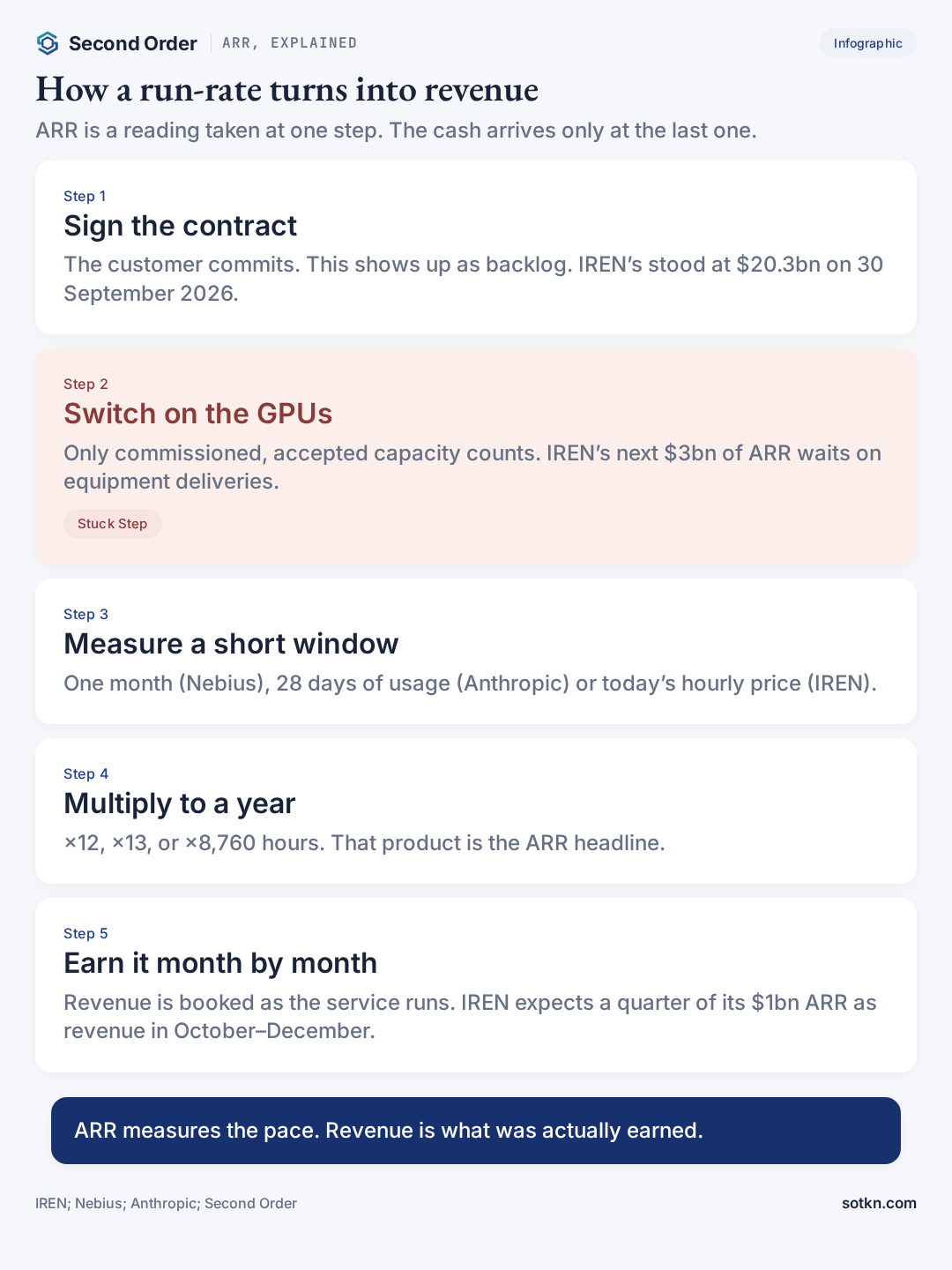
IREN, a neocloud that owns its own sites, uses a price-based formula. It takes the GPU-hour price for GPUs that are commissioned and under contract on the measurement date, multiplies by 8,760, the hours in a year, and adds storage and other extras. Its operating ARR was $1.0 billion at 30 September 2026, double the $0.5 billion at the end of June. Because the formula uses contracted prices, it assumes the GPUs are billed for the hours in the year, on the company’s own utilisation and pricing assumptions.
Anthropic, which makes the Claude models and filed to list its shares this autumn, mixes the two. Its registration statement defines run-rate revenue as usage fees over the trailing 28 days multiplied by 13, plus monthly subscription fees multiplied by 12. Thirteen 28-day blocks make 364 days, by our arithmetic. Its run-rate was about $81 billion at 31 October 2026, up $10 billion from 30 September.
| Company | What they call it | Window measured | Multiplied by | Latest figure |
|---|---|---|---|---|
| Nebius | Annualised run-rate (ARR) | AI cloud revenue in the last month of the quarter | 12 | $3.0bn, end of June 2026 |
| IREN | Operating ARR | Contracted GPU-hour price for GPUs commissioned on the date, plus storage and extras | 8,760 hours | $1.0bn, 30 Sept 2026 |
| Anthropic | Run-Rate Revenue | Usage fees over the trailing 28 days, plus current monthly subscriptions | 13 for usage, 12 for subscriptions | About $81bn, 31 Oct 2026 |
| Microsoft | AI business annual revenue run rate | Not broken out on the call | Annualised | Above $37bn, quarter to March 2026 |
From company filings, letters and calls. Each company sets its own rule, so the numbers are not directly comparable.
Microsoft gives a single figure for its AI business: it said on its call of 29 April 2026 that its AI annual revenue run rate had passed $37 billion, up 123% in a year. It did not spell out the formula on the call.
What is the difference between ARR and revenue?
Revenue is money earned over a past period and booked under accounting rules that auditors check. ARR is a pace, taken from a short window and scaled up. When a business is growing fast, ARR runs ahead of revenue, because the latest month is bigger than the average month of the quarter.
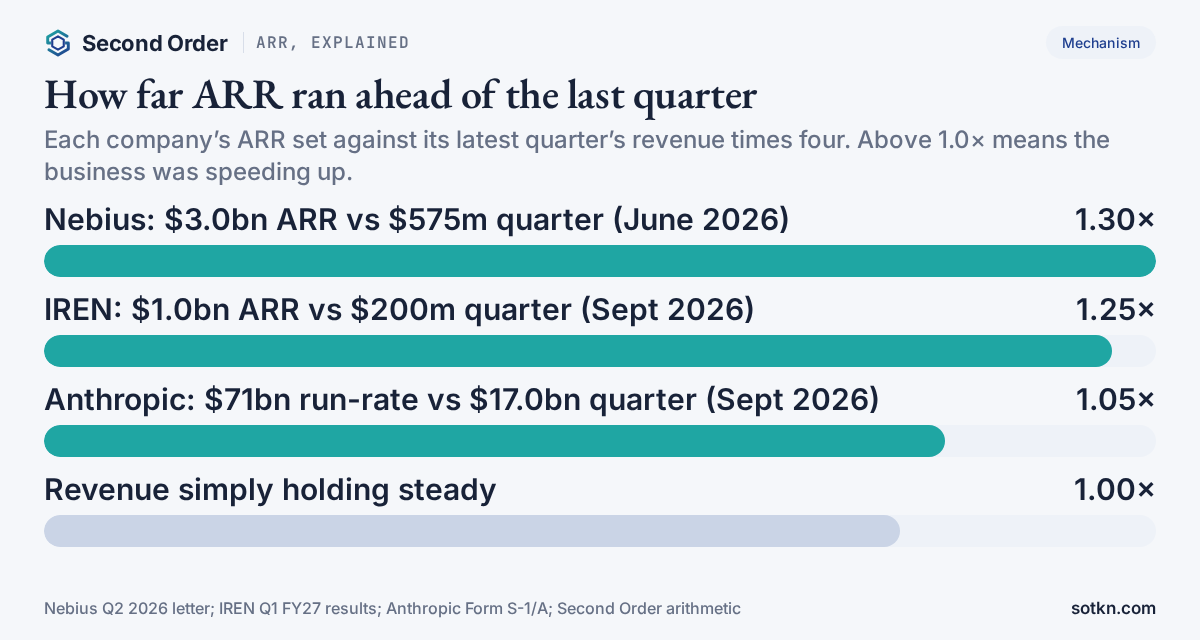
The gap is easy to measure. Nebius booked $575 million of AI cloud revenue in the April to June quarter. Four times that is $2.3 billion a year at the quarter’s average pace, against $3.0 billion of ARR, so the ARR was about 1.3 times the quarter’s pace. Put another way, June revenue was about 30% above the quarter’s monthly average of about $192 million. All of that is our arithmetic on Nebius’s figures.
IREN shows the same pattern. AI cloud revenue was $200 million in the July to September quarter, up from $71 million. Four times $200 million is $800 million, against $1.0 billion of operating ARR at quarter end, or 1.25 times, by our arithmetic. Anthropic’s gap is smaller: its run-rate of $71 billion at 30 September compares with $16,956 million of revenue in the July to September quarter, or $67.8 billion a year at that pace, about 1.05 times.
| ARR | Revenue | |
|---|---|---|
| What it is | A yearly pace taken from a short recent window | Money earned over a past period |
| Who defines it | The company, in a footnote | Accounting standards, checked by auditors |
| Time it covers | One day to one month, scaled to a year | The full quarter or year reported |
| In a fast ramp | Runs ahead | Lags |
| If usage falls | Drops at the next reading | Already booked; the fall shows next period |
| Best used for | Spotting speed and turning points | Valuing what was actually earned |
A ratio above one is not a warning on its own; it is what growth looks like. It becomes a warning when the next quarter’s revenue fails to catch up. If you want the accounting side, our total contract value Explained covers how a signed deal is sized before any of it is earned.
Why does ARR run ahead of revenue for AI clouds?
Because capacity arrives in steps and is billed from the day it is switched on. When a neocloud brings a new hall of GPUs online in the last weeks of a quarter, those GPUs count in full in the end-of-quarter ARR but earned only a few weeks of revenue in that quarter.
IREN put a number on this. On its call on 5 November 2026 it said it exited September with $1 billion of operating ARR, a quarter of which it expected to book as revenue in the October to December quarter. A quarter of $1 billion is $250 million, by our arithmetic, which is simply the exit pace held for three months. IREN also said it did not expect much revenue in that quarter from new capacity arriving late in December or early in 2027.
This is why the definition matters. IREN counts only GPUs that are commissioned and under contract. Signed capacity that is still being built is not in operating ARR; IREN calls it contracted ARR and gives a target date for it instead. Our GPU cluster acceptance Explained covers the testing step between a finished hall and a paying customer.
What does contracted ARR mean?
Contracted ARR is the run-rate a company expects once capacity it has already signed is switched on. It is a target, not a measurement. IREN said its more than $4 billion of contracted ARR was fully contracted and funded, and that the date for it had moved from the end of 2026 to January 2027, and possibly to the end of February.
IREN gave two reasons: a design change the customer asked for, outside the original scope, and supplier timing. On the call it said the data centres were practically done and it was waiting for the remaining equipment to finish commissioning. More than $4 billion would be four times its operating ARR at 30 September, or about $1 billion of revenue a quarter once fully running, by our arithmetic.
Contracted ARR sits between backlog and operating ARR. IREN’s revenue backlog, which counts contracted revenue over the full life of its deals, was $20.3 billion. Our contracted power Explained covers the same gap on the power side: signed megawatts are not live megawatts.
What does Anthropic’s $81 billion run-rate mean?
It means Anthropic’s most recent 28 days of usage, plus its current subscriptions, would add up to about $81 billion if they continued for a year. It does not mean Anthropic earned $81 billion. Its revenue for the first nine months of 2026 was $33,242 million, and for July to September alone it was $16,956 million, up 47% on the previous quarter.
The filing is unusually direct about the limits. It says run-rate revenue is not a substitute for revenue under accounting rules and is not a forecast. Because it annualises a short window, a reading taken in a seasonally quiet or busy stretch, such as holiday periods, can differ a lot from one taken at another time. It also says the figure can include usage from customers later found to be breaking its usage terms, whose revenue would not be expected to continue, and that it expects the run-rate growth rate to decline over time.
The jump from $71 billion to $81 billion in October is a rise of about 14% in one month, by our arithmetic. At $81 billion a year, Anthropic is bringing in about $6.75 billion a month at its current pace.
Is ARR a GAAP number?
No. ARR is an operating metric. No accounting standard defines it, and companies choose their own formula. That is allowed, with conditions.
The SEC’s guidance of January 2020 on key performance indicators says a company using such a metric should give a clear definition and explain how it is calculated, say why it is useful and how management uses it, and consider whether the assumptions behind it need disclosing so the metric is not misleading. If the method changes, the company should consider disclosing the change and its effect. That is why ARR definitions now sit in footnotes like the three quoted above.
The practical rule for a reader: never compare one company’s ARR with another’s until you have read both footnotes. A last-month figure, a 28-day figure and a contracted-price figure can describe very different businesses at the same headline number.
Who gets paid?
Our read: ARR is earned by the company that reports it, but a large part of it is passed straight along the stack.
- Model labs. Anthropic’s run-rate is what its customers pay to use Claude. Its compute and infrastructure costs were $9,863 million in July to September 2026, about 58% of that quarter’s revenue, by our arithmetic. It disclosed about $900.9 billion of committed spend, substantially all on compute and infrastructure, with about $70.7 billion due in the next 12 months.
- AI clouds and neoclouds. That compute bill becomes the ARR of the clouds. Nebius’s and IREN’s ARR is paid by AI labs, hyperscalers and other large AI users that take GPUs by the hour or under multi-year contracts; IREN named Microsoft and NVIDIA among its customers. Our neocloud Explained covers who they are.
- Chip, server and site suppliers. They are paid before any ARR exists, when the GPUs are bought and the halls are built. IREN said customer prepayments and GPU financing fund more than all of the GPU spending for one of its deployments.
- Hyperscalers. Microsoft’s $37 billion AI run rate covers its own AI services, and Microsoft also buys capacity from neoclouds such as IREN, so the same dollar can appear in more than one company’s run-rate as it moves along the stack.
Where is the stuck step?
Our read: before the multiplication. For an AI cloud, a GPU adds to ARR only once it is installed, powered, tested and billing. Everything that delays that day delays the ARR.
IREN’s January move is the live example. The money was raised and the contracts were signed; the gap was a customer design change and equipment still to arrive. Until that equipment is in and commissioned, more than $3 billion of the more than $4 billion target sits outside operating ARR, by our arithmetic.
For model labs the bind is the reverse: usage can grow faster than compute arrives. Either way the clock is physical, which is why our guide to AI data center power and today’s Wire on CoreWeave’s power gap sit next to this page.
What would change the view?
- Revenue catches up. If the next quarter’s revenue lands near the last ARR reading divided by four, the ARR was a fair pace. IREN has guided to about a quarter of its $1 billion ARR in October to December.
- A company changes its formula. A switch from a monthly to a contracted-price basis, or a new window, can lift the headline without any change in the business. The SEC guidance expects that to be disclosed.
- Usage drops. Usage-based ARR can fall at the next reading. Anthropic’s filing warns of seasonal swings and of revenue from customers later cut off.
- Capacity slips again. If IREN’s contracted ARR moves past February 2027, the gap between signed and running capacity widens.
The next clocks: Nebius reports third-quarter results on 12 November 2026 at 21:00 Singapore time, which will show whether its ARR kept running ahead of revenue; IREN’s more than $4 billion milestone is targeted for 31 January 2027; and Anthropic’s next reported quarter will test its October run-rate against booked revenue.
Common misconceptions
- People assume ARR is revenue already earned. Actually it is a short window scaled to a year; Anthropic’s $81 billion run-rate sits beside $33.2 billion of revenue for the first nine months of 2026.
- People assume every company calculates ARR the same way. Actually Nebius uses one month × 12, IREN contracted GPU-hour prices × 8,760 and Anthropic 28 days × 13 plus subscriptions × 12.
- People assume ARR includes signed contracts. Actually operating ARR at IREN counts only commissioned GPUs; signed capacity still being built is reported separately as contracted ARR.
- People assume a high ARR means the money is locked in. Actually usage-based ARR can fall at the next reading; backlog, not ARR, measures what is contracted.
FAQ
What is ARR?
ARR stands for annual recurring revenue. It takes the revenue a company is earning now, over a recent month or at today’s contracted prices, and multiplies it up to a full year. It is a snapshot of pace, not revenue already earned.
How do you calculate ARR?
The simplest version is last month’s recurring revenue multiplied by 12. Nebius uses exactly that. IREN multiplies the hourly price of GPUs that are switched on and under contract by 8,760 hours. Anthropic multiplies its last 28 days of usage fees by 13 and adds 12 months of current subscriptions. Always read the footnote.
What is the difference between ARR and revenue?
Revenue is what a company has earned and booked under accounting rules over a past period. ARR is a forward-looking annualised pace taken from a short window. In a fast ramp ARR runs ahead: Nebius reported $3.0 billion of ARR at the end of June 2026 against $575 million of AI cloud revenue in the quarter, which is $2.3 billion a year at the quarter’s pace.
Is ARR the same as run-rate revenue?
In AI, mostly yes. Neoclouds and model labs often call it annualised run-rate revenue, and some shorten that to ARR. In subscription software, ARR more often means only the yearly value of recurring contracts, which is narrower.
Is ARR a GAAP number?
No. ARR is an operating metric that companies define for themselves. The SEC’s 2020 guidance asks companies that use such metrics to give a clear definition, explain how it is calculated, and disclose when the method changes.
Is ARR the same as backlog?
No. Backlog, or remaining performance obligations, is contracted revenue not yet earned, often over several years. ARR is the yearly pace of what is running now. IREN had $20.3 billion of backlog and $1 billion of operating ARR at 30 September 2026.
Is this a list of stocks to buy or sell?
No. This page explains a metric and where the money goes. It does not rank companies or give buy or sell calls. Not investment advice. Do your own research.
Related: remaining performance obligation; deferred revenue; total contract value; take-or-pay GPU contracts; GPU rental prices.
Stack doors
Layer: Neoclouds. Also: Hyperscalers and AI Data Centers. Markets: US. Analysis: when the headline bill is not the earned bill.
Get the Wire — short daily notes on where AI computing gets built and who pays for it.
Not investment advice. Do your own research.
How we check this
Anthropic’s run-rate definition, run-rate figures, quarterly revenue, compute costs and commitments come from its amended registration statement filed with the SEC on 10 November 2026. IREN’s ARR definition, revenue, backlog and the moved January target come from its results release of 5 November 2026, filed with the SEC, and the share of ARR expected as December-quarter revenue from its call the same day, as transcribed. Nebius’s ARR, its definition and AI cloud revenue come from its shareholder letter of 12 August 2026. Microsoft’s AI run rate comes from its earnings call of 29 April 2026, as published by Microsoft. The disclosure standard for operating metrics comes from SEC Release 33-10751 of 30 January 2020. Every ARR figure on this page is the company’s own operating metric, not audited revenue. Ratios, such as ARR against the latest quarter times four, and implied monthly figures are our arithmetic, checked in code and labelled as ours on the page. Who gets paid and the stuck step are our read. The featured photograph is credited in its caption. This page explains a metric. It does not rank companies or give buy or sell calls. Not investment advice. Do your own research.
Last reviewed: 11 Nov 2026 · Next review: after Nebius’s third-quarter 2026 results (12 Nov 2026) and IREN’s January 2027 ARR milestone
Spot an error? Tell us and we will correct it and note the change here.
References
- Anthropic, PBC — Form S-1/A registration statement, Amendment No. 2 (SEC, 10 Nov 2026) — Run-Rate Revenue defined as trailing 28-day consumption fees × 13 plus monthly subscription fees × 12; about $81 billion at 31 October 2026, up $10 billion from 30 September; quarterly revenue $11,555 million (Q2) and $16,956 million (Q3 2026); compute and infrastructure $9,863 million in Q3; $900.9 billion of committed spend; run-rate not a substitute for GAAP revenue or a forecast
- IREN — IREN reports Q1 FY27 results, Form 8-K exhibit 99.1 (5 Nov 2026) — AI cloud revenue $200 million (prior quarter $71 million); ARR defined as GPU/hour pricing for commissioned GPUs under contract × 8,760 hours plus storage and ancillaries; more than $4 billion ARR target moved from year-end 2026 to January 2027, possibly February; backlog $20.3 billion
- IREN — first quarter fiscal 2027 earnings call transcript (5 Nov 2026) — Operating ARR doubled to $1 billion at 30 September; a quarter of it expected to be recognised as revenue in the December quarter; the January date depends on supplier deliveries and commissioning
- Nebius Group — Letter to shareholders, Q2 2026 (12 Aug 2026) — Nebius AI cloud revenue $575 million in Q2 2026; ARR $3.0 billion; ARR calculated as AI cloud revenue for the last month of the quarter × 12
- Microsoft — fiscal year 2026 third quarter earnings conference call (29 Apr 2026) — AI business annual revenue run rate surpassed $37 billion, up 123% year on year
- US Securities and Exchange Commission — Release 33-10751, guidance on key performance indicators and metrics in MD&A (30 Jan 2020) — Companies presenting an operating metric should give a clear definition and how it is calculated, why it is useful, how management uses it, material assumptions, and disclose changes in method