14.1 Trillion Won Set: Who Gets Paid While the Fourth-Quarter Cell Stays Blank
SK hynix gets paid on revenue already recorded. The third-quarter dividend is printed. The fourth-quarter cell is blank.
SK hynix gets paid on memory already in the nine-month revenue. Holders of the third-quarter dividend have a printed total. The fourth-quarter cell is an ellipsis.
On 25 November 2026 SK hynix filed the 2026 value-up implementation status with the Korea Exchange and furnished the English summary as a Form 6-K. Independent directors heard it on 23 November. The form says the decision date is the disclosure date, and the exchange list shows the receipt at 17:49. Seonghwan Park signed the 6-K. This pulse reads that form, the Korean sheet, the English exhibit, and the 28 October fair disclosure that set the floors.
The numbers that matter this month
The month’s print is a grid, not a new quarter. The revenue was already the nine months through 30 September 2026. The new fact is which cells are filled and which are an ellipsis.
| Line | Figure | What the page says |
|---|---|---|
| Nine-month revenue, through Q3 2026 | 237 trillion won | Cumulative. Full-year 2025 on the same chart is 97. Full-year 2024 is 66. |
| Nine-month operating profit | 181 trillion won | Full-year 2025 is 47. Full-year 2024 is 23. No margin is printed. |
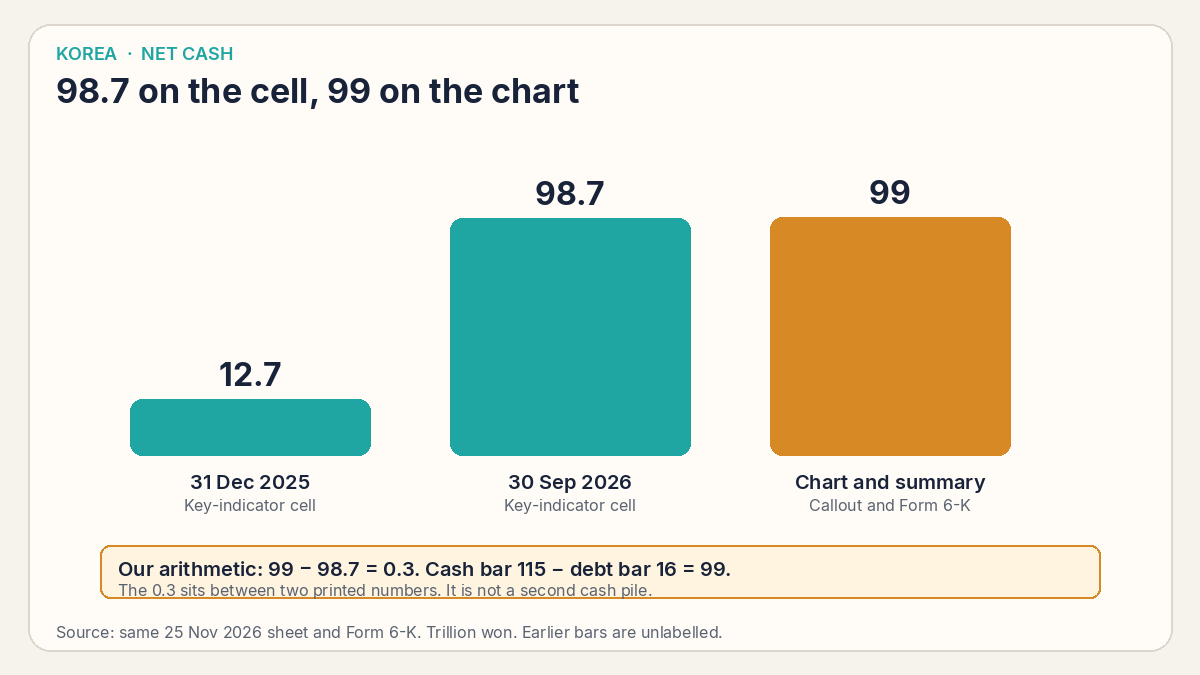
| Net cash, 30 September 2026 | 98.7 trillion won | Key-indicator cell. The chart callout and the Form 6-K both print 99. |
| Net cash, 31 December 2025 | 12.7 trillion won | Key-indicator cell. The chart’s 2025 point is 13. |
| Q1–Q2 cash dividend | 0.5 trillion won | 375 won a share in each quarter. No record date. |
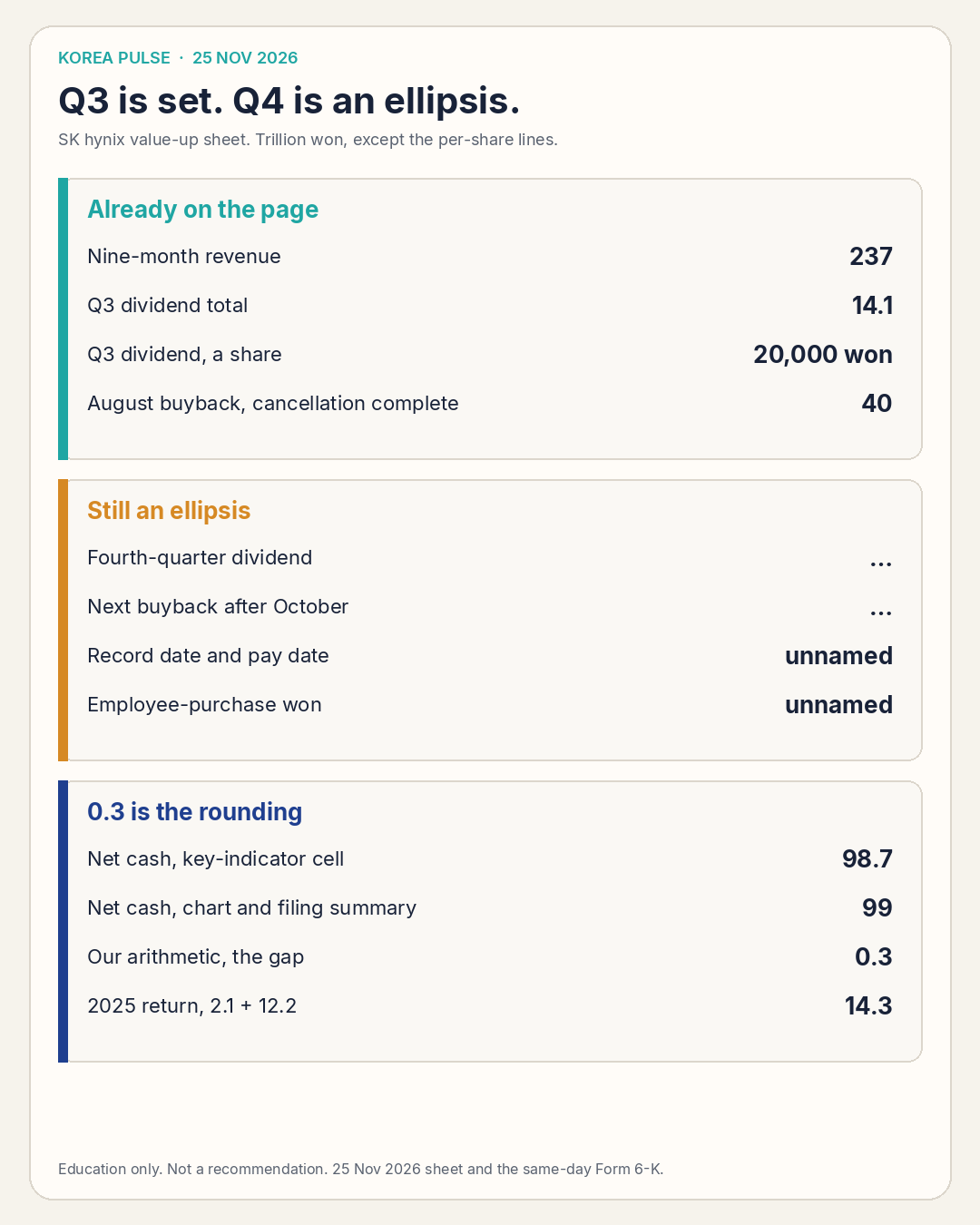
| Q3 cash dividend | 14.1 trillion won | 20,000 won a share, printed as 10,000 plus 10,000. No record date. |
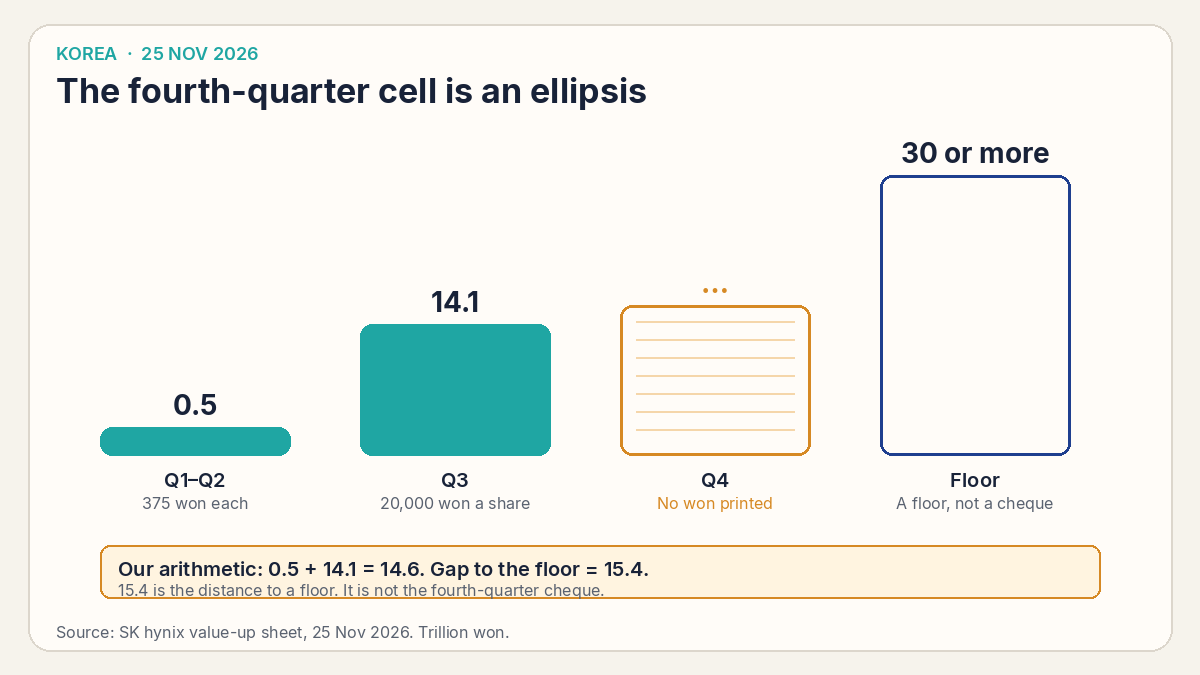
| Q4 cash dividend | An ellipsis | Total, per share, and both sub-rows are blank. |
| Cash-dividend floor | 30 trillion won or more | A floor for the year. Not a fourth-quarter cheque. |
| August buyback | 40 trillion won | 3.2 percent. Cancellation complete. Dated by the board resolution. |
| October buyback | 10 trillion won | 0.8 percent. Cancellation scheduled. Employee purchases are excluded, with no won printed. |
| Buyback floor | 60 trillion won or more | The next cell is an ellipsis. |
| High-dividend company | Does not qualify | The company’s own assessment. 2025 payout 4.9 percent. The form does not say which limb failed. |
The revenue is already recognised. The third-quarter dividend has a total. The fourth-quarter cell does not.
Why does Korea matter now?
Korea is where this memory revenue is recognised and where the board sets the return, one quarter at a time. The sheet’s nine-month revenue is 237 trillion won and the operating profit beside it is 181. The sheet names no customer and no product row. The company that has already been paid, on the only revenue line the page prints, is SK hynix.
Holders are a separate clock. The sheet says 2026 returns are being carried out through cash dividends and through buying and cancelling shares, and that each quarter’s scale is set by the board from the share price, market conditions, and cash flow. A floor of 30 trillion won or more can sit on the same page as a blank fourth quarter because the floor is a year and the cheque is a quarter.
Net cash is the stock the sheet wants a reader to see. The key-indicator cell is 12.7 trillion won at 31 December 2025 and 98.7 at 30 September 2026. The chart and the Form 6-K both round the later figure to 99. The page still does not name the day the next dividend is paid.
What changed
On 28 October 2026 a fair disclosure, also signed by Seonghwan Park, set the frame. Expected shareholder returns for fiscal 2026 were approximately 100 trillion won. Cash dividends were 30 trillion won or more. Acquisition and cancellation of treasury shares were 60 trillion won or more, including the 40 trillion won August resolution and excluding shares acquired for employees and executives. The programme would run through the payment date of the fiscal-2026 annual dividend. That date was not named. The line for the expected time of disclosure was a dash.
The October disclosure did print a third-quarter dividend of 20,000 won a share: 10,000 won from earnings and 10,000 won as a special dividend on the indirect investment in Kioxia. Most of those Kioxia gains would come back in two installments, one in the third quarter and one in the annual dividend, and the annual dividend would be set after the year-end accounts. It printed no won total for the third quarter, no 375 won, and no first-half total of 0.5 trillion won. The same day the board resolved to acquire 20 trillion won of treasury shares: approximately 10 trillion won for the shareholder return, expected to be cancelled, and approximately 10 trillion won for employee and executive compensation, an amount the note said could change.
The 25 November sheet keeps the floors and fills the cells. The first two quarters are 0.5 trillion won in total, 375 won a share in each. The third quarter is 14.1 trillion won, at the same 20,000 won a share. Under that 20,000 the sheet prints 10,000 won labelled earnings-based and 10,000 won labelled investment gains. The Korean label is 투자 성과. The sheet does not print the name Kioxia. The fourth-quarter column, including both sub-rows, is an ellipsis.
Buyback columns are dated by the board resolution, not by the day cash left. August is 40 trillion won, 3.2 percent, cancellation complete. October is 10 trillion won, 0.8 percent, cancellation scheduled. Employee-compensation purchases are excluded from the 2026 result, and no won is printed for them. The next column is an ellipsis under a floor of 60 or more. Adding this sheet’s October 10 to the October disclosure’s “approximately 10” for employees would meet that day’s 20 trillion won resolution, if the approximation had been exact and had not moved. This sheet does not lock that sum.
Our math
Two additions on the sheet tie with nothing left over. The 2025 return is a cash dividend of 2.1 trillion won plus a cancellation of 12.2, and the cell prints 14.3. The third-quarter per-share line is 10,000 plus 10,000, and the cell prints 20,000. Those 10,000 won rows are won a share. They are not a split of the 14.1 trillion won, and halving 14.1 is not a figure on the page.
Our arithmetic on the open cells starts from the filled ones. The first two quarters, 0.5, plus the third quarter, 14.1, are 14.6 trillion won. The distance from 14.6 to the floor of 30 is 15.4. The fourth-quarter cell is an ellipsis, so 15.4 is the gap to a floor, not a cheque and not a forecast. The floor says “or more,” so a later quarter can clear 15.4 without meeting a number the sheet has named. August 40 plus October 10 is 50. The distance to a buyback floor of 60 is 10, and the next cell is an ellipsis, so that 10 is not a third purchase. The percentages add to 4.0 points. The sheet does not print the share count they were divided by.
Dividing each buyback by its percentage lands on one quotient. 40 divided by 0.032 is 1,250, and 10 divided by 0.008 is 1,250. The printed market cap at 30 September 2026 is 1,297 trillion won, 47 above that quotient. The 1,250 is our arithmetic, not a market cap. The columns are resolution months, not 30 September, and a one-decimal percentage will throw the same round quotient off two rows. The printed market caps are 474 at 31 December 2025 and 1,297 at 30 September 2026. The rise is 823. 1,297 divided by 474 is 2.736, to three decimals.
The third-quarter total does not identify a share count. 14.1 trillion won divided by 20,000 won is 705,000,000, if both figures are exact. The sheet does not print that count. Two quarters at 375 won on it would be 0.52875 trillion won, and the sheet prints 0.5. Rounded to one decimal, 0.52875 is 0.5. The 0.02875 trillion won between them is what that rounding can absorb. It is not a missing dividend, and it is not a share count.
The 2.1 trillion won cash-dividend cell is the same one-decimal habit. The high-dividend form prints fiscal-2025 profit dividends of 2,108,669,020,875 won, which is 2.108669 trillion. The gap to 2.1 trillion is 8,669,020,875 won. At one decimal, 2.108669 rounds to 2.1. One pile, two precisions. Fiscal-2024 profit dividends are 1,520,090,654,120 won, and the form prints that same won again as dividend income for the year that includes 31 December 2024. The increase is 588,578,366,755 won, which is 38.720 percent to three decimals. The form prints 38.7. It also prints a 2025 payout of 4.9 percent and does not print the profit underneath. Dividing 2,108,669,020,875 by 0.049 gives 43.034 trillion won. That quotient is our arithmetic, not a printed net profit. The chart’s 2025 operating profit of 47 trillion won is a different line, and the form does not connect them.
Return on equity is an output with no inputs beside it. The 44.2 percent uses the four quarters of 2025. The 88.1 percent uses the fourth quarter of 2025 through the third quarter of 2026. 88.1 divided by 44.2 is 1.993, to three decimals, and the sheet prints neither the net income nor the equity in that fraction. Our margins, which the sheet also does not print, are 34.848 percent in 2024, 48.454 percent in 2025, and 76.371 percent on the nine months of 2026. Nine-month revenue of 237 is 2.443 times full-year 2025 revenue of 97, and nine-month operating profit of 181 is 3.851 times full-year 2025 operating profit of 47. The windows differ. The sheet does not annualise them.
Where does the money stick?
The revenue is already recognised. 237 trillion won is the nine-month total, against 97 for 2025 and 66 for 2024, and operating profit of 181 sits on the same nine-month window. No customer is named. SK hynix has already been paid that revenue. Returning some of it to holders is a later instrument.
Net cash is a stock, not a dividend. The cell goes from 12.7 trillion won to 98.7, an increase of 86.0, which is 7.772 times to three decimals. The chart’s points are −9, 13, and 99. The callout and the Form 6-K say 99. Both 12.7 and 98.7 round to the next whole number, so each gap is 0.3. That 0.3 is rounding, not a second pile. The only numbered bars are the 2026 third-quarter pair, cash of 115 and borrowings of 16. 115 minus 16 is 99, the chart’s label, not the 98.7 cell. 115 minus 98.7 is 16.3, which is 0.3 above the printed borrowings bar. The same 0.3 appears once. The 2024 and 2025 bars have no printed height.
The 14.1 trillion won is a third-quarter dividend total, with no record date and no pay date on this sheet. The August 40 is marked cancellation complete, which retires shares rather than paying cash to the holders who remain. The October 10 is marked cancellation scheduled, dated by the resolution, and the sheet does not say the cash has left. Those three figures are different instruments. The funding line says the return draws on core-business growth and on realised gains from investment assets, and it prints no won for either source. The 10,000 won investment-gains row is a third-quarter per-share line, not the funding of the 60 trillion won floor.
From December 2025 to September 2026 the sheet moves Moody’s from Baa1 to A3, S&P from BBB to A−, Fitch from BBB to BBB+, and NICE, Korea Ratings, and Korea Investors Service from AA to AA+. No spread and no coupon is printed.
Is the fourth-quarter cell still stuck?
Yes. The fourth-quarter column is an ellipsis on the total, the won a share, the earnings-based line, and the investment-gains line. The footnote says the programme runs through the moment the fiscal-2026 year-end dividend is paid, and it does not name the day. The English exhibit says the 2026 figures include planned amounts which may be determined or paid in 2027. The Korean footnote on the key-indicator page says 2025 is what was executed and 2026 includes amounts scheduled to be executed, and it does not print 2027. Neither rendering appoints a pay date.
The October disclosure had already put the second Kioxia installment into the annual dividend, to be set after the year-end accounts. This sheet does not fill that amount, and it does not print the Kioxia name. The buyback has the same shape: August complete, October scheduled, the next cell an ellipsis under a floor of 60 or more. The employee-purchase won is a third blank.
What dates matter
| Date | What is on the page |
|---|---|
| 31 December 2025 | Market cap 474. Net cash 12.7. ROE of 44.2 percent covers the four quarters of 2025. |
| Fiscal 2025 | Revenue 97. Operating profit 47. Return 14.3. Profit dividends 2,108,669,020,875 won. Payout 4.9 percent. |
| First two quarters of 2026 | 375 won a share in each. Total 0.5 trillion won. No record date. |
| August 2026 | 40 trillion won, 3.2 percent, cancellation complete. No day of the month. |
| 30 September 2026 | Market cap 1,297. Net cash 98.7 in the cell, 99 on the chart. Revenue 237. Operating profit 181. |
| Third quarter of 2026 | 14.1 trillion won at 20,000 won a share. No record date. |
| 28 October 2026 | Floors of about 100, 30 or more, and 60 or more. A 20 trillion won buyback resolution. |
| October 2026, this sheet | 10 trillion won, 0.8 percent, cancellation scheduled. |
| 23 and 25 November 2026 | Directors on the 23rd. Receipt at 17:49 on the 25th, which the form calls the decision date. |
| Fourth quarter | An ellipsis. The pay date is not printed. |
How is this different from the 28 October fair disclosure?
The October disclosure is the frame: about 100 trillion won, dividends of 30 or more, cancellations of 60 or more, 20,000 won a share, and a 20 trillion won buyback split into an approximate 10 for cancellation and an approximate 10 for employees. The next disclosure time is a dash. The November sheet is the grid under that frame. It adds 14.1 trillion won, the 0.5 and the 375 won, the percentages, the cancellation status, the charts, the rating letters, and a high-dividend box that looks at 2024 and 2025 and says the company does not qualify. A 30 trillion won floor for 2026 is not an input to the 4.9 percent.
The fourth quarter is still an ellipsis. The employee won is still off this page. The record date and the pay date are still unnamed. The October dash and the November ellipsis are the same stuck step. This sheet does not print SK Square’s stake, and it is not the Samsung hours report. The blank here is a quarter.
What would change this view?
- A fourth-quarter cell with a won total and a won a share, in place of the ellipsis.
- A record date and a pay date for the 14.1 trillion won, or for whatever the fourth quarter becomes.
- A won figure for the employee purchases this sheet excludes. The October “approximately 10” was allowed to change, and this page does not repeat it.
- A buyback cell after October, or a statement that the 60 trillion won floor has been met.
- A reconciliation of 98.7 and 99 that is not rounding. The labelled bars produce 99. The cell says 98.7.
- The profit the 4.9 percent was divided by. The form prints the ratio and the dividend, and not that profit.
Practical takeaways
- SK hynix has already been paid 237 trillion won of revenue through the third quarter of 2026. The sheet names no customer.
- Holders of the third-quarter dividend have 14.1 trillion won printed at 20,000 won a share. They do not have a record date or a pay date on this sheet.
- The fourth-quarter cell is an ellipsis. The 15.4 trillion won between 14.6 and the floor of 30 is our arithmetic, not the cheque.
- August’s 40 trillion won is cancellation complete. October’s 10 is cancellation scheduled. The next stretch to a floor of 60 is an ellipsis, and the employee won is not on the page.
- Net cash of 98.7 and the chart’s 99 are one stock rounded two ways. The high-dividend box, on 2024 and 2025, says the company does not qualify. That box is not the 2026 plan.
FAQ
Who gets paid on the 25 November sheet?
SK hynix gets paid on revenue already on the sheet, 237 trillion won through the third quarter of 2026. Holders of the third-quarter dividend have 14.1 trillion won printed at 20,000 won a share. The fourth-quarter cell is an ellipsis.
Is 14.1 trillion won the fourth-quarter cheque?
14.1 trillion won is the third-quarter total on the 25 November sheet, next to 20,000 won a share. The fourth-quarter cell is an ellipsis. The gap from the printed quarters to the 30 trillion won floor is our arithmetic, and it is not a cheque.
Why do the pages print both 98.7 and 99 trillion won of net cash?
The key-indicator cell at 30 September 2026 is 98.7 trillion won. The chart callout, the chart’s net-cash label, and the 25 November filing summary print 99. The 0.3 trillion won between them is the rounding of 98.7 to a whole number.
Does this filing say SK hynix qualifies as a high-dividend company?
The company’s own assessment on the 25 November form is that it does not qualify. The form prints a 2025 payout ratio of 4.9 percent and a 38.7 percent increase in profit dividends, and it does not say which limb of the test those figures failed.
What is still blank?
The fourth-quarter dividend cell, including the per-share line and the investment-gains line. The sheet also leaves the next buyback cell as an ellipsis, prints no won for the employee purchases it excludes, and does not name a record date or a pay date.
Keep reading on the map
The neighbours are a parent cheque that was still a plan, and a factory clock that was already full.
- Korea markets — the running file of who gets paid.
- SK Square’s cheque — the parent’s own return, still a plan on 2 November, a different cheque from this sheet.
- Samsung’s hours — a full factory clock, and a spare-bit line this sheet does not touch.
- Korea and HBM — who gets paid while memory stays booked.
- The markets map — Taiwan, Korea, the United States, China.
Education only. The figures are the ones in SK hynix’s value-up disclosure received at 17:49 on 25 November 2026, the progress sheet attached to it, the Form 6-K and Exhibit 99.1 of the same day, and the fair disclosure of 28 October 2026. Planned amounts are the company’s plan. Not a recommendation to buy or sell.
Sources: Form 6-K, 25 November 2026. Exhibit 99.1, 25 November 2026. DART receipt 20261125800766. Value-up progress sheet (PDF). Form 6-K, 28 October 2026. IR page named in the filing.