₩230 Billion of Wiring, ₩46 Billion on Hold: Who Gets Paid While Wonju’s AI Data Centre Waits for Its Bank Loan
On 20 November Kumyang Green Power signed a ₩230 billion contract to wire a 99 MW AI data centre in Wonju. Its shares jumped 30%. But the 20% advance, ₩46 billion, is paid only after the developer’s bank loan is approved. That loan is the stuck step.
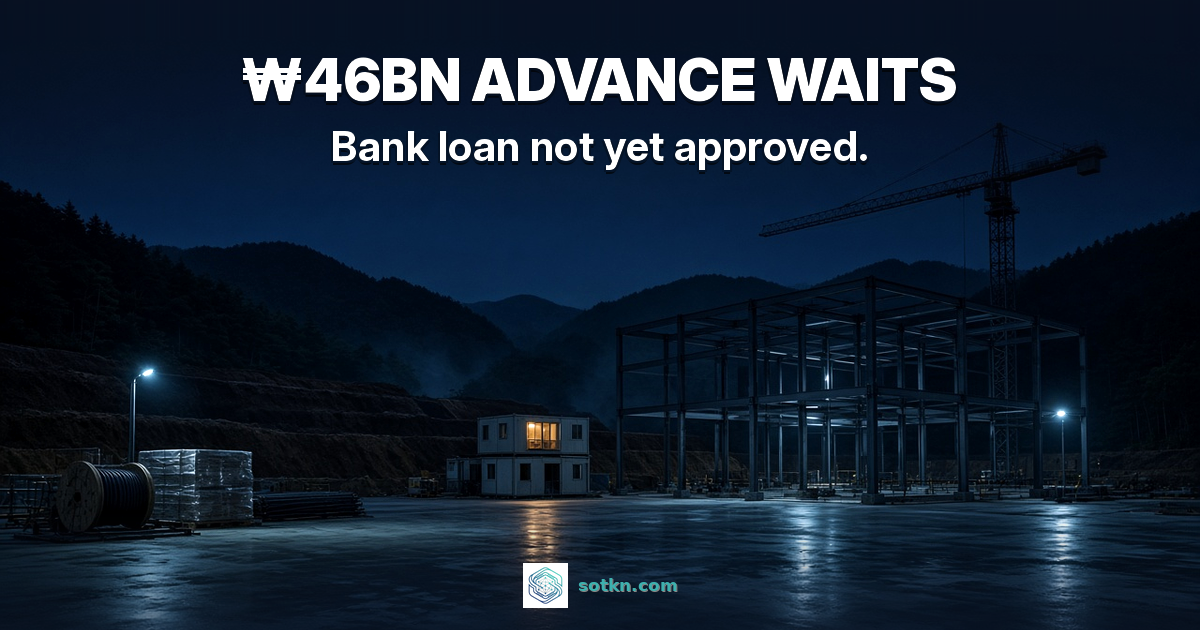
A Korean electrical contractor just won the biggest job in its history: ₩230 billion to wire an AI data centre in Wonju. Its shares jumped 30% in a day. But read the filing. The first payment, a ₩46 billion advance, comes only after the developer’s bank loan is approved. That loan was meant to land in August. It has not. The developer had about ₩20 million in cash at the end of 2025. So the hall has a contractor, a power contract and a plan. What it does not have yet is the money. That is the stuck step.
KOREA PULSE · AI DATA CENTERS · Data as at 25 Nov 2026 (Kumyang Green Power DART filing of 20 Nov; Korean press of 23–24 Nov; Hanwha briefing of 24 Nov) · Next update: Mega Data Korea’s project loan approval and Kumyang’s first advance
Affects: AI Data Centers — Markets: Korea
Education only, not advice to buy or sell any security. ₩ is the Korean won. Where we give US dollars we use the rate implied by the Korea Herald on 24 November (₩10 trillion = US$7.5 billion), our arithmetic. MW (megawatt) here is the power a data centre is built to draw. On 13 November we wrote that Korea’s AI data centres are waiting for tenants (tenants first). This note is about the next gate along: the loan that pays the people who build the hall.
The numbers that matter this week
Contract, DART 20 Nov
₩230bn
Electrical and telecom works, Wonju, to 30 Mar 2029
NewShare of Kumyang’s 2025 revenue
86.87%
Roughly doubles its order backlog
BigAdvance (20%)
₩46bn
Paid only after the client’s PF loan is approved
WaitingDeveloper cash, end 2025
~₩20m
No revenue in 2025 · going-concern doubt
ThinThe project
99 MW · ₩1.4tn
Three 40 MW halls · up to 120 MW by 2030
PlannedThe gate
PF loan
Reported target August 2026 · not yet approved
Stuck stepKumyang Green Power DART filing, 20 Nov 2026; Korea Financial Newspaper and Newsfarm, 23 Nov 2026; Yonhap, 15 Jan 2026; Wonju MBC, 12 Oct 2026. Status chips are Second Order’s read.
On this page: Why it matters · What happened · Project finance? · The Wonju project · How Kumyang is paid · How big for Kumyang · The developer · Hanwha’s other way · The grid rule · Who gets paid · What is stuck? · Dates next · FAQ
Why does one wiring contract in Wonju matter?
Think about building a house. The electrician signs up and agrees a price. The plan says the owner pays a fifth up front so the electrician can buy cable and hire crews. But the owner has not got the mortgage yet. The deposit will come when the bank says yes. Until then, the electrician can wait, or start work with its own money and hope.
That is the Wonju story in one picture. Korea wants many more AI data centres. The government is cutting red tape on power reviews. Big groups like SK, Samsung, Hanwha and Naver are drawing up plans. But a lot of the actual building will be done by smaller developers who borrow most of the money. For them, the gate is not only power or permits. It is the loan.
This week a listed contractor showed us exactly where that gate sits, in writing. Kumyang Green Power’s filing does not hide it. It says the advance comes after the client’s project-finance approval. The market cheered the size of the contract. The filing tells you when cash can start to move.
It also matters for the wider picture. In October we showed that more than half of recent Korean data centre power requests were told there was no supply (the grid queue). Wonju says it has its power contract. So this project has passed the gate that stops most others, and is now stuck at the next one. That is useful. It shows what comes after power.
What happened this week?
On Friday 20 November, after the market closed, Kumyang Green Power told the exchange it had signed a contract with Mega Data Korea. Here is what the filing says, in order.
- The job: electrical and telecom work for the Wonju Mega Cluster AI data centre in Wonju, Gangwon Province.
- The price: ₩230 billion, before VAT. That is 86.87% of Kumyang’s 2025 consolidated revenue of about ₩264.8 billion.
- The term: 20 November 2026 to 30 March 2029. The filing gives 20 November as the start of work and the finish as the completion date.
- Payment: 20% advance (₩46 billion), 75% in monthly progress payments, and the last 5% after completion.
- Progress payments: billed at each month end and paid within 15 days. The last 5% within 30 days of completion.
- The catch: the advance will be paid after the client’s project-finance (PF) approval.
- Another catch: when the detailed design is fixed, design changes can change the contract price, and the timetable and price can change under the contract terms.
- The filing marks the contract as not conditional, and says Kumyang has done no similar work for this client in the last three years.
The market saw the first line and not the last ones. On Monday 23 November Kumyang’s shares rose by the daily limit of 30%, to ₩9,620, from ₩7,400. That was on a day when the main KOSPI index fell 3.31% as AI chip stocks sold off in the US. On Tuesday 24 November the shares rose more than 9% to ₩10,490, their highest since late May.
Then the questions came. On 23 November the Korea Financial Newspaper looked at the client and found its auditor had raised a doubt about whether it can keep going as a business. Another Korean outlet, Newsfarm, pointed out that the client’s own audit report had aimed to draw a project loan of about ₩1.6 trillion in August 2026. Three months later, the filing still says “after PF approval”. The loan is not there yet.
On the same Monday, two ministries also proposed easier power reviews for AI data centres. And on Tuesday, Hanwha Aerospace showed officials around its own 180 MW AI data centre site in Changwon. We come back to both below, because they show the two ways Korea’s data centres are being paid for.
What is project finance, in plain words?
Project finance, or PF, is a big loan made to one project rather than to a whole company. The bank looks at the project itself: the land, the building, the power contract and, above all, who will pay to use it. If the bank likes what it sees, it lends most of the building cost. The project pays the loan back from its future income.
Banks do not lend all at once. They want the paperwork done first. Usually that means permits, a fixed price for building, a power contract, and some proof of customers, such as a signed lease. In Korea, PF has a hard recent history. Many property projects stalled when these loans dried up, and lenders became stricter. So a PF approval is not a formality. It is a real test.
Why does a contractor care? Because builders usually get paid out of that loan. An advance lets the contractor buy cable, switchgear and labour before the bills come in. Without it, the contractor pays first and waits. For how the money stack in a data centre usually works, see data center financing, explained. For why money paid up front matters, see prepayment, explained.
One more word that matters here: tenant. A data centre earns money when someone moves in and pays for space and power. A loan for a data centre is much easier to get when a big customer has already signed. We have not seen a tenant named for Wonju in the filings and releases we read. That does not mean there is none. It means none has been made public.
What is being built in Wonju?
Wonju is a city in Gangwon Province, east of Seoul. It is outside the capital region, which matters for the government’s plans to move data centres away from Seoul’s crowded grid.
The developer, Mega Data Korea, held a groundbreaking ceremony on 15 January 2026. The plan, as Wonju City and Yonhap reported it that day: a hyperscale AI data centre of 99 MW, up to 120 MW, in three 40 MW halls plus an operations building, for about ₩1.4 trillion in total. It sits in Wonju’s first “urban high-tech industrial complex”. The project began in September 2021 and was picked by the trade ministry as one of ten national data centre projects. The developer has filed a patent on immersion cooling, where servers sit in special liquid, and signed a memorandum with Kyndryl Korea on running the site.
A local broadcaster, Wonju MBC, visited in October. It reported that earthworks began in March 2026 and that this was the only AI data centre site in the province with real digging under way. The first 40 MW phase was due by October 2028, and all 120 MW by 2030. It also reported that 99 MW of power had already been contracted, with another 21 MW being sought from KEPCO, the state power company.
The plan (Jan and Oct 2026)
What is in place
What is not public
Yonhap and Wonju City, 15 Jan 2026; Wonju MBC, 12 Oct 2026; Kumyang Green Power DART filing, 20 Nov 2026. *Our arithmetic at the Korea Herald’s 24 Nov rate.
Our arithmetic: ₩1.4 trillion over 99 MW is about ₩14 billion per MW, roughly US$10.6 million. That is a shell-and-power cost, not a cost with chips inside. The servers and GPUs would be bought by whoever rents the space. Kumyang’s ₩230 billion is about 16% of the total cost, our arithmetic, which is a normal-looking share for electrical and network work in a power-heavy building.
One number does not line up neatly. The total project cost was given as ₩1.4 trillion in January. The loan target reported from the audit report is about ₩1.6 trillion. Loans can be larger than build costs when they also cover interest during building, fees and refinancing of land debt. Neither the filing nor the press reports explain the gap, so we just flag it.
How does Kumyang get paid, and when?
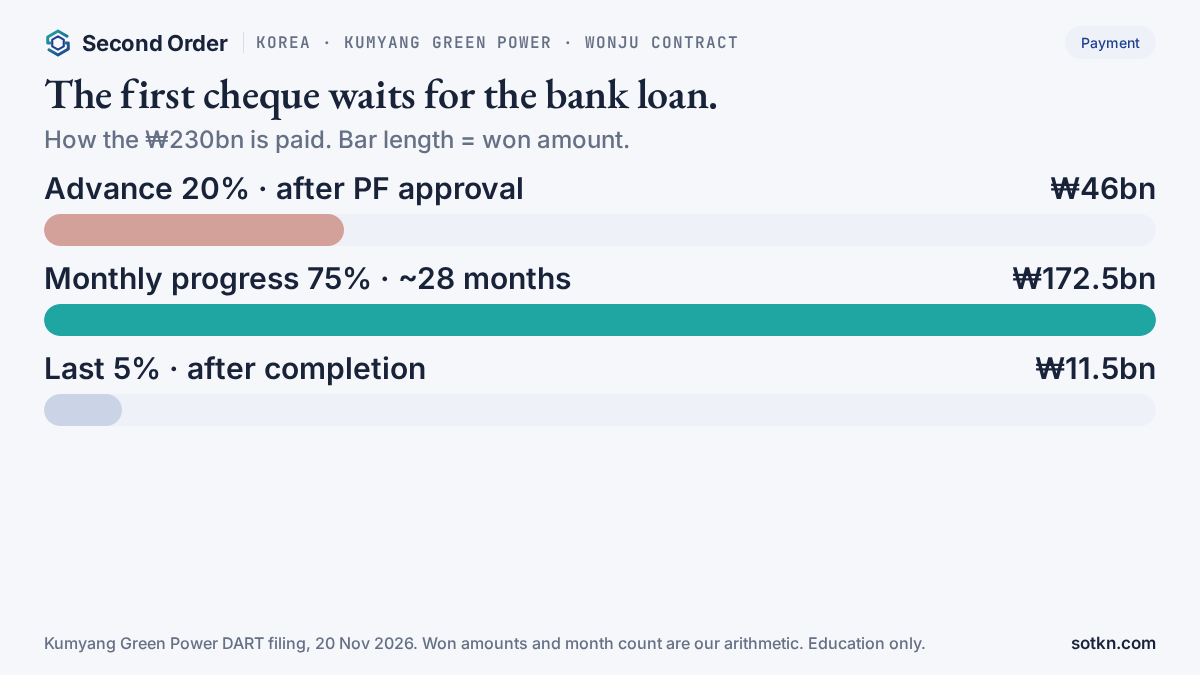
The filing splits the ₩230 billion three ways. In won, our arithmetic: ₩46 billion as an advance, ₩172.5 billion in monthly progress payments, and ₩11.5 billion held until the end.
The advance is the only part with a written condition, and the condition is the loan. The monthly payments look safer on paper, because they are tied to work done. But think about where that money comes from. The Korea Financial Newspaper reported that the developer’s audit report planned a separate loan to pay early contractors until June 2026, before the main PF. If the main loan is not in place, the monthly payments also depend on whatever short-term money the developer can find.
How big is each monthly payment? From 20 November 2026 to 30 March 2029 is about 28 months. Spread ₩172.5 billion evenly and it is about ₩6.1 billion a month, our arithmetic; the newspaper made the same estimate. Real building jobs are lumpy. Electrical work is light at the start and heavy near the end, when transformers, switchgear and cables go in. So the early months would be smaller.
Compare that with Kumyang’s earlier jobs. The same newspaper noted that on two wind farm contracts signed in 2024, worth ₩30 billion each, Kumyang can bill 65% of the price as an advance. Here it is 20%, and only after the loan. That is a much thinner cushion. For how suppliers sometimes end up funding their customers, see vendor financing, explained.
How big is this job for Kumyang?
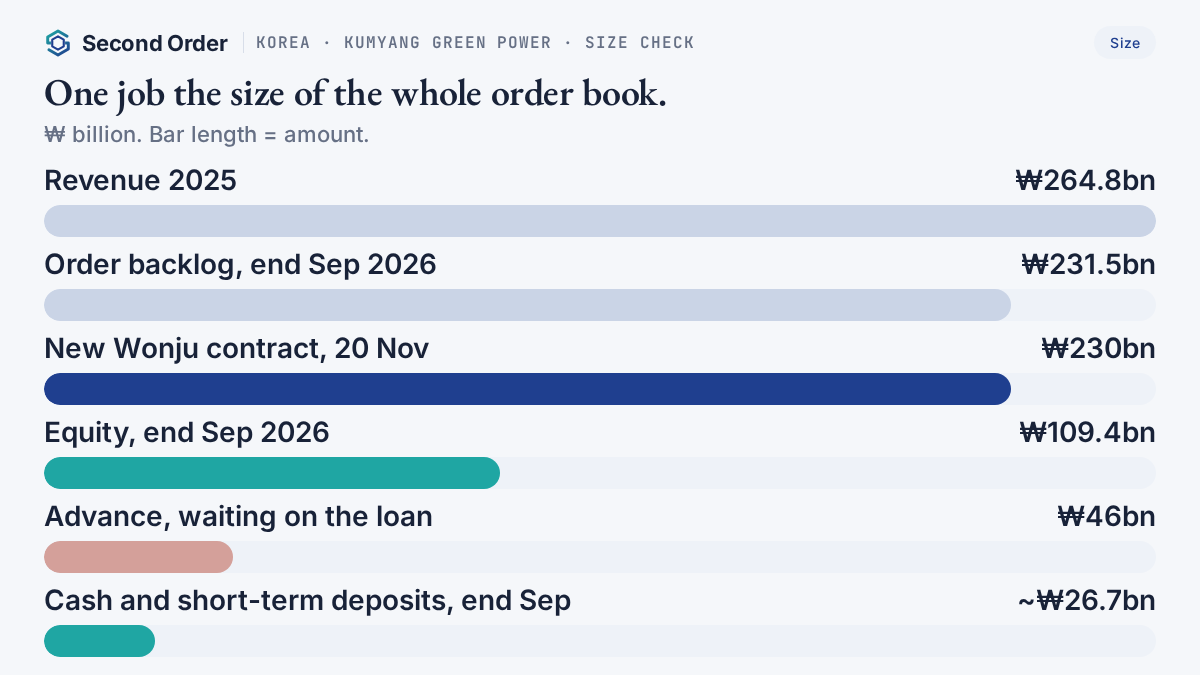
Very big. Kumyang Green Power is a 33-year-old electrical and instrumentation contractor based in Ulsan. It wires refineries, chemical and chip plants, nuclear plants, and wind, solar and fuel-cell farms. It listed on KOSDAQ in March 2023. Its data centre experience, Newsfarm reported, is a small ₩2.2 billion job on an AI data centre in Ulsan that started in June.
Kumyang, size (₩)
Kumyang, cash (₩)
Against the new job
Kumyang Green Power DART filing, 20 Nov 2026; third-quarter figures as reported by the Korea Financial Newspaper and Newsfarm, 23 Nov 2026. *Our arithmetic.
Put simply: one contract is the same size as the whole order book Kumyang had at the end of September. It is about twice the company’s equity. And the advance alone is larger than the cash it had on hand.
Kumyang’s recent results also matter. It lost ₩5.3 billion at the operating level in the first nine months of 2026, though it made ₩0.9 billion in the third quarter alone. Newsfarm read the notes and found that rising cost estimates on jobs had cut profit by ₩20.3 billion in 2024 and ₩9 billion so far in 2026. In plain words: on fixed-price jobs, Kumyang has more than once found the work cost more than it planned. A large fixed-price job, with a price that can still change after the design is fixed, carries that same risk.
Its equity also includes ₩22 billion raised in April through a 30-year convertible bond that counts as equity in the accounts. It pays 2% a year, quarterly. Kumyang also guarantees up to ₩45 billion of a project loan for a Jeju solar company it part-owns. None of this is unusual on its own. Together, it means Kumyang has less room to carry a big job on its own money for long.
Why does the developer’s balance sheet matter so much?
Because the developer is the one who has to get the loan. Here is what Mega Data Korea’s audited 2025 accounts showed, as the Korea Financial Newspaper reported them on 23 November.
2025 results (₩)
End 2025 (₩)
Land and equity (₩)
Mega Data Korea 2025 audit report as reported by the Korea Financial Newspaper, 23 Nov 2026.
Read that slowly. A company with almost no cash, and about ₩20 billion more owed within a year than it could raise within a year, is the client on a ₩230 billion contract. Its equity went up mostly because its land was valued higher, not because it earned money. That land is already pledged to lenders, including credit unions. The auditor wrote that whether the company survives depends on its next fundraising, its application for state support and its efforts to fix its finances.
None of this is strange for a developer at this stage. Most data centre developers have no revenue until the first hall opens. Land is often their main asset. The point is simpler. Everything downstream, from the contractor’s advance to the first rack, waits for one decision by a group of lenders. And lenders will want to see who is going to pay rent.
This is the same shape we saw at Pohang in October, where a ₩600 billion AI data centre was funded with ₩450 billion of PF and ₩150 billion of equity, and a cloud firm had pre-leased 16 MW before the money came together (Pohang’s ₩600 billion). The difference is that Pohang named its first tenant. Wonju has not, publicly. If you want the background on why signed tenants unlock loans, see leases not yet commenced, explained and retail vs wholesale colocation.
How is Hanwha’s Changwon plan different?
On Tuesday 24 November, a day after Kumyang’s jump, Hanwha Aerospace briefed officials from the National AI Strategy Committee and the Defense Acquisition Program Administration at a building site in Changwon, in the south-east. It is building a defence AI data centre there. Hanwha said:
- Eventual size: 180 MW, filled with high-density GPU servers.
- Money: ₩10 trillion (about US$7.5 billion) set aside for the first phase.
- Timing: part of the site online in July 2028 for first services.
- Power: the group plans to use its own power generation assets to grow data centres in Korea and abroad.
- Customer: the military, with a model under study where the military keeps control of its data and defence firms run the site.
Our arithmetic: ₩10 trillion over 180 MW is about ₩55.6 billion per MW, roughly four times Wonju’s figure. Hanwha has not said whether the ₩10 trillion includes the GPU servers. If it does, the gap mostly reflects chips, not concrete. So do not read the two per-MW numbers as a like-for-like price.
The bigger difference is who pays. Hanwha’s money comes from a large group’s own investment plan; the ₩55 trillion plan for aerospace and defence AI was announced in July. Its first customer is expected to be the state. Wonju’s money has to come from outside lenders, and its customers are not public. One is a big group building for a known user. The other is a small developer building in the hope that users come.
Hanwha has its own stuck step. The military has not yet agreed how it would use a privately run centre. But that is a deal between a group and the state, not a loan waiting on a tenant. For more on the big Korean groups that do have their own customers, see what SK Telecom does and what Naver does.
Does the new grid rule help Wonju?
On 23 November the science ministry and the climate and energy ministry said AI data centres outside the capital region with a contracted load of 50 MW or less will skip the grid impact review. Centres inside special AI data centre zones will skip the non-technical part of the review, whatever their size. And mega-projects and centres using the new one-stop permit route will be reviewed first. We covered the 50 MW line on the Wire (the 50 MW grid pass) and asked where cash sticks if the pass stops there (if the grid pass stops at 50 MW).
For Wonju, the rule changes little. At 99 MW it is above the 50 MW line. And by the local broadcaster’s account, it already has its power contract for 99 MW. So power is not what binds this project today. Money is. That is a useful reminder: clearing the grid gate does not mean the hall gets built. Each gate has its own clock.
There is also a demand worry in the background. On 20 November, US President Donald Trump threatened heavy taxes on big US tech firms that build AI data centres in other countries. It is not policy. But Korean developers are counting on demand from global AI and cloud firms to fill large halls. Korean press asked this week whether US firms would be caught even when they only lease a hall built by a Korean developer. For lenders deciding on a loan to a hall with no public tenant, that question does not help.
Who gets paid while the loan waits?
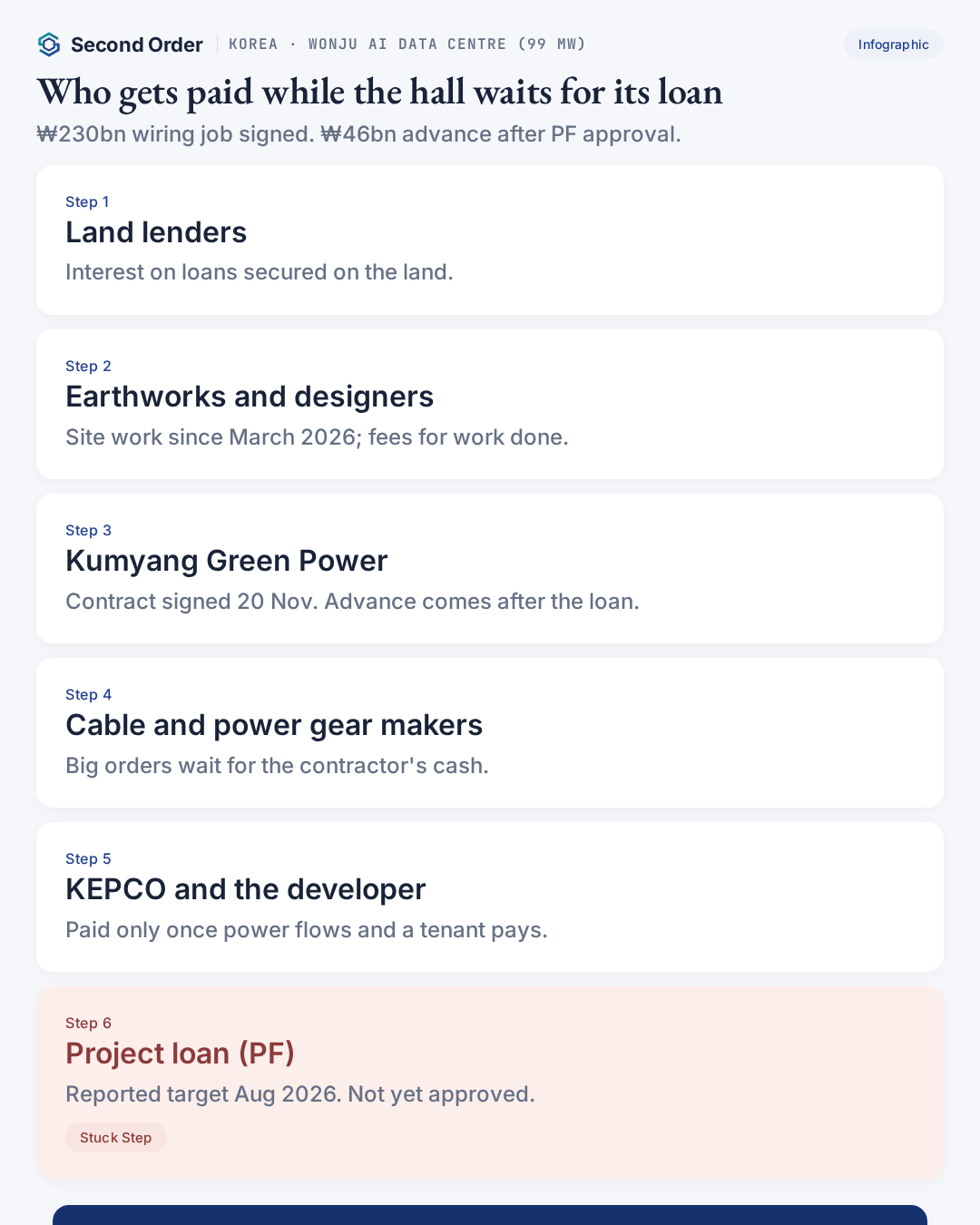
Most of the money in this story has not moved yet. Some has. Here is the split as we read it.
Paid now or already
Paid after the loan
Waits longer
Second Order’s read of the Kumyang Green Power DART filing of 20 Nov 2026 and the Mega Data Korea accounts as reported on 23 Nov 2026.
The steadiest earners today are the lenders that already hold the land as security. They get interest whether or not the hall is built. The people who worked on the ground, the earthworks crews and the designers, have been paid or are owed for work already done.
Kumyang sits in the middle. It has a signed contract, a start date and a rising share price. But a share price is not cash. The first real cheque is the advance, and it comes after the loan. Until then, Kumyang’s own suppliers, the makers of cable and power gear, also wait for orders.
Further down the line, KEPCO is paid only once the hall draws power, and Mega Data Korea is paid only once a tenant moves in. That last step, the tenant, is what makes every other step bankable. For how one big customer can carry a whole project, see customer concentration, explained. And for the companies that rent space from developers like this one, see colocation, explained.
What is stuck, and what would change our read?
The stuck step is the project loan. The reported target was August 2026. On 20 November the filing still describes the advance as coming after approval. Nothing else in the chain can move far until it lands: the advance, the big gear orders, the hall frames, and in the end the October 2028 date for the first 40 MW.
After the loan, the stuck step moves. First to the detailed design, which can change Kumyang’s price. Then to the gear: big transformers and switchgear have long waits worldwide, as we showed when Korean makers booked US data centre orders years ahead. Then to a tenant moving in and paying.
What would make us more positive? A public PF approval with named lenders and a loan size. Kumyang reporting the ₩46 billion advance as received, which would show up as a jump in cash or advances in its next results. A named tenant or a signed pre-lease. And Wonju’s extra 21 MW of power agreed with KEPCO.
What would make us more cautious? Months more with no loan. A cut in the contract value after the design is fixed. Kumyang’s unbilled work or short-term borrowing climbing while no advance arrives. A change in Mega Data Korea’s ownership or a new partner coming in on tough terms. Or the first-phase date sliding past October 2028.
We are careful about one thing. Going-concern doubts are common for young developers with no revenue. They do not mean a project will fail. They mean the next round of money decides it. For how the stuck step tends to move from one link to the next, see where the stuck step moves.
What dates test this next?
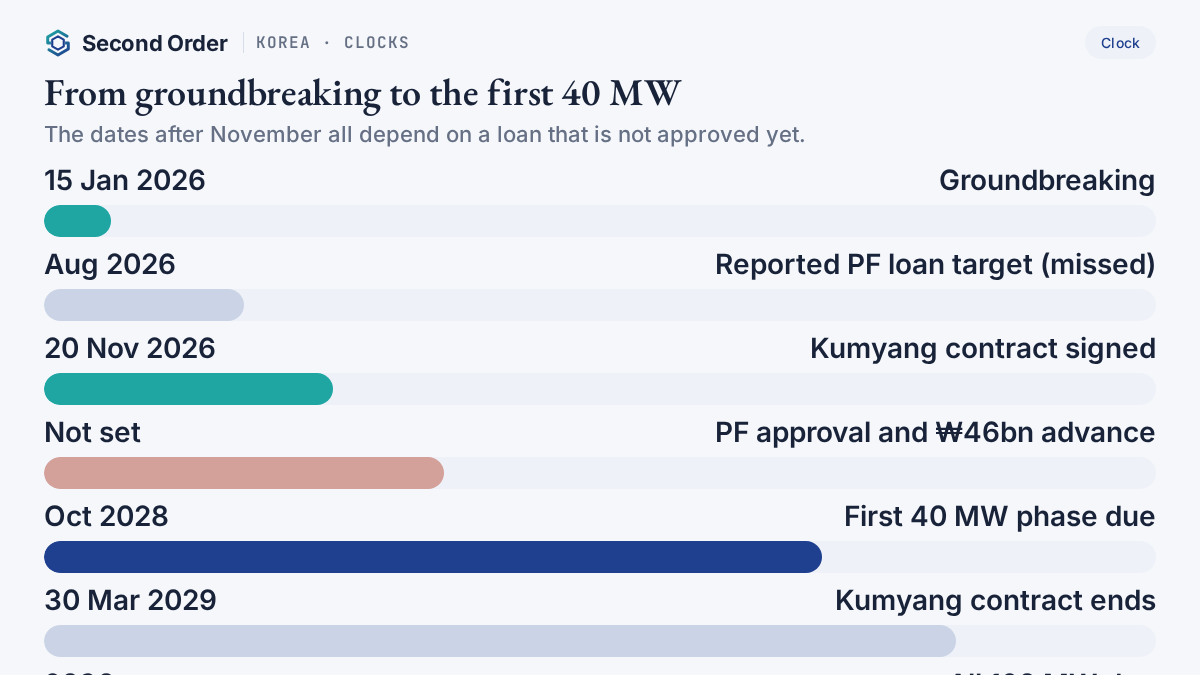
- 15 January 2026 — groundbreaking ceremony in Wonju.
- March 2026 — earthworks start on site.
- June 2026 — end of the bridge-loan window the audit report described for early contractor payments.
- August 2026 — the reported target for the roughly ₩1.6 trillion PF loan. Missed, going by the 20 November filing.
- 20 November 2026 — Kumyang contract signed; work start date.
- Not dated — PF approval, and with it the ₩46 billion advance.
- By the end of March 2027 — Kumyang’s 2026 annual report, which should show whether any advance arrived by year end.
- October 2028 — first 40 MW phase due (as reported in October 2026).
- July 2028 — Hanwha Changwon partial start, for comparison.
- 30 March 2029 — Kumyang contract end date.
- 2030 — all 120 MW due.
Kumyang Green Power DART filing, 20 Nov 2026; Korea Financial Newspaper and Newsfarm, 23 Nov 2026; Yonhap, 15 Jan 2026; Wonju MBC, 12 Oct 2026; Korea Herald, 24 Nov 2026. Plans, not facts.
How does this fit the rest of our notes?
Korea’s AI data centre story has moved through gates in order. First the grid: in October, 279 of 522 power requests were told there was no supply (the grid queue), and even chip fabs wait years for big power lines (fast-track paperwork, slow power lines). Then the gear: Korean transformer and switchgear makers sold their slots years ahead to US buyers (power gear booked ahead). Then the tenants: in November, plans far outran signed customers (tenants first). Wonju adds the next gate: the loan.
If you are new to how a hall makes money, start with the AI factory, explained. All our Korea notes are on Korea Markets.
How we check this. The contract value, dates and payment terms come from Kumyang Green Power’s own DART filing of 20 November 2026. Mega Data Korea’s 2025 accounts and its auditor’s note come from Korean financial press that read its audit report; the roughly ₩1.6 trillion loan target is as reported there, not from a lender. The project size, cost and timetable come from the Wonju groundbreaking reports and a local broadcaster. Hanwha’s plan is from its own briefing as reported. Every split, per-MW figure, month count and dollar conversion is labelled “our arithmetic”. The references we used are listed at the end. Our editorial standards →
FAQ
What did Kumyang Green Power sign on 20 November?
A ₩230 billion contract, before VAT, to do the electrical and telecom work for the Wonju Mega Cluster AI data centre in Gangwon Province. The client is Mega Data Korea, the developer. The job runs from 20 November 2026 to 30 March 2029. It is worth 86.87% of Kumyang’s 2025 revenue.
Why is the advance payment on hold?
The filing says the 20% advance, ₩46 billion, will be paid after the client’s project-finance loan is approved. Project finance is a big bank loan secured on the project itself. Until that loan is approved, the advance does not move.
Who is Mega Data Korea?
A Wonju data centre developer set up in 2021. Its audited 2025 accounts showed no revenue, an operating loss of ₩3.8 billion and about ₩20 million of cash at year end. Its auditor raised a doubt about whether it can keep going as a business. Its biggest asset is land, which is pledged to lenders.
How big is the Wonju data centre?
The plan is 99 MW, up to 120 MW, in three 40 MW halls, for about ₩1.4 trillion in total. The first 40 MW phase was due by October 2028, with all 120 MW by 2030. No tenant has been named in the filings or releases we read.
How is Hanwha’s Changwon plan different?
Hanwha Aerospace said on 24 November it will build a 180 MW defence AI data centre in Changwon, with ₩10 trillion set aside for the first phase and part of it online in July 2028. A big group is paying from its own plan, and the military is the intended user. Wonju is a small developer that needs a bank loan first.
Is this investment advice?
No. Education only. It maps who gets paid and which step is stuck. It is not a recommendation to buy or sell any security, and we leave out price targets and ratings on purpose.
References
Outbound links below are nofollow. We list only the sources actually used. Internal sotkn.com links in the body are separate.
- Kumyang Green Power Co., Ltd. (KOSDAQ: 282720), Single sales and supply contract (Wonju Mega Cluster AI data centre electrical and telecom works), DART filing, 20 Nov 2026. dart.fss.or.kr — the ₩230 billion contract value, 86.87% of 2025 revenue, the 20 Nov 2026 to 30 Mar 2029 term, the 20/75/5 payment split, the advance paid only after the client’s PF approval, and the note that design changes can change the price.
- Korea Financial Newspaper (fntimes), [THE COMPASS] Kumyang Green Power wins ₩230bn job; client faces going-concern doubt, 23 Nov 2026. fntimes.com — Mega Data Korea’s 2025 accounts (no revenue, losses, cash, current assets and liabilities, land revaluation, pledged land), the auditor’s going-concern doubt, the bridge-loan plan, Kumyang’s equity and backlog, and the 65% advance terms on its earlier wind jobs.
- Newsfarm, Kumyang Green Power (282720): an electrical contractor wins a data centre job the size of its revenue, 23 Nov 2026 (updated 24 Nov). newsfarm101.co.kr — the limit-up close of ₩9,620 on 23 November, the roughly ₩1.6 trillion PF loan Mega Data Korea’s audit report targeted for August 2026, and Kumyang’s nine-month results, cash flow, contract assets, borrowings and guarantees.
- Investing.com, Kumyang Green Power shares jump 9% to six-month high on AI data center contract, 24 Nov 2026. uk.investing.com — the move to ₩10,490 on 24 November and the 30% rise the day before.
- Yonhap News Agency, Wonju’s first data centre gets under way (groundbreaking report), 15 Jan 2026. yna.co.kr — the 15 January groundbreaking, 99 MW (up to 120 MW), three 40 MW halls, the ₩1.4 trillion total cost and the 2028 completion goal.
- Wonju MBC (via Chuncheon MBC), From warehouse to factory: AI data centre plans surge, 12 Oct 2026. chmbc.co.kr — site works since March 2026, the 40 MW first phase due October 2028, 120 MW by 2030, and 99 MW of power contracted with a further 21 MW being sought from KEPCO.
- The Korea Herald, Hanwha to establish defense AI data center in Changwon, 24 Nov 2026. koreaherald.com — Hanwha Aerospace’s 180 MW Changwon plan, the ₩10 trillion (US$7.5 billion) first phase, the July 2028 partial start and the operating model under study.
- Ministry of Science and ICT and Ministry of Climate, Energy and Environment, press release on grid impact assessment changes for AI data centres, 23 Nov 2026. modu.go.kr — the 50 MW exemption outside the capital region, the simplified review inside AI data centre zones and the fast track for mega-projects.
- The Asia Business Daily, Trump mentions data center tax bomb; Korea must prepare for risks, 24 Nov 2026. view.asiae.co.kr — the 20 November remark on taxing US firms that build AI data centres abroad and what it could mean for Korean developers.
Not investment advice. Do your own research. Education only. Map of who gets paid and which step is stuck — not a buy list.
More on this desk: Korea Markets · AI Data Centers · all Markets.