Retail vs Wholesale Colocation: What Is the Difference, and Who Gets Paid?
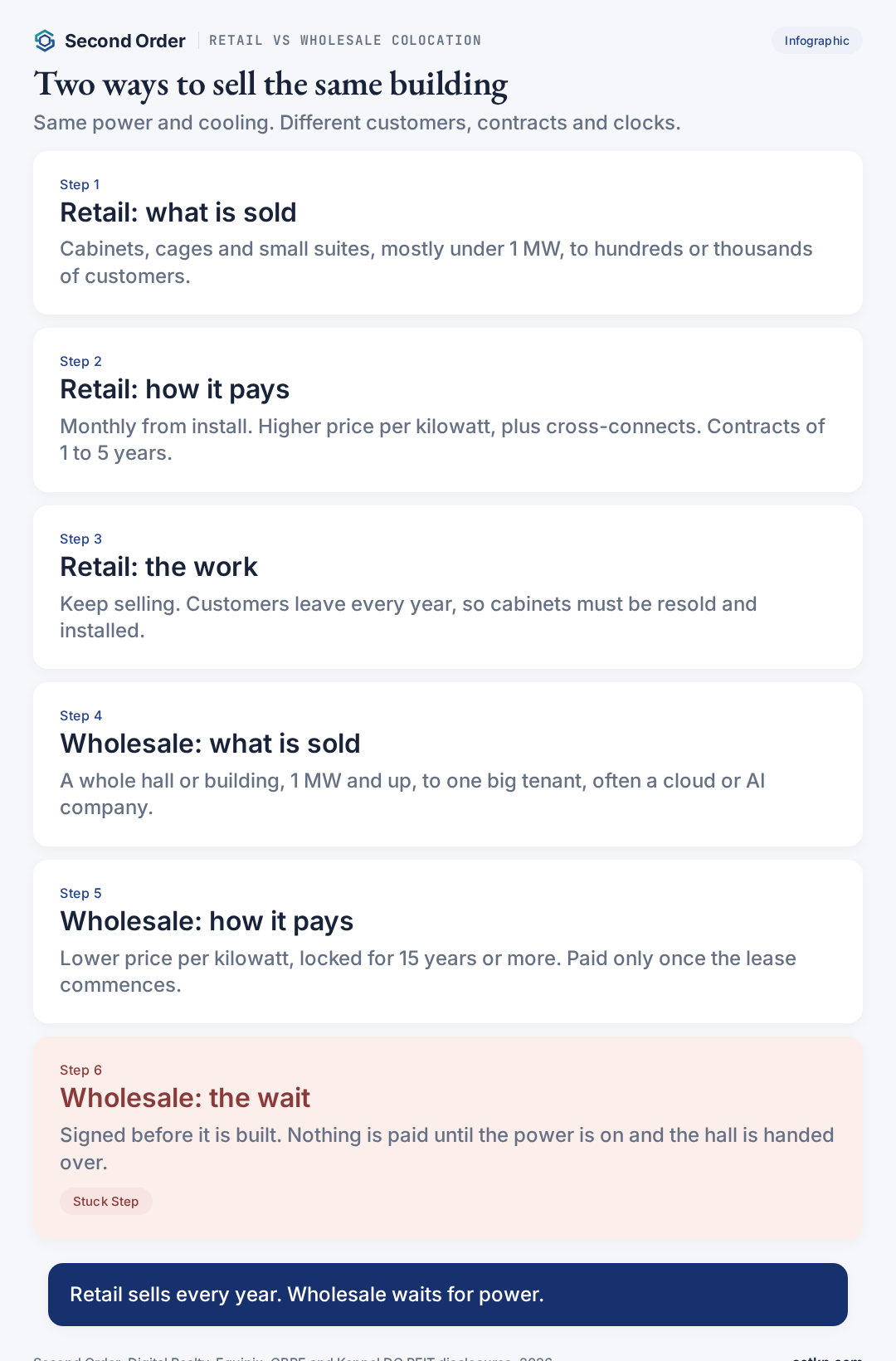
Retail colocation sells cabinets and cages to many customers on short contracts. Wholesale leases a whole hall, a megawatt or more, to one big tenant for a decade or longer. Retail earns more per kilowatt; wholesale locks in more years, but only pays once the power is ready.
EXPLAINED · Versus · Last reviewed: 24 Nov 2026 · Next review: when Digital Realty and Equinix report their fourth-quarter 2026 results (early 2027)
Retail colocation rents space by the cabinet or cage, usually under one megawatt, to many customers on contracts of a few years; wholesale colocation leases a whole hall or building, a megawatt or more, to one large tenant on a lease that can run 15 years or longer.
In short. What is the difference between retail and wholesale colocation? Retail sells cabinets and cages to many customers on contracts of one to five years. Wholesale leases a whole hall, a megawatt or more, to one big tenant for 15 years or more. Retail earns more per kilowatt: at Digital Realty, existing contracts under one megawatt bring in about US$323 per kilowatt per month against about US$137 over one megawatt, by our arithmetic. Wholesale locks in more years: new leases over one megawatt averaged 17.9 years in the third quarter of 2026, against 5.5 years under one megawatt. Our read: retail’s stuck step is selling and installing every year; wholesale’s is ready power, because a signed lease pays nothing until the hall is handed over.
Why an investor cares: the same building can be sold two ways, and each way pays on a different clock. This page sits in our AI Data Centers layer. It builds on our colocation explained page, which covers how a shared data centre works, and sits beside our hyperscale vs colocation page, which compares owning a building with renting space in one.
What is the difference between retail and wholesale colocation?
Think of a shopping mall. A retail colocation provider is like a mall that rents out small shops. It has hundreds or thousands of tenants, each taking a few cabinets or a locked cage. It runs everything: power, cooling, security, and the network links between tenants.
A wholesale colocation provider is like a landlord that leases a whole department store to one big name. The tenant takes a full hall or building, a megawatt or more, and often runs the inside itself. The landlord provides the shell, the power and the cooling plant.
Three things change between the two: how big each deal is, how long it lasts, and how much is paid for each kilowatt of power. Most of the money questions follow from those three.
| Retail colocation | Wholesale colocation | |
|---|---|---|
| What is sold | Cabinets, cages, small suites | A whole hall or building |
| Typical size | Under 1 MW | 1 MW and up, often tens of MW |
| Typical customer | Banks, networks, software firms, enterprises; many per building | Cloud and AI companies; one or a few per building |
| Contract length | 1 to 5 years, then often yearly renewals | 10 to 20 years; 17.9 years on Digital Realty’s new Q3 2026 leases |
| Price per kilowatt | Higher: about US$323 a month on Digital Realty’s existing book | Lower: about US$137 a month on the existing book |
| Extra income | Cross-connects and network services | Little; the tenant runs its own network |
| Who runs the space | The landlord, fully fitted | Often the tenant, inside a powered shell or fitted hall |
| When cash starts | Soon after the cabinet is installed | When the lease commences, often a year or more after signing |
| Main risk | Customers leave; constant reselling | A few tenants; building and power must arrive on time |
Figures are Digital Realty’s 3Q26 financial supplement (29 Oct 2026), with per-kilowatt prices our arithmetic. Under 1 MW stands in for retail and over 1 MW for wholesale. The rest is Second Order’s summary of how the two models work.
What is retail colocation?
Retail colocation sells data centre space in small pieces. A customer might take one cabinet, a row of cabinets, or a cage with its own locked door. It brings its own servers. The landlord supplies everything around them.
The customers are a long list of smaller names: banks and trading firms, network companies, software firms, and enterprises running part of their own computing. Many choose a building because of who else is inside it. A cable to a cloud provider or a network in the same building is fast and cheap. Our carrier-neutral data center page covers why that matters.
Equinix is the best-known name in retail colocation. In the third quarter of 2026 it made US$2,571 million of revenue. Colocation, meaning space and power, was US$1,826 million, about 71% of it, by our arithmetic. Interconnection, mostly the cables that link one customer to another, was US$465 million, about 19% of recurring revenue.
Retail contracts are short. Equinix says in its 10-Q that most of its contracts start with a term of one to five years, then renew automatically one year at a time.
What is wholesale colocation?
Wholesale colocation sells capacity in big blocks. The usual dividing line is about one megawatt. That is enough for roughly 150 to 200 racks of ordinary servers at 5 to 7 kilowatts each, by our arithmetic, but far fewer of the newest AI racks. Above that, the deal is a lease on a hall or a whole building.
The tenants are mostly the largest cloud and AI companies. They need many megawatts in one place, quickly, and they do not want to build every site themselves. So they sign long leases with landlords who will. Our data center lease explained page covers how those leases are written.
Wholesale tenants often fit out and run the hall themselves. Some take a powered shell: a finished building with power and cooling plant, but no servers or racks. Others take a fully fitted hall. Either way, the landlord has one customer for that space, not hundreds.
Even Equinix, the retail leader, runs a wholesale arm, called xScale, through joint ventures. Its 10-Q shows most of those stakes at 20%, which means partners own most of those big halls. That split tells you how different the two businesses are: the retail model wants control, while the wholesale model wants cheap, patient capital.
Retail vs wholesale colocation: price per kilowatt
Data centre space is priced per kilowatt of power, per month, not per square metre. Power is the scarce thing, so that is what the customer pays for.
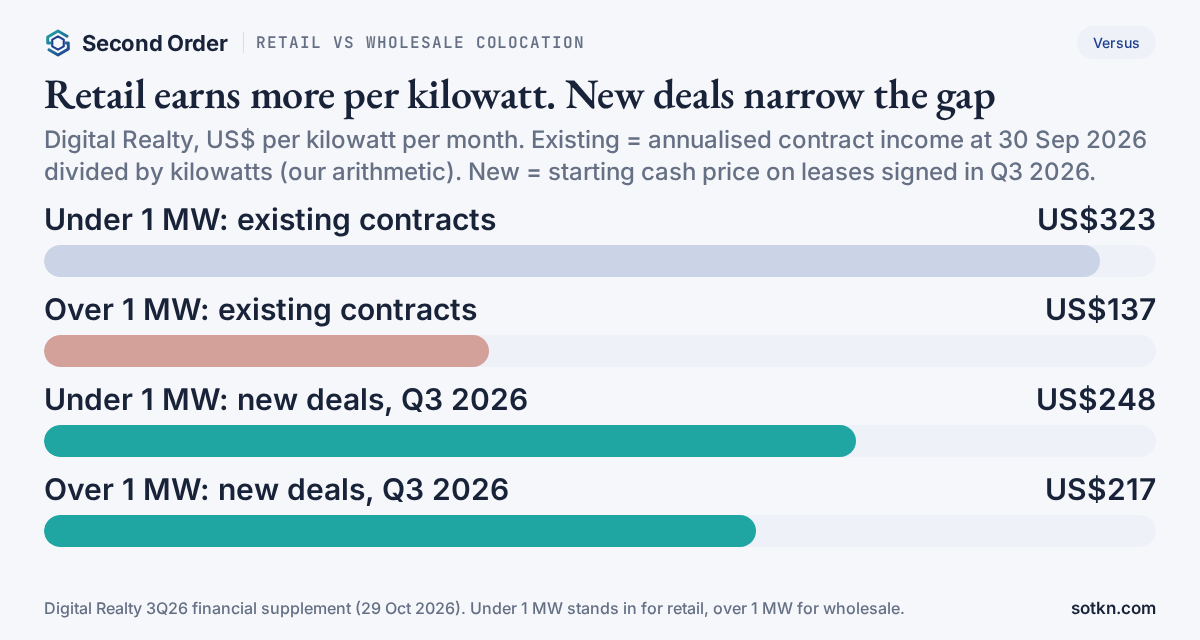
Retail costs more per kilowatt. Digital Realty, which sells both, splits its numbers into contracts under one megawatt and over one megawatt. At 30 September 2026, its existing contracts under one megawatt brought in about US$1.67 billion a year on 431 megawatts of capacity. That is about US$323 per kilowatt per month, by our arithmetic. Contracts over one megawatt brought in about US$3.10 billion a year on 1,885 megawatts, about US$137 per kilowatt per month.
So retail earns about 2.4 times as much per kilowatt on the existing book, by our arithmetic. Smaller contracts were only about 19% of Digital Realty’s leased kilowatts, but about a third of its contract income.
Why the gap? A retail customer pays for service as well as power. The landlord fits out the space, runs it, and sells it in small lots, which costs more per kilowatt. The retail customer also pays for being inside a busy building, close to the networks and clouds it wants to reach.
Why is the price gap closing on new deals?
Look at new deals rather than the old book, and the picture changes. In the third quarter of 2026, Digital Realty’s new leases under one megawatt started at US$248 per kilowatt per month in cash. New leases over one megawatt started at US$217. Retail was still higher, but only by about 14%, by our arithmetic, not 2.4 times.
The old wholesale book was signed years ago, when power was easier to find and big tenants could push prices down. Today the main markets are almost full. CBRE says vacancy in the primary North American markets fell to a record low of 1.4% in the first half of 2026. Big tenants now compete for the few blocks of power that are ready.
Renewals show it most clearly. When Digital Realty renewed contracts over one megawatt in the third quarter, the cash price rose 26.3%, from US$125 to US$158 per kilowatt per month. Contracts under one megawatt renewed 4.7% higher, from US$301 to US$315.
CBRE saw the same pattern across deal sizes. Average asking prices in the primary markets rose 8.3% in the first half of 2026 for deals of 3 to 10 megawatts, 7.9% for 500 kilowatts to 3 megawatts, 6.7% for 10 megawatts and up, and 4.3% for 250 to 500 kilowatts.
One more detail matters. Digital Realty’s average price across the whole lease, its GAAP figure, was US$275 for new wholesale leases, higher than US$262 for retail. That is because long wholesale leases build in yearly price rises. Spread over 17.9 years, those rises lift the average above the starting price, by about 27% for wholesale against about 6% for retail, by our arithmetic.
| Digital Realty, quarter to 30 Sep 2026 | Under 1 MW | Over 1 MW |
|---|---|---|
| New capacity leased | 41.2 MW | 143.6 MW |
| New annual contract income | US$129.6m | US$474.2m |
| Starting cash price, per kW per month | US$248 | US$217 |
| Average price over the lease, per kW per month | US$262 | US$275 |
| Average new lease term | 5.5 years | 17.9 years |
| Cost to win the lease, per kW | US$18 | US$1 |
| Renewal term | 1.7 years | 5.5 years |
| Cash price change on renewal | +4.7% (US$301 to US$315) | +26.3% (US$125 to US$158) |
| Churn in the quarter | 1.6% | 0.0% |
Digital Realty’s share, as reported in its 3Q26 financial supplement (29 Oct 2026). “Average price over the lease” is its GAAP figure, which spreads yearly price rises across the whole term.
Retail vs wholesale colocation: contract length
This is the biggest difference. Digital Realty’s new leases over one megawatt in the third quarter averaged 17.9 years. New leases under one megawatt averaged 5.5 years. That is more than three times as long.
Renewals are shorter still. Retail renewals averaged 1.7 years, wholesale renewals 5.5 years. Retail customers tend to roll forward a year or two at a time, which matches Equinix’s one-year automatic renewals.
Short contracts cut both ways. They let a retail landlord reprice often. Equinix said on its call of 28 October 2026 that its contracts are often shorter than those in the wholesale market, so it can review them and their prices more often. But short contracts also mean customers can leave.
The lease table shows how much comes up soon. About 61% of Digital Realty’s contract income under one megawatt expires by the end of 2027 or is already month to month, by our arithmetic. Over one megawatt, it is about 12%, and about a quarter runs beyond 2035.
Who leaves, and how often?
Customers leave retail more often. Churn is the share of recurring income lost because customers ended or did not renew their contracts. Digital Realty’s churn under one megawatt was 1.6% in the third quarter, and 7.9% over the last 12 months. Over one megawatt it was 0.0% in the quarter and 1.8% over 12 months.
Equinix reported churn of 1.7% for the quarter, which it said reflected careful customer management and tight capacity. A retail landlord lives with that steady loss. It has to sell enough each quarter to replace the customers who leave, before it can grow.
That is why retail costs more to sell. Digital Realty spent about US$18 per kilowatt to win its new leases under one megawatt in the third quarter, against about US$1 per kilowatt for leases over one megawatt. Selling to many small customers needs a sales team and a lot of small installs. Selling to one cloud company needs a few big negotiations.
Which is riskier?
Neither is safe. They carry different risks.
Retail spreads risk across many customers. If one leaves, the building barely notices. The risk is slow: if demand weakens, the landlord feels it each year as contracts come up and fewer customers renew. Wholesale concentrates risk in a few tenants. If one big tenant walks away or delays, a whole hall can sit empty or unpaid. Our customer concentration explained page covers how to read that.
Keppel DC REIT, a Singapore-listed data centre trust, shows the pattern. Its largest client, a hyperscaler, made up 43.4% of its rental income at 30 September 2026, by its own disclosure.
Wholesale has one more risk: it is often signed before the building exists. The landlord spends years and billions building it. If the power is late, the lease is late. Our leases not yet commenced page covers how those signed-but-not-started leases show up in the accounts.
When does each one start paying?
Retail pays soon. Once a cabinet is installed and powered, the customer starts paying every month. The wait is usually weeks, not years. The landlord still needs the space built and ready to sell, so it builds ahead of demand in small steps.
Equinix said it expects to deliver more than 13,000 cabinets in the fourth quarter of 2026, its biggest quarter on record, with more than 20% of that capacity already sold. It said 15% of the retail capacity due in 2027 was pre-sold too.
Wholesale pays late. A wholesale lease is often signed a year or more before the hall is ready. CBRE says 80.4% of the 7,481.1 megawatts under construction in the primary North American markets in the first half of 2026 was already pre-leased. Less than 1,500 megawatts of future capacity was still available, about six months of demand at the current pace.
Pre-leased is not paid. The landlord collects nothing until the hall is handed over and the lease commences. Our how long it takes to build an AI data center page covers that clock, and our contracted power explained page covers the power promise behind it.
Retail and wholesale colocation in Singapore
Singapore is a good place to see the two models side by side, because land and power are tight and the main operators sell both.
Keppel DC REIT reports its contracts by type. At 30 September 2026, fully fitted colocation, halls it fits out and runs for clients, made up 74.4% of its rental income, with an average of 2.8 years left on those contracts. Fully fitted space for a single tenant made 20.6%, with 8.9 years left. Shell and core space, where the tenant fits out the inside, made 5.0%, with 6.5 years left.
So single-tenant contracts had about three times as long to run as its colocation contracts, by our arithmetic. Keppel DC REIT said its income weighted by rent has a shorter life than by area because more of its income comes from colocation, which typically has shorter contracts. Its labels are its own, not the same as Digital Realty’s size split, but the pattern matches.
Keppel DC REIT said prices on renewed and new contracts in the first nine months of 2026 were about 14% above the contracts they replaced. Our Markets note on Keppel DC REIT’s third quarter covers that update, and our note on Equinix SG6 covers a new retail building in Singapore.
Who gets paid?
- Retail landlords, every month, from many customers. They earn a higher price per kilowatt and extra income from cross-connects. They pay for it with sales costs and churn.
- Wholesale landlords, later and for longer. They are paid once a lease commences, then for 15 years or more. They carry the building cost and the wait.
- Builders and power equipment makers, first. Wholesale halls are often pre-leased, so builders and suppliers of switchgear, generators and cooling are paid while the landlord is still waiting for its first payment.
- Network companies, inside retail buildings. Retail buildings are meeting places for networks. Network companies sell to customers who come for the connections.
- Capital partners, in wholesale. Big wholesale halls need patient money. Joint venture partners and lenders fund much of the build and are paid over the long lease.
Where is the stuck step?
Our read: it is different for each.
For wholesale, the stuck step is ready power. The tenant has signed. The money is promised. But nothing is paid until the substation, the switchgear and the hall are finished and the lease commences. With 80.4% of North American capacity under construction pre-leased, the wait is not for customers. It is for power.
For retail, the stuck step is selling and installing, every year, in buildings that are full. Retail buildings sit in busy city areas where new power is hard to add. The landlord has to resell what customers leave and squeeze more power into each cabinet, while finding room to grow.
Our stuck-step map shows how the slow step moves along the AI chain, and our Keppel DC REIT stuck-step analysis looks at one landlord’s version of it.
The clocks
- Early 2027. Digital Realty and Equinix report their fourth-quarter 2026 results. Watch the cash price change on renewals over one megawatt and churn under one megawatt.
- Early 2027. Keppel DC REIT reports its full-year 2026 results, with an update on contract length by type.
- Early 2027. CBRE publishes its second-half 2026 North America report. Watch vacancy and the share of new capacity pre-leased.
- During 2027. About 14.6% of Digital Realty’s total contract income sits in contracts under one megawatt that expire in 2027, a big test of retail renewal prices.
- 2028. Keppel DC REIT’s colocation contracts making up 14.4% of its rental income expire, rising to 27.1% in 2029.
What would change the view?
- Power gets easier. If new power arrives faster and vacancy rises, wholesale renewal prices would stop jumping and the price gap with retail could widen again.
- AI tenants slow down. If big tenants delay or cancel halls they signed for, wholesale’s long leases matter less than whether they start on time.
- Retail churn rises. If more small customers move to the cloud or leave when contracts end, retail’s higher price per kilowatt would be harder to hold.
- AI comes to retail. If more AI inference moves into retail buildings near users, retail would need far more power per cabinet, and its stuck step would look more like wholesale’s.
Common misconceptions
- People assume wholesale is always cheaper. Actually, on the existing book it is, but on new deals the gap is small. Digital Realty’s new wholesale leases started at US$217 per kilowatt per month against US$248 for retail in the third quarter of 2026.
- People assume a signed wholesale lease is income. Actually, it pays nothing until it commences, often a year or more later, once the power is on.
- People assume retail is risky because contracts are short. Actually, short contracts spread across many customers can be steadier than one big lease. The risk is the steady work of reselling.
- People assume retail and wholesale are different buildings. Actually, many landlords sell both, sometimes on the same campus. The difference is the contract, not the building.
FAQ
What is the difference between retail and wholesale colocation?
Size, term and who the customer is. Retail colocation sells cabinets, cages or small suites, usually under one megawatt, to many customers on contracts of one to five years. Wholesale colocation leases a whole hall or building, a megawatt or more, to one big tenant, often a cloud company, on a lease that can run 15 years or longer.
What is retail colocation?
Retail colocation is when a data centre owner sells space and power in small pieces, such as a few cabinets or a locked cage, inside a shared building. The owner runs the building, cooling, security and power. The customer brings its own servers and usually buys network connections to other customers in the same building.
What is wholesale colocation?
Wholesale colocation is when a tenant leases a large block of capacity, from about one megawatt up to a whole building, and often fits out and runs much of it itself. The landlord provides the shell, power and cooling plant. Most wholesale tenants today are cloud and AI companies.
Is retail colocation more expensive than wholesale?
Per kilowatt, usually yes. Digital Realty’s existing contracts under one megawatt bring in about US$323 per kilowatt per month, against about US$137 for contracts over one megawatt, by our arithmetic from its 30 September 2026 lease table. On new deals the gap is much smaller now that power is scarce: US$248 against US$217 in the third quarter of 2026.
How long are retail and wholesale colocation contracts?
Retail contracts are short. Equinix says most of its contracts start at one to five years and then renew a year at a time. Wholesale leases are long. Digital Realty’s new leases over one megawatt in the third quarter of 2026 averaged 17.9 years, against 5.5 years for leases under one megawatt.
Which is riskier for the landlord?
They carry different risks. Retail has many small customers who can leave each year, so the landlord must keep selling, but no single customer can sink it. Wholesale locks in many years of income from a few tenants, but the landlord must build first and depends heavily on those few names.
Who buys wholesale colocation?
Mostly the largest cloud and AI companies, which need many megawatts in one place quickly and prefer not to build every site themselves. Keppel DC REIT, for example, says its largest client is a hyperscaler that makes up 43.4% of its rental income.
When does a wholesale lease start paying?
When the hall is delivered and the lease commences, not when it is signed. Many wholesale leases are signed while the building is still going up. CBRE says 80.4% of the capacity under construction in the main North American markets was already pre-leased in the first half of 2026. The landlord is paid only once the power is on and the tenant moves in.
Related: colocation explained; hyperscale vs colocation; carrier-neutral data center; finance lease vs operating lease; data center tiers explained.
Stack doors
Layer: AI Data Centers. Players: Equinix, Digital Realty, Keppel DC REIT, Digital Core REIT. Markets: Digital Realty’s third quarter; Equinix’s third quarter.
Get the Wire — short daily notes on where AI computing gets built and who pays for it.
Not investment advice. Do your own research.
How we check this
The industry has no single legal line between retail and wholesale colocation. We use Digital Realty’s own split, leases under one megawatt and over one megawatt, because it is the clearest public data that puts both models side by side in one company. All Digital Realty figures come from its third-quarter 2026 earnings release and financial supplement, filed with the SEC on 29 October 2026; prices per kilowatt for its existing contracts are our arithmetic from its lease expiry table. Equinix figures come from its third-quarter 2026 release and 10-Q of 28 October 2026, and its call remarks are quoted from the Investing.com transcript. Market figures come from CBRE’s North America Data Center Trends H1 2026 report of 27 August 2026. Singapore-listed Keppel DC REIT figures come from its 3Q 2026 operational update of 23 October 2026; its contract labels are its own and are not the same as Digital Realty’s size split. We do not quote asking prices for any single market or a Singapore price per kilowatt, because no source we could check gives one. Percentages, ratios and per-kilowatt prices are our arithmetic, checked in code. Who gets paid and the stuck step are our read. The featured image is a CC BY 4.0 photograph of a data centre campus, graded by us; it is illustrative and is not tied to any company named here. This page explains how two ways of selling data centre space work. It does not rate any company as an investment or give buy or sell calls. Not investment advice. Do your own research.
Last reviewed: 24 Nov 2026 · Next review: when Digital Realty and Equinix report their fourth-quarter 2026 results (early 2027)
Spot an error? Tell us and we will correct it and note the change here.
References
- Digital Realty — Third quarter 2026 earnings release and financial supplement, Form 8-K Exhibit 99.1 (29 Oct 2026) — Leases signed and renewed by size (0–1 MW and over 1 MW): price per kilowatt, lease term, leasing cost, renewal price change, churn; lease expirations by size at 30 Sep 2026
- Equinix — Third quarter 2026 results, press release (28 Oct 2026) — Revenue US$2,571m; colocation US$1,826m; interconnection US$465m; nearly 40% more cabinets planned for delivery in 2026
- Equinix — Form 10-Q for the quarter ended 30 Sep 2026 (filed 28 Oct 2026) — Most contracts have an initial term of one to five years, then renew in one-year steps; xScale joint ventures, mostly 20% stakes
- Equinix — Third quarter 2026 earnings call, transcript via Investing.com (28 Oct 2026) — Churn 1.7%; more than 13,000 cabinets due in Q4, over 20% pre-sold; 15% of 2027 retail capacity pre-sold; shorter contracts than wholesale
- CBRE — North America Data Center Trends H1 2026 (27 Aug 2026) — Primary-market vacancy 1.4%; asking-price rises by deal size; 80.4% of 7,481.1 MW under construction pre-leased; under 1,500 MW left, about six months of demand
- Keppel DC REIT — 3Q 2026 operational updates (23 Oct 2026) — Contract mix at 30 Sep 2026: fully fitted colocation 74.4% of rental income, WALE 2.8 years; fully fitted single tenant 20.6%, WALE 8.9 years; shell and core 5.0%, 6.5 years