Who Are the Colocation Providers? Five Kinds of Data Center Landlord, and Who Gets Paid
Colocation providers own data centers and lease space, power and connections to other firms. There are five kinds, from interconnection hubs to listed REITs. All are paid the same way: only once the power is on and the lease starts.
EXPLAINED · Players · Last reviewed: 27 Nov 2026 · Next review: after Equinix, Digital Realty and Iron Mountain report the fourth quarter of 2026, or when NEXTDC reports its half year in February 2027
A colocation provider is a company that owns or runs data centers and leases space, power, cooling and network connections inside them to other companies, which bring and run their own computers.
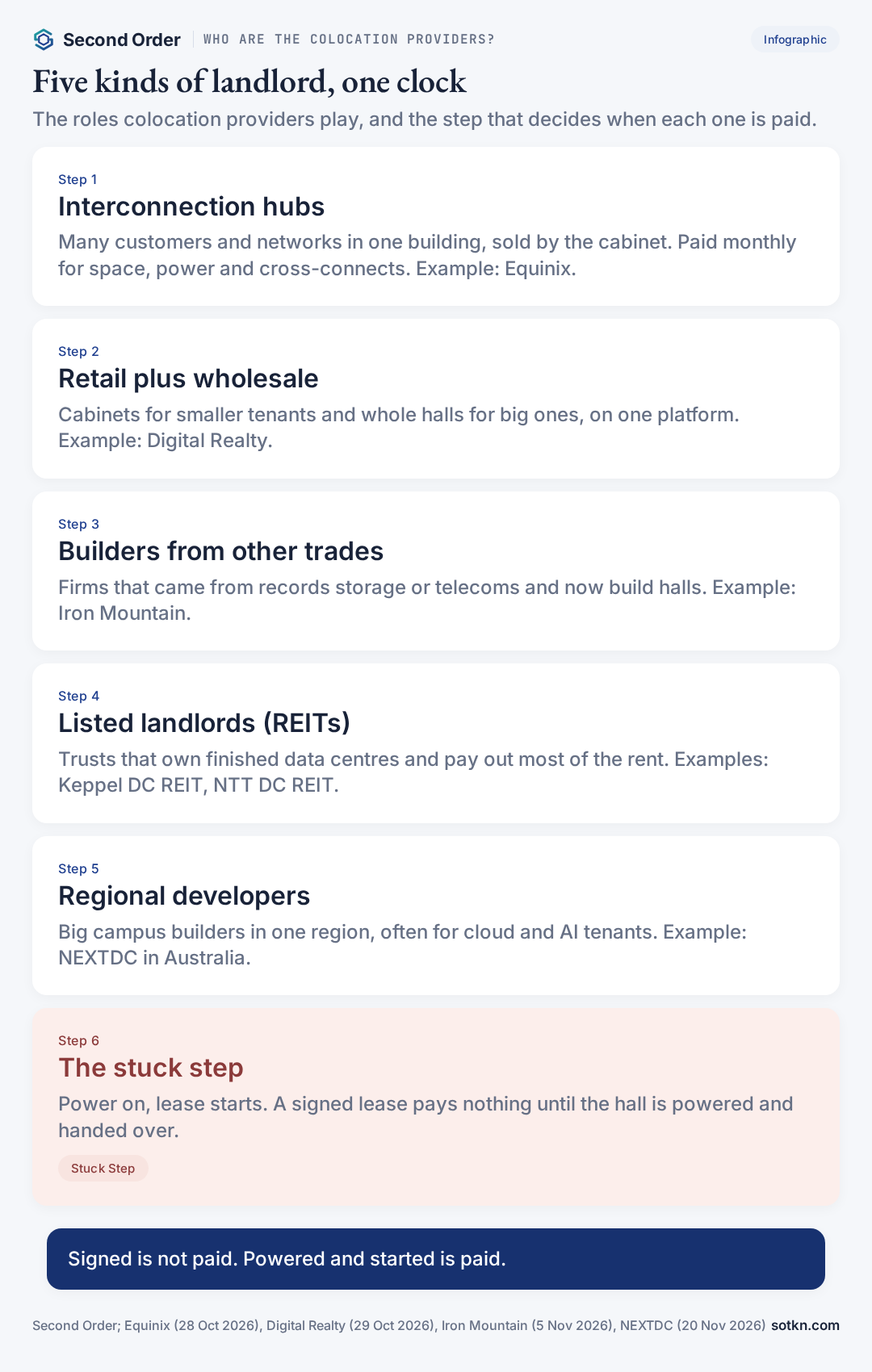
In short. Who are the colocation providers? They are the landlords of the internet: companies that own data centers and lease space, power and network links inside them to other firms. They come in five kinds: interconnection hubs such as Equinix, mixed retail and wholesale platforms such as Digital Realty, builders from other trades such as Iron Mountain, listed landlords such as Singapore’s Keppel DC REIT and NTT DC REIT, and regional campus developers such as NEXTDC. All five are paid the same way, by the month, once a lease has started. Our read: the stuck step is power. A lease is signed long before it pays. Digital Realty’s new leases in the third quarter of 2026 had a 17-month average wait from signing to start, and NEXTDC kept about A$140 million out of its FY27 guidance because power to one site was late.
Why an investor cares: colocation providers sit between the companies that buy AI chips and the power grid. When a cloud firm or a bank wants servers running in a city, it often rents the building from one of them. This page sits in our AI Data Centers layer. Our colocation explained page covers how the product works. This page covers who sells it, and how each kind of seller gets paid.
What is a colocation provider?
Think of a colocation provider as a landlord for computers. It owns or runs the building. It brings in power from the grid, puts in backup generators and batteries, cools the rooms, guards the doors and runs the rooms where network cables meet. Then it leases all of that to other companies.
The tenants bring their own servers, storage and network gear. They pay each month for the space, the power they use and the cables that link them to other companies. The provider does not own the tenant’s computers and does not run its software. That is the main line between a colocation provider and a cloud provider.
Colocation comes in two main sizes. Retail colocation sells a single cabinet, a few cabinets or a locked cage to many smaller customers. Wholesale colocation leases a whole hall, or a whole building, to one large tenant. Our retail vs wholesale colocation page explains the gap in price, term and risk. Many providers sell both.
One more term matters for this page: carrier-neutral. A carrier-neutral data center lets many network companies bring their cables in, so tenants can pick and mix. Most of the providers below run carrier-neutral sites. Our carrier-neutral data center explained page covers why that draws customers.
The five kinds of colocation provider
There is no single type of colocation provider. They differ in what they sell, who they sell to and how long their leases run. We sort them into five roles. A company can play more than one.
| Kind of provider | What it sells | Typical customer | Example and latest dated fact |
|---|---|---|---|
| Interconnection hub | Cabinets and cages in busy buildings, plus cross-connects between customers | Banks, networks, cloud on-ramps, enterprises | Equinix: colocation US$1,826m and interconnection US$465m of US$2,571m revenue, Q3 2026 |
| Retail plus wholesale platform | Cabinets for small tenants and whole halls for large ones | Enterprises and hyperscale cloud firms | Digital Realty: record US$627m of bookings at its share, Q3 2026 |
| Builder from another trade | Wholesale halls, plus some enterprise space | Hyperscale cloud firms | Iron Mountain: 102.5 MW signed, 544.6 MW in operation, 30 Sep 2026 |
| Listed landlord (REIT) | Finished, mostly full data centres; most rent paid out to unitholders | Colocation operators, cloud firms, sponsors | Keppel DC REIT: 27 data centres, 93.0% occupied; NTT DC REIT: 97.5% occupied, 30 Sep 2026 |
| Regional campus developer | Large campuses in one region, retail and wholesale | Cloud and AI tenants, governments, enterprises | NEXTDC: forward order book about 565 MW, 20 Nov 2026 |
This is a map of roles, not a ranking or a full list. Many large builders, such as AirTrunk, Vantage, QTS and STT GDC, are private and do not publish quarterly figures we can date and check, so we name them without numbers.
Each role has its own trade-off. Retail sellers get higher prices per kilowatt but shorter contracts. Wholesale sellers get long leases but fewer, larger tenants who drive hard bargains. Listed landlords get steady rent but must keep buying or building to grow. The rest of this page walks through each role with the latest dated numbers we can check.
Interconnection hubs: Equinix
Equinix is the clearest example of a retail colocation provider built around interconnection. Its pitch is not just space. It is that many networks, cloud on-ramps and companies already sit in the same building, so a new tenant can link to all of them with a short cable.
In the third quarter of 2026 Equinix reported revenue of US$2,571 million, up 11% from a year earlier. Colocation brought in US$1,826 million, or 71.0% of revenue, by our arithmetic. Interconnection brought in US$465 million, or about 19% of recurring revenue. Colocation revenue grew 11.5% from a year earlier, by our arithmetic.
The contracts are short and they renew. Equinix says in its filing for the quarter that most of its contracts run for one to five years at first and then renew automatically, one year at a time. More than 90% of its revenue has been recurring over the past three years. That is the retail model: many tenants, monthly bills, and a fight every year to keep customers from leaving.
Demand is not the issue right now. Equinix reported record annualized gross bookings of US$533 million in the quarter, up 35%, and added 6,900 net interconnections. It said it now plans nearly 40% more cabinets for delivery in 2026 than it first expected. Its cabinet utilization was about 78% at 30 September 2026, the same as a year earlier, so new space is filling about as fast as it is built.
Equinix also has a wholesale side, called xScale, built through joint ventures, and in the quarter it completed an investment in the Nordic operator atNorth with CPP Investments. Our Equinix Stack page covers the full model, and our Markets note on Equinix’s third-quarter cabinets follows the build clock.
Retail and wholesale under one roof: Digital Realty
Digital Realty sells both sizes and reports them side by side, split at one megawatt. Deals of up to one megawatt are close to retail. Deals above one megawatt are wholesale, usually for cloud and AI tenants.
In the third quarter of 2026 Digital Realty signed record bookings. At 100% share, counting partners in its joint ventures, new leases are expected to bring in US$855 million of annual rent. At Digital Realty’s own share the figure was US$627 million. Of that, US$130 million came from deals of up to one megawatt and US$22 million from interconnection.
Asia Pacific was the largest region. New leases there came to US$283.4 million of annual rent at Digital Realty’s share, for 79.7 megawatts. That is 45.2% of the quarter’s total, by our arithmetic, ahead of the Americas at US$242.9 million.
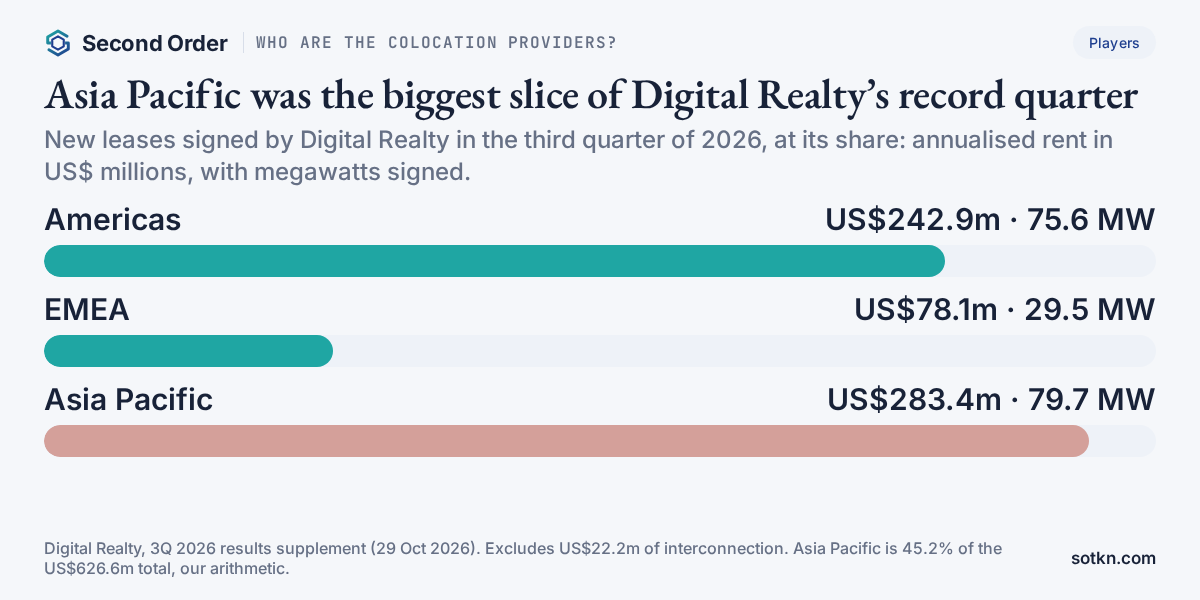
The price per kilowatt is closer than you might expect between the two sizes in this one quarter. Digital Realty reported US$262 a kilowatt a month for its small deals and US$275 for its large ones, across all regions. In Asia Pacific, the large deals came in at US$297. Our read: when power is short, big tenants pay up too, and the old retail premium narrows on new deals.
The catch is time. Digital Realty said the weighted average gap between signing a new lease in the quarter and the date the lease starts was 17 months. At 30 September 2026 it had a record US$2.5 billion of annual rent signed but not yet started, at 100% share, or US$1.8 billion at its own share.
Renewals tell the other half of the story. Digital Realty said rents on renewed leases rose 11.8% on a cash basis. Our Digital Realty Stack page covers the company, and our Markets note on Digital Realty’s signed-not-billed backlog follows that queue.
Builders from other trades: Iron Mountain
Some colocation providers started somewhere else. Iron Mountain is best known for storing paper records. It now also builds and leases data centers, mostly wholesale halls for hyperscale cloud firms. Telecom companies such as NTT took a similar path from networks into data centers.
Iron Mountain’s data center business brought in US$273.6 million in the third quarter of 2026, up 34.0% from a year earlier. That is still only 13.7% of the company’s US$1,990.6 million of revenue, by our arithmetic. But it is the fastest-growing part.
The scale of the build is the point. At 30 September 2026 Iron Mountain had 544.6 megawatts in operation, 97.2% leased. It had another 317.1 megawatts under construction and 511.9 megawatts held for future development. That is a total of 1,373.6 megawatts, about 2.5 times what is running today, by our arithmetic.
The signing pace jumped. Iron Mountain signed 102.5 megawatts of new and expansion leases in the quarter, at an average of US$127 a kilowatt a month. In the same quarter, leases for 29.2 megawatts started. So it signed about three and a half times as much as began paying, by our arithmetic.
Its project list shows the clock in plain dates. A 51.5-megawatt project in Mumbai, MUM-3, was 100% pre-leased at 30 September 2026, with US$35.6 million spent out of an expected US$319.0 million, and completion expected in the third quarter of 2028. A 32-megawatt hall in Northern Virginia, VA-8, was also fully pre-leased, with completion expected in the third quarter of 2028. Iron Mountain also runs SIN-1 in Singapore, 6.8 megawatts and fully leased.
Its leases are long. The weighted average lease expiry, or WALE, was 10.0 years. That is the wholesale trade: long, fixed rent from a few large tenants, but long waits before the rent starts. Our Iron Mountain Stack page covers the rest of the company.
Listed landlords in Singapore: Keppel DC REIT, NTT DC REIT and Digital Core REIT
A real estate investment trust, or REIT, is a listed fund that owns property and pays out most of its rent to unitholders. Singapore has become a home for data center REITs. Three are listed on the Singapore Exchange: Keppel DC REIT, NTT DC REIT and Digital Core REIT.
REITs mostly buy finished, working data centres rather than build from bare land. So they usually skip the longest wait. What they own is already powered. Their job is to keep it full, push rents up at renewal and buy more.
Keppel DC REIT is the largest by count. At 30 September 2026 it owned 27 data centres in 10 countries, worth about S$7.6 billion. Singapore was 51.9% of its assets and Japan 28.6%. Occupancy was 93.0%, and contracted power was about 96%.
Keppel’s numbers also show the gap between retail and wholesale inside one landlord. Fully fitted colocation space, where Keppel runs the hall for many tenants, made up 74.4% of rental income, with a WALE of only 2.8 years. Fully fitted single-tenant space made up 20.6%, with a WALE of 8.9 years, about 3.2 times longer, by our arithmetic. Keppel itself notes that colocation assets typically have shorter contracts.
Keppel is still buying. On 1 October 2026 it completed the purchase of an 88.62% interest in two hyperscale colocation data centres in Inzai City, Greater Tokyo, for ¥168.4 billion, about S$1,372 million. Our Markets note on Keppel DC REIT’s Tokyo data centres covers the deal, and the Keppel DC REIT Stack page covers the trust.
NTT DC REIT listed in Singapore in July 2025, sponsored by Japan’s NTT group. It owns six carrier-neutral data centres in Northern Virginia, Northern California, Vienna and Singapore, with a mix of hyperscale and colocation tenants. In the half year to 30 September 2026 its gross revenue was US$119.8 million and its net property income US$55.8 million, a margin of 46.6%, by our arithmetic.
Occupancy by IT load rose to 97.5% at 30 September 2026, from 95.9% three months earlier, after tenants expanded at two California sites. Counting leases signed but not yet started, it would be 98.1%. Rents on renewed leases rose 11.7%, helped by a 23% increase when its Singapore site, SG1, was renewed with its sponsor NTT. Its WALE was 4.0 years.
Digital Core REIT, sponsored by Digital Realty, is the third. Our Digital Core REIT Stack page covers its portfolio and its tenants.
Regional developers: NEXTDC and others in Asia Pacific
The fifth kind of provider builds very large campuses in one region. These developers sell both retail space and whole halls, but their growth comes from big cloud and AI tenants. Many of them are private, such as AirTrunk in Australia and Asia, and STT GDC, which is based in Singapore. NEXTDC is the clearest listed example.
NEXTDC, listed in Australia, told its annual meeting on 20 November 2026 that FY26 was its biggest contracting year ever, leaving a forward order book of about 565 megawatts. It said it has a development pipeline of over 5 gigawatts across Australia and other markets. Its largest contracted build, S4 in Western Sydney, has 250 megawatts of a planned 365 megawatts under contract, about 68%, by our arithmetic.
It also showed what happens when the power does not arrive. NEXTDC’s M3 site in Melbourne needs new power lines from the local network company, Jemena. Jemena suspended that work after residents objected to the size of new power poles. NEXTDC said about A$140 million of each of net revenue and underlying EBITDA tied to the affected M3 contracts now sits outside its FY27 guidance until it can be reliably forecast.
Its FY27 guidance, excluding that amount, is A$485 million to A$500 million of net revenue and A$260 million to A$275 million of underlying EBITDA. The M3 amount is about 28% of the net revenue midpoint, by our arithmetic. NEXTDC also said it would spend A$4.5 billion to A$5.0 billion on capital works in FY27, after a review that cut A$980 million, or 17% to 19%, on a like-for-like basis.
A shareholder fight sits on top. A vehicle owned equally by Goodman Group and Digital Realty bought 9.9% of NEXTDC, and NEXTDC’s chairman called both of them competitors. Our NEXTDC AGM note covers the power clock, the NEXTDC Analysis covers what the share price assumes, and the NEXTDC Stack page covers the company.
Elsewhere in Asia, the same role is played by China’s GDS and VNET and India’s Sify. Our Stack pages on GDS, VNET and Sify cover each one.
How do colocation providers get paid?
Almost all of the money comes in monthly, once a lease has started. There are four main lines.
- Space and power. The tenant pays for cabinets, cages or a whole hall. Larger deals are usually priced per kilowatt of power reserved, which is why companies report rent per kilowatt a month.
- Power used. Many contracts also bill for the electricity the tenant actually uses. Equinix says metered power is not counted in its remaining performance obligations, because it depends on use.
- Interconnection. Each cable between two tenants, or between a tenant and a network, is a monthly fee. At Equinix this was about 19% of recurring revenue in the third quarter of 2026.
- Set-up and fit-out. One-off fees for installing a cage or building out a hall to a tenant’s needs. NTT DC REIT said higher tenant fit-out revenue helped its half year.
The contract decides how long that money is locked in. Retail contracts run one to five years and renew. Wholesale leases run much longer: Iron Mountain’s WALE was 10.0 years. Our data center lease explained page covers the terms in more detail, and our contracted power explained page explains why landlords sell power, not floor space.
Who gets paid?
Colocation money flows to several groups, each in a different way and at a different time.
- Retail hubs, monthly and soon. Equinix sells cabinets in buildings that already exist, so most new deals start paying quickly. Its bookings rose 35% in the third quarter of 2026.
- Wholesale builders, later and for longer. Digital Realty and Iron Mountain sign big leases that start a year or two later. Digital Realty’s lag was 17 months; Iron Mountain’s Mumbai and Virginia projects complete in 2028.
- REIT unitholders, from finished halls. Keppel DC REIT and NTT DC REIT own space that is already powered, so their income comes from occupancy and renewals rather than new builds.
- Network companies. Carriers pay to be inside busy buildings and get paid by tenants who connect to them.
- Power companies and builders. Utilities, network operators such as Jemena and construction firms are paid before the landlord sees any rent.
Our read: the landlord is usually the last in line. It pays for land, power works and building years before the first rent arrives. Our who builds AI data centers page covers the firms paid first.
Where is the stuck step?
The stuck step is getting the power on so a signed lease can start.
A colocation lease can be signed long before the hall exists. Rent usually begins only when the space is powered, cooled and handed over to the tenant. Until then the provider is spending money, not earning it.
The numbers from the third quarter of 2026 all point the same way. Digital Realty had US$2.5 billion of annual rent signed but not started, and a 17-month average wait on new deals. Iron Mountain signed 102.5 megawatts but saw only 29.2 megawatts start. Equinix said in its filing that, in some markets, growth may depend more and more on the timely delivery of new capacity and the power behind it.
NEXTDC shows the cost of a slip. Its M3 customers have signed. The building work goes on. But without Jemena’s new lines, about A$140 million of FY27 net revenue sits outside guidance.
Our read: for colocation providers, demand is the easy part right now. The hard part is turning a signed lease into a powered hall on time. That is the gap our leases not yet commenced explained page tracks from the tenant’s side.
Colocation providers in Singapore and Asia
Singapore is both a big market and a tight one. NTT DC REIT, quoting the research firm DC Byte, said on 11 November 2026 that demand in Singapore remains robust but new deployments are limited by scarce new supply. It said AI and neocloud customers increasingly want large deployments that are hard to fit into the space available.
That is why Singapore landlords are looking outward. Keppel DC REIT now has more than a quarter of its assets in Japan. Iron Mountain runs a small, fully leased site in Singapore while building far larger ones in India. Our note on Equinix’s SG6 tender site covers how Singapore now hands out new capacity.
Asia Pacific is also where big tenants are signing. Asia Pacific was 45.2% of Digital Realty’s new lease rent in the third quarter of 2026, by our arithmetic. For investors in Singapore, the point is simple: the local data center REITs own finished, powered space in a market where new power is scarce. That makes existing halls worth more, but it also caps how fast those REITs can grow at home.
How to read a colocation provider’s numbers
Colocation providers report a lot of numbers. A few matter more than the rest. Here is what to look for, with a dated example of each.
| Number to look for | What it tells you | Example, as reported |
|---|---|---|
| Bookings or leases signed | Future rent agreed, not yet paid | Digital Realty US$627m at its share, Q3 2026 |
| Leases commenced | Rent that has actually started | Iron Mountain 29.2 MW commenced against 102.5 MW signed, Q3 2026 |
| Signed-not-commenced backlog | The queue waiting for power and handover | Digital Realty US$2.5bn at 100% share, 30 Sep 2026 |
| Occupancy or utilisation | How full the live space is | Equinix cabinets about 78%; NTT DC REIT 97.5%; Keppel DC REIT 93.0% |
| Lease length (WALE) | How long the rent is locked in | Iron Mountain 10.0 years; NTT DC REIT 4.0 years; Keppel colocation 2.8 years |
| Renewal price change | Whether old customers pay more when they renew | Digital Realty +11.8% cash; NTT DC REIT +11.7%; Iron Mountain +10.0% cash |
Figures are as each company reports them, for the quarter or half to 30 September 2026. Definitions differ between companies, so compare a company with itself over time before comparing across companies.
The most useful pair is signed against commenced. When signings run far ahead of starts, the provider has demand but is waiting on power and building. When starts catch up, rent and cash catch up too.
The clocks
- Now. NEXTDC’s M3 power works are paused while Jemena consults the community; about A$140 million of FY27 net revenue sits outside guidance.
- 31 December 2026. NEXTDC’s next covenant test date, which it expects to pass.
- Early 2027. Equinix, Digital Realty and Iron Mountain report the fourth quarter of 2026: watch bookings, commencements and the signed-not-started backlog.
- February 2027. NEXTDC reports its half year and progress on its five-point plan.
- 31 March 2027. End of NTT DC REIT’s financial year, by which 11.2% of its leases were due to expire.
- 2H 2027. Keppel DC Singapore 8 upgrade works due to complete.
- Third quarter of 2028. Iron Mountain’s fully pre-leased MUM-3 in Mumbai and VA-8 in Northern Virginia due to complete.
What would change the view?
- The lag shortens. If Digital Realty’s signing-to-start gap falls well below 17 months, power is arriving faster and the stuck step is easing.
- Signings slow while starts catch up. That would mean the backlog is being worked down and demand, not power, is the new limit.
- Renewal rises fade. If renewal price increases drop from the 10% to 12% range seen in 2026, the shortage is easing for existing space too.
- A big power delay spreads. If more sites face local opposition to grid works, as NEXTDC’s M3 did, more signed rent could slip out of guidance.
Common misconceptions
- People assume a colocation provider owns the servers. Actually, the tenant owns and runs the servers. The provider sells a powered, cooled and connected place to put them.
- People assume a signed lease is money in the bank. Actually, rent usually starts only once the space is powered and handed over. Digital Realty’s average wait in the third quarter of 2026 was 17 months.
- People assume colocation and cloud are the same business. Actually, cloud firms sell computing they own. Colocation firms sell space and power, and cloud firms are often their biggest tenants.
- People assume all colocation leases are long. Actually, retail contracts often run one to five years. Keppel DC REIT’s colocation income had a WALE of 2.8 years, against 8.9 years for single-tenant space.
FAQ
Who are the colocation providers?
Colocation providers are the companies that own or run data centers and lease space, power and network links inside them. Listed examples include Equinix, Digital Realty and Iron Mountain in the US, Keppel DC REIT, NTT DC REIT and Digital Core REIT in Singapore, and NEXTDC in Australia. Many large builders are private.
What does a colocation provider do?
It builds or buys the building, brings in grid power, installs backup power and cooling, and runs security and network rooms. Customers bring their own servers and pay each month for space, power and connections. The provider does not own the customer’s computers.
How do colocation providers make money?
Mostly from monthly recurring fees: rent for cabinets, cages or whole halls, usually priced by kilowatt, plus fees for cross-connects between customers and networks. Equinix said more than 90% of its revenue has been recurring over the past three years.
What is the difference between retail and wholesale colocation?
Retail colocation sells cabinets and cages to many smaller customers on contracts of one to five years. Wholesale colocation leases whole halls or buildings, often one megawatt or more, to a few large tenants on long leases. Digital Realty reports both, split at one megawatt.
Are colocation providers the same as cloud providers?
No. A cloud provider rents you computing it owns and runs. A colocation provider rents you a powered, cooled, connected place to put computing you own. Cloud providers are often big colocation customers themselves.
Which colocation providers are listed in Singapore?
Keppel DC REIT, NTT DC REIT and Digital Core REIT are data center REITs listed on the Singapore Exchange. Keppel DC REIT had 27 data centres in 10 countries at 30 September 2026; NTT DC REIT had six assets in the US, Austria and Singapore.
Why does power matter so much for colocation providers?
Because a lease usually starts paying only when the hall is powered and handed over. Digital Realty’s new leases in the third quarter of 2026 had an average 17-month gap between signing and start. NEXTDC kept about A$140 million out of its FY27 guidance after power to its M3 site was delayed.
Is colocation a good investment?
This page does not give investment advice or buy and sell calls. It explains who the providers are and how they are paid. What we can say is that signed leases are not cash until power is on and the lease starts, so the gap between the two is worth watching.
Related: colocation explained; retail vs wholesale colocation; hyperscale vs colocation data center; carrier-neutral data center explained; cloud interconnect explained; who are the hyperscalers.
Stack doors
Layer: AI Data Centers. Providers on this page: Equinix, Digital Realty, Iron Mountain, Keppel DC REIT and NEXTDC. For the fight over NEXTDC’s register, see our Markets note on the Goodman and Digital Realty stake.
Get the Wire — short daily notes on where AI computing gets built and who pays for it.
Not investment advice. Do your own research.
How we check this
Equinix figures come from its third-quarter results release and Form 10-Q, both dated 28 October 2026. Digital Realty figures come from its third-quarter results and supplement filed on 29 October 2026. Iron Mountain figures come from its third-quarter supplemental report of 5 November 2026. NTT DC REIT figures come from its half-year media release lodged with the Singapore Exchange on 11 November 2026. Keppel DC REIT figures come from its third-quarter operational update of 23 October 2026. NEXTDC figures come from its AGM address lodged with the ASX on 20 November 2026. All were read again on 27 November 2026. Each company defines bookings, occupancy and lease length in its own way, so we quote each as reported and say whose measure it is. Every share, ratio and percentage not quoted from a source is our arithmetic, checked in code. We name private providers without figures because they do not publish dated, checkable numbers. Who gets paid and the stuck step are our read, labelled as such. The featured image is a CC BY-SA 2.0 photograph of a colocation hall, with a grade added by us; it is illustrative and not tied to any company named here. This page maps who the colocation providers are and how they are paid. It does not rate any company as an investment or give buy or sell calls. Not investment advice. Do your own research.
Last reviewed: 27 Nov 2026 · Next review: after Equinix, Digital Realty and Iron Mountain report the fourth quarter of 2026, or when NEXTDC reports its half year in February 2027
Spot an error? Tell us and we will correct it and note the change here.
References
- Equinix — Equinix Reports Third-Quarter Results and Raises 2026 Guidance (28 Oct 2026) — Revenue US$2,571m; colocation US$1,826m and interconnection US$465m; record annualized gross bookings US$533m, up 35%; 6,900 net interconnections added; nearly 40% more cabinets planned for 2026 delivery; 2026 revenue guidance US$10,325m to US$10,365m
- Equinix — Form 10-Q for the quarter ended 30 September 2026 (filed 28 Oct 2026) — Contracts generally one to five years, then renew in one-year steps; recurring revenue more than 90% of total; cabinet utilization about 78%; growth in some markets depends on timely delivery of new capacity and power
- Digital Realty — Third Quarter 2026 results and supplement, Form 8-K Exhibit 99.1 (29 Oct 2026) — Record bookings US$855m at 100% share and US$627m at its share; new leases by region and size (Asia Pacific US$283.4m at 79.7 MW); 17-month signing-to-start lag; US$2.5bn signed-not-commenced backlog; 11.8% cash renewal increase
- Iron Mountain — Supplemental Financial Information, third quarter 2026 (5 Nov 2026) — Data center revenue US$273.6m, up 34.0%; 544.6 leasable MW, 97.2% leased; 102.5 MW signed and 29.2 MW commenced in the quarter; 317.1 MW under construction; WALE 10.0 years; project table incl. MUM-3, VA-8, SIN-1
- NTT DC REIT — 1H FY26/27 DPU exceeds IPO Projection by 10.0%, media release via SGX (11 Nov 2026) — Six carrier-neutral assets in Northern Virginia, Northern California, Vienna and Singapore; occupancy 97.5%, committed 98.1%; WALE 4.0 years; rental reversion 11.7%; DC Byte view that Singapore supply is limited
- Keppel DC REIT — 3Q 2026 Operational Updates (23 Oct 2026) — 27 data centres in 10 countries, about S$7.6bn of assets; occupancy 93.0%; contracted power about 96%; colocation 74.4% of rental income with a 2.8-year WALE versus 8.9 years single-tenant; Tokyo Data Centre 4 and 5 for ¥168.4bn
- NEXTDC — 2026 AGM Chairman and CEO’s Address, ASX release (20 Nov 2026) — Forward order book about 565 MW; FY27 net revenue guidance A$485m to A$500m and underlying EBITDA A$260m to A$275m, excluding about A$140m tied to M3 contracts delayed by power; capex A$4.5bn to A$5.0bn; S4 250 MW of 365 MW contracted