What Is a Cloud Interconnect?
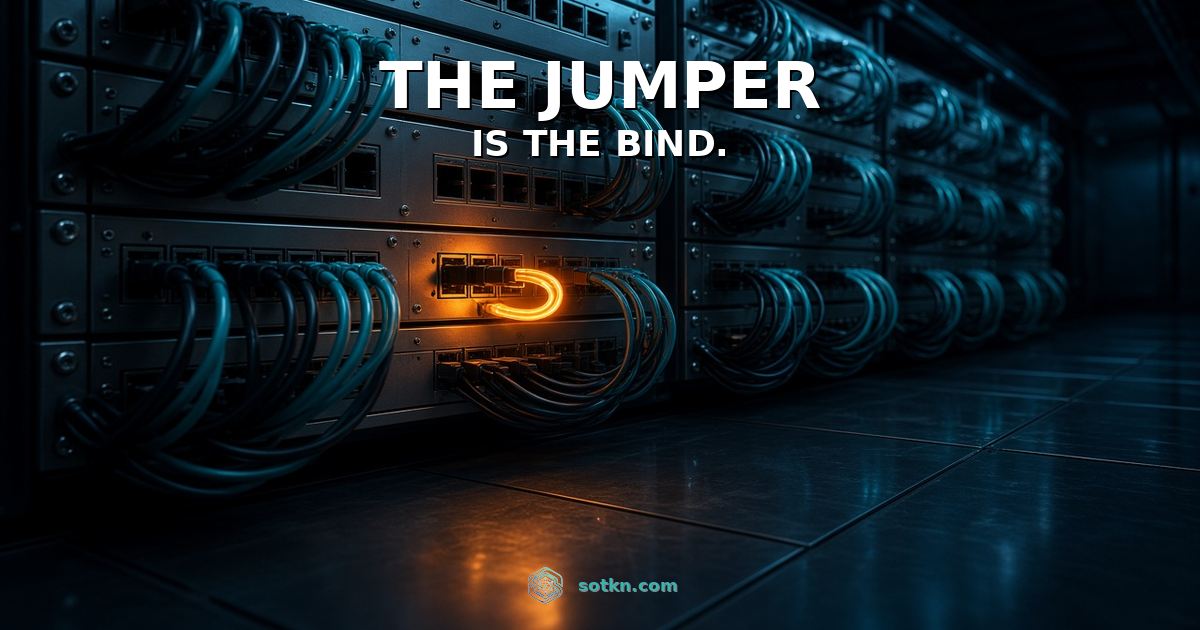
A cloud interconnect is a private port into a hyperscaler, billed by the hour even when little data moves. The jumper in the meet-me room is the stuck step.
EXPLAINED · Mechanism · Last reviewed: 25 Nov 2026 · Next review: when AWS, Microsoft or Google republish the port-hour card, or if AWS changes the 90-day letter-of-authorization billing rule
A cloud interconnect is a private port into a hyperscaler's network, patched in a building where the two networks meet, and billed for the port even when little data moves.
In short. The hyperscaler is paid for the port hour, or a monthly port fee, and often again for data leaving. On the cards checked 25 November 2026, data coming in is free. The cross-connect, the jumper in the meet-me room, is a separate bill those cards do not print. Our read: the stuck step is that jumper, and the clock that can start before the jumper is finished.
Why an investor cares: the public-internet byte is a different meter, covered in what cloud egress is. A private port is the other door on the Hyperscalers layer. The byte can look cheap. The port does not wait for the byte.
What is a cloud interconnect?
A cloud interconnect stays off the public internet. Your router and the cloud's router meet in a colocation building. Someone patches a jumper, or a partner sells a circuit that ends on a port into that cloud.
Amazon calls it AWS Direct Connect: a dedicated Ethernet link to an AWS port, or a hosted connection on a partner's port. Microsoft calls it ExpressRoute, and says it does not go over the public internet. Google calls it Cloud Interconnect, and says your network must meet Google's in a colocation facility.
The building is not the cloud region. The port sits at an on-ramp, which may be a different hall from the servers. Where the servers sit is what a cloud region is. The city versus the building is region versus availability zone.
How do the three clouds price the port?
Each card has a port charge and a data-out charge. They do not share a unit or a definition of a month. Read each line on its own card.
Amazon's Direct Connect pricing page, fetched 25 November 2026, prices dedicated port hours the same everywhere except Japan. A 10 Gbps dedicated port is US$2.25 an hour outside Japan and US$2.142 in Japan. A 1 Gbps port is US$0.30, or US$0.285 in Japan. A 100 Gbps port is US$22.50 and a 400 Gbps port is US$85.00, Japan included. You are charged for the hour even when no data passes. The page's examples use 730 hours, 8,760 divided by 12.
One idle 10 Gbps dedicated port for that month is 730 × US$2.25 = US$1,642.50, our arithmetic. Amazon's own light example is two hosted 2 Gbps ports at US$0.66 an hour: 2 × 0.66 × 730 = US$963.60, plus 1,024 GB out from US East (Ohio) at US$0.020 per GB = US$20.48, total US$984.08. Port hours are 963.60 / 984.08 = 97.9% of that AWS bill, our arithmetic. The page says this leaves out the delivery partner.
Data out depends on the source region and the Direct Connect location. Amazon says the table is directional. Contiguous United States to a US location is US$0.0200 per GB. The Asia Pacific group Amazon lists as Bangkok, Kuala Lumpur, Seoul, Singapore, Taiwan and Hong Kong, sent to a location in that same group, is US$0.0410 per GB. The same 1,024 GB is US$20.48 from the US group and 1,024 × 0.0410 = US$41.98 from the Singapore group, our arithmetic, 2.05 times the US rate. Data in is US$0.00 per GB at every location on that page.
Google's Cloud Interconnect pricing page, fetched the same day, bills the circuit by the hour and each VLAN attachment by the hour. A 10 Gbps Dedicated circuit is US$2.328 an hour, 100 Gbps is US$23.28, and 400 Gbps is US$85.00. A VLAN attachment from 1 to 10 Gbps is US$0.10 an hour. Google's example uses 30 × 24 = 720 hours. One 10 Gbps circuit on that clock is 720 × 2.328 = US$1,676.16, our arithmetic, before the VLAN hour. That port is not Amazon's port.
Google's data out is US$0.02 per GiB between the United States and Canada, and US$0.042 per GiB inside Asia excluding China, India, Indonesia and the Philippines. A gibibyte is not Amazon's gigabyte. We do not convert them. Inbound is not charged. A partner's own network fee is not on the Google bill.
Microsoft's ExpressRoute page, fetched the same day, uses 730 hours for its monthly estimates. On the metered plan, inbound is free and outbound is extra. The FAQ says the fee includes two ports, on two routers. Zone 1 standard is US$436 a month at 1 Gbps and US$3,400 at 10 Gbps. Outbound is US$0.025 per GB in Zone 1, US$0.05 in Zone 2, US$0.14 in Zone 3 and US$0.10 in Zone 4. The table does not name the cities. We do not guess them. ExpressRoute Direct, a pair of ports into Microsoft's network, is US$6,000 a month in Zone 1 for 10 Gbps, US$50,000 for 100 Gbps and US$150,000 for 400 Gbps.
Why does the port hour bind?
The port is capacity you asked to have provisioned. The cards bill it whether or not the month is full of bytes.
In Amazon's light example the data line is US$20.48 and the port line is US$963.60. The partner's fee is still extra. The size is also a one-way door: Amazon says you cannot change a dedicated port's speed after the request, and Google says the link type cannot be changed later. A short circuit becomes a second circuit, so both hours can run while the new jumper is patched. Four dedicated 10 Gbps AWS ports, the maximum-resiliency example, are 4 × 2.25 × 730 = US$6,570.00 before any data, our arithmetic.
Who gets paid — and where is the stuck step?
Our read: three parties can be paid, and the cloud card shows two of them.
- The hyperscaler, for the port and for data out. AWS, Azure or Google on these pages. Who they are is who the hyperscalers are. Inbound pays them nothing on the lines checked.
- The partner, sometimes on top. Amazon bills the hosted port hour and says the partner may charge more. Google bills a partner VLAN hour and says the provider may also bill you outside Google Cloud.
- The building, for the jumper. Amazon's cross-connect page says the jumper price comes from the facility or the partner. If your gear is not in the building, you cannot order that patch yourself. Google says you submit the letter of authorization to your vendor, and the vendor provisions the connection. Azure says your service provider may charge extra.
The stuck step is the jumper. A port can exist in the console before the patch carries traffic. Amazon's colocation page lists dark fibre as one way a partner extends a circuit from the Direct Connect location out to you. That strand is the path to the port. It is not the port. The strand on its own is what dark fiber is. The hall is what colocation is. None of the three cloud cards prints the facility's monthly fee. We do not invent one.
What happens on day 90?
Amazon's dedicated-connection guide does not wait for traffic. Billing starts when the port is active, or 90 days after the letter of authorization, whichever comes first. You avoid it by deleting the port before it is active, or within those 90 days. Separately, the cross-connect page says that if the cross-connect is not done within 90 days, the letter's authority to the facility expires. You can download a new letter. If you no longer want the port after that, the guide says you must delete the connection yourself.
Those are two clocks. One can start Amazon's hour while the jumper is dark. The other withdraws the facility's permission to patch it. A new letter does not cancel the port.
If AWS asks for more information, you have 7 days or the connection is deleted. A classic request can take up to 72 business hours to review. A hosted port, on the Direct Connect FAQ, bills from the moment you accept it.
Azure's clock is the service key. Billing starts when the key is issued. It stops only after you request deletion and the provider has de-provisioned the circuit. The key can precede the finished jumper. The delete request does not stop the fee while the circuit is still up.
Google bills the connection and the VLAN attachment by the hour, and the overview has you submit the letter before the vendor provisions the patch. The pricing page does not print a 90-day start. We do not invent one.
Common misconceptions
- People assume a private port is dark fiber. Actually the port is on the hyperscaler's equipment. Dark fibre, on Amazon's page, is one way a partner can extend a circuit to that port.
- People assume the cheap byte is the bill. Actually Amazon's light example is US$963.60 of port hours in a US$984.08 AWS bill, 97.9%, our arithmetic. The partner is extra.
- People assume the meter starts when data flows. Actually Amazon starts a dedicated port at activation or 90 days after the letter. Azure starts when the service key is issued.
- People assume one cloud has one private price. Actually the 10 Gbps dedicated hour is US$2.25 outside Japan and US$2.142 in Japan, and data out is US$0.0200 per GB to a US location against US$0.0410 inside the Singapore group. Google bills a gibibyte.
FAQ
What is a cloud interconnect?
A cloud interconnect is a private port into a hyperscaler's network, patched in a colocation building. On these cards the names are AWS Direct Connect, Azure ExpressRoute and Google Cloud Interconnect.
How much is an AWS Direct Connect port hour?
A dedicated 10 Gbps port is US$2.25 an hour outside Japan and US$2.142 in Japan, on the page fetched 25 November 2026. Data in is US$0.00 per GB. Data out from the contiguous United States to a US location is US$0.0200 per GB.
Does a private port bill before any data moves?
It can. Amazon starts the dedicated port hour when the port is active or 90 days after the letter of authorization, whichever comes first, even with no data passing. An idle 10 Gbps port for 730 hours is US$1,642.50, our arithmetic.
Who charges for the cross-connect?
The facility or the partner. Amazon, Google and Azure each say that jumper price is not on the cloud card. Ask the provider.
What happens 90 days after an AWS letter of authorization?
Billing starts if the port is still not active, unless you deleted it. The letter's authority to the facility also expires if the cross-connect is not done. A new download renews the authority. It does not cancel the port.
Is a cloud interconnect the same as cloud egress?
No. Egress is the public-internet byte. A cloud interconnect is the private port, billed by the hour or the month, plus its own data-out rate.
Is a cloud interconnect the same as dark fiber?
No. Dark fiber is glass you light yourself. The interconnect is the hyperscaler's port. A partner may use dark fibre only to reach that port.
Is this advice to buy or sell any company?
No. This page explains the port and who it pays. Not investment advice. Do your own research.
Related terms
Related: what cloud egress is; what dark fiber is; what a cloud region is; what colocation is; who the hyperscalers are.
Markets and stack doors
Layer: Hyperscalers. The US$0.0200 rate, and the US locations where you order the jumper, sit on the US Markets door. The US$0.0410 rate inside Amazon's Singapore group, and Equinix SG2 on the cross-connect list, sit on the Singapore Markets door.
Get the Wire, a free daily note on who pays for AI computing.
How we check this. Rates, the 730-hour examples and the excluded partner charges are the AWS Direct Connect pricing page, fetched 25 November 2026. The 90-day billing start, the 7-day reply, the 72-business-hour review and the fixed speed are Amazon's dedicated-connection guide. The letter's expiry, the facility's price and the dark-fibre option are the cross-connect page. Hosted billing on acceptance is the Direct Connect FAQ. Google's hours, GiB rates and free inbound are the Cloud Interconnect pricing page. The letter and the fixed link type are the Dedicated Interconnect overview. Microsoft's fees, zone rates, service-key clock and the two-port note are the ExpressRoute pricing page, including the page data fetched the same day. Products of a rate and a quantity are our arithmetic. Who gets paid, and the stuck step, are our read. Not investment advice. Do your own research.
Last reviewed: 25 Nov 2026 · Next review: when AWS, Microsoft or Google republish the port-hour card, or if AWS changes the 90-day letter-of-authorization billing rule
Spot an error? Tell us and we will correct it and note the change here.
Sources
- Amazon Web Services — AWS Direct Connect pricing (fetched 25 Nov 2026) — port hours, data-out rates, 730-hour examples
- Amazon Web Services — Dedicated Direct Connect connections (fetched 25 Nov 2026) — 90-day billing start, fixed speed, 7-day and 72-business-hour clocks
- Amazon Web Services — Requesting cross connects (fetched 25 Nov 2026) — letter expiry, facility-priced jumper, dark-fibre extension
- Amazon Web Services — Direct Connect FAQ (fetched 25 Nov 2026) — hosted hours start on acceptance
- Google Cloud — Cloud Interconnect pricing (fetched 25 Nov 2026) — circuit hours, GiB rates, inbound not charged
- Google Cloud — Dedicated Interconnect overview (fetched 25 Nov 2026) — letter to the vendor, fixed link type
- Microsoft Azure — ExpressRoute pricing (fetched 25 Nov 2026) — monthly fees, service-key clock, two ports in the fee
S
Writes Second Order by TKN — a plain-English map of AI infrastructure and semiconductors for non-specialist investors. Focus: who gets paid, where money sticks, and which step is stuck.