What Is Dark Fiber? The Unlit Glass Linking AI Data Centers
Dark fiber is optical cable already in the ground with no light running through it. Buyers lease the bare glass, often for about 20 years, and light it themselves. The owner is usually paid up front, but books the money as revenue slowly, so cash runs years ahead of reported sales.
EXPLAINED · Mechanism · Last reviewed: 24 Nov 2026 · Next review: after Lumen’s and Corning’s fourth-quarter 2026 results (early 2027) and Telstra’s half-year results (February 2027)
Dark fiber is optical fiber cable that is already in the ground but has no light running through it, because nobody has attached the lasers and equipment that send data yet. A buyer leases the bare glass, often for about 20 years, and lights it with its own gear, which is how big cloud and AI companies link their data centers.
In short. Dark fiber is glass in the ground with no light in it yet. The buyer leases the strands, usually for about 20 years, and lights them itself. Who gets paid: the fiber owner, often up front. Lumen says it has signed more than $13.5 billion of these custom fiber deals, yet booked only $66 million of revenue from them in the third quarter of 2026, against $117 million of cash received. The stuck step is digging: a route has to be in the ground before anyone can light it, and Telstra’s budget for its new Australian fibre network and a satellite project rose from about A$1.6 billion to about A$1.8 billion partly because of site and route conditions. Cash runs years ahead of reported revenue.
Why an investor cares: dark fiber sounds like plumbing, but it is a way of being paid. The owner of the glass is often paid early, for decades of use, and reports that money as revenue only slowly. When AI sites move apart to find power, the glass between them becomes worth more. This page builds on what an AI data center is and our carrier-neutral data center explainer, and answers one question: what is dark fiber, and why do AI data centers lease it?
What is dark fiber?
It is optical fiber with nothing plugged into it. Fiber is a strand of glass about as thin as a hair. Data travels down it as pulses of light. With no laser at one end and no receiver at the other, the strand carries nothing. That is the dark part.
Lumen, which runs more than 340,000 route miles of fiber, mostly long-haul links between cities, puts it the same way in its 2025 annual report. It calls dark fiber unlit optical fiber that has been laid but not yet equipped to transmit data. It sells access to that glass to customers who want to build their own networks.
Four words help when you read about it.
- Strand. One thread of glass. A single cable holds many strands, so one trench can serve many buyers.
- Conduit. The duct under the ground that houses and protects the cable. Lumen leases conduit as well as fiber.
- Route mile and fiber mile. A route mile is one mile of path. A fiber mile is one mile of one strand. A cable with many strands on one route mile adds many fiber miles. Lumen reported over 340,000 route miles at the end of 2025, and says it deployed 5 million fiber miles in 2026, funded by signed deals. The two numbers measure different things, so do not compare them.
- IRU. An indefeasible right of use. It is a long, fixed right to use named strands. Lumen says its IRUs typically run 20 years.
Fiber runs under roads and railways, or along the seabed. Lumen describes its custom fiber deals as using underused assets already in the ground. In plain words: spare strands, laid years ago, waiting for a buyer. They stay dark until someone pays to use them.
Dark fiber vs lit fiber: what is the difference?
Who runs the equipment. With dark fiber, the buyer adds its own lasers and switches at each end and controls the speed. With lit fiber, the owner runs the equipment and sells a service, such as a wavelength or internet access, at a set speed.
| Question | Dark fiber | Lit fiber (wavelength or internet) | Build your own route |
|---|---|---|---|
| What you get | Bare strands of glass on a fixed route | A service with a set speed, run by the owner | Your own cable, conduit and rights of way |
| Who adds the lasers and switches | The buyer | The owner | The builder |
| Typical deal | An IRU of about 20 years, much of it paid up front | Monthly fees on contracts of a few years | Capex, then years of upkeep |
| Room to grow | High: upgrade the gear, keep the glass | Limited to what you buy | High, if the route has spare strands |
| Example from the filings | Lumen dark fiber and conduit revenue up $239 million in nine months of 2026 | Lumen: installs from AI companies on its new wavelength network up five times | Microsoft: 120,000 miles of dedicated fiber for its AI WAN |
| What limits it | Whether the route is already in the ground | The owner’s capacity and price | Permits, crews and years of build |
Examples are from each company’s own filings or releases listed under References. Many buyers mix all three.
Each has a reason to exist. Dark fiber suits a buyer with a big, growing load and its own network team: when better lasers arrive, it swaps the gear and keeps the glass. Lit fiber suits a buyer that wants a link quickly and does not want to run it. Many buyers use both.
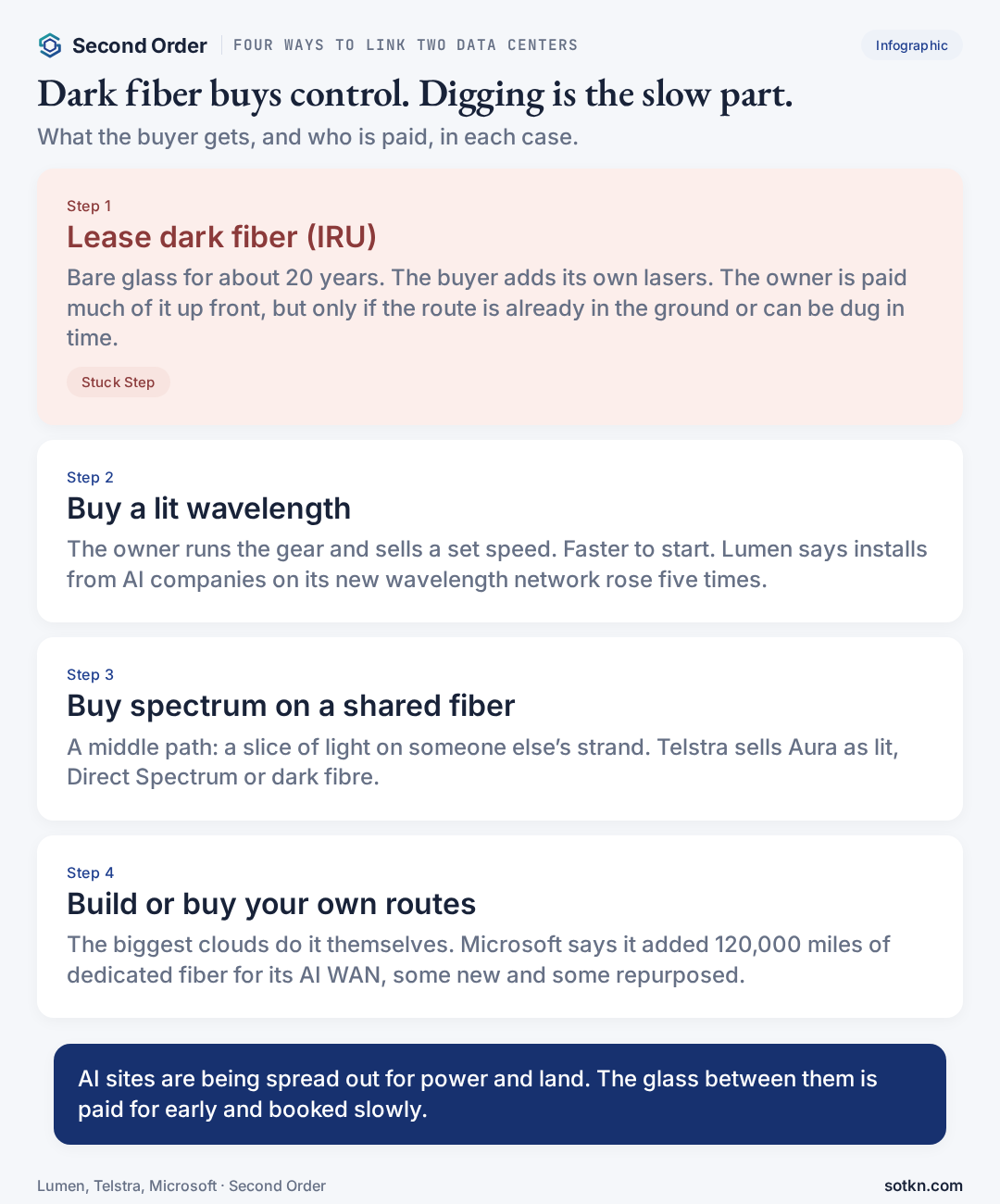
Telstra’s new Australian network shows the full menu. Its InfraCo arm sells the same Aura routes three ways: as lit services, as a slice of light on a shared strand that it calls Direct Spectrum, or as customer-managed dark fibre. Lumen sells a fast-growing lit product as well; it says installs from AI companies on its new wavelength network rose five times in the twelve months to October 2026. Our silicon photonics explainer covers the lasers and optics that turn dark glass into a lit link.
Why do AI data centers need dark fiber?
Because big AI jobs no longer fit in one building. Power and land are hard to find in one place, so AI sites are being spread out, and then joined up with fiber.
Microsoft explained this plainly in November 2025. It said land and power availability made it attractive, and by then necessary, to put its second Fairwater AI site in Atlanta, far from the first one in Wisconsin. It then linked the sites with what it calls an AI WAN, a wide area network on dedicated fiber, so GPUs in different states can work on one training job. Microsoft said it had deployed 120,000 miles of dedicated fiber for this network, raising its overall fiber mileage by more than 25% in one year. Some of the fiber was new. Some had been bought years earlier and repurposed.
Read that last line twice. Fiber that sat unused for years became useful once AI sites had to be split up. That is the dark fiber business in one sentence. Our scale-up vs scale-out explainer covers the networks inside a cluster; dark fiber is the next step out, between buildings. Our map of where AI data centers are located shows why the sites drift toward power.
The traffic data points the same way. Lumen said total traffic on its public internet backbone grew more than 20% in 2026 to date, and that traffic it labels as AI grew 1,000% from April. Those are Lumen’s own measures, on its own network. They do not include private links like dark fiber, which by design carry traffic Lumen does not see.
How is dark fiber sold and paid for?
Usually on a long IRU, paid largely at the start, and reported slowly. That gap between cash and revenue is the part most readers miss.
Lumen’s annual report spells out the accounting. Cash received for dark fiber is treated as lease revenue and recognised evenly over the term of the lease. Cash for capacity on lit fiber is treated as ordinary contract revenue, also spread over the term. Either way, a 20-year deal paid today shows up as a small slice of revenue each year for 20 years.
You can see it in Lumen’s books. It sells large custom fiber packages, tied to data center connectivity, under the name Private Connectivity Fabric, or PCF. Its 10-Q says advance payments under PCF deals have increased operating cash flow and deferred revenue, which is money received for work not yet done. Long-term deferred revenue was $8,238 million at 30 September 2026, up from $6,406 million at the end of 2025, a rise of $1,832 million or 28.6% in nine months (our arithmetic). Not all of that rise is AI: $525 million of it relates to fiber rights Lumen granted in the sale of its consumer fiber business to AT&T, which leaves $1,307 million (our arithmetic). Our deferred revenue explainer and prepayment explainer cover how that money sits on the balance sheet.
There is a second trap. Lumen reported $6.1 billion of revenue still to be recognised from existing contracts at 30 September 2026. Its note says that figure excludes contracts classified as leases. Lumen treats dark fiber deals as leases. So the backlog number most readers look for leaves out the deals this page is about. Our remaining performance obligation explainer explains that backlog line, and our finance lease vs operating lease explainer covers the lease side.
Who gets paid from dark fiber?
Here is the original angle of this page: in dark fiber, the owner of the route is paid first, and the glass maker is paid even earlier, before anyone knows which strands will be lit.
- The route owner, up front. Lumen says it has signed more than $13.5 billion of PCF deals in total, with $700 million of that signed in 2026, which means at least $12.8 billion was signed before this year (our arithmetic). Its revenue from dark fiber and conduit rose $59 million in the third quarter of 2026 and $239 million in the first nine months, against a $112 million rise for all of 2025.
- The route owner, slowly. In the third quarter Lumen booked $66 million of PCF revenue. That is about 5% of its $1,279 million of strategic business revenue (our arithmetic). At that pace for a year, $264 million, it is about 2% of the signed total (our arithmetic). Our view: this is not a sign the deals are weak. It is what 20-year deals look like when they start.
- The glass maker. Corning makes optical fiber and cable. In the third quarter of 2026 its Optical Communications sales rose 44% to $2.38 billion. It said Enterprise Networks, which its 10-Q says includes networks for hyperscale data centers, grew 84%, and its Gen AI product sales more than doubled. Much of that is fiber inside and around data centers, not only long routes between them, but the glass in a dark route has to be bought before the route is dug.
- The landlord at each end. A dark route ends in a building, often a data center. Our carrier-neutral explainer shows how landlords charge a monthly fee for each cable that meets inside.
- The optics makers. Lighting the glass needs lasers and transceivers. See our Wire on Lumentum’s AI optics and Catalyst on the Marvell and Lumentum laser deal.
Now put the three PCF numbers side by side. In the third quarter of 2026 Lumen spent $269 million of capex on PCF builds, received $117 million of cash from PCF customers and booked $66 million of PCF revenue. Capex was about 2.3 times the cash received in the quarter, and revenue was about 56% of it (our arithmetic).
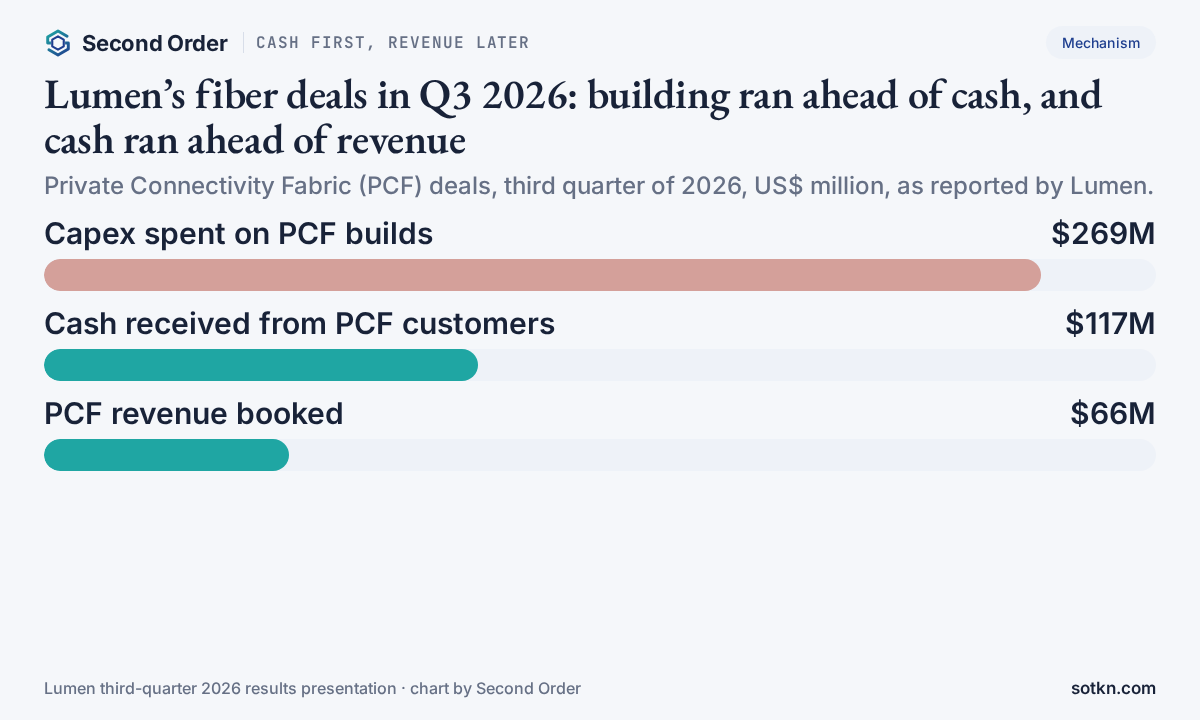
Read the chart with care. It is one quarter, and much of the cash for these deals arrived in earlier years. Lumen says customers fund the builds and that the payments vary by quarter. Its 10-Q also notes a fall in advance payments under PCF deals compared with a year earlier. The point is the order of events: build, then cash, then revenue, stretched over two decades. Compare it with the data center lease, where rent starts only when the hall is handed over.
Where is the stuck step?
In the digging. You cannot lease a dark strand on a route that is not in the ground. And putting it in the ground is slow, local work.
Permits and crews. Lumen’s annual report warns that its PCF deals carry delivery obligations and performance conditions that affect when and how much revenue it can book, and that construction delays or cost overruns from weather, supply chain, labour or permitting could raise costs. Those are the company’s own words about its own risk.
Site and route conditions. Telstra now expects the total strategic investment for its Aura Network and a Viasat satellite project to be about A$1.8 billion through FY28, up from about A$1.6 billion. That is A$0.2 billion, or 12.5%, more (our arithmetic). Telstra said the rise reflects inflation and project-specific factors, including site and route conditions.
Spare glass versus new glass. The fastest dark fiber is the kind already buried. Lumen says PCF uses underused assets already in the ground and is faster to deploy than new builds. Microsoft also reused older fiber. Once the spare strands on a route are sold, new demand needs new digging, and the clock gets longer. Our build-time explainer shows the same clock for the buildings themselves.
Big buyers can go around you. Lumen’s annual report also says some hyperscale customers have built infrastructure that reduced their reliance on its network. The largest buyers are also the most able to build their own routes. Our Stack page on Microsoft covers the biggest of them.
Our view: dark fiber is a good business while the spare strands last, because the money comes early. The thing to watch is the moment a route owner’s cheap, already-buried glass runs out and every new deal needs a new trench.
Dark fiber in Australia, Singapore and Malaysia
Australia. Telstra is building a new intercity fibre network called Aura. In its FY26 results on 13 August 2026 it said it had more than 8,500 km of fibre in the ground, was over halfway through the build and had six routes ready for service. It said Google, AWS, Firmus and Microsoft had signed long-term contracts across Aura, its subsea cables or its long-haul fibre, with Microsoft as the foundational Aura partner, and it expects a mid-teens internal rate of return with a cash payback of about nine years. It invested A$457 million in its strategic projects in FY26, and its InfraCo Fixed income grew 2.5% to about A$2.8 billion, helped among other things by dark fibre. Telstra InfraCo says Microsoft’s Australian data centres are connected by Aura. See what NEXTDC does, what Macquarie Technology does and our Australia door.
Singapore. Singapore’s national fibre network is run by NetLink NBN Trust under a regulated asset base model, with prices set under IMDA’s review framework. Its point-to-point fibre links, which it calls segment connections, rose to 4,317 at 31 March 2026 from 3,930 a year earlier, up 9.8% (our arithmetic). Yet revenue from these and its non-building address point connections fell 3.0% to S$18.2 million (our arithmetic), about 4.4% of total revenue (our arithmetic). NetLink says its network supports high-capacity links into data centres across Singapore. The lesson is that in a regulated market more strands do not automatically mean more money. See what Nxera does, what Keppel DC REIT does and our Singapore door.
Malaysia. We did not find a public filing this week that splits out dark fiber revenue for Johor or Kuala Lumpur, so we give no figure here. The same questions apply there: who owns the routes between sites, and are they already dug? Watch our Malaysia door for dated notes.
What would change this view?
- Revenue catches up with cash. If PCF revenue grows faster than the cash received, the long tail of past prepayments is starting to show in reported sales.
- New signings stall. Lumen signed $700 million of PCF deals in 2026, far less than the total signed before. If new signings stay small, the up-front cash will fade while the build bill remains.
- Lit beats dark. If AI companies keep choosing lit wavelengths over bare glass, more of the money goes to whoever runs the gear, and less to the owner of the strands.
- Big buyers build their own. If hyperscalers lay more of their own routes, dark fiber owners lose their biggest customers.
- AI sites stop spreading out. If power becomes easy to find in one place again, the need for long links between sites falls.
How to read a dark fiber deal headline
- Signed, received or booked? A deal total is not cash, and cash is not revenue. Lumen reports all three for PCF; most headlines report only the first.
- Route miles or fiber miles? They differ by the number of strands. Ask which one a figure is.
- Is the route already dug? Spare glass can be leased in months. New routes take years and carry permit and cost risk.
- Lease or contract? Dark fiber deals may be leases and may sit outside the backlog figure. Check the notes.
- Who owns the gear at each end? If the buyer lights it, the buyer controls the speed and the upgrades, and the optics makers sell to the buyer.
FAQ
What is dark fiber in simple terms?
It is fiber optic cable that has been laid but is not switched on. No light, so no data, runs through it until a buyer connects its own lasers and switches at each end. Lumen’s annual report defines it as fiber that has been laid but not yet equipped to transmit data.
Why is it called dark fiber?
Fiber carries data as pulses of light. A strand with no equipment attached carries no light, so it is dark. Once someone attaches equipment and sends traffic, it is lit.
What is the difference between dark fiber and lit fiber?
With dark fiber you lease the bare glass and run it yourself. With lit fiber the owner runs the equipment and sells you a service, such as a wavelength or internet access, with a set speed. Dark fiber gives more control and room to grow; lit fiber is quicker and needs no in-house network team.
How is dark fiber sold?
Usually through an indefeasible right of use, or IRU: a long-term right to use specific strands. Lumen says its IRUs typically run 20 years. In Lumen’s large custom fiber deals, customers pay much of the money in advance, and Lumen books it as revenue a little at a time over the term.
Why do AI data centers need dark fiber?
Because large AI jobs now run across several buildings. Microsoft says it spread its Fairwater AI sites across states because of land and power, then linked them with 120,000 miles of dedicated fiber so the GPUs can work as one system.
Who owns dark fiber?
Long-haul carriers such as Lumen, infrastructure arms of telecom groups such as Telstra InfraCo, regulated national networks such as NetLink in Singapore, and the biggest cloud companies themselves, which buy or build their own routes.
Is dark fiber in a company’s backlog?
Not always. Lumen treats dark fiber deals as leases, and leases are excluded from the $6.1 billion of performance obligations it reported at 30 September 2026. So a big dark fiber deal can be missing from the headline backlog figure.
Is dark fiber the same as a cross connect?
No. A cross connect is a short cable inside one data center that links two tenants. Dark fiber usually runs between buildings or cities. Our carrier-neutral data center explainer covers cross connects.
Is this a list of stocks to buy or sell?
No. This page explains how the money and the constraints move around dark fiber. It does not give buy or sell calls. Not investment advice.
Related: what is an AI data center; carrier-neutral data centers; colocation; who makes AI cluster networking; InfiniBand vs Ethernet; scale-up vs scale-out; edge data centers; cloud regions; the Stargate data center.
Stack doors
Layer: AI Data Centers. Also: Neoclouds, Hyperscalers, Semiconductors. Markets: Australia, Malaysia, Singapore, US.
Get the Wire — short daily notes when a data center or fiber deal names its size, its customer and its date.
How we check this
Figures come from Lumen’s annual report on Form 10-K for 2025 (filed with the SEC on 20 February 2026), its quarterly report on Form 10-Q for the third quarter of 2026 and its results presentation of 4 November 2026; Corning’s third-quarter 2026 results release of 27 October 2026 and its 10-Q; Microsoft’s feature of 12 November 2025 on its Fairwater sites; Telstra’s FY26 results release and presentation materials of 13 August 2026 and its InfraCo page on the Aura Network; and NetLink NBN Trust’s Annual Report 2026. Each source was fetched on 24 November 2026. Lumen’s PCF deal total is its own count of signed agreements, not revenue. Lumen’s deferred revenue includes items other than fiber deals, including fiber rights granted in its sale of a consumer fiber business to AT&T. Microsoft’s 120,000 miles is its own figure, and it does not say whether that is route miles or fiber miles. Telstra figures are in Australian dollars, NetLink figures in Singapore dollars and the rest in US dollars; we do not convert or add them together. Every share, ratio or growth rate we derived is labelled “our arithmetic”. The featured photo shows crews laying fiber along a road near Old Faithful in Yellowstone, taken by the National Park Service on 9 June 2025 and in the public domain, graded by Second Order; it is not a route named here. This page explains how the money and the constraints move. It does not give buy or sell calls. Not investment advice. Do your own research.
Last reviewed: 24 Nov 2026 · Next review: after Lumen’s and Corning’s fourth-quarter 2026 results (early 2027) and Telstra’s half-year results (February 2027)
Spot an error? Tell us and we will correct it and note the change here.
References
- Lumen Technologies — Form 10-K for the year ended 31 Dec 2025 (SEC, filed 20 Feb 2026) — definition of dark fiber and conduit; IRUs with a typical term of 20 years; dark fiber cash treated as lease revenue recognised over the term; over 340,000 route miles; dark fiber and conduit revenue up $112 million in 2025; PCF risk factor (construction, permitting, delivery conditions)
- Lumen Technologies — Form 10-Q for the quarter ended 30 Sep 2026 (SEC, filed 4 Nov 2026) — dark fiber and conduit revenue up $59 million in Q3 and $239 million in nine months; operating lease revenue $307 million; deferred revenue $8,238 million long-term; PCF advance payments raise cash flow and deferred revenue; $6.1 billion of performance obligations, excluding leases; AT&T fibre IRU
- Lumen Technologies — Third-quarter 2026 results presentation (8-K exhibit, 4 Nov 2026) — over $13.5 billion of PCF deals signed, $700 million in 2026; Q3 PCF cash received $117 million, revenue $66 million, capex $269 million; 5 million fiber miles deployed in 2026; AI traffic growth on its backbone
- Corning — Third-quarter 2026 results release (27 Oct 2026, SEC 8-K exhibit) — Optical Communications sales up 44% to $2.38 billion; Enterprise Networks up 84%; Gen AI product sales more than doubled
- Microsoft Source — From Wisconsin to Atlanta: Microsoft connects datacenters to build its first AI superfactory (12 Nov 2025) — AI WAN on dedicated fiber; 120,000 miles deployed, overall mileage up more than 25% in a year; some fiber new, some acquired years ago and repurposed; land and power push sites apart
- Corning — Form 10-Q for the quarter ended 30 Sep 2026 (SEC, filed 29 Oct 2026) — Optical Communications segment: the enterprise network group includes optical networks for hyperscale data centers; segment sales $2,379 million vs $1,652 million
- Telstra — FY26 results market release (13 Aug 2026) — Aura Network: more than 8,500 km of fibre in the ground, six routes ready; long-term contracts with Google, AWS, Firmus and Microsoft; about A$1.8 billion strategic investment to FY28 vs A$1.6 billion; mid-teens IRR and about nine-year cash payback
- Telstra — FY26 results presentation materials and transcript (13 Aug 2026) — InfraCo Fixed income up 2.5% to about A$2.8 billion, with growth including dark fibre; A$457 million of strategic investment in FY26; cost rise linked to site and route conditions
- Telstra InfraCo — Scaling up within the AI ecosystem (accessed 24 Nov 2026) — Aura sold as lit, Direct Spectrum or customer-managed dark fibre; Microsoft’s Australian data centres connected via Aura; ready routes as of September 2026
- NetLink NBN Trust — Annual Report 2026, year to 31 Mar 2026 (SGX) — segment (point-to-point) connections 4,317 vs 3,930; NBAP 3,581 vs 3,241; NBAP and segment revenue S$18.2 million vs S$18.8 million; regulated asset base and IMDA price review; network supports links into Singapore data centres