What Does Naver Do? The Partner-Funded AI Factory Model
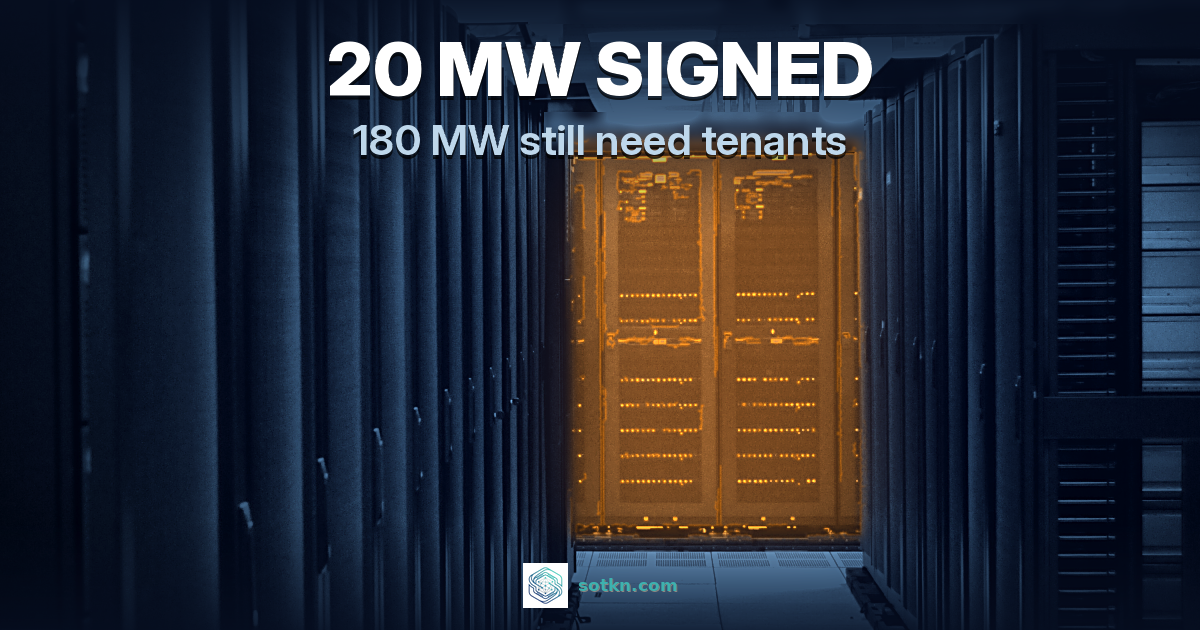
Korea's biggest internet company is building a 200 MW AI factory on Brookfield's money and Nvidia's chips. It has signed one customer, for about 20 MW. The other 180 MW still need tenants, and the money is built to follow them.
STACK · Hyperscalers · Status: Holding · Last reviewed: 14 Nov 2026
Naver runs South Korea's largest search engine, but the part of the company that now carries its biggest bet is a cloud that wants to rent AI computing to the world. It builds its own data centers, trains its own models, and is now putting up a 200 MW AI factory for outside AI companies, paid for mostly with other people's money.
In short. Naver, South Korea's biggest search company, is turning its cloud arm into a landlord for AI computing. It plans a 200 MW AI factory at its GAK Sejong data center by 2028, with GPUs and halls paid for by a Brookfield vehicle of up to $9 billion and chips from Nvidia, which now owns about 4% of Naver. On 12 November 2026 Naver said it had signed its first customer: a US-based AI inference company, about KRW2 trillion over four to five years for roughly 20 MW. Our read: Nvidia and the builders get paid first, Brookfield earns a fee stream guaranteed by Naver, and Naver Cloud earns the margin last. The stuck step is tenants. The money is designed to follow signed demand, and 180 of the 200 MW are still unsold.
Why an investor cares: Naver has found a way to build at hyperscaler scale without spending like one. Brookfield's money buys the GPUs, Nvidia sells them and owns a slice of Naver, and Naver Cloud sells the computing. For the basics of the group, start with who the hyperscalers are. This page is about how Naver's version makes money, who it pays, and where it gets stuck.
Numbers that matter
| Number | What it is | Why it matters |
|---|---|---|
| KRW2tn | First AI factory contract, a US-based AI inference company, total over four to five years | About US$1.5bn at the exchange rate Nvidia's share deal used, our arithmetic; revenue starts in the first half of 2027 |
| 20 of 200 MW | Capacity signed versus the 2028 plan | One-tenth sold, our arithmetic; Naver says it is in talks with more than ten companies for the rest |
| $9bn | Most Brookfield's vehicle will invest in GPUs and data centers | Naver does not pay up front, but guarantees the usage fees for up to eight years |
| KRW1,341.2bn | Nvidia's purchase of new Naver shares, closed in November | About 4.13% of Naver, locked up for a year |
| KRW451.3bn | Operating profit, July–September 2026 | Down 20.9% from a year earlier as computing and marketing costs rose |
| +29.1% | Rise in infrastructure costs, year on year, third quarter | Depreciation on new computing assets and data center rent are already in the profit line |
Company figures are listed at the end of the page. Sums, ratios and conversions are our arithmetic from Naver's results and announcements.
What does Naver actually do in AI?
It sells AI at three levels. At the bottom are its own buildings. Naver was the first Korean IT company to design its own data centers, GAK Chuncheon in 2013 and GAK Sejong in 2023, and it says it operates every layer from the data center and GPU clusters to AI platforms, models and services. GAK Sejong is the hub for the AI factory.
In the middle is Naver Cloud, which rents computing. Naver describes it as the only company in Korea offering GPU-as-a-service at large scale, and Nvidia counts it among its cloud partners, the firms that resell Nvidia systems as a service. Our explainers on GPU-as-a-service and the Nvidia Cloud Partner programme set out what those labels mean in practice.
Naver Cloud also does government work. In September 2026 a consortium it leads won a Korean government project to build a cybersecurity AI model, for which Naver Cloud planned to deploy 4,000 of its own Nvidia B200 GPUs alongside 256 lent by the government. That is a useful floor: Naver already owns thousands of current Nvidia chips.
At the top are models and apps. HyperCLOVA X is Naver's own model family, which Nvidia says Naver is moving onto Nvidia's Nemotron open models. It powers an AI Tab in search, a shopping agent, and a personal AI agent app due before the end of 2026.
Underneath it all is the cash engine. In July–September 2026 Naver made KRW3,472.4 billion of revenue, up 10.7% from a year earlier, of which search advertising and shopping services brought in KRW1,948.4 billion.
How does Naver make money from AI cloud?
Today, mostly inside a segment called Enterprise. Enterprise revenue was KRW193.3 billion in the third quarter, up 33% from a year earlier, and the finance chief said part of that rise came from a Saudi Arabian digital twin project rather than from GPU rental. Naver does not report GPU cloud revenue on its own, so there is no clean figure for how much it earns from renting chips today.
The AI factory is the new model, and it bills like a long lease. Customers reserve a block of GPU capacity for years, and Naver Cloud recognises the revenue as it delivers. The first contract shows the shape. It is worth about KRW2 trillion in total, the finance chief said, spread over four to five years depending on the chip, and it covers about 20 MW of capacity running a mix of Nvidia's B300 and its next-generation Vera Rubin systems. Our explainer on take-or-pay GPU contracts shows why the length and firmness of a deal like this matter as much as the headline value.
On our arithmetic, KRW2 trillion over 20 MW is about KRW100 billion of revenue per megawatt over the life of the contract. Spread evenly across four to five years, it would be roughly KRW400–500 billion a year, against KRW663 billion of Enterprise revenue in the past four quarters, our sum. Naver says the revenue will be staggered rather than even, so treat those as orders of magnitude, not a forecast.
The customer, which Naver has not named, is a US-based company that runs models for others, a business known as AI inference. Most of the companies Naver is talking to are in North America or elsewhere outside Asia, management said.
The margin comes later. Naver said a two-to-three-month gap between equipment arriving and paid service means a lower first-year margin. It expects an operating profit in 2027 after all costs, and double-digit margins from 2028. Those are targets resting on one signed contract.
Why does Brookfield own the GPUs?
Because Naver chose not to put them on its own cheque book. On 27 October 2026 Naver signed an agreement under which Brookfield sets up a vehicle, provisionally called Asset Co., funds 100% of its capital and invests up to $9 billion in GPUs and data centers. Asset Co. then provides the computing to Naver Cloud, which runs the AI factory and sells it to customers.
Naver Cloud pays Asset Co. usage fees that are tied to the revenue it earns, which Naver says eases the early financial burden. Naver guarantees those fees for up to eight years. Naver says the guarantee in itself creates no cash outflow or cost, but it does mean Naver stands behind the payments if the business falls short.
Two details matter for Naver's accounts. Asset Co. will be consolidated, because Naver is judged to control it, so the AI factory's assets and results will sit in Naver's statements even though Brookfield owns the equity. And Naver says only actual costs such as depreciation will then flow through its operating profit, a better margin, it argues, than renting GPUs from an outside provider. Our explainers on capex versus depreciation and who finances GPU clusters explain why that choice changes how the profits look.
The finance chief added that Asset Co. is funded by Brookfield's equity, not borrowing, and that S&P kept Naver's credit rating and stable outlook after taking the deal into account. Our Wire on the Brookfield deal covered the October filing in detail.
Where does Nvidia fit?
Nvidia is supplier, partner and shareholder at once. In June 2026 the two agreed a gigawatt-scale AI factory starting at 55 MW at GAK Sejong. On 22 July Naver signed a preliminary $9 billion agreement with Brookfield and on 24 July a $1 billion investment agreement with Nvidia, Nvidia's first such investment in Asia, according to Naver. Nvidia said the build would reach 200 MW by 2028.
Nvidia's money came with a condition: Naver had to line up at least $9 billion of committed financing, separate from Nvidia's own investment. The Brookfield agreement met it. Nvidia then paid KRW1,341.2 billion for 6,558,435 new Naver shares at KRW204,500 each, Dong-A Business Review reported on 6 November, about 4.13% of Naver, making it the third-largest shareholder. The shares are locked up for a year.
On the 12 November call, Naver said it was in talks with Nvidia on the largest server order in the Asia region, to secure lower costs and an early place in line for Vera Rubin. That order has not been announced. Our Markets piece on CoreWeave and Vera Rubin shows how hard the queue for the new platform has become.
How is the cost already showing up?
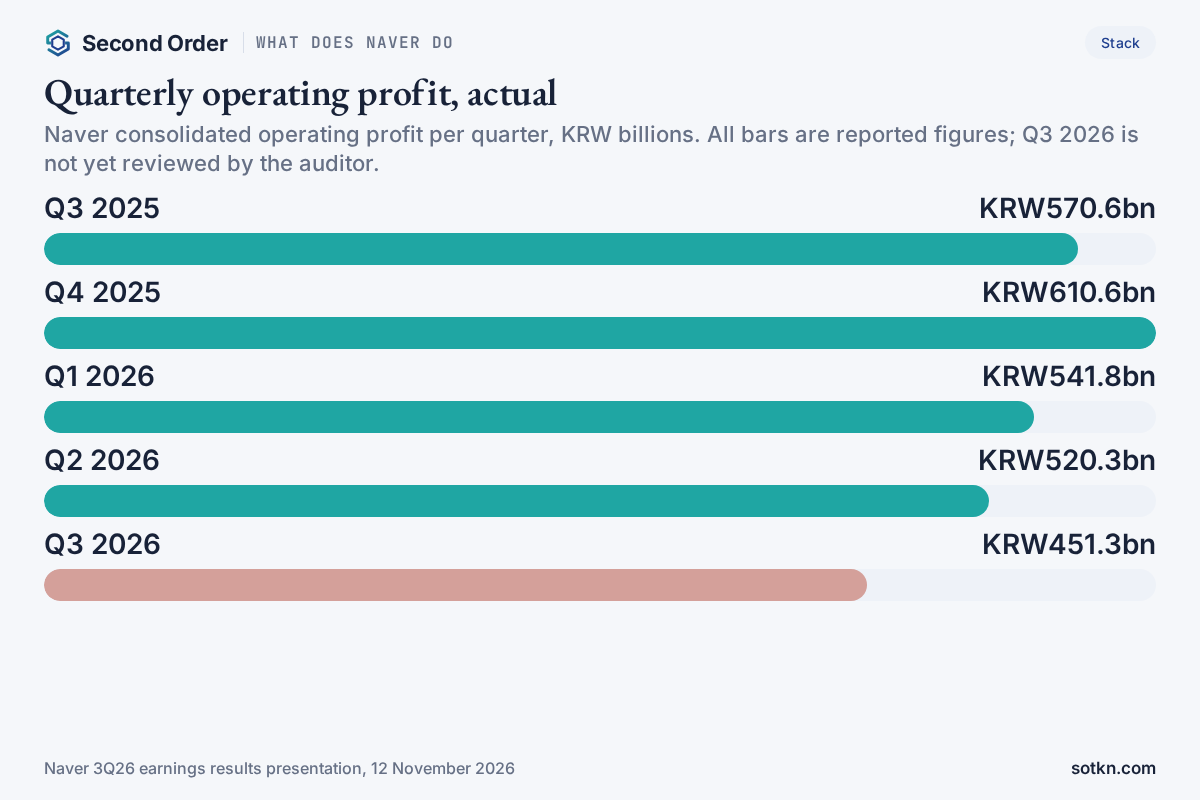
The chart shows the squeeze. Operating profit fell for three quarters in a row, to KRW451.3 billion, and the operating margin fell from 18.2% to 13.0% in a year. Infrastructure costs rose 29.1% from a year earlier to KRW282.3 billion, which Naver put down to depreciation on newly installed computing assets for its own use and higher data center rent and telecoms costs. Marketing rose 32.3% on shopping promotions and payment terminals.
Note what that cost line is not. The AI factory has not started; it opens in the first half of 2027. The rising depreciation comes from Naver's own computing, bought with its own cash for search, shopping and its models. The finance chief said Naver generates operating cash flow of about KRW2 trillion a year and that this spending on its own infrastructure would peak in 2026 and fall slightly from 2027. Our guide to GPU depreciation explains why that cost keeps running for years after the purchase.
Cash shows the same strain. Naver's own measure of consolidated free cash flow was minus KRW151 billion in the third quarter, against plus KRW202 billion a year earlier, after higher capex and about KRW300 billion of corporate tax. Net cash, by Naver's definition, was still KRW1,974.9 billion.
Who gets paid first?
- Nvidia. Brookfield's money buys Nvidia systems, B300 now and Vera Rubin next. Nvidia's KRW1.34 trillion share purchase in Naver will, on our read, flow back many times over as hardware orders if the AI factory fills. Nvidia also collaborates on the DSX platform the factory runs on.
- Builders and landlords. The factory needs halls with dense power and liquid cooling. Naver said it has secured most of the liquid-cooled space available in Korea; whoever owns or fits it out is paid as it is readied. Our Markets piece on Korea's AI data center grid queue shows why ready power is scarce.
- Brookfield. Asset Co. earns usage fees from Naver Cloud, linked to Naver Cloud's revenue and guaranteed by Naver for up to eight years. That is the kind of long, backed income stream infrastructure investors look for.
- Naver Cloud, last and by the month. Customers pay for reserved capacity once service starts. Only after the fees to Asset Co., power, space and staff does Naver keep a margin, which it expects to reach double digits from 2028.
The order is the same one we see across the layer: chips, halls and power are paid for first, and the cloud earns it back over the life of the hardware. What is different at Naver is who fronts the cash. Our Analysis on where cash sticks when chips sit in a separate vehicle walks through the risks of that structure.
What is the stuck step?
Tenants. Not money, and on Naver's account not halls either. Brookfield's vehicle can fund up to $9 billion and Nvidia's investment has closed. Naver says its contracted data center capacity already exceeds its 2028 target. What is missing is renters: about 20 MW of the planned 200 MW is signed, one-tenth on our arithmetic, with a single customer.
The structure makes tenants the gate by design. The finance chief said Brookfield's contributions will be sized and timed as customer demand is confirmed, and that Naver will secure demand first and then expand. That protects the balance sheet, but capacity grows only as fast as contracts are signed. On our read, slow signings would leave the 200 MW plan waiting while the cost of Naver's own computing keeps running.
The second gate is chips. Most prospective customers want Vera Rubin, management said, and supply of it is limited. Naver's pitch is that it can deliver the newest chips sooner than rivals because it has the liquid-cooled halls and is negotiating a large server order. Until that order is confirmed and the systems arrive, the timing of each contract depends on Nvidia's delivery schedule. Our Wire on a 20,000-GPU Rubin order shows how other buyers are queuing for the same platform.
A third risk is concentration: one young inference company accounts for all the signed capacity. Today's Wire on Lambda's terminable deal is a reminder that headline contract values can carry exit clauses; Naver has not disclosed its contract's termination terms.
Our read on the stuck step: for the next year, Naver's AI factory grows as fast as it can turn its talks with more than ten companies into signed, multi-year contracts. We mark the status Holding rather than Tightening, because Naver has the money and the halls lined up ahead of demand and has not yet reported a delay.
Who else does this?
Naver sits on the hyperscaler layer beside much larger firms. Microsoft and Oracle also rent big blocks of GPU capacity to AI labs on long contracts, but fund the hardware themselves. In China, Baidu and Huawei lean on their own chips because access to Nvidia's is restricted.
In business model the AI factory looks more like a neocloud, a specialist that rents GPUs to AI companies, than a classic cloud. The difference is the parent: a profitable search and shopping group with net cash and a credit rating behind the guarantee. Our explainer on neoclouds versus hyperscalers and our pages on CoreWeave and Lambda show the pure-play version. In Korea itself, our Markets piece on Korea's AI data centers waiting for tenants shows the same gate across the country's other builds.
Nvidia frames the project as Korea's sovereign AI factory. Yet the first paying customer is American, and most of the companies in talks are outside Asia.
What would change this view?
- Easing: further multi-year contracts take the sold share well beyond 20 MW, the Nvidia server order is confirmed with dates, or service starts on time in the first half of 2027.
- Tightening: no new contracts by switch-on, late Vera Rubin systems, or the first customer cutting back, leaving guaranteed fees running against idle capacity.
- A pricing shift: GPU rental prices fall as US capacity comes on line. Management said it sees shortage, not oversupply, for now.
What should you watch next?
Three things. First, each new AI factory contract, its megawatts and length, against the 180 MW unsold. Second, the Nvidia server order and Vera Rubin deliveries. Third, the switch-on in the first half of 2027, after which Asset Co.'s assets and costs appear in Naver's results. Our explainer on hyperscaler capex lines to watch shows which numbers to check in any of these reports.
Practical takeaways
Read Naver as a search group building an AI cloud on a partner's balance sheet and its own guarantee. The money and halls came first; customers must follow. Our guide to GPU utilisation shows why filled capacity is what pays.
FAQ
What does Naver do?
Naver runs South Korea's largest search engine and a group of businesses around it: shopping, payments, webtoons, second-hand marketplaces such as Poshmark and Wallapop, and Naver Cloud. Naver Cloud runs its own data centers, trains the HyperCLOVA X models and rents GPU computing.
What is Naver's AI factory?
It is a plan to build GPU capacity at Naver's GAK Sejong data center and rent it to AI companies. Naver plans to start at 55 MW in the first half of 2027 and reach 200 MW in 2028, with a long-term goal of 1 GW. Brookfield's vehicle funds it, Nvidia supplies the chips and Naver Cloud sells the service.
How much has Naver signed for its AI factory?
One contract so far. On 12 November 2026 Naver said it had signed a compute supply deal worth about KRW2 trillion with a US-based AI inference company, covering about 20 MW over four to five years. It says it is talking to more than ten other potential customers about the remaining 180 MW.
Who owns the GPUs in Naver's AI factory?
A vehicle funded entirely by Brookfield, provisionally called Asset Co., which will invest up to $9 billion in GPUs and data centers. Naver will consolidate it. Naver Cloud pays usage fees tied to its revenue, and Naver guarantees those fees for up to eight years.
Is Naver a hyperscaler?
On our reading it is a national one. It designs and runs its own data centers, trains its own models and rents GPU computing to outside customers, including the Korean government. Its spending is far smaller than the US giants'.
Is this a recommendation to buy Naver?
No. This page explains how Naver's AI cloud makes money and where it can get stuck. It gives no buy or sell calls. Not investment advice. Do your own research.
Keep reading on the map
Layer: Hyperscalers on The Stack. Also on the layer: Google, Amazon and how hyperscalers buy power. Explained: revenue backlog versus RPO and AI capex. Analysis: GPUs ordered before renters.
Get the Wire — short daily notes when compute, chips and GPU financing move.
Not investment advice. Do your own research.
How we check this
Figures come from Naver's 12 November 2026 results presentation and earnings call, its October and July 2026 announcements, Nvidia's 24 July release and the press reports listed below, all read on 14 November 2026. Naver's third-quarter figures have not yet been reviewed by its auditor, as the company notes. Call remarks come from an interpreted transcript; we use them only where the meaning is clear. Naver has not named its first AI factory customer or disclosed the contract's price per megawatt. Sums, ratios and US dollar conversions are our arithmetic and are labelled as ours. Who gets paid and the stuck step are our read. The featured image is a graded photograph of a generic server aisle, not a Naver data center. This page explains a business. It gives no buy or sell calls. Not investment advice. Do your own research.
Last reviewed: 14 Nov 2026 · Next review: after Naver's fourth-quarter 2026 results, and sooner if Naver signs a second AI factory customer or confirms its Nvidia server order
Spot an error? Tell us and we will correct it and note the change here.
References
- Naver — 3Q26 earnings results presentation (12 Nov 2026) — revenue, segment results, costs, cash and free cash flow by quarter (unaudited)
- Naver Q3 2026 earnings call transcript, via Stock Analysis / Quartr (12 Nov 2026) — 20 MW, KRW2 trillion contract; 180 MW in talks; Nvidia order; Asset Co. structure
- Daehan Economic Daily — Naver CEO: AI factory revenue from first half of next year (12 Nov 2026, Korean) — contract length and total, margin path, own capex peaking in 2026
- Naver — Signs agreement with Brookfield to secure computing infrastructure (27 Oct 2026) — Asset Co. up to $9 billion; revenue-linked fees; eight-year guarantee; consolidation
- Naver — Chairman Lee Hae-jin announces partnership with NVIDIA and Brookfield (24 Jul 2026) — Brookfield and Nvidia agreements; GAK Chuncheon and GAK Sejong
- NVIDIA — NAVER, NVIDIA and Brookfield to expand Korea's national AI factory buildout (24 Jul 2026) — 55 MW to 200 MW by 2028; 1 GW aim; investment conditions; Vera Rubin and Blackwell
- Dong-A Business Review — Nvidia completes Naver investment (6 Nov 2026) — KRW1,341.2 billion for 6,558,435 shares; about 4.13%; one-year lock-up
- Yonhap — Naver Cloud consortium to develop sovereign AI model for cybersecurity (3 Sep 2026) — 4,000 Naver Cloud B200 GPUs for the cybersecurity model project