$390 Billion Booked: Who Gets Paid While NVIDIA's Memory Line Stays Blank
NVIDIA is already paid on the quarter. The 17 November 2026 filing prints Data Center revenue of $107.6 billion. The $390 billion supply book leaves the memory share blank.
NVIDIA is already paid on the quarter. The Form 8-K furnished on 17 November 2026 prints Data Center revenue of $107.6 billion for the quarter ended 25 October 2026. Supply commitments are $390 billion, up from $279 billion, “primarily” for memory. The memory dollars, the vendors and the bits are not on the page. That is the stuck step.
US PULSE · Semiconductors · Data as at 17 Nov 2026 · Next update: when a later NVIDIA filing splits the supply book, or the Form 10-Q arrives
Affects: Semiconductors · Hyperscalers — Markets: United States · Taiwan · Korea
In short: Quarter revenue is $115,844 million. Data Center is $107.6 billion. Supply commitments are $390 billion, and the memory share is blank. Who gets paid is NVIDIA on sales already recognized. Not a recommendation.
Education only, not advice to buy or sell any security. Every figure below is from NVIDIA’s Form 8-K of 17 November 2026 and its three exhibits, unless a sum is marked as our arithmetic. The statements are unaudited. Where an exhibit is silent, this note says so.
The numbers that matter this month
| Line | Figure | What the filing is counting |
|---|---|---|
| Revenue, quarter ended 25 Oct 2026 | $115,844 million | GAAP. Commentary rounds this to $115.8 billion |
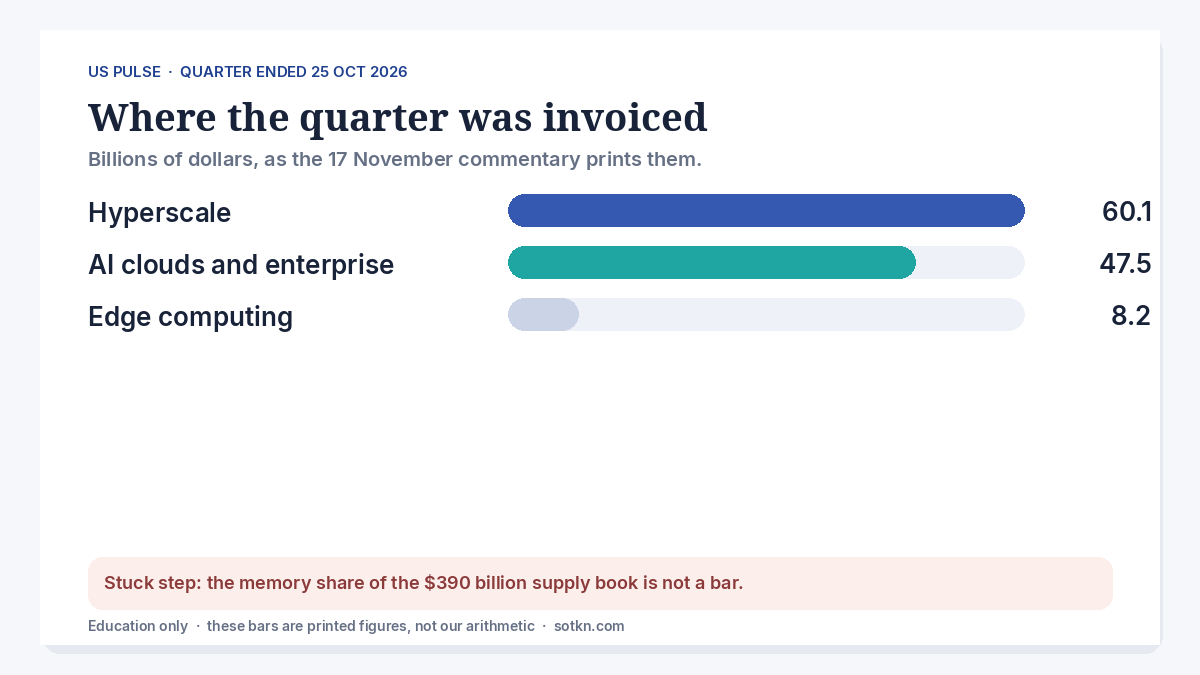
| Data Center | $107.6 billion | Hyperscale $60.1 billion plus AI clouds, industrial and enterprise $47.5 billion |
| Edge computing | $8.2 billion | The other platform. With Data Center it sums to $115.8 billion |
| Gross profit | $86,676 million | GAAP. Printed gross margin 74.8 percent |
| Operating income | $77,520 million | GAAP. Commentary rounds this to $77.5 billion |
| Net income | $65,287 million | GAAP. Diluted earnings per share $2.70 |
| Supply commitments | $390 billion | Up from $279 billion. Memory share unnamed |
| Neocloud, rest of fiscal 2027 | A dash | Additional commitments total $32 billion. The near cell is blank |
| Hopper shipments to China | $2.4 billion | This quarter’s shipments. Not the headquarters line |
| China headquarters revenue | $11,050 million | Customers headquartered in China, including Hong Kong |
Status on the memory row is ours: the commentary does not print a memory dollar. The other rows are printed. Full sources are at the end.
Why does the United States matter now?
Because the invoice for the leading AI systems is still written here, and this is the new print. Customers headquartered in the United States accounted for $72,899 million of the quarter’s $115,844 million. Our arithmetic: that is 62.929 percent of revenue. The printed share from outside the United States is 37 percent. Our division of the remainder, $42,945 million, by revenue is 37.071 percent, which rounds to that 37.
Headquarters is not the dock. The supplemental says the end customer and the shipping location can differ from where the direct customer is based. Taiwan headquarters were $30,295 million. China, including Hong Kong, was $11,050 million. Other countries were $1,600 million and are not named. The four lines sum to $115,844 million.
Who gets paid is NVIDIA, on sales already taken. Three direct customers were 14 percent, 11 percent and 11 percent of revenue, primarily in Compute & Networking. The names are not printed. If those rates were exact, our arithmetic is $16,218.16 million, $12,742.84 million and $12,742.84 million, together $41,703.84 million, or 36.000 percent. The print does not say the percentages are unrounded, so we do not turn them into named invoices.
Vera Rubin NVL72 racks are already running at CoreWeave, Google Cloud, Microsoft Azure, Oracle Cloud Infrastructure and Nebius, and coming online soon at SpaceXSI. The release does not split the $107.6 billion across those names.
What changed
The new documents are the Form 8-K of 17 November 2026 and three exhibits: the press release, commentary by Colette Kress, and a supplemental in millions. The quarter ended 25 October 2026, the third quarter of fiscal 2027. Kress is named as interim chief executive and as chief financial officer. The forward-looking statement lists a leadership transition, a search for a chief executive, and an investigation by an independent committee of the board. It does not print a date or a cause. This note does not add one.
The income statement ties. Revenue $115,844 million minus cost of revenue $29,168 million is gross profit $86,676 million. Research and development $7,454 million plus sales, general and administrative $1,702 million is operating expense of $9,156 million, and operating income of $77,520 million. Other income of $1,497 million makes pretax income $79,017 million. Tax of $13,730 million leaves net income of $65,287 million. Diluted earnings per share are $2.70 on 24,186 million shares. Our arithmetic: $65,287 million divided by 24,186 million is $2.70. The commentary’s $115.8 billion, $77.5 billion and $65.3 billion are those lines rounded.
The platform cut ties on the rounded billions. Hyperscale $60.1 billion plus AI clouds, industrial and enterprise $47.5 billion is Data Center $107.6 billion. Edge computing $8.2 billion brings the total to $115.8 billion. The segment cut ties on its own: Compute & Networking $106.0 billion plus Graphics $9.8 billion is $115.8 billion. The two cuts do not meet. Our arithmetic on the rounded billions: Data Center minus Compute & Networking is $1.6 billion, and Graphics minus Edge is the same $1.6 billion. Rates in the commentary were calculated on millions, so the true bridge could differ by a few hundred million. The exhibits do not print the crosswalk. We do not assign the $1.6 billion to a product.
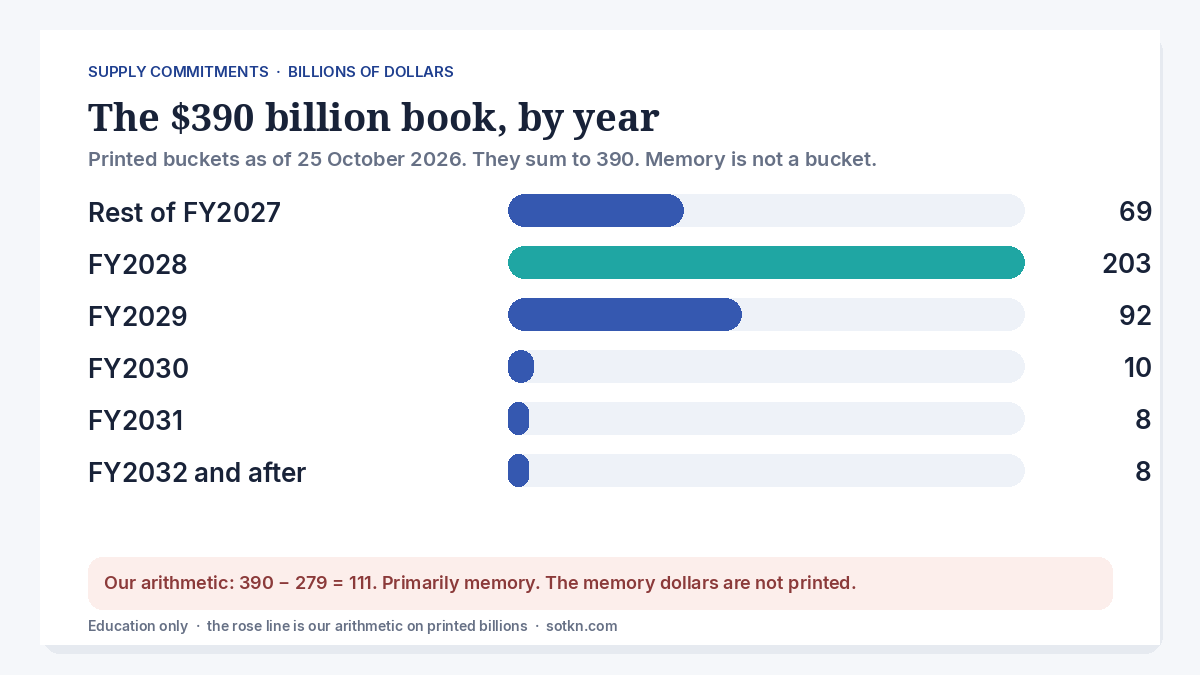
The supply book is the change that matters. Commitments are $390 billion, from $279 billion last quarter. The commentary says the increase is primarily multi-year memory procurement. It does not give “primarily” a percentage. Our arithmetic: the increase is $111 billion, 28.462 percent of the new book. That is the increase, not a printed memory line.
Manufacturers are named in a different sentence: Amkor Technology, IBIDEN, King Yuan Electronics, Samsung Electro-Mechanics, Siliconware Precision Industries and Unimicron, for plans to scale manufacturing. The sentence does not call them the memory vendors, and it does not split the $390 billion. We do not move those names onto the memory line.
Hopper shipments of Data Center products to China were $2.4 billion this quarter. The outlook assumes no Data Center compute revenue from China. One figure is a shipment already made. The other is an assumption about a later quarter, and it says compute, not Hopper. China-headquartered revenue, including Hong Kong, is a third clock at $11,050 million. The exhibits never say the Hopper shipments sit inside that line, so we do not subtract.
Our math
Each percentage below is our arithmetic on printed cells. The label is our arithmetic. Where the commentary already rounded from millions the exhibits do not show, we do not replace the printed rate.
GAAP gross margin is $86,676 million divided by $115,844 million, which is 74.821 percent, against a printed 74.8 percent. Non-GAAP gross profit of $86,724 million is 74.863 percent, against a printed 74.9 percent. Operating margin is 66.918 percent. Net margin is 56.358 percent. Tax of $13,730 million on pretax income of $79,017 million is 17.376 percent, against a printed 17.4 percent. Non-GAAP net income is $64,870 million. Pretax income minus the reconciliation’s $881 million adjustment is $78,136 million, and the tax implied by subtracting non-GAAP net income is $13,266 million, a rate of 16.978 percent. The commentary prints 17.0 percent. We do not call 16.978 a different rate.
Year-on-year revenue on the millions is 103.214 percent, against a printed 103 percent. Platform rates were calculated on millions, so the rounded billions do not always divide to the printed rate. Edge computing’s billions give 41.379 percent against a printed 42 percent. We do not correct it. Hyperscale is 55.855 percent of rounded Data Center revenue. Data Center is 92.919 percent of the rounded $115.8 billion.
Free cash flow ties. Operating cash flow of $48,253 million, minus property and intangible purchases of $4,422 million, minus principal payments of $54 million, is the printed $43,777 million. Repurchases of $22,122 million plus dividends paid of $6,026 million are $28,148 million, which the commentary rounds to $28.1 billion.
Inventory shows where the parts sit. Raw materials $15,802 million, work in process $17,767 million and finished goods $6,155 million sum to $39,724 million. Our arithmetic: those shares are 39.779 percent, 44.726 percent and 15.494 percent. At 25 January they were 17.787 percent, 41.219 percent and 40.994 percent. Finished goods fell $2,619 million. Raw materials rose $11,995 million and work in process rose $8,945 million. The three changes equal the balance-sheet increase of $18,321 million. Nine-month cash flow uses $18,352 million of inventory, net of acquisitions. The $31 million gap is unnamed.
Days sales outstanding are printed as 64, up from 60. The prior quarter in the reconciliation ends 26 July 2026. From 27 July through 25 October is 91 days. Our arithmetic on receivables of $81,033 million is 63.655 days, which rounds to 64. The exhibits do not print the balance behind the sequential 60.
Two gaps stay open. Cash and cash equivalents are $29,089 million. The securities table reports $27,521 million as cash equivalents. The $1,568 million difference is unnamed. Non-marketable securities are $65,528 million. The private-holdings rollforward ends at $61,650 million. The $3,878 million difference is unnamed.
Where does the money stick?
Who gets paid, and the line the exhibits will not name.
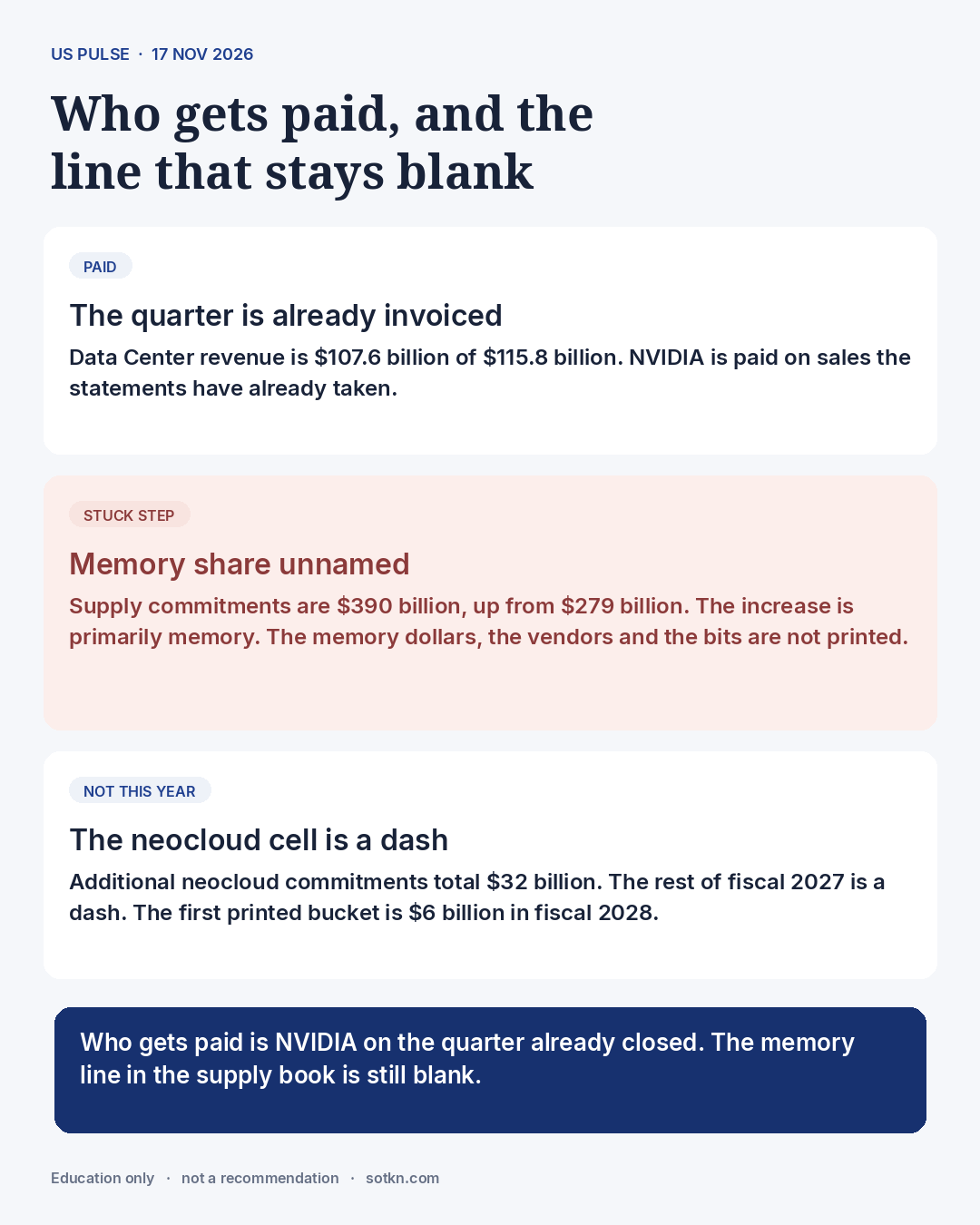
First, in sales already recognized. Data Center is $107.6 billion of a $115.8 billion quarter. Gross profit is $86,676 million and free cash flow is $43,777 million. That is the closed quarter, not a forecast. Two direct customers were 18 percent and 17 percent of receivables of $81,033 million. If those rates were exact, our arithmetic is $14,585.94 million and $13,775.61 million, together $28,361.55 million, or 35.000 percent of receivables. The names are not printed.
Second, in a supply book with no vendor line. The buckets are $69 billion for the rest of fiscal 2027, $203 billion in fiscal 2028, $92 billion in fiscal 2029, then $10 billion, $8 billion and $8 billion. They sum to $390 billion. Fiscal 2028 is 52.051 percent of the book. “Primarily” memory describes the $111 billion increase. It is not a column. No vendor, no bits, no price per bit.
Third, in commitments the exhibits keep in other tables. Cloud agreements of $28 billion plus leases not yet commenced of $74 billion equal $102 billion, which matches the prose. That same sentence says the combined figure rose from last quarter’s $74 billion. This quarter’s lease bucket is also $74 billion. The exhibits do not say those two 74s are the same contracts. We do not subtract them. Equity commitments of $20 billion and capital-expenditure commitments of $6 billion bring the main table to $518 billion.
The neocloud table is not inside that $518 billion. It totals $32 billion, and the rest of fiscal 2027 is a dash. The first printed bucket is $6 billion in fiscal 2028. A dash is not a zero. The commentary says the commitment counts only if financing is secured and the capacity is deployed, made operational and accepted. None of that $32 billion is inside the $115,844 million already recognized.
Guarantees are a further pile, and no cash has moved. Maximum gross exposure is $118.0 billion: $3.5 billion, $105.0 billion at SB Energy, and $9.5 billion. The company says it has made no payments. The $105 billion covers about 4.25 gigawatts, with the first building expected in fiscal 2029. Our arithmetic of $24.706 billion per gigawatt is not a printed price. An option on about 3.8 further gigawatts has no dollar. We do not add the $518 billion, the $32 billion and the $118 billion.
Nine-month financing cash flow shows an outflow of $2,944 million labelled Groq, Inc. The quarter cell is a dash, and the exhibits do not say what it bought. The press release announces an agreement to acquire Hugging Face. The forward-looking statement calls that deal pending, and these exhibits do not print a price. The Groq line and the Hugging Face sentence are not one cheque.
Is the memory line still stuck?
Yes. This filing still has no dollar, no vendor and no bit count for the memory inside the $390 billion.
“Primarily” is not a number. The year buckets are supply and capacity, not memory versus everything else. Finished goods are 15.494 percent of inventory, down from 40.994 percent at 25 January, so the module pile is the thin one. That describes inventory. It is not a memory-purchase figure.
The named manufacturers, the $2.4 billion of Hopper shipments, and the racks already running do not price the memory. The neocloud dash is a different blank cell. Until a later filing prints the memory dollars, the line stays blank.
What dates matter
17 November 2026 is the furnishing date. The quarter ended 25 October 2026. The commentary says the Form 10-Q is planned in the coming weeks, and does not give a day. The next dated cheque is the dividend: $0.25 a share, record 2 December 2026, payment 23 December 2026. We do not multiply $0.25 by the diluted share count. That count is a weighted average, and dividends already paid this quarter were a separate $6,026 million.
About $227.3 billion of repurchase authorization remains, which the commentary says the company plans to use through fiscal 2028. The board added $150 billion in September 2026. The exhibits do not print the authorization before that addition. We do not derive it. A long lock-up runs through December 2027 and is described as $4.7 billion inside other assets. The securities table’s matching column is $4,669 million. Other assets on the balance sheet are $17,166 million, so $12,497 million of that line is not broken out. A separate footnote puts $21.0 billion under short-term lock-up. The exhibits do not add the two lock-ups. Leases commence somewhere between the fourth quarter of fiscal 2027 and fiscal 2033. The fourth-quarter outlook includes an extra week and does not print the quarter’s end date.
How is this different from the 17 November Cisco pulse?
The Cisco pulse that morning read a networking quarter whose AI row was missing. NVIDIA’s Data Center row is on this page, at $107.6 billion. The blank cell here is the memory share of a supply book already sized at $390 billion.
The Samsung pulse of 20 November read a Korean report in which hours were full and capacity copied packaged output. This note has no hour clock and no bit count. It has a dollar book and the word “primarily” where a memory line would be. We do not add those bits to these billions. Taiwan shows up here only as $30,295 million of headquarters revenue. The September TSMC pulse is a different invoice, and this note does not restate it.
What would change this view?
- A later NVIDIA filing splits the $390 billion into memory and other supply, with vendors, dollars and a bit count.
- The neocloud cell for the rest of fiscal 2027 stops being a dash, because a commitment has become an accepted sale.
- Data Center and Compute & Networking are bridged in millions, so the $1.6 billion gap on the rounded billions is either confirmed or retired.
- Hopper shipments to China and China-headquartered revenue are shown as the same pile or as different piles, in one table.
- The three direct customers, and the two receivable customers, are named with dollars.
- The $3,878 million between non-marketable securities and the private rollforward is given a line.
- The outlook replaces “not assuming any Data Center compute revenue from China” with a figure.
Until one of those is printed, the memory line stays blank, and “primarily” remains a word rather than a share.
Practical takeaways
- NVIDIA is paid on $115,844 million of quarterly revenue, of which the commentary puts $107.6 billion in Data Center.
- Supply commitments are $390 billion, up $111 billion on our arithmetic, and the memory share is the stuck step.
- The neocloud remainder of fiscal 2027 is a dash. The $32 billion is a later, contingent table, not this quarter’s revenue.
- Guarantees of $118 billion, with no payments made, are a third pile. They are not added to the $518 billion commitment table.
FAQ
Who gets paid on NVIDIA’s 17 November 2026 results?
NVIDIA, on sales already recognized. Quarterly revenue is $115,844 million, and the commentary puts $107.6 billion of it in Data Center. The three largest direct customers are unnamed.
What is stuck in the $390 billion supply book?
The memory share. Commitments rose from $279 billion to $390 billion, “primarily” for multi-year memory. The exhibits print no memory dollars, no vendors and no bits.
Does the filing say how much of that book is memory?
No. “Primarily” is the only word on the increase. That increase, $111 billion, is our arithmetic. The year buckets are supply and capacity, not a memory column.
How is the $2.4 billion of Hopper shipments to China different from China-headquartered revenue?
They are different clocks. The $2.4 billion is this quarter’s shipments of Hopper products to China. The $11,050 million is revenue from customers headquartered in China, including Hong Kong. The exhibits do not say one sits inside the other, so this note does not subtract them.
Is this investment advice?
No. It is education only. It maps who gets paid and which step is stuck. It is not a recommendation to buy or sell any security, and it leaves out share prices, broker ratings and price targets on purpose.
How we check this. Revenue, profit, cash flow, inventory, geography, customers, commitments, guarantees and the equity rollforward come from NVIDIA’s Form 8-K furnished on 17 November 2026 and from Exhibits 99.1, 99.2 and 99.3. Sums we worked out are labelled our arithmetic. The Cisco, Samsung and TSMC notes are linked as earlier readings, not as figures in this filing. Our editorial standards.
Not investment advice. Do your own research.
Keep reading on the map
The United States door is the US markets shelf. The prior US pulse, on Cisco’s quarter the same week, is $18,517 million invoiced, with the AI row unnamed. Korea’s latest memory print is Samsung’s spare-bit line. The foundry invoice on the other side of the chain is the September TSMC pulse. China’s latest cloud print is Baidu’s GPU yuan. The layer these dollars sit on is Semiconductors in the Stack. The map question under all of them is where the stuck step moves.
References
- NVIDIA Corporation, Form 8-K, furnished 17 November 2026, quarter ended 25 October 2026. SEC Form 8-K — the cover that attaches the three exhibits.
- NVIDIA Corporation, Exhibit 99.1, press release, 17 November 2026. Exhibit 99.1 — the quarter’s headline figures, the dividend dates, the Hopper-to-China sentence, the named manufacturing plans, and the agreement to acquire Hugging Face.
- NVIDIA Corporation, Exhibit 99.2, CFO commentary, 17 November 2026. Exhibit 99.2 — platform and segment revenue, the supply book, the neocloud table, the guarantees, and the GAAP to non-GAAP reconciliation.
- NVIDIA Corporation, Exhibit 99.3, supplemental financial information, quarter ended 25 October 2026. Exhibit 99.3 — the income statement, balance sheet, cash flow, inventory, geography and customer concentration, in millions.