If ASML Supply Stays Short Into 2028, Where Does Cash Stick?
ASML said planned supply for 2027 and 2028 will not fully meet demand, with 2028 capacity beyond +30% still under investigation. Where does cash stick? Three scenarios, arithmetic shown.
ANALYSIS · MEMBERS CONTINUE · 5 min free / 14 min full · Data as at 14 Oct 2026
ASML said on 14 October that supply as currently planned for both 2027 and 2028 will not fully meet customer demand. Customers are already expressing interest in orders for 2029 and even 2030. If the lithography tools that print advanced chips stay short that far out, where does the cash stick?
New to the two scanner types? Start with EUV vs DUV.
In short
- The question: if ASML supply stays short into 2028, where does cash stick?
- The answer: Scenario B. Cash sticks first with ASML on systems and Installed Base Management upgrades, then with foundries and memory makers who hold booked slots, then with chip customers who already have allocation. Halls and GPU clouds without a tool slot wait
- Why: on 14 October 2026, ASML reported €11.7 billion of Q3 sales and said planned supply for 2027 and 2028 will not fully meet demand. It is investigating capacity for 2028 beyond the 30% previously communicated. Productivity upgrades keep stretching wafer output from tools already shipped
- The size of the book: Q3 Installed Base Management was €3.3 billion on the same day systems kept ramping. Full-year sales guide is now €44–45 billion. From the July plan, 2026 Low-NA EUV capacity of about 65 and DUV immersion of about 130 were each set for a +30% step in 2027 — about 85 and 169 tools (ours) — and another +30% for 2028 was only under investigation. That plan still leaves demand unmet
- Behind the wall: who gets paid, in order · three scenarios, arithmetic shown · what a short tool clock costs buyers without a slot · six practical takeaways · Members' FAQ
- What would break it: a deeper High-NA and intensity squeeze into 2029 (A), or early extra capacity and cooler demand (C)
- Nothing here is a recommendation. This maps what today's results already assume, with the working shown
What's in this piece: the numbers that matter · why tool output became the clock · what the map assumes in one line · members from here · who gets paid, in order · three scenarios, arithmetic shown · our read · what would change the view, with dates · practical takeaways · FAQ · references
The numbers that matter
| What | Figure | Date | What it tells us |
|---|---|---|---|
| Q3 total net sales | €11.7 billion (€11.662B) | ASML results, 14 Oct 2026 | Record quarter toward the high end of guide |
| Q3 net income | €5.0 billion (€4.960B) | Same release, 14 Oct 2026 | Profit beat the street print CNBC cited |
| Q3 Installed Base Management | €3.3 billion (€3.289B) | Same release, 14 Oct 2026 | Upgrades and service already a large cash lane |
| Q3 gross margin | 57.5% | Same release, 14 Oct 2026 | Above guidance; upgrades helped the mix |
| New systems sold (Q3) | 113 new + 8 used | Same release, 14 Oct 2026 | Ramp is real; the shortage claim is still about future years |
| FY26 sales guide | €44–45 billion, GM around 56% | Same release, 14 Oct 2026 | Lower end raised from €43 billion |
| Q4 sales guide | €14.2–15.2 billion, GM around 57% | Same release, 14 Oct 2026 | Heavy finish to the year |
| Supply vs demand | Planned supply for 2027 and 2028 will not fully meet demand | CEO statement, 14 Oct 2026 | The short clock is named for two years |
| 2028 capacity probe | Investigating increase beyond the 30% previously communicated | Same statement, 14 Oct 2026 | Even the investigated step may not be enough |
| 2026 Low-NA / DUV base | ~65 Low-NA EUV; ~130 DUV immersion | Q2 release, 15 Jul 2026 | Baseline the +30% plans sit on |
| Order interest out-years | Interest in orders for 2029 and even 2030 | CEO statement, 14 Oct 2026 | Demand talk already past the short years |
| China sales mix | About 20% of sales (unchanged forecast) | Same day commentary | Mix held; not the shortage story |
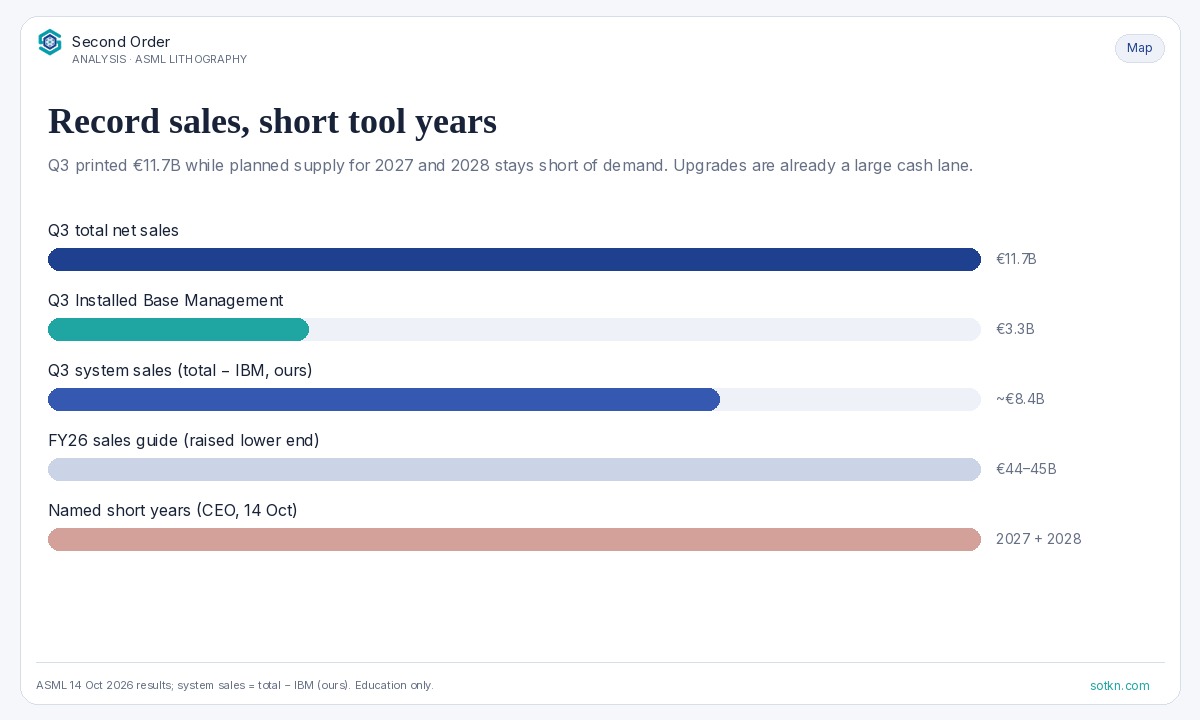
Chart 1 — ASML's named short years against a record quarter and the upgrade lane. Second Order arithmetic from the 14 Oct and 15 Jul releases. Education only.
Why did lithography tool output become the clock?
An advanced logic or memory node needs three things that must arrive together: wafers at the right process, packaging capacity, and the lithography tools that print the patterns. The Semiconductors layer shows where EUV, DUV immersion and High-NA sit. Without a Low-NA EUV or immersion tool in the right year, a fab expansion is only a hall and a power contract.
ASML is the only commercial maker of EUV scanners. On 14 October it said customers are raising short- and medium-term equipment demand forecasts on AI, that some are expressing interest in orders for 2029 and even 2030, and that supply as currently planned for both 2027 and 2028 will not fully meet demand. It is investigating ways to increase capacity for 2028 beyond the 30% increase previously communicated, and it keeps selling productivity upgrades that stretch wafer capacity from tools already in the field.
That July plan is the arithmetic base. On 15 July ASML said it planned to add 30% to 2026 Low-NA EUV capacity of around 65 for 2027, and to investigate another 30% for 2028; the same structure applied to 2026 DUV immersion capacity of around 130. CNBC also reported that during the quarter Samsung and TSMC committed to using High-NA EUV — the next tool class, which adds intensity rather than clearing the Low-NA queue.
Our ASML Wire has the day-of signal. This piece asks the money question: when planned tool supply stays short into 2028, who gets paid, and who waits?
What does the map already assume?
Three answers compete:
- The shortage deepens. High-NA adoption and higher lithography intensity widen the gap into 2029. Extra 2028 capacity does not land, or lands late. Upgrade demand stays extreme
- The shortage holds as stated. Planned 2027–28 supply stays short of demand. The 2028 step beyond +30% remains under investigation. Installed Base Management keeps stretching wafers. Slot holders ship; everyone else waits
- The shortage softens. Extra capacity lands early, AI equipment forecasts cool, or High-NA and China mix ease pressure. The short clock shortens toward a single year
A tip sheet would pick a lithography stock. Analysis asks which answer today's results already need.
Our read, in one line: the map already assumes Scenario B. Planned supply for 2027 and 2028 stays short of demand as ASML said, so cash sticks first with ASML on systems and Installed Base Management, then with foundries and memory makers who hold booked slots, then with chip customers who already have allocation. Halls and GPU clouds without a tool slot wait. The stuck step is Low-NA EUV and DUV immersion tool output — and the upgrades that stretch wafers from tools already shipped — not another year of sales guidance. The scenarios and the arithmetic are below.
The free preview ends here.
—— Still to read · ~9 of 14 minutes ——
MEMBERS CONTINUE HERE
- Who gets paid, in order, and who waits
- Three scenarios with the arithmetic
- What a short tool clock costs buyers without a slot
- Six practical takeaways
- Members' FAQ