NT$7,515,463,105 Priced: Who Gets Paid While UMC's Delivery Clock Stays Blank
Lam Research International Sdn. Bhd. is the named seller on a UMC machinery batch priced at NT$7,515,463,105. Delivery dates and the payment clock are blank.
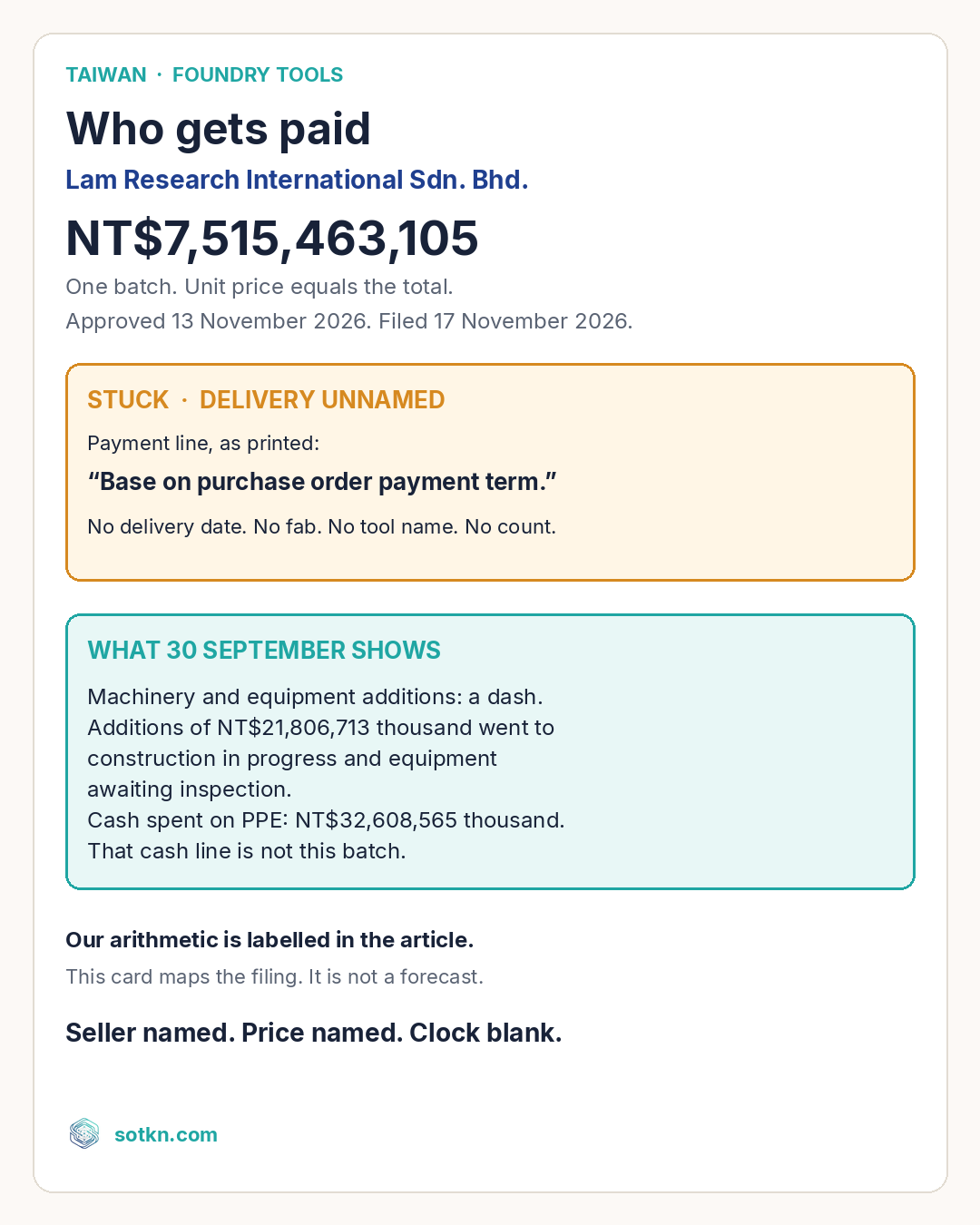
Lam Research International Sdn. Bhd. is the named seller on a machinery batch United Microelectronics has priced at NT$7,515,463,105. The step that is stuck is delivery. The 13 November 2026 announcement names the seller, the batch price, and the purpose. It leaves the delivery date, the payment dates, the fab, and the tool name blank.
TAIWAN · FOUNDRY TOOLS · 17 November 2026
UMC furnished that announcement to the U.S. Securities and Exchange Commission on 17 November 2026, in a Form 6-K signed by Chitung Liu, chief financial officer. The substance sits in Exhibit 99. Exhibit 99.1 is the machinery announcement, approved on 13 November. Exhibit 99.2 is a conference notice for 23–24 November. The conference outline does not add a tool figure.
Read the price as a price. October sales are a separate print. The nine-month accounts, filed on 28 October, close on 30 September, before this approval.
The numbers that matter this month
The table keeps each figure in the unit its own document uses. The machinery announcements are in New Taiwan dollars. The sales report and the financial statements are in thousands of New Taiwan dollars. Mixing them without saying so is how a batch starts to look like a month of revenue.
| Item | Figure | What the document calls it | Date |
|---|---|---|---|
| Lam batch | NT$7,515,463,105 | One batch. Average unit price equals the total. | Approved 13 Nov 2026. Filed 17 Nov 2026. |
| October net sales | NT$25,197,532 thousand | Net sales | Sales announcement 5 Nov 2026 |
| January–October net sales | NT$229,207,213 thousand | Year to date | Same sales announcement |
| July–September operating revenue | NT$74,239,117 thousand | Operating revenues, reviewed | Quarter ended 30 Sep 2026. Filed 28 Oct 2026. |
| Nine-month operating revenue | NT$204,009,681 thousand | Operating revenues, reviewed | Same statements |
| Cash spent on property, plant and equipment | NT$32,608,565 thousand | Acquisition of PPE, cash flow | Nine months ended 30 Sep 2026 |
| Machinery and equipment additions | A dash | Cost rollforward | Same nine months |
| CIP and equipment awaiting inspection, additions | NT$21,806,713 thousand | Cost rollforward | Same nine months |
| Synopsys software and IP batch | NT$1,171,169,241 | One batch of intangible assets | Approved 10 Nov 2026. Filed 12 Nov 2026. |
| Applied Materials machinery batch | NT$6,983,784,720 | One earlier machinery batch | Approved 1 Oct 2026. Filed 6 Oct 2026. |
Transaction volume is “one batch.” Average unit price and total price are both NT$7,515,463,105. A per-tool count is not on the form. The counterparty is Lam Research International Sdn. Bhd., a non-related party. Purpose: “For production and R&D.” The Selection Meeting set the price by negotiation against market price. The board-resolution line is NA. Approval is 13 November 2026. The occurrence window is 27 January 2026 through 13 November 2026. Prior material information on the same event: NA.
Payment is one sentence: “Base on purchase order payment term.” Restrictive covenants, other terms, and the broker line are blank in substance: No, No, and None. Appraisal lines are NA. The form names no fab, no process step, and no model. Sdn. Bhd. identifies the contracting seller. It does not say where the tool is built or which UMC site receives it.
Why does Taiwan matter now?
Taiwan’s foundries get paid when a wafer is sold. UMC’s 5 November sales announcement already prints October. Net sales were NT$25,197,532 thousand, against NT$21,294,974 thousand in October 2025. The announcement prints the change as NT$3,902,558 thousand and 18.33 percent. January through October net sales were NT$229,207,213 thousand, against NT$197,038,628 thousand a year earlier, a printed change of NT$32,168,585 thousand and 16.33 percent.
Those wafers are the paid step. The 17 November filing is the step in front of a later wafer: a tool batch priced for production and research, with delivery still unnamed. Fab utilization describes a line that is already running. It does not turn a priced batch into an installed chamber.
The reviewed quarter is the same split. For the three months ended 30 September 2026, the consolidated statements print operating revenues of NT$74,239,117 thousand, gross profit of NT$25,204,523 thousand, and operating income of NT$18,642,533 thousand. The board authorized the statements on 28 October 2026 and furnished them that day. The review report is a review under the Taiwan issuer rules and IAS 34, and the filing says so. Customers have already paid for those wafers. The Lam price is a later document.
What changed
On 13 November the price became a public material announcement. The occurrence window opens on 27 January, so purchase orders inside the batch can be months old. “Previously released: NA” means this price had no earlier material-information release. The age of an order and the date the price was disclosed are different facts. The 17 November 6-K also says UMC will attend Citi’s “2026 Taiwan Corporate Day” on 23–24 November, at 09:00, at W Hotel Taipei. That outline names the event and stops.
The week before, a 12 November 6-K furnished a different set of papers. Its exhibit includes a software and intellectual-property batch, conference notices, and a capital-reduction registration. The software batch is the useful neighbour.
That batch is also “one batch,” and its average unit price also equals the total: NT$1,171,169,241. The seller is Synopsys International Limited, Taiwan Branch, a non-related party. The occurrence window is 5 May 2026 through 10 November 2026. Approval is 10 November 2026. Purpose: “For Production and R&D.” Payment is the same sentence, “Base on purchase order payment term.” The difference is a line the machinery form does not have. Source of funds: working capital. A CPA is named: Tsai wen ching of Kau Wei CPAs Firm, certificate No. 1494 of Tai-Tsai-Cheng (No. 6). The Lam machinery form’s appraisal and CPA lines are NA.
The same exhibit records a capital reduction from cancellation of restricted shares, approved and registered on 10 November 2026. Paid-in capital falls from NT$125,700,938,990 to NT$125,695,204,800, and shares fall from 12,539,542,899 to 12,538,969,480. Book value per share moves from NT$37.55 to NT$37.56. The exhibit prints no cash amount for that cancellation. Cash dividends of NT$32,697,420 thousand are a nine-month financing line that ends on 30 September.
October sales were already public on 5 November. This filing does not restate them.
Our math
Every percentage below is our arithmetic, labelled as such. The inputs are the printed figures. Where a filing already prints a rate, the check is whether the division rounds to that rate.
October’s printed 18.33 percent is 3,902,558 / 21,294,974 = 18.326 percent, which rounds to 18.33 at two decimals. The year-to-date 16.33 percent is 32,168,585 / 197,038,628 = 16.326 percent. The printed rates and the division agree once the rounding is stated. Nine-month operating revenue plus October net sales is 204,009,681 + 25,197,532 = 229,207,213 thousand, equal to the printed January–October sales. The year-to-date line is the reviewed nine months plus October. The Lam batch is in neither document.
Gross margin for the quarter is 25,204,523 / 74,239,117 = 33.950 percent, against 17,623,318 / 59,127,040 = 29.806 percent a year earlier. Operating margin is 18,642,533 / 74,239,117 = 25.111 percent. Third-quarter revenue rose 25.559 percent on the year-ago quarter. These are wafers already recognised.
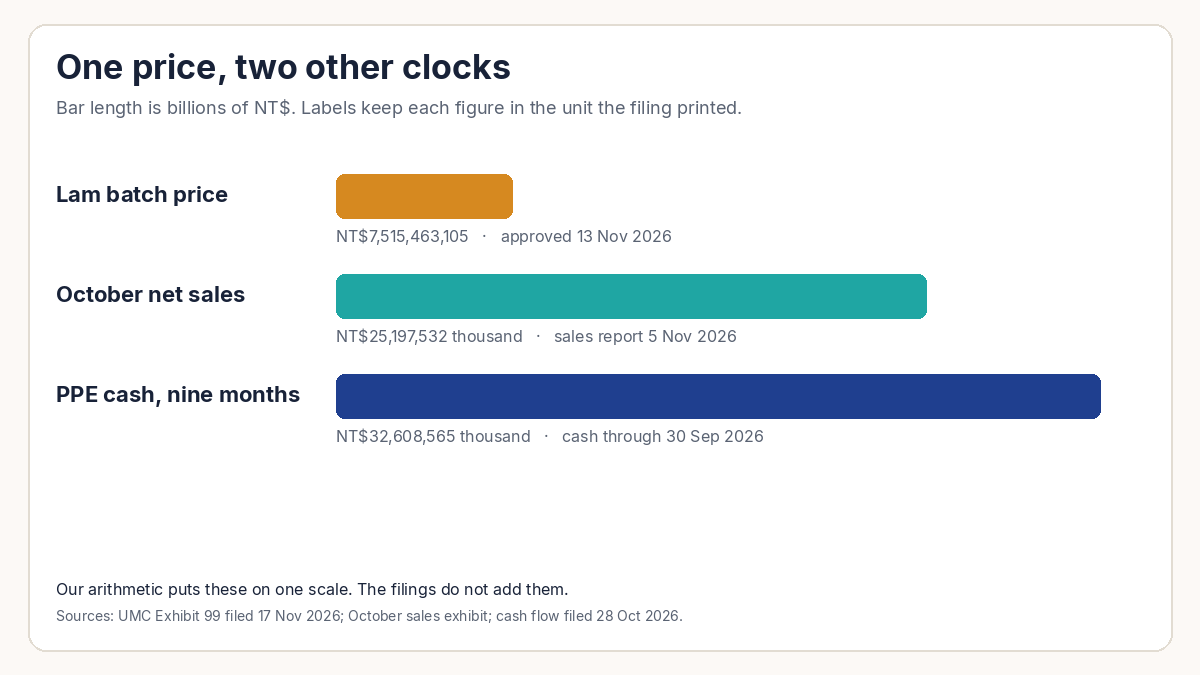
The Lam price is in dollars and the statements are in thousands, so the comparison multiplies the statement figures by 1,000. The batch is 7,515,463.105 thousand. It is 29.826 percent of October net sales (7,515,463,105 / 25,197,532,000), 3.279 percent of January–October sales, 10.123 percent of third-quarter revenue, and 23.048 percent of nine-month cash spent on property, plant and equipment (7,515,463,105 / 32,608,565,000). That cash line is NT$32,608,565 thousand, NT$310,154 thousand under the year-ago NT$32,918,719 thousand. The 13 November approval cannot revise a cash line that stops on 30 September.
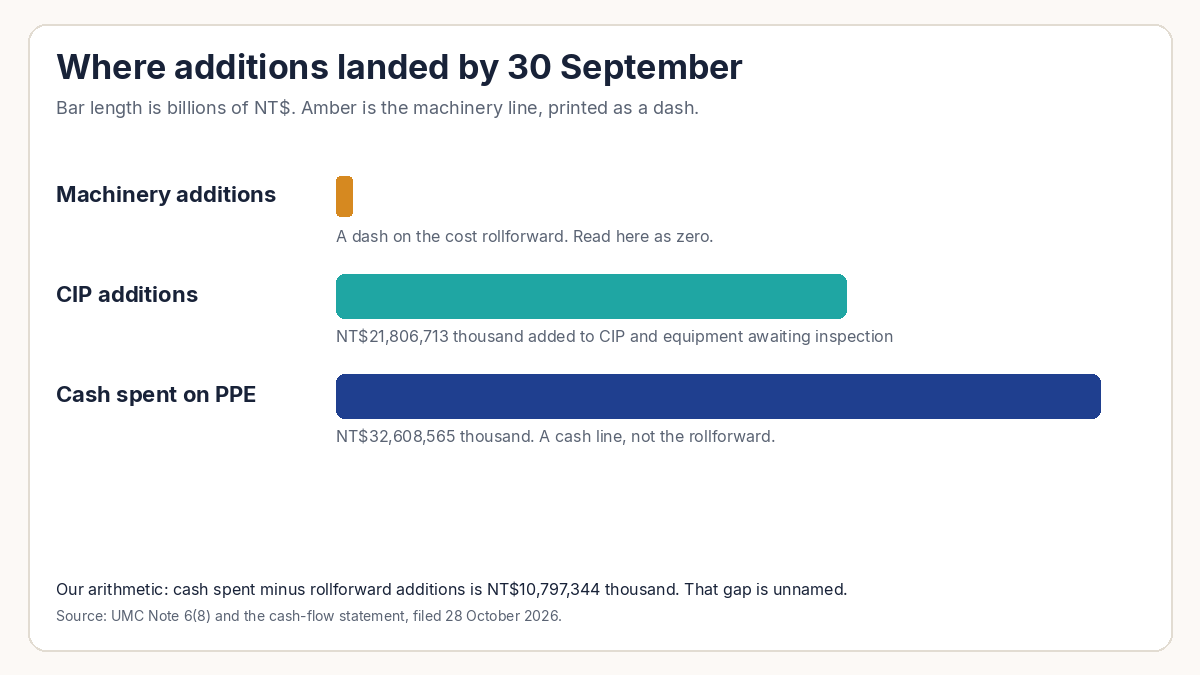
The cost rollforward shows where additions landed before the approval. Total additions are NT$21,811,221 thousand. Buildings take NT$4,508 thousand. Construction in progress and equipment awaiting inspection take NT$21,806,713 thousand. Machinery additions are a dash. 4,508 + 21,806,713 = 21,811,221, which closes only if the dash is zero. The construction-in-progress column also closes: 26,966,564 + 21,806,713 − 5,353 − 29,015,562 + 368,644 = 20,121,006 thousand, the printed ending balance. The batch price is 37.351 percent of that stock. The stock is not labelled with Lam’s name.
Machinery cost still rose by NT$40,161,251 thousand, from NT$1,179,267,510 thousand to NT$1,219,428,761 thousand. Transfers in of NT$31,087,823 thousand, plus exchange of NT$11,077,268 thousand, minus disposals of NT$2,003,840 thousand, equal that rise. Tools reach the machinery line by transfer out of the awaiting-inspection column. This announcement does not say the Lam batch has transferred.
Cash spent minus rollforward additions is 32,608,565 − 21,811,221 = 10,797,344 thousand. The statements do not label the difference. It is larger than the Lam batch, and subtracting the batch from it would invent a remainder: the approval is after 30 September, and the occurrence window overlaps the nine months. The filing does not split the batch by date.
Depreciation is the bridge that does close. Main-rollforward depreciation of NT$46,224,647 thousand, plus NT$47,456 thousand on the note’s second rollforward, plus right-of-use depreciation of NT$542,779 thousand, equals the cash-flow depreciation of NT$46,814,882 thousand. Those three lines meet. The Lam price meets none of them. The two rollforward nets, NT$251,511,832 thousand and NT$1,690,936 thousand, sum to the balance-sheet property line of NT$253,202,768 thousand. Machinery on the second rollforward stays at a cost of NT$6,345 thousand and a net of zero.
Prepayments are an open bridge, and they are the wrong shelf for this order. The balance-sheet line falls by NT$286,306 thousand, from NT$3,496,213 thousand to NT$3,209,907 thousand. The cash-flow reconciliation prints NT$1,373,334 thousand. The NT$1,087,028 thousand difference is unnamed. It is not a printed deposit on the Lam batch.
The Applied Materials batch in the 6 October exhibit is NT$6,983,784,720. Lam is larger by NT$531,678,385, or 7.613 percent. The windows overlap from 27 January through 1 October. Their sum, NT$14,499,247,825, is in neither filing. The Synopsys price is 6.417 times smaller (7,515,463,105 / 1,171,169,241). It equals 55.015 percent of nine-month intangible-asset cash of NT$2,128,802 thousand, and that window also runs past 30 September, so the percentage is a scale. The Synopsys form names working capital as the source of funds. The Lam form has no such line.
The restricted-share count does divide cleanly. Paid-in capital falls NT$5,734,190 and shares fall 573,419, exactly NT$10 a share. Parent equity of NT$470,916,768 thousand divided by the old share count is NT$37.5545, which rounds to the printed NT$37.55. The same equity on the new share count is NT$37.5563, which rounds to NT$37.56. The filing does not print that numerator. The tool form has no count to divide by. Interest capitalised for the 2026 nine months is zero, and asset-acquisition grants of NT$3,981,430 thousand are a separate cash inflow. The Lam form mentions neither.
Where does the money stick?
The seller on the form is paid when the purchase order’s payment term says so. The term is not copied into the announcement. UMC has named the price and the counterparty. The cash movement is stuck on a document the public filing points to and does not quote.
October’s NT$25,197,532 thousand and the quarter’s NT$74,239,117 thousand are recognised wafer revenue. Cash at 30 September was NT$142,616,840 thousand, and nine-month operating cash flow was NT$85,694,244 thousand. A cash balance is not a statement that this batch has been paid from it. The software form names working capital. The machinery form does not.
Inside the factory accounts, money that has been spent on tools and has not yet become machinery sits in construction in progress and equipment awaiting inspection. That is the column that took NT$21,806,713 thousand of additions through September, and the column that still held NT$20,121,006 thousand at the month’s end. The Lam approval is later than that balance sheet. The occurrence window is earlier than that balance sheet at its start. The batch can overlap the column without being identified inside it. Until a filing attaches this price to a delivery, a payment, or a transfer into machinery, the identifiable stuck step is the blank purchase-order clock.
Is delivery still stuck?
Yes, on the documents in hand. The announcement gives a price, a seller, a purpose, and an approval date of 13 November 2026. It gives no arrival date, no acceptance date, no fab, and no tool name. The only quantity is one batch, so a chamber count cannot be computed from the unit price.
The September machinery line does not fill that blank. Additions there are a dash. Tools that did reach machinery arrived by transfer, in amounts the note does not tie to a supplier. A purchase order inside the 27 January window can already have been paid or still be open. “Previously released: NA” says the price is newly public. It does not say the invoice is unpaid. The payment sentence contains no amounts and no dates. The 23 November outline filed beside it does not add a model or a day.
What dates matter
Counting both ends, the occurrence window from 27 January to 13 November 2026 is 291 calendar days. Our day count measures the window. It does not assign a purchase order to a day inside it. The other dates on the page are 30 September, the account cutoff; 28 October, the statements; 1 October and 6 October, the Applied Materials batch; 5 November, October sales; 10 November and 12 November, the Synopsys batch and the share cancellation; 13 November and 17 November, this price and this 6-K; 23–24 November, the Citi conference at 09:00, outline limited to the event name.
The next monthly sales figure is not in this 6-K. A November sales print would be a wafer number unless it names this batch.
How is this different from the October tool batch?
The 1 October batch uses the same form. One batch, unit price equal to the total, payment “Base on purchase order payment term,” purpose “For production and R&D,” price negotiation, market price, the Selection Meeting, board resolution NA, appraisal NA. The seller is Applied Materials South East Asia Pte. Ltd., and the price is NT$6,983,784,720. The Lam batch is a later window, a different seller, and a price NT$531,678,385 higher. Same blank clock. New price.
The Synopsys batch, filed four days earlier, is software and intellectual property, with a named funding source and a named CPA. Adding its NT$1,171,169,241 to the Lam price produces a figure neither exhibit prints.
TSMC’s October invoice named a month of foundry revenue and left the back end of the mix unnamed. UMC’s October revenue is named too, in the 5 November sales report. This 17 November print names a tool price and leaves delivery unnamed. The September TSMC invoice is that same shape, one month earlier. Hanmi’s quarter is the tool seller with tools already accepted and the exchange line unnamed. Here the price is in New Taiwan dollars and the delivery line is blank. This filing is the order.
What would change this view?
A payment schedule, a delivery or acceptance date, a tool count, a fab, or a model name would move the stuck step. So would a later rollforward that ties this price to machinery, or a source-of-funds line of the kind the Synopsys form already uses. The 23–24 November outline, as filed, contains none of these. A later filing that put the whole batch inside the 30 September cash line would also change the view. This exhibit says prior material information on the event was NA, and it still leaves the cash split unstated.
Practical takeaways
- Treat NT$7,515,463,105 as the price of one batch. The average unit price is that same number, so there is no per-tool price to divide.
- The seller is named: Lam Research International Sdn. Bhd. The payment clock is the purchase order, and the dates on that order are not in the filing.
- October’s NT$25,197,532 thousand is wafer sales. Nine-month equipment cash of NT$32,608,565 thousand ends on 30 September. The approval is 13 November. These are three clocks.
- Machinery additions through September are a dash. Additions that the rollforward does print went to construction in progress and equipment awaiting inspection.
- Leave the unnamed gaps unnamed. Cash spent minus rollforward additions is NT$10,797,344 thousand. The prepayments bridge is off by NT$1,087,028 thousand. Neither gap is labelled as this batch.
- The Applied Materials price and the Synopsys price are other batches. The filings do not add them to the Lam price.
FAQ
Who gets paid on UMC’s 13 November machinery announcement?
Lam Research International Sdn. Bhd. is the named seller on a machinery batch UMC priced at NT$7,515,463,105. The Selection Meeting set that price by negotiation against market price. The form does not say which day the seller receives the cash.
How big is the Lam Research batch?
The batch price is NT$7,515,463,105, and the average unit price on the form is the same figure because the volume is one batch. Our arithmetic puts that price at 29.826 percent of October net sales and 23.048 percent of nine-month equipment cash. Those are scales. They are not a claim that the cash has been paid.
Does the filing say when the tools arrive or when UMC pays?
The payment line reads “Base on purchase order payment term,” and the form leaves delivery dates, payment amounts by date, the fab, and the tool name blank. The approval date is 13 November 2026. That is the date the price was approved for announcement, not a delivery date. The 6-K that carries the announcement is dated 17 November 2026.
Is the batch already on the 30 September machinery line?
Machinery additions for the nine months ended 30 September are a dash, and that balance sheet predates the 13 November approval. The additions the rollforward does print, NT$21,806,713 thousand, went to construction in progress and equipment awaiting inspection. Orders inside the 27 January window could already sit in that column, and this filing does not split the batch by date.
What would move this batch from a price to a delivered tool?
A later document that prints a delivery date, a payment schedule, or a tool count would move it, as would a rollforward that ties this price to machinery rather than leaving it as a material-information total. The conference outline in the same 17 November exhibit names Citi’s Taiwan Corporate Day on 23–24 November and does not include those facts.
Keep reading on the map
The Taiwan markets page collects the country pulses. TSMC’s October invoice is the foundry print where the month’s revenue is named and the back end of the mix is not. The September TSMC revenue pulse is the same invoice shape, one month earlier. Fab utilization explains why a line that is already running is a different fact from a tool that is still on order. Hanmi’s quarter is the tool seller who has already been paid for accepted tools, with the currency bridge left unnamed. The semiconductors stack is the longer map of who pays for the factory.
The documents behind this pulse are the 17 November exhibit, the 17 November 6-K, the 12 November exhibit, the 6 October machinery exhibit, the 5 November sales announcement, and the nine-month financial statements filed on 28 October.