NT$3.9 Billion of New Leases: Who Gets Paid While Taiwan’s Telcos Wait for AI Power-On
Taiwan's telcos are adding AI data centre space by renting halls or selling them before they open. Taiwan Mobile's leased assets jumped NT$3.9 billion in a quarter as megawatts were energised, while its capex fell. Landlords and builders are paid first; the stuck step is power-on.
Taiwan's telecom operators are adding AI data centre space by renting halls, or by selling them before they open, and they get paid only as each block of megawatts is switched on. Taiwan Mobile's third-quarter accounts show it: its leased assets rose about NT$3.9 billion in three months as new AI halls were energised, while its cash capex fell. Chunghwa Telecom builds its own halls, but for customers it has already signed. The landlord and the builders are paid first. The stuck step is power-on.
TAIWAN · AI DATA CENTERS · Q3 2026 results, 4 to 12 Nov 2026 · Next update: Taipower's fair-allocation rule for AI data centre power
Affects: AI Data Centers · Hyperscalers · Neoclouds — Markets: Taiwan · Korea · Malaysia · Singapore
Education only, not advice to buy or sell any security. Figures are as published by the companies named, or as reported where stated, unless labelled as our arithmetic. New Taiwan dollar figures are not converted.
The numbers that matter this week
Taiwan Mobile right-of-use assets
NT$18.65B
Up from NT$14.73B in Q2 · tied to energised MW
LeasingTaiwan Mobile data centre revenue, Q3
+140%
A new phase of AI hall capacity switched on
EarningTaiwan Mobile cash capex, 9 months
NT$6.62B
Down 25% on the year · the hall sits on a lease
LightChunghwa IDC revenue, Q3
+26%
10th straight quarter · Lunping up to 36 MW
EarningTaipower AI data centre approvals
1,441 MW
750 MW of it in 2026 · approved is not running
ApprovedPower-on
The bind
Each phase pays only once its megawatts are live
Stuck stepFigures from Taiwan Mobile (12 Nov 2026), Chunghwa Telecom (4 Nov 2026) and Taipower's chairman (14 Oct 2026, as reported). Status chips are Second Order’s read.
On this page: Why it matters · Taiwan Mobile · The Guishan lease · Chunghwa · Far EasTone and Chief · Taipower · Our math · Who gets paid · What is stuck? · Dates next · Elsewhere · What would change this · FAQ
Why do the telcos' results matter for Taiwan's AI data centres?
Because Taiwan's companies assemble a large share of the world's AI servers, yet little is said in public about the halls that run them at home. The island's three big telecom operators, together with Chunghwa's data centre arm Chief Telecom, are the listed companies closest to that build. In the space of three weeks they showed how they are paying for it, and the answer is mostly not with their own capex.
That matters for who gets paid and when. A telco that rents a hall from a developer does not pay for the building up front. It signs a long lease, and the cost lands on its balance sheet in steps as each floor is powered and handed over. A telco that builds its own hall does pay up front, so it wants a customer signed before it pours concrete. Either way, nobody earns until the power is on.
In October we followed the wires that have to reach these halls in our Taipower grid Pulse, which covered the 43 substations Taipower plans over 15 years. This piece is one step further along: the halls themselves, who owns them, and what has to happen before they pay. For what makes an AI hall different from an ordinary data centre, see what an AI data center is.
1 · Landlords and developers
Who: Land, building and power connection, leased to the telco
Paid: Vantage at Guishan: lease to 30 Sep 2035, NT$8.983B
2 · Builders and power gear
Who: Construction, fit-out, electrical and cooling plant
Paid: Chunghwa ICT orders +84% in Q3 on AIDC installations
3 · Telcos with live halls
Who: Colocation and AI hall services to cloud and enterprise users
Paid: Taiwan Mobile data centre revenue +140%; Chunghwa IDC +26%
4 · The next phase of megawatts
Who: Halls and floors still waiting to be energised
Paid: Taiwan Mobile: schedule set by energised-MW milestones
What did Taiwan Mobile's accounts show?
That its AI data centre growth is arriving through leases, not capex. Taiwan Mobile reported its third quarter on 12 November 2026. On the call, the company said it had activated a new phase of AI data centre capacity in the quarter, and that this drove data centre revenue up 140% and lifted its enterprise arm, which it calls Telco+, by 34%.
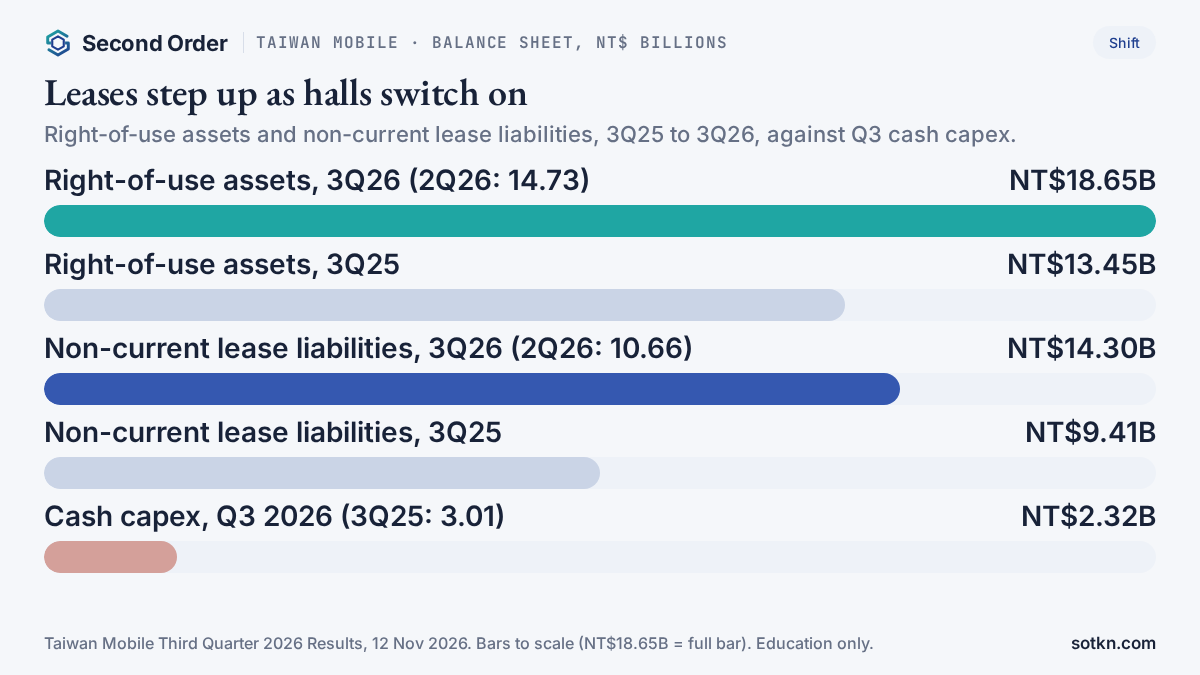
The balance sheet shows what that phase cost and how it was paid for. Right-of-use assets, which is where a company books the space it leases, rose to NT$18.65 billion from NT$14.73 billion at the end of June and NT$13.45 billion a year earlier. Lease liabilities rose with them: NT$4.75 billion current and NT$14.30 billion non-current, against NT$4.37 billion and NT$10.66 billion in June. The company said both rose because it executed a phased AI data centre commercialisation schedule, in line with sequential milestones for energised megawatts.
- Capex went the other way. Group cash capex for the first nine months fell 25% on the year to NT$6.62 billion. In the third quarter alone it was NT$2.32 billion, against NT$3.01 billion a year earlier.
- Depreciation moved into leases. The company said lower equipment depreciation more than offset the IFRS 16 lease depreciation that came with the AI data centre expansion. Under IFRS 16, rent on a building like this is booked mostly as depreciation of the leased asset.
- Cash flow felt the ramp. Operating cash flow fell to NT$7.56 billion in the quarter from NT$9.35 billion a year earlier. The company put part of that down to scaling up AI data centre services, alongside a pay-TV content business and a new retail brand.
In plain terms: the hall arrives on Taiwan Mobile's books as a lease when it is powered and handed over, not as a building it paid for. For how the two kinds of lease are accounted for, see finance lease versus operating lease, and for why capex and depreciation tell different stories, see capex versus depreciation.
How does the Guishan lease work?
Taiwan Mobile's AI hall is in Guishan, Taoyuan, on a campus developed by Vantage, the US data centre company. In the model Taiwan Mobile has described, Vantage is responsible for the land, the building and the power. Taiwan Mobile leases the halls and installs the equipment its customers need.
The lease runs from 1 July 2025 to 30 September 2035. In a filing on 31 July 2026, reported by the Economic Daily News, Taiwan Mobile raised the right-of-use amount for the lease to NT$8.983 billion, because some floors had been leased early. The hall has a maximum load of 25 MW, of which 16 MW is IT load for the servers, and it can cool up to 135 kW per rack.
The early floors are the point. Taiwan Mobile did not take the whole building on day one. It took floors as they were ready, and each one added to the lease on its balance sheet. The third-quarter jump in right-of-use assets is that process showing up in the numbers. The Commercial Times reported on 5 November that Taiwan Mobile plans to add another 1 MW of capacity at Guishan, due to start by the end of the second quarter of 2027.
The 25 MW and the 16 MW are different meters: the first is power into the building, the second is power available to the computers, with the rest going to cooling and conversion. For the difference, see contracted power, explained and how much power an AI data center uses. For how a data centre lease is put together, see data center leases, explained.
How is Chunghwa Telecom doing it differently?
Chunghwa, Taiwan's largest telco, builds and owns its halls, but it builds for customers it has already confirmed. On 5 August 2026 it started operating a new AI data centre in Lunping, Taoyuan, which it said will add up to 36 MW to its data centre capacity at full build-out. It has a second AI data centre under construction in Taichung, where it signed a memorandum with the Taiwan Stock Exchange in July to provide dedicated colocation space.
Asked on that August call what the 36 MW would cost and what return it expected, Chunghwa declined to give project figures. It said the Lunping and Taichung sites are being built to provide AI data centre service for confirmed customers.
The third-quarter numbers, reported on 4 November, show the business moving. Chunghwa said IDC revenue grew 26% on the year, its tenth straight quarter of growth, helped by installation projects for high-tech companies. Third-quarter ICT order intake rose 84%, and cumulative orders to September were already 1.4 times the whole of 2025, driven by large government projects and AI data centre installations for enterprise customers. Total capex for the nine months was NT$16.17 billion, down 6.5% on the year.
So Chunghwa earns twice from the same trend: once as a landlord with its own halls, and once as a contractor installing AI data centre systems for enterprise and government customers. For why governments and companies want AI computing kept inside the country, see sovereign AI, explained.
Where do Far EasTone and Chief Telecom stand?
Far EasTone, the third big operator, has not committed. At its third-quarter call on 5 November, president Chee Ching said the company is actively evaluating AI data centre investment but has not decided on building a new one, and will weigh group resources and returns first. It has planning under way for its existing data centres, the Commercial Times reported.
Chief Telecom, the data centre company in the Chunghwa group, is building outside Taipei. It broke ground on 20 October on an AI data centre in Huwei, Yunlin, in the Central Taiwan Science Park area. The Commercial Times reported a total investment of about NT$3.3 billion, a four-storey building with 16 MW of total power, and operation from the second half of 2028. Chief Telecom's chairman said about half the space is already reserved, mainly by large international cloud providers and fintech, medical and agricultural technology users. The company aims for the site to turn a profit by 2031.
Put together, the four companies are running three models at once: rent from a developer (Taiwan Mobile), build for confirmed customers (Chunghwa and Chief), and wait (Far EasTone). What none of them does is build a large hall on spec and hope a tenant turns up.
That is the same caution we saw in Korea last week, where operators outside Seoul said they want a tenant before they build, in our Korea tenants-first Pulse. For the difference between a hall built for one cloud tenant and one rented out to many, see hyperscale versus colocation data centers.
How much power has Taipower approved for AI data centres?
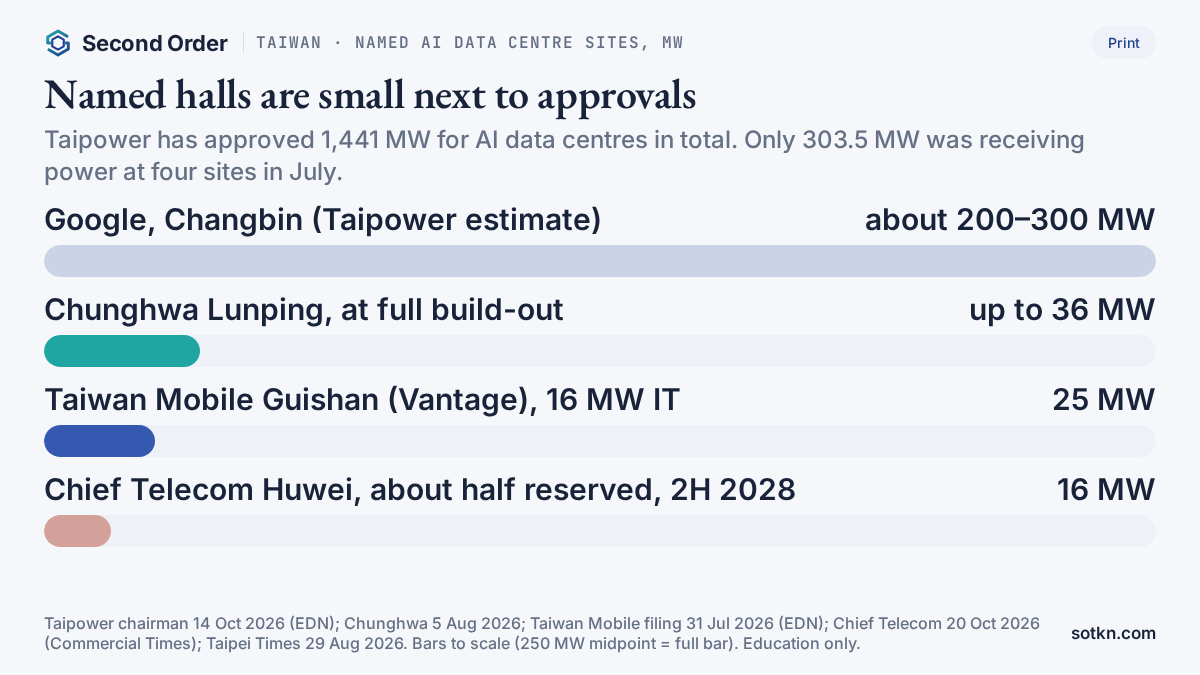
A lot more than the telcos are using. Taipower's chairman Tseng Wen-sheng said on 14 October 2026 that the utility has approved 1,441 MW of supply for AI data centres in total, 750 MW of it in 2026 alone. Google's site in the Changbin industrial zone accounts for about 200 to 300 MW. Other applicants include telecom and communications companies, he said.
He also named a problem. Some of those applying, he said, are not the investors who will build and run a hall but site providers who reserve power for a plot and then go looking for an investor. A 100 MW AI data centre needs about NT$150 billion of funding, he said, so some applicants secure the power first. That troubles Taipower, because power approved for one site cannot go to another. He said the utility wants approvals to go to real investors and is thinking about how to set fair rules.
Approved is not the same as running. Taipower data to 31 July, reported by the Taipei Times in August, showed 75 transmission-level data centre requests for 4,523 MW. Taipower had agreed to 47 of them, for 3,331 MW, but about 40% of those did not proceed to a formal application in time and expired. Only four sites, with 303.5 MW of contracted capacity, were actually receiving power; five more, with 567 MW approved, were under construction.
So the scarce thing in Taiwan is not a megawatt on paper. It is a megawatt that is approved, connected, switched on and sitting under a hall with a customer in it. For where Taiwan's grid has to go to deliver that, see our Taipower grid Pulse, and for why AI campuses cluster where they do, see where AI data centers are located.
What does our arithmetic show?
Taiwan Mobile, one quarter
Megawatts in context
Three caveats. First, Taiwan Mobile's right-of-use assets cover all its leases, including towers, shops and warehouses, so not every dollar of the NT$3.9 billion is Guishan; the company tied the rise to the AI data centre schedule, but did not split it out. Second, the NT$8.983 billion is the right-of-use amount the company disclosed for the lease, which is a present-value accounting figure rather than a sum of future cheques. Third, the 77 MW mixes power into the building (Lunping, Guishan, Huwei) with no IT-load split for two of the three.
One more comparison shows where the money in an AI hall really goes. Taipower's chairman put the funding for a 100 MW AI data centre at about NT$150 billion, or about NT$1.5 billion per megawatt. Chief Telecom's Huwei building comes to about NT$206 million per megawatt (our arithmetic), roughly a seventh of that. On our reading, most of the rest is the computing equipment that tenants put inside, which is why a telco can rent or build the shell and still leave the largest bill to its customers.
For what a megawatt costs to build around the world, see how much it costs to build an AI data center.
Who gets paid, and in what order?
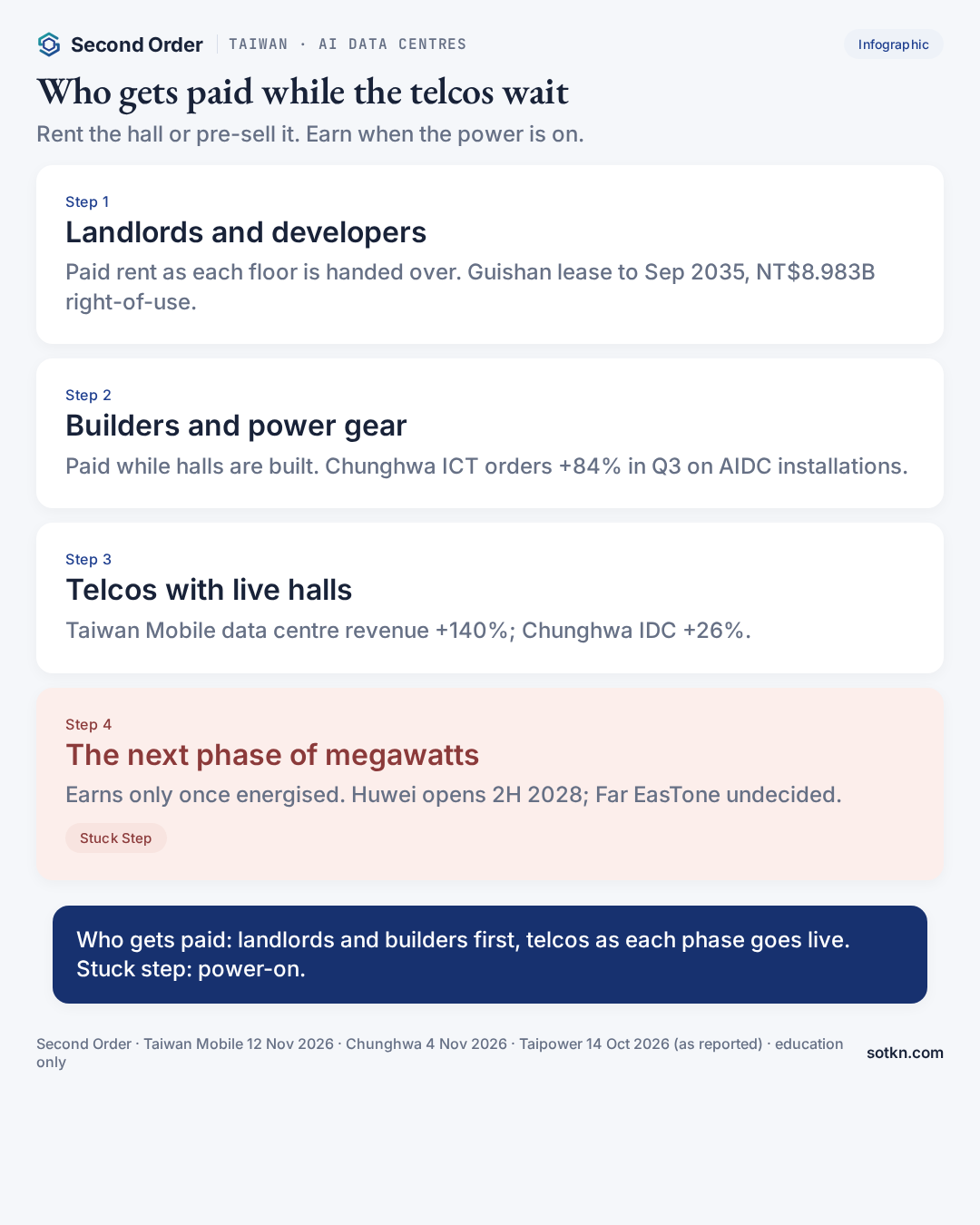
First, the landlord. A developer that provides the land, building and power connection is paid rent from the day each floor is handed over, on a lease that runs about ten years at Guishan. It carries the building cost; the telco carries a long rent bill. Taiwan Mobile's NT$3.9 billion step-up in leased assets in one quarter is, on the other side of the contract, a developer's income locked in.
Second, the builders and power and cooling suppliers. They are paid while halls are built, whoever owns them. Chunghwa's 84% jump in ICT orders, driven partly by AI data centre installations for enterprise customers, is this layer showing up in a telco's own numbers. For who those builders are, see who builds AI data centers, and for the servers made in Taiwan that fill the halls, our Hon Hai rack-ramp Pulse.
Third, the telcos with live halls. Taiwan Mobile's data centre revenue rose 140% in the quarter a new phase was switched on, and Chunghwa's IDC revenue rose 26%. They earn colocation and service fees once customers move in, and they earn more where they also sell the network and security around the hall.
Fourth, Taipower and its grid contractors, whose work sets the pace for everyone above. Their payment comes through connection works and tariffs, but their decisions decide which hall can switch on next.
Last, the next phase of megawatts: floors not yet energised, a Huwei hall half reserved but not open until 2028, and Far EasTone's hall that has not been decided. They earn nothing until the power is on and a tenant is in.
One-line rule: in Taiwan this month, landlords and builders are paid first, telcos as each phase goes live, and the next phase last. The stuck step is power-on.
So what is the stuck step?
Power-on: getting each block of megawatts approved, connected and energised so a customer can start paying. It is not money for the building: Taiwan Mobile has a landlord paying for it and Chunghwa is cutting total capex while it builds. It is not, for now, demand: Chunghwa builds for confirmed customers, Chief has half of Huwei reserved, and Taiwan Mobile took Guishan floors early. Three things keep the step tight:
- The companies say so. Taiwan Mobile ties its lease accounting to milestones for energised megawatts. Its next 1 MW at Guishan is not due until the end of the second quarter of 2027.
- Approvals are being held, not used. Taipower's chairman said some applicants reserve power before they have an investor, and its July data showed about 40% of agreed requests expired before a formal application. Power held that way is not available to a hall that is ready.
- New halls are years out. Chief Telecom's Huwei site, broken ground in October, opens in the second half of 2028. A hall that is half sold today still pays nothing for about two years.
So-what: in Taiwan the scarce thing is not a customer or a building, but a megawatt that is actually switched on. The companies that rent switched-on floors, or build where power is already secured, are the ones whose data centre revenue is growing now.
Which dates test this read next?
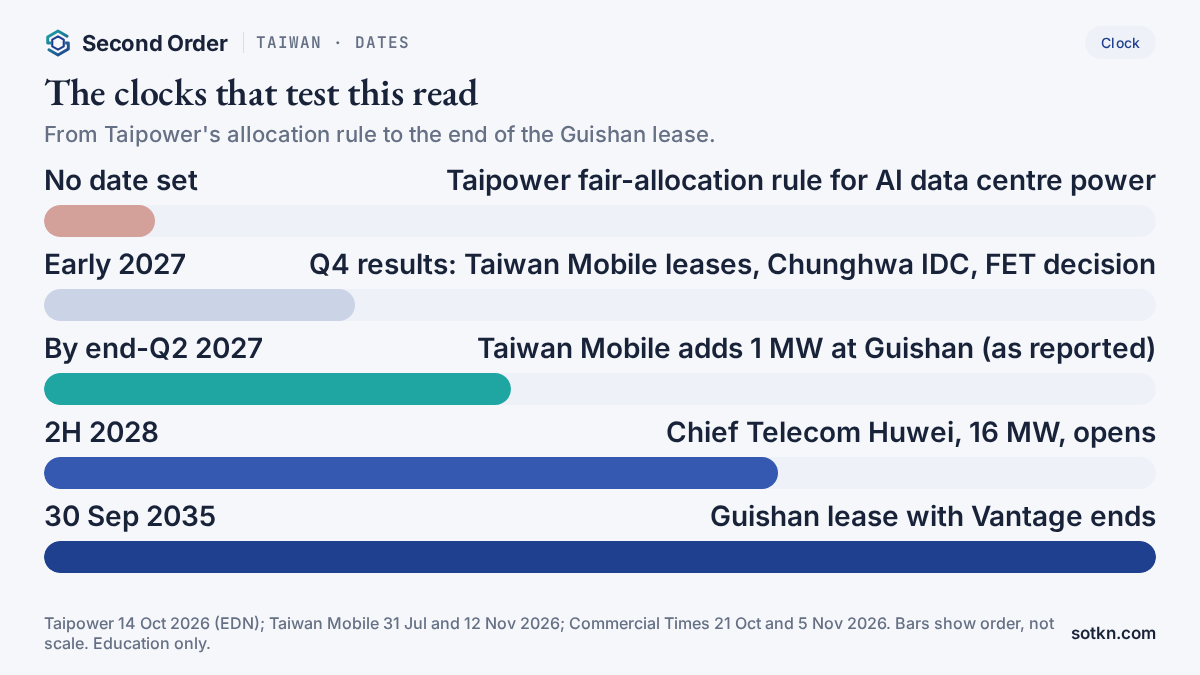
- No date set — Taipower's fair-allocation rule for AI data centre power. The test: whether it takes back approvals from site holders without an investor, freeing power for halls that are ready.
- Early 2027 — fourth-quarter results from Chunghwa, Taiwan Mobile and Far EasTone. The test: whether Taiwan Mobile's leased assets keep stepping up, whether Chunghwa's IDC growth holds, and whether Far EasTone decides on a hall.
- By end-Q2 2027 — Taiwan Mobile's extra 1 MW at Guishan is due, as reported. The test: the next block of energised capacity arriving on time.
- 2027 onward — Chunghwa's Taichung AI data centre, with the Taiwan Stock Exchange as a colocation user. The test: an opening date and how much of Lunping's 36 MW is live.
- 2H 2028 — Chief Telecom's 16 MW Huwei hall is due to open. The test: whether the other half of the space is reserved before it opens.
- 30 September 2035 — the Guishan lease ends. Until then, Taiwan Mobile's rent to Vantage is a fixed cost whether or not every rack is filled.
How does this compare with Korea, Malaysia and Singapore?
Korea's operators are building more of their own halls and holding back outside Seoul until a tenant signs, as our Korea tenants-first Pulse showed. Taiwan's telcos are smaller in megawatts and lean harder on renting from developers.
Malaysia is turning held-but-unused power into a cost. Our Malaysia booked-power Pulse followed a charge on connected power that a data centre books but leaves idle. Taipower has not done that, but its chairman's complaint about applicants holding power without an investor is the same problem.
Singapore rations megawatts by tender and then fits them out in phases. Our Equinix SG6 Pulse followed the first tender-won hall to open at 8 MW of a planned 20 MW — the same phase-by-phase power-on that shows up in Taiwan Mobile's accounts.
What would change this view?
- Taipower publishes allocation rules that free up held approvals — power-on would come faster for halls that are ready.
- Taiwan Mobile's right-of-use assets stop rising while its data centre revenue keeps growing — the bind would have moved from power to filling the halls already live.
- Far EasTone commits to a new hall, or a telco starts one with no named customer — the cautious, customer-first pattern would be breaking.
- Chief Telecom's Huwei date slips past 2028 — the stuck step would be construction as well as power.
- Chunghwa's ICT orders fall back — the installation boom paying builders now would be fading.
Practical takeaways
- Taiwan Mobile right-of-use assets NT$18.65 billion, up about NT$3.9 billion in Q3, tied to energised-MW milestones
- Taiwan Mobile data centre revenue up 140%; nine-month cash capex down 25% to NT$6.62 billion
- Guishan hall leased from Vantage to 30 September 2035; NT$8.983 billion right-of-use; 25 MW, 16 MW IT load
- Chunghwa IDC revenue up 26%, ICT orders up 84%; Lunping up to 36 MW built for confirmed customers
- Far EasTone: new hall not decided; Chief Telecom Huwei 16 MW, about half reserved, opens 2H 2028
- Taipower: 1,441 MW approved for AI data centres; only 303.5 MW receiving power at four sites in July
- Landlords and builders are paid first. Stuck step: power-on
FAQ
How are Taiwan's telcos adding AI data centre capacity?
Two ways. Taiwan Mobile rents the building: at Guishan in Taoyuan, the developer Vantage provides land, building and power, and Taiwan Mobile leases the halls and fits them out for customers, on a lease running to 30 September 2035 worth NT$8.983 billion. Chunghwa Telecom builds its own, but for customers it has already confirmed: its Lunping site in Taoyuan opened in August with up to 36 MW at full build-out, and a Taichung site is under construction with the Taiwan Stock Exchange signed up for space. Far EasTone said on 5 November that a new AI data centre is still being evaluated.
Why did Taiwan Mobile's leased assets jump?
Because more of the Guishan halls were switched on and handed over. Under IFRS 16 a lease is booked as a right-of-use asset and a matching liability when the space becomes available. Taiwan Mobile's right-of-use assets rose from NT$14.73 billion to NT$18.65 billion in the third quarter, and it said this followed a phased AI data centre schedule in line with milestones for energised megawatts. That is about NT$3.9 billion in one quarter, on our arithmetic, against cash capex of NT$2.32 billion.
How much power has Taipower approved for AI data centres?
Taipower's chairman said on 14 October 2026 that it has approved 1,441 MW for AI data centres in total, 750 MW of it this year, with Google's site in Changbin alone at about 200 to 300 MW. Approved is not the same as running: Taipower data reported by the Taipei Times showed 303.5 MW contracted at four sites actually receiving power as of July.
Who gets paid first while the halls are switched on?
On our map: the landlord and the builders. A developer like Vantage is paid rent from the day each floor is handed over, on a lease that runs about ten years. Contractors and power and cooling suppliers are paid while the halls are built. The telco earns when its customers move in and the megawatts behind them are live, which is why Taiwan Mobile's data centre revenue rose 140% in the quarter a new phase was activated.
What is the stuck step?
Power-on: getting each phase of a hall energised so a customer can start paying. Taiwan Mobile ties its accounts to milestones for energised megawatts; Chief Telecom's Huwei hall, half reserved, does not open until the second half of 2028; and Taipower says some applicants are holding power approvals before they have an investor, which can keep power from those ready to build.
Is this investment advice?
No. Education only. It maps who gets paid and which step is stuck. It is not a recommendation to buy or sell any security, and we leave out share prices, valuations, broker ratings and price targets on purpose.
Keep reading on the map
- Taiwan Markets hub — country page
- Taipower grid Pulse · Hon Hai rack-ramp Pulse · Taiwan memory imports Pulse · Taiwan ready fab shell Pulse
- Korea tenants-first Pulse · Malaysia booked-power Pulse · Equinix SG6 Pulse
- AI Data Centers on the Stack · Hyperscalers · Neoclouds
- What is an AI data center? · Data center leases · Finance vs operating lease · Contracted power · How long a build takes
- All Markets doors — Taiwan, Korea, US, China, Singapore, Australia, Malaysia
How we check this. Taiwan Mobile figures come from its third-quarter management report and call script of 12 November 2026, and the Guishan lease terms from its 31 July 2026 filing as reported by the Economic Daily News. Chunghwa Telecom figures come from its third-quarter results release and call script of 4 November and its second-quarter call script of 5 August. Far EasTone and Chief Telecom remarks are as reported by the Commercial Times on 5 November and 21 October. Taipower's approval figures are from its chairman's remarks of 14 October as reported by the Economic Daily News, and its July connection data as reported by the Taipei Times. Anything we worked out ourselves is labelled “our arithmetic”. Share prices, valuations, broker ratings and price targets are left out on purpose. The references we used are listed at the end. Our editorial standards →
Not investment advice. Do your own research.
References
- Taiwan Mobile, Third Quarter 2026 Results (management report), 12 Nov 2026. corp.taiwanmobile.com — right-of-use assets NT$18.65 billion vs NT$14.73 billion in Q2 and NT$13.45 billion a year earlier; current lease liabilities NT$4.75 billion and non-current NT$14.30 billion vs NT$4.37 billion and NT$10.66 billion; phased AIDC commercialisation in line with milestones for energised MW; Q3 cash capex NT$2.32 billion; IFRS 16 lease depreciation tied to AIDC expansion.
- Taiwan Mobile, 3Q26 Results Conference Call script, 12 Nov 2026. corp.taiwanmobile.com — a new phase of AIDC capacity activated in the quarter; data centre revenue up 140%; Telco+ revenue up 34%; group cash capex down 25% to NT$6.62 billion for the first nine months.
- Economic Daily News, Taiwan Mobile: Guishan AIDC rent raised to NT$8.983 billion (Chinese), 31 Jul 2026. money.udn.com — lease with Vantage for the Guishan, Taoyuan data centre from 1 July 2025 to 30 September 2035; right-of-use amount updated to NT$8.983 billion because some floors were leased early; 25 MW maximum load, 16 MW IT load, up to 135 kW per rack.
- Chunghwa Telecom, Third Quarter 2026 operating results release, 4 Nov 2026. cht.com.tw — revenue NT$67.59 billion, up 16.7%; ICT revenue up 19%; third-quarter ICT order intake up 84%.
- Chunghwa Telecom, Q3 2026 conference call presentation script, 4 Nov 2026. cht.com.tw — IDC revenue up 26%, a tenth straight quarter of growth, on installation projects for high-tech companies; cumulative ICT order intake to September 1.4 times full-year 2025, on government projects and AIDC installations for enterprise customers; capex NT$16.17 billion for the nine months, down 6.5%.
- Chunghwa Telecom, Q2 2026 conference call presentation script with Q&A, 5 Aug 2026. cht.com.tw — Lunping, Taoyuan AI data centre started operation, adding up to 36 MW at full build-out; Taiwan Stock Exchange memorandum for dedicated colocation in the Taichung AI data centre under construction; both built for confirmed customers; project IRR not disclosed.
- Commercial Times, Far EasTone Q3 call: new AIDC not yet decided (Chinese), 5 Nov 2026. ctee.com.tw — Far EasTone president Chee Ching said a new AI data centre is being evaluated but not decided; Taiwan Mobile plans 1 MW more at Guishan by the end of Q2 2027.
- Commercial Times, Chief Telecom breaks ground on Huwei AI data centre (Chinese), 21 Oct 2026. ctee.com.tw — groundbreaking on 20 October; about NT$3.3 billion; 16 MW total power; four floors; operation in the second half of 2028; about 50% reserved, mainly by international cloud providers and fintech; aiming for profit by 2031.
- Economic Daily News, Taipower chairman: AIDC power for real investors (Chinese), 14 Oct 2026. udn.com — Taipower approved 750 MW for AI data centres in 2026 and 1,441 MW in total; Google at Changbin about 200 to 300 MW; some applicants reserve power for sites before finding investors; a 100 MW AI data centre needs about NT$150 billion; Taipower considering fair approval rules.
- Taipei Times, Taiwan's AI strategy has a public data problem, 29 Aug 2026. taipeitimes.com — Taipower data to 31 July: 75 transmission-level data centre requests for 4,523 MW, 47 agreed for 3,331 MW, about 40% of those expired; 303.5 MW contracted at four sites receiving power; five more sites under construction with 567 MW approved.