What Does Advantest Do? The Chip Tester Model
Advantest builds the automated testers that check AI processors and memory before they ship. Demand is outrunning its factories, and the DRAM inside each tester is getting scarce, so building testers is the step that binds.

STACK · Semiconductors · Status: Tightening · Last reviewed: 31 Oct 2026
Advantest is a Japanese company that makes automated test equipment, the machines that check whether a chip works before it is shipped. Chipmakers, foundries and test houses buy its testers to check AI processors, CPUs and memory, then pay it again for interface boards, upgrades and service.
In short. Advantest makes the machines that test chips before they ship, and it sells most of the testers used on AI processors. It expects SoC tester sales of ¥1,375 billion in the year to March 2027, three times the level of two years earlier, and it raised its forecast this week because it could build and ship more machines than planned. Our read: Advantest gets paid first, at a gross margin above 70%. The stuck step is its own output: more than 5,000 SoC testers a year today against a goal of 10,000, with each machine needing DRAM that is scarce.
Why an investor cares: every AI chip has to pass test before it can be sold, and each new generation spends longer on the tester than the last. Advantest sits at that gate for most of the industry’s processors. If you want the whole test chain, from tester makers to test houses, start with our guide to who tests AI chips. This page is about the company that makes most of the machines.
Numbers that matter
| Number | What it is | Why it matters |
|---|---|---|
| ¥477.7bn | Sales, July–September 2026, a record | Up 30% on the quarter before, at a 55.9% operating margin |
| ¥1,375bn | SoC tester sales forecast, year to March 2027 | Raised from ¥1,243.5bn in July; ¥440.4bn two years earlier |
| 66% | Advantest’s estimate of its SoC tester share, 2025 | Up from 56% in 2024; it sees a path above 70% |
| 5,000+ | SoC testers it can build a year | Target 10,000, originally by March 2029, now to come much sooner |
| about 7× | Rubin final test time against Hopper, Nomura estimate | Each AI chip ties up a tester for longer |
Company and analyst figures are listed at the end of the page. The quarterly rise is our arithmetic from ¥367.5bn to ¥477.7bn.
What does Advantest actually do?
It builds the machines that decide whether a chip ships. A tester sends signals into a chip, reads what comes back and compares it with what a good chip should do, pin by pin and at full speed. A chip is tested at least twice: once while it is still part of a wafer, through a probe card that touches each die, and again after it has been packaged, often followed by burn-in and system-level test.
Advantest sells into both steps. Its main products are the V93000, a platform for testing system-on-chip devices such as GPUs, custom AI chips, CPUs and network chips, and a range of memory testers for DRAM and flash. Around those it sells test handlers that move chips in and out, device interfaces that connect each chip design to the tester, and system-level test machines.
The company was founded in 1954 as Takeda Riken Industries, a maker of electronic measuring instruments, and launched Japan’s first semiconductor test systems in 1972. Its biggest step came in 2011, when it bought Verigy, then a major rival in chip test. That deal brought the V93000, first launched in 1999, which is now the base of its AI business.
Almost none of its sales are at home. In the six months to September 2026, 99.4% of sales went to customers outside Japan. On Advantest’s regional chart, more than half of July–September sales, ¥261.3 billion of ¥477.7 billion, shipped to Taiwan, where most AI processors are made and packaged. Our guide to who makes advanced packaging covers the step just before test.
How does Advantest make money?
Mostly by selling machines. In July–September 2026 test systems brought in ¥436.7 billion of its ¥477.7 billion sales. SoC testers were ¥353.3 billion of that and memory testers ¥53.4 billion; the rest, about ¥30 billion on our arithmetic, came from handlers, system-level testers and device interfaces. Services and others added ¥41.1 billion, from support contracts on the installed base and consumables such as test interface boards.
The margins are unusually high for a machine maker. Gross margin passed 70% in the quarter, at 71.1%, and operating margin was 55.9%, because the most complex and most expensive testers, the ones used on AI chips, made up more of the mix. Advantest expects a gross margin of about 68% for the full year and an operating margin of 51.9%.
For the year to March 2027 it now expects sales of ¥1,863.0 billion and operating income of ¥967.0 billion, up from ¥1,714.0 billion and ¥846.0 billion in its July forecast. Second-half sales are expected to be about 20% above the first half. The yen helps: Advantest says each one-yen fall against the dollar adds about ¥5.8 billion to annual operating income.
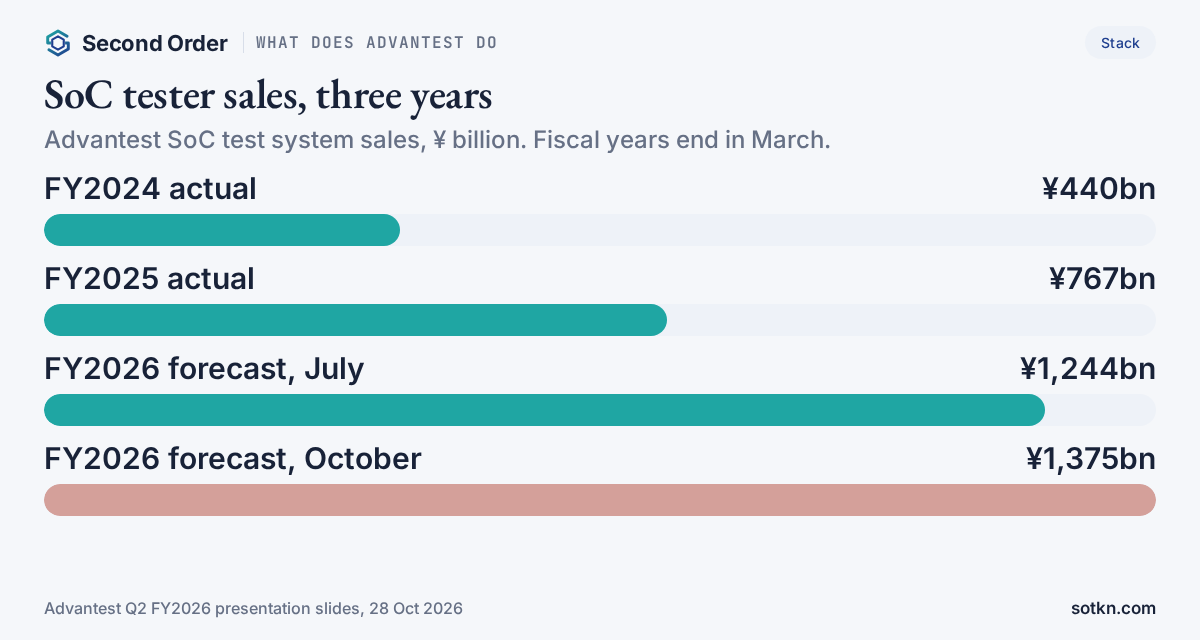
The chart shows the shape of the business. SoC tester sales are on course to roughly triple in two years, on our arithmetic, and the October forecast is ¥131.5 billion above the July one. Advantest said that increase did not come from a bigger market forecast, which it left unchanged. It came from building and shipping more machines than it had planned.
Why is demand still rising?
Two forces stack on top of each other: more AI chips, and more test time per chip. Advantest put it plainly on 28 October: tester demand is driven by rising chip volumes, along with more test content and more test insertions with each new generation.
The test time effect is large. Nomura estimates, as reported by TrendForce in October, that NVIDIA’s Blackwell takes about four times as long as Hopper in final test and Rubin about seven times as long. Nomura also estimates that testing’s share of a GPU’s manufacturing cost rises from 1.9% for Hopper to 2.5% for Blackwell and 3.3% for Rubin. Our arithmetic: if a Rubin chip ties up a tester seven times as long, the same tester handles about one-seventh as many of them in an hour.
The demand is also spreading. Advantest said the biggest single reason for raising its SoC tester forecast was CPUs, as AI agents push up the number of server CPUs and the ratio of CPUs to GPUs in inference. That sits on top of GPUs and custom AI chips, the subject of our guide to who makes custom AI chips. Further out, it expects testers for co-packaged optics, where light and electronics share a package, to double or triple each year towards a market of about $1 billion.
Advantest sizes the SoC tester market at about $11.5 billion in 2026 and the memory tester market at $2.5 billion to $3.0 billion, against about $6.0 billion for both together in 2024. It says the tester market has grown by about 50% a year on average over the past few years, and it does not yet see that slowing. Those are its estimates, and it will give a number for 2027 in January.
Who gets paid first?
- Advantest. It is paid when each tester ships, at a gross margin above 70%, and customers are paying ahead: advance receipts rose by ¥44.2 billion in the six months to September. Each tester sold then earns service fees and interface board sales for years.
- Its parts suppliers. Every SoC and memory tester uses a lot of DRAM, and Advantest says higher DRAM prices are a major reason its second-half margin will dip. The memory makers are paid before Advantest’s margin is.
- The test houses. Companies such as KYEC, ASE and Sigurd buy the testers and sell the hours. TrendForce reported in October that Sigurd’s customers are signing capacity deals of more than a year and that Sigurd has started raising prices.
- The chip designers, who pay for all of it. NVIDIA and the custom chip designers carry the bill, and on Nomura’s estimate test takes a growing share of what each GPU costs to make.
Our analysis of the CoWoS stuck step shows the same pattern one step earlier in the line: when a step is short, the owner of the scarce machine or slot sets the terms.
What limits it?
Its own factories. Advantest can now build more than 5,000 SoC testers a year. Its plan had been to reach 10,000 a year by the end of the 2028 fiscal year, in March 2029. On 28 October it said that date must come forward significantly and that it is highly confident it can do so, but it gave no new date. A further doubling, to 20,000 a year, is under internal discussion.
To get there it uses a hybrid model: its own plants for the hardest work, and outside electronics manufacturers for volume. That spreads the risk, but it also means Advantest’s output depends on how fast partners and parts suppliers can grow with it. It will explain its supply chain plan at an investor session on 12 November.
The second limit is memory. Advantest said memory supply is tight across the industry and that it is not immune. DRAM makers have shifted output from older DRAM towards HBM and server memory, the subject of our HBM explainer, and its customers know memory has to be made available for testers to be delivered. Our read: the AI build-out is now competing with itself, because the memory that goes into AI servers is also needed inside the machines that test AI chips.
The third limit is the rest of the line. Testers only earn their keep when chips reach them. Advantest expects semiconductor and advanced packaging supply to stay short of demand through 2027. TrendForce, citing Commercial Times, reported that chip equipment lead times have stretched to six to eight months from three to six. A tester that ships before the packaging line is ready waits.
Our read on the stuck step: for the next year it is Advantest’s ability to build testers, not customers’ willingness to buy them. That is why the forecast rose on capacity rather than on a bigger market, and why we mark the status Tightening.
Who else does this?
Teradyne of the US is the other large tester maker. In the quarter to 27 September 2026 it reported $1,306 million of revenue, of which $1,072 million came from semiconductor test, with record memory test sales. Advantest’s test system sales of ¥436.7 billion in July–September were about $2.7 billion at its average rate of ¥161 to the dollar, our conversion, so roughly two and a half times Teradyne’s semiconductor test revenue.
Downstream, NVIDIA expects its total testing capacity to double from 2026 to 2027 and has given KYEC a $1.1 billion advance to build US test sites. Those sites need testers, and Advantest estimates it holds about two-thirds of the SoC tester market. Upstream in the fab, the toolmakers on this layer, such as KLA and Tokyo Electron, sell into wafer making; Advantest sells into the step after it. Our guide to who makes wafer fab equipment covers that earlier step.
What would change this view?
- Easing: Advantest names a near date for 10,000 testers a year, or DRAM prices fall enough to lift its second-half margin back above the first half’s.
- Tightening further: component shortages slow shipments in the January quarter, or the packaging lines before test run late and push tester deliveries back.
- A shift in share: Teradyne winning a large AI processor as a second supplier would show whether the 66% share can keep rising towards 70%.
Practical takeaways
Read Advantest as a toll on the last gate before an AI chip ships. Its growth now depends on how many testers it can build and how much memory it can get, not on whether customers want them. The next dates are its supply chain session on 12 November and its third-quarter results in January 2027, when it has said it may give the 2027 market outlook and a date for 10,000 testers. Our Wire on CoWoS prices and chip testing tracks the step just before it.
FAQ
What does Advantest do?
Advantest is a Japanese company that makes automated test equipment: the machines that check whether chips work before they are shipped. Its V93000 platform tests processors such as GPUs, custom AI chips and CPUs, and its memory testers check DRAM and flash. It also sells handlers, interface boards and service.
Is Advantest the biggest chip tester maker?
In processor testers, yes on its own estimate. Advantest says its share of the SoC tester market rose from 56% in 2024 to 66% in 2025 and sees a path above 70%. Its July–September 2026 test system sales of ¥436.7 billion were about $2.7 billion, against Teradyne’s $1.07 billion of semiconductor test revenue in a similar quarter, on our conversion.
Who are Advantest’s competitors?
Teradyne of the US is the other large maker of testers for processors and memory. Smaller makers compete in parts of memory test. Probe card makers such as FormFactor and test houses such as KYEC, ASE and Sigurd sit beside the tester makers rather than against them.
Why do AI chips need more testing?
Each generation packs more silicon and memory into one package, so each chip spends longer on the tester. Nomura estimates, as reported by TrendForce, put Blackwell’s final test time at about four times Hopper’s and Rubin’s at about seven times. More chips, each tested for longer, need more testers.
What limits Advantest’s growth?
Its own output. It can build more than 5,000 SoC testers a year and wants to reach 10,000 well before its original March 2029 date. Each tester also needs a lot of DRAM, which is scarce and rising in price, and Advantest says customers must help make that memory available.
Is this a recommendation to buy Advantest?
No. This page explains how Advantest makes money and where it can get stuck. It gives no buy or sell calls. Not investment advice. Do your own research.
Keep reading on the map
Layer: Semiconductors. Also on the layer: TSMC, SK Hynix and ASML. Explained: chiplets. Analysis: the ASE packaging stuck step.
Get the Wire — short daily notes when testers, packaging lines and memory supply move.
Not investment advice. Do your own research.
How we check this
Figures come from Advantest’s results, presentation, slides and Q&A summary for the quarter to 30 September 2026, Teradyne’s third-quarter release, NVIDIA’s supply chain release and TrendForce News reports, read on 31 October 2026. Market share and tester market sizes are Advantest’s own estimates; test time multiples are Nomura’s estimates as reported, not NVIDIA figures. Regional splits are read from Advantest’s chart. Dollar conversions, growth rates and ratios are our arithmetic and are labelled as ours. Who gets paid and the stuck step are our read. The featured image is a graded photo of a wafer prober, not Advantest equipment. This page explains a business. It gives no buy or sell calls. Not investment advice. Do your own research.
Last reviewed: 31 Oct 2026 · Next review: after Advantest’s supply chain briefing on 12 November 2026 and its third-quarter results in January 2027
Spot an error? Tell us and we will correct it and note the change here.
References
- Advantest — FY2026 second quarter (semi-annual) consolidated financial results (28 Oct 2026) — six-month sales ¥845.2bn, up 60.5%; test system segment ¥770.2bn; services and others ¥75.0bn; advance receipts up ¥44.2bn; ¥100.0bn convertible bonds; 99.4% of sales overseas; full-year forecast raised to ¥1,863.0bn sales and ¥967.0bn operating income
- Advantest — Q2 FY2026 presentation with notes (28 Oct 2026) — Q2 SoC test system sales ¥353.3bn, memory ¥53.4bn; operating margin 55.9%; CY2026 SoC tester market about $11.5bn and memory $2.5–3.0bn; SoC tester capacity above 5,000 systems a year, aiming for 10,000 well ahead of plan; interim dividend ¥49 and buyback up to ¥280.0bn
- Advantest — Q2 FY2026 presentation slides (28 Oct 2026) — quarterly sales by ship-to region; FY2026 SoC test system sales forecast ¥1,375.0bn against ¥767.4bn in FY2025 and ¥440.4bn in FY2024; memory test systems ¥229.0bn; gross margin 71.1% in Q2
- Advantest — Q2 FY2026 financial briefing Q&A summary (28 Oct 2026) — SoC tester share 56% in CY2024 and 66% in CY2025 on its estimate; 10,000-unit target was due by end FY2028, now to be brought forward; 20,000 under discussion; testers use significant DRAM; tester market grew about 50% a year; CPO tester market heading to about $1bn
- Advantest — Company history — founded in 1954 as Takeda Riken Industries; first Japanese-made semiconductor test systems in 1972; acquired Verigy in 2011
- Advantest — 25th anniversary of the V93000 SoC test platform (8 Aug 2024) — V93000 introduced in July 1999 and added to Advantest’s portfolio with the Verigy acquisition in 2011
- Teradyne — Reports third quarter 2026 results (27 Oct 2026) — revenue $1,306m, of which Semiconductor Test $1,072m; record memory and integrated systems test revenue; fourth-quarter guide $1,250–1,350m
- TrendForce News — AI chip testing capacity tightness prompts 1-year-plus deals (8 Oct 2026) — citing Seoul Economic Daily and Nomura: Blackwell final test about four times Hopper, Rubin about seven times; test share of GPU manufacturing cost 1.9%, 2.5%, 3.3%; Sigurd customers signing capacity deals of more than a year and Sigurd raising prices
- TrendForce News — TSMC reportedly eyes 20% CoWoS price hike (27 Oct 2026) — citing Commercial Times: chip equipment lead times six to eight months, up from three to six; longer AI chip test cycles straining packaging and test capacity
- NVIDIA — NVIDIA and supply chain partners expand capacity (21 Oct 2026) — NVIDIA expects its total semiconductor testing capacity to double from calendar 2026 to 2027; $1.1bn capacity reservation advance to KYEC for US test sites