GPU Allocation Explained: How Nvidia Picks Who Gets GPUs
GPU allocation is how Nvidia shares out chips when demand beats supply. On its 17 Nov 2026 call it said buyers need land, power and shell ready, money in place and, below investment grade, solid offtake, and that all pay the same price. The stuck step is the buyer’s site.
EXPLAINED · Mechanism · Last reviewed: 20 Nov 2026 · Next review: when Nvidia files its Form 10-Q for the quarter to 25 October 2026, and again after its fourth-quarter results
GPU allocation is how a chipmaker such as Nvidia shares out scarce AI chips among buyers who want more than it can make: who gets how many, and when.
In short. How does Nvidia decide who gets its GPUs? On its 17 November 2026 earnings call, interim chief executive Colette Kress gave three tests: land, power and shell ready to go, capital set up, and, for buyers below investment grade, solid offtake. She said all buyers pay the same price. Our read: in this Nvidia GPU shortage, the queue is not ordered by who pays most but by who can switch the chips on soonest. The stuck step is the buyer’s site and money, not Nvidia’s factories. Ready hyperscalers get paid first; neoclouds still building, or still raising money, wait.
Why an investor cares: when a seller has more buyers than product, the order of the line decides whose revenue arrives first and whose plans slip. For AI chips that line now runs through data-centre sites, not chip factories. This page sits in our Neoclouds layer. Our who buys AI GPUs page covers who the buyers are; this page covers how the queue between them is ordered.
What is GPU allocation? The short answer
When a chip is in short supply, the maker cannot fill every order at once. It has to decide who gets chips this quarter, who gets them next quarter, and who waits. That decision is allocation. Every big chipmaker does it in a tight market. What changes is the rule used to rank the line.
There are a few common rules. A seller can serve the oldest orders first. It can favour its largest customers. It can raise prices and let the highest bidder win. Or it can ship first to whoever will use the product soonest. Nvidia’s answer this month was the last one: readiness to use the chips, with the same price for all.
Is there an Nvidia GPU shortage?
For data-centre chips, yes, by Nvidia’s own account. On its 17 November 2026 call it said demand was “far exceeding supply” and still “continuing to outpace supply”. Those are remarks, not filed numbers. The filed numbers point the same way.
Nvidia’s supply commitments, the money it has promised suppliers for parts and capacity, rose to US$390 billion at 25 October 2026 from US$279 billion a quarter earlier. That is a jump of US$111 billion, or about 40%, by our arithmetic, and Nvidia says it was mainly multi-year memory supply. US$203 billion of the total falls in its next fiscal year. On the same day it announced new substrate and packaging deals with Kinsus, Samsung Electro-Mechanics and SPIL, to add capacity in the parts that limit how many chips it can finish.
Nvidia still grew fast. Data Center revenue reached a record US$107.6 billion in the quarter to 25 October, up 21% on the quarter before. For the quarter to late January 2027, which has an extra week, it guided revenue of US$130.0 billion, plus or minus 3%, with no data-centre computing sales to China assumed. A shortage here does not mean sales are falling. It means buyers want more than that. Our Kinsus Catalyst shows one supplier adding capacity to close the gap.
One note on words. Many searches for a “GPU shortage” are about gaming cards. That is a different market. Nvidia’s filing says higher memory and system prices continue to weigh on consumer PC demand. This page is about the data-centre chips that run AI.
How does Nvidia decide who gets its GPUs?
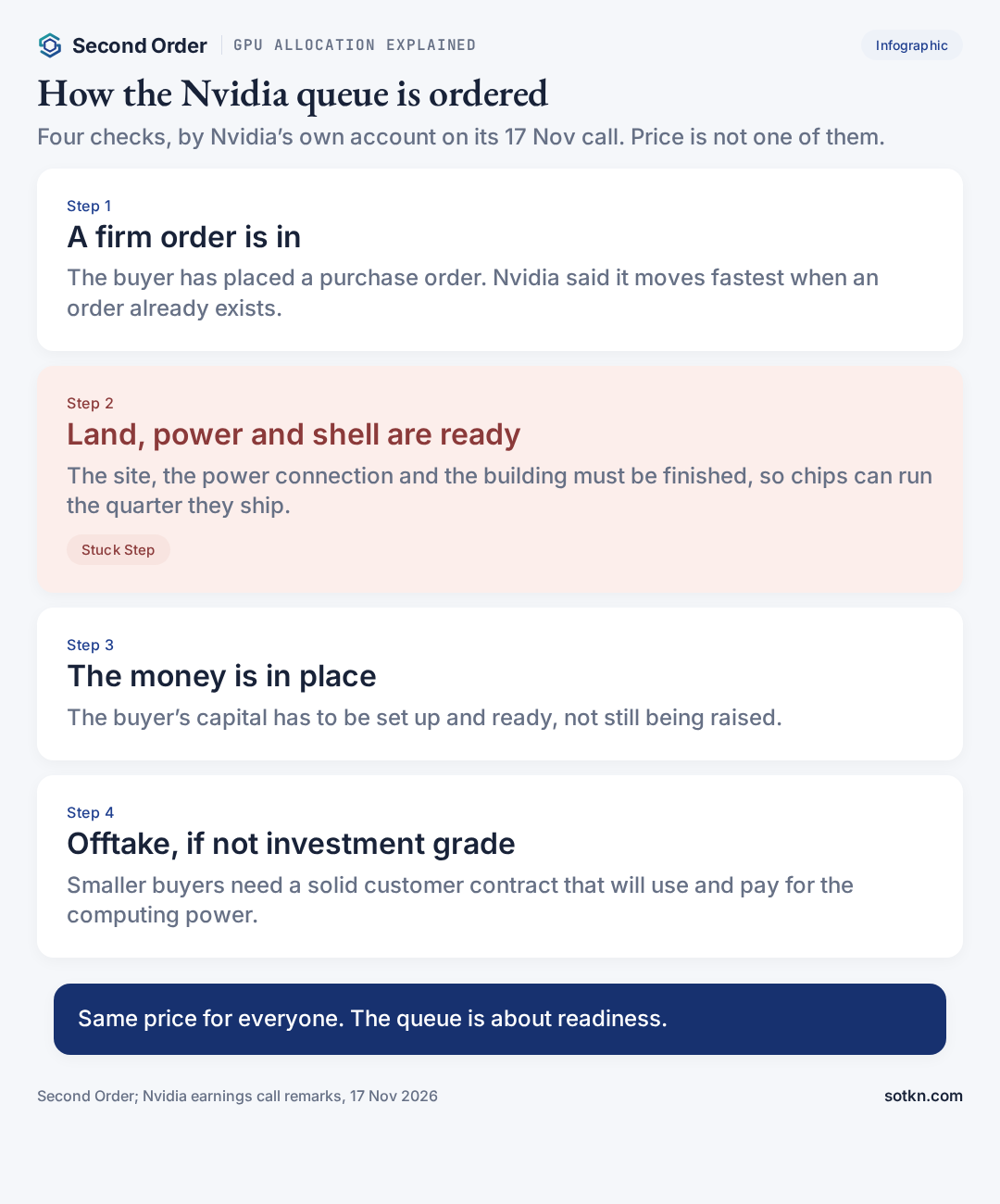
An analyst asked the question directly on the call. Colette Kress, Nvidia’s interim chief executive and chief financial officer, answered that Nvidia wants each buyer to be able to use the chips “very efficiently in the very beginning”, in the quarter they ship. Then she listed what that takes.
First, the site: “land, power, and shell, whether or not it is structured, ready to go, is already set up and completed”. She called that “one of the most important things”. Second, the money: “Their capital, it needs to be set up, ready to go.” Third, for buyers without an investment-grade credit rating, “do they have that solid offtake”, meaning a paying customer lined up to use the computing power. She added that Nvidia moves fastest “when there is already a PO available”, a purchase order.
Then the line that matters most for anyone worried about price: “It is not anything in terms of any types of different pricing. All are getting the same pricing.” The table sets out the tests.
| Test | What Nvidia said on the call | What it means | Who passes easily | Who tends to wait |
|---|---|---|---|---|
| Site ready | “land, power, and shell… ready to go” | The building is finished and powered, so chips can run the quarter they ship | Large clouds with finished halls | Buyers whose site is still being built or waiting for power |
| Money ready | “Their capital, it needs to be set up, ready to go” | Funding is signed, not still being raised | Investment-grade buyers with cash and cheap debt | Young companies mid-way through a raise |
| Offtake | for customers “outside of the IG… do they have that solid offtake” | A paying customer is lined up to use the computing power | Neoclouds with signed long contracts | Neoclouds building on hope of future demand |
| Order in | “particularly when there is already a PO available” | A firm purchase order exists | Buyers with orders already placed | Buyers still negotiating |
| Price | “All are getting the same pricing.” | Paying more does not buy a better place in line, by Nvidia’s account | — | — |
Quotes are from Nvidia’s third-quarter earnings call of 17 November 2026 (call remarks, not a filing). “IG” means investment grade. The last two columns are our read.
Why readiness and not price?
Our read: a GPU that cannot be switched on earns nothing for anyone. If Nvidia ships a rack to a hall that has no power yet, the rack sits in a crate. The buyer pays interest on hardware that makes no money. The buyer’s own customer waits. And Nvidia waits longer to be paid, or carries a customer that may struggle to pay at all.
The filings show why Nvidia cares about being paid. Its receivables, money customers owe it, stood at US$81.0 billion at 25 October 2026, and days sales outstanding rose to 64 from 60 a quarter earlier. Nvidia put that down to the timing of its Rubin shipments and to “extended payment terms on large, multi-quarter agreements with certain investment-grade customers.” So even the strongest buyers are paying more slowly. A weaker buyer with an unfinished site would add risk on top.
Ranking by readiness also keeps the price flat for everyone, which suits a seller with a long list of buyers it wants to keep. Raising prices in a shortage can win this quarter and lose the next one. That is a judgement call, and Nvidia has made it out loud. For what happens to rental prices further down the chain, see our GPU rental price page.
How Nvidia helps buyers get ready
If site readiness is the bottleneck, the obvious move for Nvidia is to help buyers get ready. Its filings say it does exactly that. Its CFO commentary says many neoclouds and frontier labs “are growing faster than their balance sheets and long-term credit profiles can support,” and that Nvidia has entered arrangements that “help select customers secure the land, power and data center capacity needed to support their growth.”
The tools are listed in the same filing. Nvidia has US$3.5 billion of land, power and shell guarantees for neoclouds, unchanged from July. It has US$32 billion of neocloud agreements to rent back capacity, down from US$36 billion in July. Those agreements take effect only if the neocloud secures financing and the capacity is “deployed, made operational, and accepted by us.” Our vendor financing explainer covers this book in full, and our GPU cluster acceptance page explains that last step.
The biggest guarantee is not for a neocloud. Nvidia has up to US$105 billion of credit support for the land, power and shell at SB Energy’s campus in Ohio, which will host Nvidia infrastructure under 20-year leases to OpenAI. Each guarantee only takes effect when its building is ready for service, the first expected in Nvidia’s fiscal 2029. Total guarantees reached US$118.0 billion, up US$9.5 billion from July, by our arithmetic. Our data centre financing page explains how these buildings get funded.
On the call, Kress also pointed to a deal with several Nvidia cloud partners in Australia to develop up to 2 GW of land, power and shell capacity by the end of calendar 2027. Our Nvidia cloud partner explainer covers who those partners are and how the programme works.
Who gets GPUs first? What the numbers show
Nvidia does not publish who received how many chips. The revenue split gives the best clue. Of the US$107.6 billion of Data Center revenue in the quarter to 25 October, the Hyperscale platform, the largest cloud companies, brought in US$60.1 billion, about 56%, by our arithmetic. The rest, US$47.5 billion or about 44%, came from what Nvidia calls AI Clouds, Industrial and Enterprise, which includes the neoclouds.
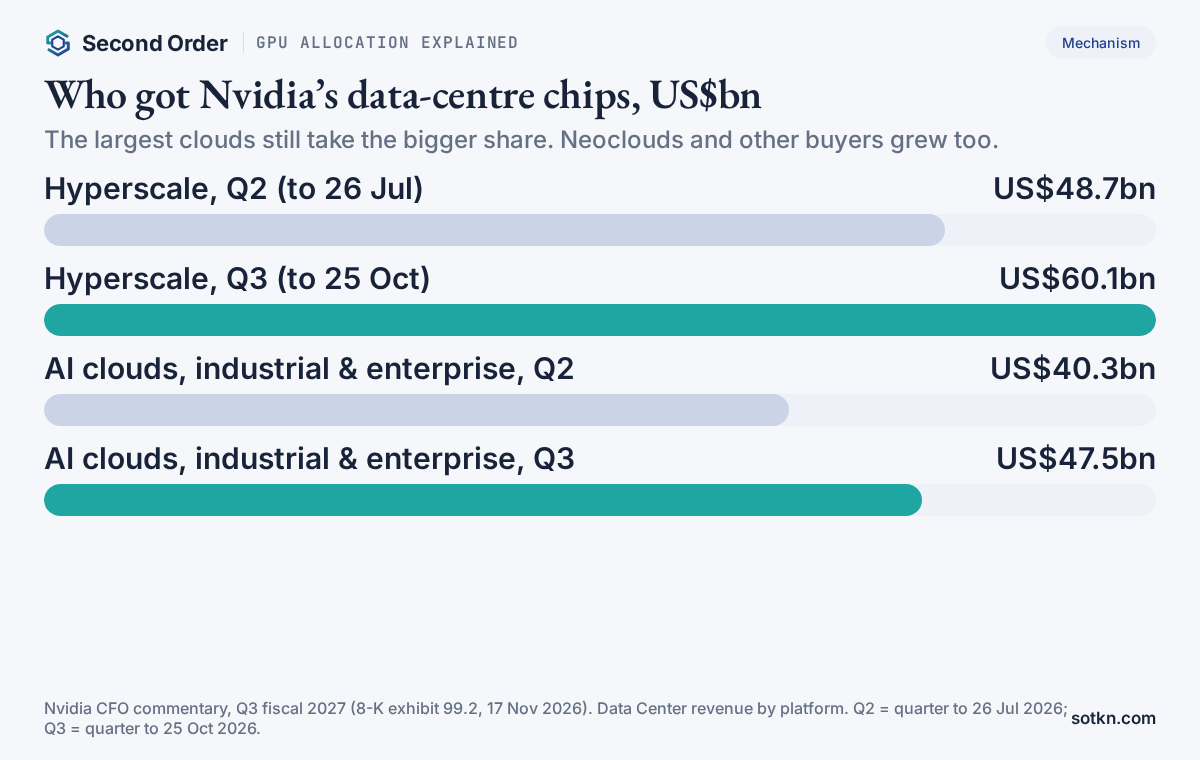
Both grew. Hyperscale rose 23% on the quarter and the second group 18%; over a year, the second group was up 195%. On the call, Kress said that growth came from Rubin shipments to leading neocloud customers and from frontier labs starting to build their own data centres. So the neoclouds that are ready are getting chips. The ones that are not ready do not show up in these numbers at all.
The buyers are also concentrated. Nvidia’s supplemental filing says three direct customers made up 14%, 11% and 11% of its third-quarter revenue, 36% together, by our arithmetic. Two direct customers made up 18% and 17% of what it was owed. Direct customers are often the companies that build the servers, not the end users, so these are not names on a list. Our customer concentration page explains why that matters, and our Wire on the US$81 billion customers owe goes further.
Does allocation change the price? The margin clue
Nvidia says the price is the same for all buyers in the queue. It did not say the price stays the same over time. The gross margin outlook shows why that difference matters.
| Line | Figure | Type |
|---|---|---|
| Q3 outlook given in August | 74.0% gross margin, plus or minus 0.5 points | Filed (CFO commentary, 26 Aug 2026) |
| Q3 actual, quarter to 25 Oct 2026 | 74.8% GAAP gross margin (Q2: 75.0%) | Filed (CFO commentary, 17 Nov 2026) |
| Q4 outlook, quarter to late Jan 2027 | 71.0–72.0% GAAP and non-GAAP gross margin | Filed (CFO commentary, 17 Nov 2026) |
| Gap from Q3 to Q4 midpoint | About 3.3 points | Our arithmetic |
| Fiscal 2028 | “72%-73% range” | Call remark, 17 Nov 2026 |
Nvidia’s fiscal year 2027 ends in late January 2027. The fourth quarter includes an extra week.
Gross margin is what is left of each sales dollar after the direct cost of the products. Nvidia beat its own third-quarter outlook, at 74.8% against a range that topped out at 74.5%. But it expects the fourth quarter to drop to 71.0–72.0%. Asked about it, Kress said the fourth quarter “is our bottom” and gave the reason: “we honored many of the different POs that we had already received from our customers, and we just wanted to make sure that that was held solid as we moved to a new pricing as we moved into the new year.”
In plain words, and this is our read: supply costs changed a lot this year, as Kress described on the call. Nvidia chose to fill orders it had already signed on the terms agreed, rather than reprice them, and took the hit to its margin. New pricing comes in “as we moved into the new year”, which we read as Nvidia’s fiscal 2028, starting in late January 2027. Nvidia did not give the size or shape of that change. Our read: the 72–73% margin Kress expects for fiscal 2028 points to a partial recovery, not a return to 75%.
For buyers, the lesson is that an early, firm order did two jobs this year. It held a place in the line, and it held the old price.
Who gets paid?
Our read: buyers with finished, powered sites and signed money get chips first. Everyone else in the chain is paid according to how close they are to that point.
- Ready hyperscalers first. Investment-grade clouds with finished halls pass every test easily. The Hyperscale platform took US$60.1 billion of Nvidia’s data-centre sales last quarter, and some investment-grade buyers now get longer payment terms as well.
- Neoclouds with sites and offtake next. A neocloud with a powered building and a signed customer gets the same price and a place in the line. Our CoreWeave page shows what that model looks like at scale.
- Owners of powered shells. Whoever has land, power and a finished building to rent now holds the scarce thing in the chain. Developers and landlords with ready sites can charge for it.
- Nvidia, on a steady line. It ships to buyers that can pay and use the chips at once, keeps one price, and backs a few chosen sites with its own guarantees.
- Waiting: buyers that are not ready. Neoclouds still building, still raising money, or without offtake. They pay the same price when they get there, but they get there later. Our Nscale page shows a neocloud racing to get sites ready.
Where is the stuck step?
Our read: land, power and shell readiness, and the money to finish it. Nvidia is adding chip supply through deals with substrate and packaging makers. Demand is not the problem either. The slow part is the buyer’s side: a finished, powered building and signed funding, in the quarter the chips ship.
That moves the question an investor should ask. It is less “can Nvidia make enough chips?” and more “whose sites will be ready, and who is paying for them?” Our neocloud explainer covers why that is hardest for young, indebted buyers, and our analysis of neocloud debt near 1,000 basis points covers what their borrowing costs.
The clocks
- The 10-Q. Nvidia said it would file its quarterly report “in the coming weeks”. It had not filed when we reviewed this page on 20 November 2026. The full notes may add detail on commitments and customers.
- Late January 2027. The fourth quarter, with its extra week and its 71.0–72.0% margin outlook, ends. Kress said new pricing comes with the new year.
- Calendar 2027. Nvidia’s Australian partners aim to develop up to 2 GW of land, power and shell by the end of 2027, by Nvidia’s account on the call.
- Fiscal 2028. US$6 billion of neocloud agreements and US$203 billion of supply commitments fall in Nvidia’s next fiscal year.
- Fiscal 2029. The first SB Energy guarantee in Ohio is expected to take effect when its building is ready for service.
What would change the view?
- Supply catches up. If new substrate, packaging and memory capacity arrives faster than sites, the queue shortens and allocation stops mattering. Falling supply commitments would be one sign.
- Prices split. If Nvidia starts charging some buyers more, or offers better terms for priority, the “same pricing” rule is gone and the queue becomes an auction.
- Sites stop being scarce. If powered shells become easy to find, readiness stops ranking the line and the advantage of ready buyers fades.
- A guarantee is called. Nvidia says it has made no payments on its guarantees so far. A first payment would show that helping buyers get ready carries real cost.
Common misconceptions
- People assume the biggest bidder gets the most GPUs. Actually, Nvidia says all buyers pay the same price, and ranks the line by whether a buyer can use the chips at once.
- People assume a GPU shortage means Nvidia is short of factories. Actually, Nvidia is signing more supply, and says the key check is the buyer’s site and money.
- People assume only hyperscalers get chips. Actually, about 44% of last quarter’s data-centre revenue came from AI clouds, industrial and enterprise buyers, including neoclouds.
- People assume a purchase order guarantees delivery. Actually, an order helps, but Nvidia also checks that the site and the funding are ready before it allocates.
- People assume the gaming GPU shortage is the same thing. Actually, gaming cards are a separate market. Nvidia’s filing ties weaker consumer PC demand to higher memory and system prices.
FAQ
How does Nvidia decide who gets its GPUs?
On its 17 November 2026 earnings call, Nvidia’s interim chief executive Colette Kress said the company looks first at whether a buyer’s land, power and shell are ready, then whether its capital is set up, and, for buyers below investment grade, whether they have solid offtake. She said all buyers get the same pricing. These were call remarks, not a written policy in a filing.
Is there an Nvidia GPU shortage in 2026?
For data-centre chips, Nvidia says demand is still running ahead of supply. On the 17 November call it said demand was “far exceeding supply”, and its filings show supply commitments rising to US$390 billion at 25 October 2026 from US$279 billion a quarter earlier. The shortage people feel on gaming cards is a different story, tied mainly to memory and system prices.
Does Nvidia charge some customers more to jump the queue?
Nvidia says no. On the call Kress said, “All are getting the same pricing.” By her account, the queue is ordered by readiness, not by who pays more. We cannot check contract prices ourselves, because Nvidia does not publish them.
What is land, power and shell?
It is the basic site a data centre needs before chips can go in: the land, a working power connection, and the building shell around the halls. If any of the three is missing, servers that arrive have nowhere to run.
What is offtake, and why does it matter for allocation?
Offtake is a signed customer who will use and pay for the computing power once it is running. For a buyer without an investment-grade credit rating, a solid offtake contract shows Nvidia, and lenders, that the chips will earn money once they are installed.
Who are Nvidia’s biggest customers?
Nvidia does not name them in its results. Its supplemental filing says three direct customers made up 14%, 11% and 11% of third-quarter revenue, and its Hyperscale platform, the largest cloud companies, brought in US$60.1 billion of its US$107.6 billion Data Center revenue.
Why is Nvidia’s gross margin falling in the fourth quarter?
Nvidia guided its fourth-quarter gross margin to 71.0–72.0%, down from 74.8% in the third quarter. On the call, Kress said the fourth quarter is the bottom because Nvidia honoured purchase orders it had already received, after a big change in its supply costs, before moving to new pricing in the new fiscal year.
Is this advice to buy or sell Nvidia?
No. This page explains how GPU allocation works and what Nvidia has said and filed. It does not rate companies as investments or give buy or sell calls. Not investment advice. Do your own research.
Related: vendor financing explained; who buys AI GPUs; who the neoclouds are; Nvidia cloud partners; GPU cluster acceptance; GPU rental prices; Anthropic’s supplier placement.
Stack doors
Layer: Neoclouds. Players: CoreWeave and Nscale. Earlier Wire: Nvidia’s neocloud commitments.
Get the Wire — short daily notes on where AI computing gets built and who pays for it.
Not investment advice. Do your own research.
How we check this
Nvidia’s revenue by platform, gross margin, fourth-quarter outlook, supply commitments, neocloud agreements, guarantees and receivables come from its CFO commentary for the quarter to 25 October 2026, filed as exhibit 99.2 to its Form 8-K of 17 November 2026. Customer concentration and the income statement come from its supplemental financial information, exhibit 99.3 to the same 8-K. The third-quarter margin outlook and the July figures for agreements and guarantees come from its CFO commentary of 26 August 2026. The supplier agreements come from Nvidia’s newsroom release of 17 November 2026. Everything Nvidia said about how it allocates chips, about pricing, and about the fourth-quarter margin bottom comes from its earnings call of 17 November 2026. We read it in a third-party transcript and quote it as call remarks, not as filed figures; Nvidia has not put an allocation policy in any filing. Nvidia had not filed its Form 10-Q for the quarter when we reviewed this page on 20 November 2026; we will update the page when it does. Shares, gaps and growth rates are our arithmetic, checked in code and labelled as ours on the page. Who gets paid and the stuck step are our read. We do not know any contract price, and we do not say any named company was moved up or down the queue, because no filing says so. The featured image is a CC0 photograph from Wikimedia Commons, graded by us; it is not an Nvidia customer site. This page explains a mechanism. It does not rate companies as investments or give buy or sell calls. Not investment advice. Do your own research.
Last reviewed: 20 Nov 2026 · Next review: when Nvidia files its Form 10-Q for the quarter to 25 October 2026, and again after its fourth-quarter results
Spot an error? Tell us and we will correct it and note the change here.
References
- Nvidia — CFO Commentary on Third Quarter Fiscal 2027 Results, Form 8-K exhibit 99.2 (17 Nov 2026) — Data Center revenue US$107.6bn (Hyperscale US$60.1bn; AI Clouds, Industrial & Enterprise US$47.5bn); GAAP gross margin 74.8%; fourth-quarter outlook of US$130.0bn ±3% and 71.0–72.0% gross margin; supply commitments US$390bn; neocloud agreements US$32bn; guarantees US$118.0bn including US$3.5bn of land, power and shell guarantees for neoclouds; DSO 64 days
- Nvidia — Supplemental Financial Information, Quarter Ended 25 Oct 2026, Form 8-K exhibit 99.3 (17 Nov 2026) — Customer concentration: three direct customers at 14%, 11% and 11% of third-quarter revenue; two at 18% and 17% of receivables; income statement
- Nvidia — CFO Commentary on Second Quarter Fiscal 2027 Results, Form 8-K exhibit (26 Aug 2026) — Third-quarter gross margin outlook of 74.0% ±50 basis points; AI cloud agreements US$36bn; guarantees US$108.5bn at 26 Jul 2026
- Nvidia Newsroom — Nvidia expands commitments with supply chain partners to support AI infrastructure buildout (17 Nov 2026) — New substrate and packaging capacity agreements with Kinsus, Samsung Electro-Mechanics, SPIL and Amkor, aligning supply with demand
- Nvidia third-quarter fiscal 2027 earnings call transcript, via Stock Analysis (secondary; call of 17 Nov 2026) — Remarks by interim CEO and CFO Colette Kress on allocation (land, power and shell; capital; offtake; same pricing), the fourth-quarter gross margin bottom and new pricing; quoted as call remarks, not filings