What Is a Neocloud? Specialist GPU Clouds for AI Work
A neocloud is a specialist cloud that bills GPU clusters for AI work. What it is, how it earns, and why utilisation and realised price decide everything.

A neocloud is a specialist cloud that bills GPU and AI accelerator capacity — usually by the hour or under committed contracts — rather than offering a broad menu of cloud services.
The money link: a neocloud gets paid when a customer uses a working GPU and pays for that hour (or when committed capacity delivers billable hours). Backlog is not cash until delivery and use. Utilisation and realised price are the two dials.
EXPLAINEDLast reviewed: 02 Oct 2026Next review: after next CoreWeave (or major neocloud) earnings
In short: A neocloud places GPUs in a power-ready hall and bills customers for accelerator time. Cash arrives when a customer uses a working GPU and pays for that hour (or committed capacity delivers billable hours). Backlog is visibility, not cash. Utilisation and realised price decide the earn. Hyperscalers sell many services; neoclouds concentrate on accelerators.
Education only. Not investment advice. Do your own research.
What is a neocloud?
A neocloud concentrates on accelerators. Customers take GPU time by the hour, by the instance, or under reserved contracts.
The core loop is six steps:
- Buy AI servers with GPUs (or finance them)
- Place them in a hall with power, cooling, and network
- Offer instances to customers
- Bill for time, reservations, or committed use
- Pay for hardware depreciation, power, space, staff, and software
- Keep the gap if utilisation and pricing cover costs
That gap is the earn.
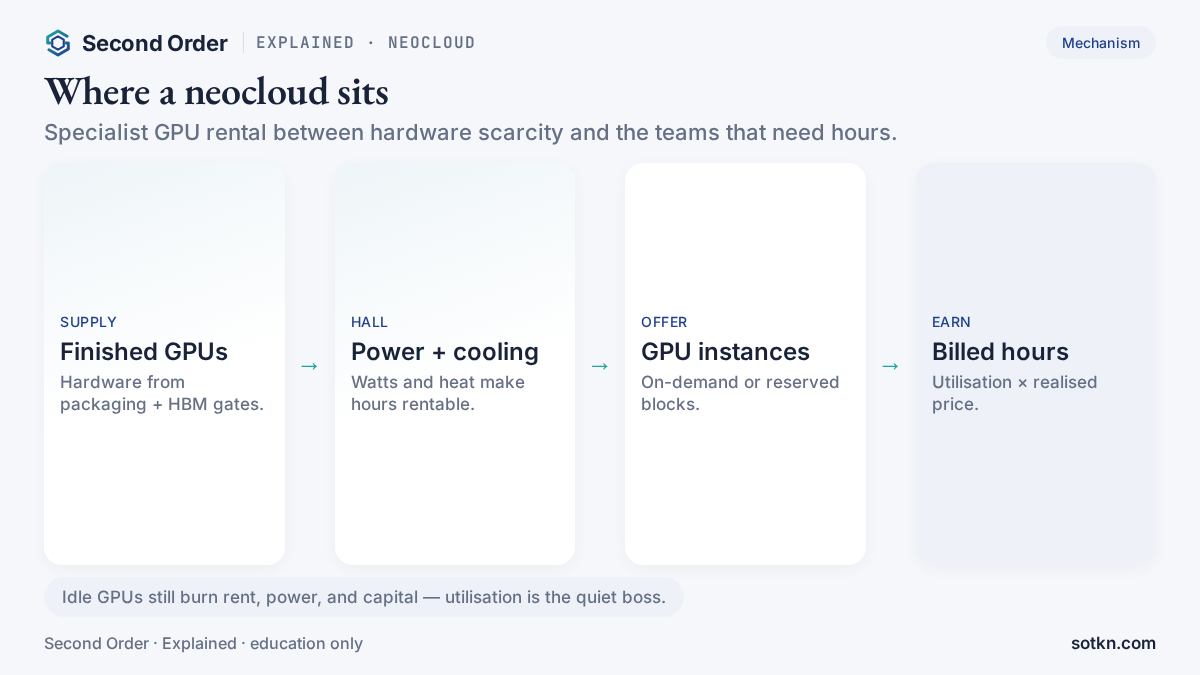
| Stage | Role | Read |
|---|---|---|
| Supply | Finished GPUs | Hardware from packaging + HBM gates |
| Hall | Power + cooling | Watts make hours billable |
| Offer | GPU instances | On-demand or reserved blocks |
| Earn | Billed hours | Utilisation × realised price |
The stack layer for this business is neoclouds. Upstream clocks sit in HBM explained and CoWoS explained; contract shape sits in take-or-pay GPU contracts and remaining performance obligation.
What are the key differences between a hyperscaler and a neocloud?
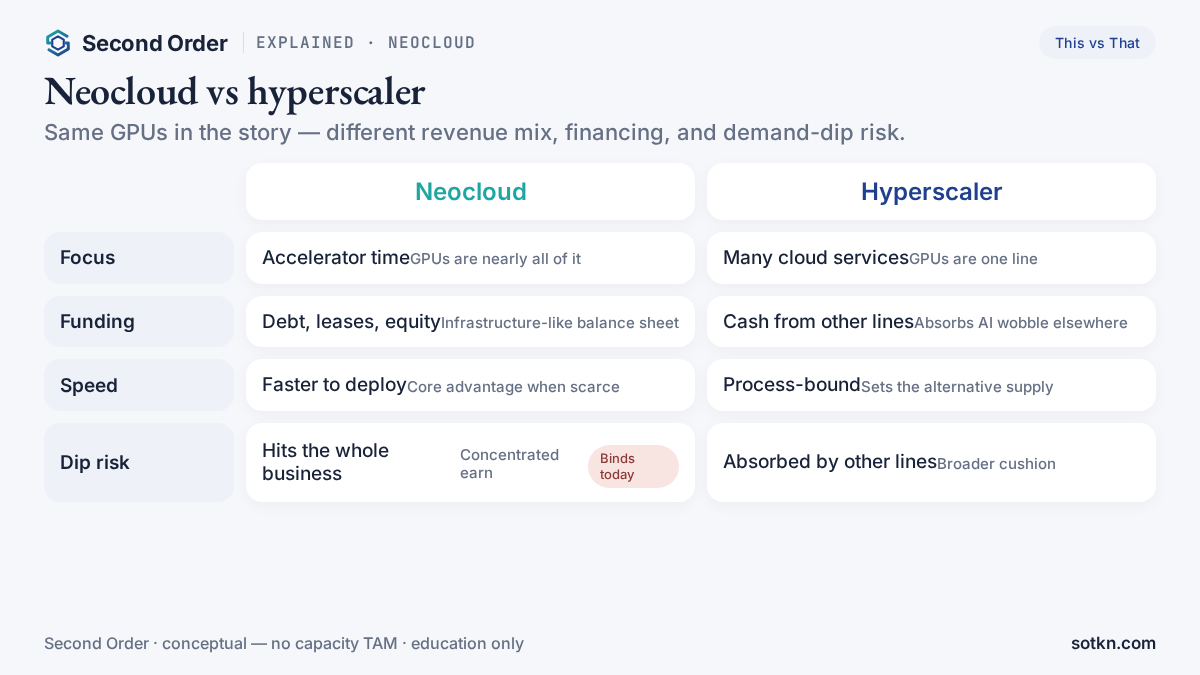
A hyperscaler sells many services with GPUs as one line. A neocloud sells accelerator time and little else — that drives concentration, financing shape, and dip sensitivity.
| Axis | Hyperscaler | Neocloud |
|---|---|---|
| Service range | Storage, databases, general compute, GPUs | Accelerators, plus the minimum around them |
| Revenue concentration | GPUs are a slice | GPUs are effectively all of it |
| What funds expansion | Cash from unrelated businesses | Debt, equipment financing, equity, prepayments |
| Sensitivity to a demand dip | Absorbed by other lines | Hits the whole business |
| Time to deploy new capacity | Slower, process-bound | Faster — the core advantage |
Hyperscalers set the alternative supply. When they expand AI instances, neocloud pricing feels pressure. When their queues are long, neoclouds absorb overflow. Customers frequently use both. See also hyperscaler explained and the hyperscalers stack layer.
What are the main neocloud company groups?
Three groups earn differently. Ask which group, not which name — education only, not a buy list.
| Group | Examples (illustrative) | What defines them |
|---|---|---|
| Scaled, capital-markets funded | CoreWeave, Nebius, Crusoe | Large committed fleets, long contracts, heavy debt or financing structures |
| Developer-first | Lambda, RunPod, Vast.ai, Together AI | Self-serve, hourly, smaller commitments, price-competitive |
| Sovereign and regional | Operators built around national or regional capacity | Policy-driven demand, local data requirements |
Examples illustrate group shape — not a preference list. Education only.
Dated scale markers (company-reported, as labelled):
- CoreWeave. FY2025 revenue US$5.131B; backlog US$66.8B as of 31 Dec 2025 (26 Feb 2026 results). Q2 2026 revenue US$2.575B; backlog about US$104B as of 30 Jun 2026, excluding more than US$25B early-Q3 commitments (11 Aug 2026). No newer quarterly print as of 2 Oct 2026. Backlog is company-defined under committed contracts — not cash.
- Nebius. Group revenue US$582.3M in Q2 2026; AI cloud US$574.9M (12 Aug 2026 PR). On 1 Oct 2026 Nebius said it acquired Inferize to cut idle GPU tax on cold starts — a utilisation bind, not a new revenue print (EQS; terms undisclosed).
- Crusoe. Raised US$3.9B in a Series F that pushed post-money valuation to US$30.9B (TechCrunch, 17 Sep 2026) — an example of private capital-markets-funded scale, not a valuation call.
When GPUs are scarce, secured supply is a moat and developer list pricing gets squeezed. Markets door: CoreWeave neocloud contracts.
What does a GPU hour cost?
GPU-hour prices move with accelerator scarcity, commitment length, and whether the hall is power-ready — not list rate alone. The same card can carry very different effective prices depending on who is asking.
| Snapshot (list) | Rate | As at | Source |
|---|---|---|---|
| Lambda on-demand H100 PCIe | US$3.29 / GPU-hour | 02 Oct 2026 | Lambda public pricing |
| Lambda on-demand H100 SXM (8-GPU) | US$3.99 / GPU-hour | 02 Oct 2026 | Lambda public pricing |
| Lambda on-demand B200 SXM6 | US$6.69–US$6.99 / GPU-hour (by node size) | 02 Oct 2026 | Lambda public pricing |
List price ≠ realised price. Large committed buyers negotiate off-page. Educational snapshot of developer-first on-demand quotes only.
Accelerator type, commitment length, discounts, and power-ready capacity move the quote. Separate list price from realised price.
How does the revenue actually come in?
- On-demand. Customers start and stop GPUs at a posted rate. Revenue falls when machines sit idle.
- Reserved and committed capacity. Customers book blocks for months. Cash is predictable once delivery starts.
- Extras and prepaid credits. Storage, networking, and support add fees; prepaid pulls cash forward but still converts into usage later.
Why is utilisation the quiet boss?
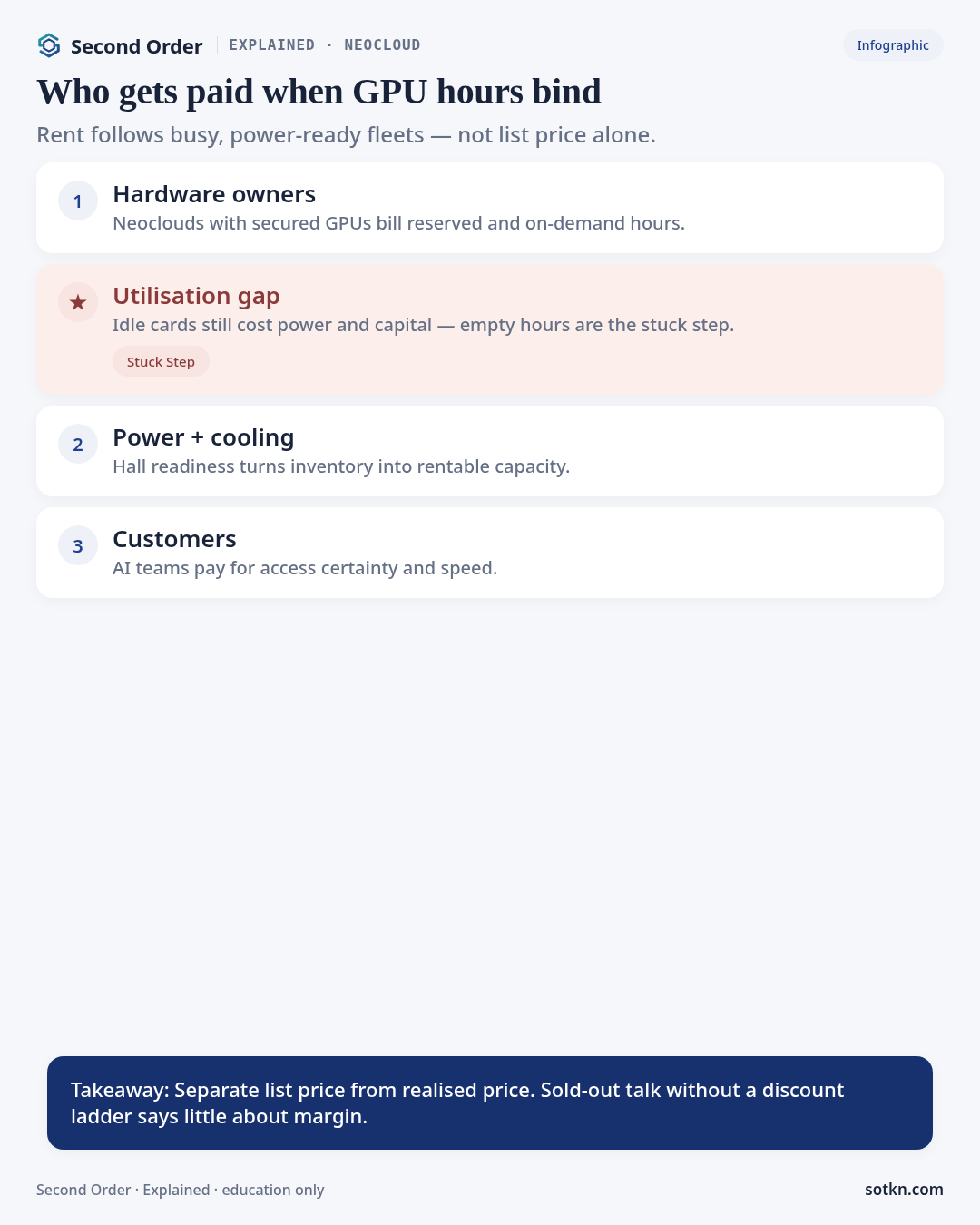
Utilisation is the share of the fleet actively earning customer bills. A GPU that sits idle still burns space cost, power, and capital cost.
High utilisation spreads fixed hardware cost across more revenue hours. Drivers:
- Demand from AI training and inference
- Mix of reserved versus on-demand use
- Ability to place small jobs into gaps
- Scarcity of competing capacity elsewhere
- Cold-start and spare-capacity drag (idle GPU tax)
Volume and rate are separate — a sold-out fleet can still be soft on realised price.
What is the idle GPU tax — and why backlog is not cash?
The idle GPU tax is the cost of capacity assigned or held ready but not yet serving paid work — cold starts, demand spikes, weight reloads. On 1 Oct 2026 Nebius said it acquired Inferize to shorten cold starts and cut that tax (EQS; terms undisclosed). Lesson: filled racks are not paid hours. See Nebius Inferize idle GPU tax Wire. Separately, scaled neoclouds report large backlog or RPO under committed contracts — visibility, not cash, until power-ready capacity is live and hours are paid. CoreWeave’s ~US$104B backlog as of 30 Jun 2026 is not cash this quarter. See remaining performance obligation and RPO vs take-or-pay.
What does it cost to run?
| Cost | Why it bites |
|---|---|
| Hardware | GPUs and servers; cost spreads as depreciation or financing expense |
| Power and cooling | Dense racks draw heavy power and make heavy heat; bills scale with use |
| Space and connectivity | Colocation cost, build cost, and network transit |
| People and software | Operators, support, security, billing, and the scheduler that raises utilisation |
Per GPU-month: billed hours × effective rate, minus hardware carry, power, cooling, space, and ops. Newer accelerators can age older fleets.
How does scarcity upstream affect the earn?
When finished GPUs are scarce because of memory or packaging queues, neoclouds with secured supply keep fleets full and rates firm — while buying the next tranche gets harder. Earn on the existing fleet can look strong while expansion stays constrained.
Power-ready capacity is the other gate — without watts, inventory is not billable. The market door where most listed neocloud exposure sits is CoreWeave neocloud contracts.
What are the failure modes?
- Idle fleet after a demand dip or a wave of new supply
- Power or cooling limits that prevent full clock speeds
- A generation shift that strands older cards for top workloads
- Customer concentration if a few buyers dominate revenue
- Idle GPU tax that keeps assigned capacity from becoming paid hours
Debt or equipment financing speeds growth but adds covenants; equity buys runway but does not remove the need for utilisation.
Common misconceptions
- People assume a neocloud is just a small hyperscaler. Actually revenue concentration on accelerators changes the entire risk shape — a demand dip hits the whole business.
- People assume list GPU-hour prices are what providers earn. Actually realised price after discounts is the number that matters; sold-out fleets can still be soft on margin.
- People assume more GPUs automatically means more profit. Actually idle cards still cost power and capital — utilisation is the quiet boss.
- People assume backlog equals cash. Actually backlog and RPO are visibility under committed contracts — cash waits on delivery, power, and paid hours.
Practical takeaways
- The earn is billed GPU time minus hardware carry, power, cooling, space, and operations
- Utilisation is the quiet boss — including idle GPU tax on cold starts and spare capacity
- List price is not realised price; backlog and RPO are not cash until delivery and paid hours
- Ask whether GPUs are idle for lack of customers, lack of power, or cold-start drag
- Judge the group — scaled, developer-first, or sovereign — before judging the name
FAQ
What is a neocloud?
A specialist cloud that bills GPU and AI accelerator capacity — by the hour or under committed contracts — rather than a broad cloud menu.
What are the key differences between a hyperscaler and a neocloud?
A hyperscaler earns across many services with GPUs as one line; a neocloud concentrates on accelerator time, so dips hit the whole business.
Is Oracle a neocloud?
Structurally a hyperscaler (full cloud platform). Its AI line can still behave like a neocloud when growth concentrates on GPU contracts.
What are the main neocloud company groups?
Scaled capital-markets-funded operators, developer-first platforms, and sovereign or regional operators — each responds differently to the same scarcity.
How does a neocloud make money?
It bills accelerator time at utilisation high enough to cover hardware, power, cooling, space, and ops. List price is not realised price; backlog is not cash until delivery and paid hours.
What is utilisation in a neocloud?
The share of the fleet actively earning customer bills. Idle GPUs still cost power and capital — including the idle GPU tax from cold starts and spare capacity.
What does a GPU hour cost?
No single rate. As at 2 Oct 2026 Lambda listed on-demand H100 PCIe at US$3.29/GPU-hour, H100 SXM (8-GPU) at US$3.99, and B200 SXM6 at US$6.69–US$6.99 — list prices, not negotiated bids.
Related terms
- Hyperscaler — broad cloud vs accelerator-focused earn.
- GPU as a Service — billed accelerator hours when capacity turns usable.
- Take-or-pay GPU contracts — committed capacity awaiting delivery.
- Remaining performance obligation — visibility that is not yet billed hours.
- Neocloud vs hyperscaler — versus page for the same boundary.
- GPU cloud providers — roles along the fleet, hours, offtake, and power bind.
- HBM — memory that gates finished AI GPUs.
- CoWoS — packaging that gates GPU supply.
Where this sits in the stack
Layer home: neoclouds, next to hyperscalers.
Further reading
Markets: CoreWeave neocloud contracts. Wire: Nebius Inferize idle GPU tax.
How we check this
Figures come from company filings and government releases, each dated in the list below. Capacity and timing from press reports are labelled as reported, not guided. Where we work something out ourselves, the arithmetic is shown in full.
Last reviewed: 02 Oct 2026 · Next review: after next CoreWeave (or major neocloud) earnings
Spot an error? Tell us and we will correct it and note the change here.
Sources
- CoreWeave — FY2025 / Q4 2025 results (26 Feb 2026) — revenue US$5.131B; backlog US$66.8B at 31 Dec 2025
- CoreWeave — Q2 2026 results (11 Aug 2026) — revenue US$2.575B; backlog ~US$104B at 30 Jun 2026 (excludes >US$25B early-Q3 commitments)
- Nebius — Q2 2026 financial results PR (12 Aug 2026) — group revenue US$582.3M; AI cloud US$574.9M
- Nebius / EQS — acquires Inferize; idle GPU tax / utilisation bind (1 Oct 2026; terms undisclosed)
- Lambda — public GPU cloud pricing (accessed 2 Oct 2026)
- TechCrunch — Crusoe raises US$3.9B Series F (17 Sep 2026)
Get the Wire — short notes when the neocloud clock moves.