What Does Firmus Do? The Prepaid-Chip Neocloud Model
Firmus rents Nvidia GPU capacity to companies such as Meta and OpenAI from halls in Melbourne, Singapore and, soon, Tasmania, Batam and Kuala Lumpur. Its float was pulled in October, and up to US$550 million of chip prepayments for Batam fall due by December.
STACK · Neoclouds · Status: Tightening · Last reviewed: 15 Nov 2026
Firmus Technologies started in 2019 as a bitcoin miner in Sydney. Seven years later it rents some of the most expensive computers in the world to Meta and OpenAI, and in October it nearly became the biggest new listing on the Australian stock market since Telstra. Then the float was pulled, and the bill for its next chips is still due.
In short. Firmus Technologies is a Sydney-based neocloud. It buys Nvidia systems, installs them in data halls it owns or leases, and rents the computing to AI companies on multi-year, take-or-pay contracts. It runs about 46 MW today, in Melbourne and Singapore, and is building or planning about 865 MW more in Tasmania, Batam and Kuala Lumpur. Its US$5 billion float on the ASX was pulled on 9 October 2026. Its audited accounts show a US$8.3 billion chip commitment for Batam, with up to US$550 million of prepayments due by December. Our read: Nvidia, landlords and builders get paid first, and Firmus earns its margin last, from 2027 onwards. The stuck step is cash: chips have to be paid for before the customers who have signed for them start paying.
Why an investor cares: Firmus is a clean example of how a young neocloud is built. It signs customers, orders chips against those contracts, and has to find the cash for the chips before the customers start paying. If you are new to the group, start with who the neoclouds are. This page is about how Firmus makes money, who gets paid before it does, and where the chain is stuck today.
Numbers that matter
| Number | What it is | Why it matters |
|---|---|---|
| US$50.8m | Revenue, year to 30 June 2026, with a loss of US$68.2m | Today's business is small next to what it has promised to buy |
| 46 MW | Capacity running, in Melbourne and Singapore | About 5% of what is running or planned, our arithmetic on 46 MW against 911 MW |
| US$8.3bn | Chip purchase commitment for the Batam project | Up to US$550m of prepayments due by December 2026 |
| US$19.4bn | Future contracts with big tech firms, per the directors' letter in the annual accounts | The offer document reportedly claimed US$72.8bn; the two figures come from different documents |
| US$5bn | The float it pulled on 9 October 2026 | The raise was meant to fund servers; Firmus is now seeking private money |
| 30 Nov | Date after which some investors get bonus shares if Firmus has not floated | A cost of waiting, paid in dilution |
Figures are listed at the end of the page. Sums and ratios are our arithmetic from those reports.
What does Firmus actually do?
It sells GPU computing by the block. Firmus buys Nvidia rack-scale systems, puts them in data halls, and rents the capacity to AI companies that want dedicated chips for training and running models. This is the GPU-as-a-service model, sold not by the hour but on long contracts for reserved capacity. Firmus calls its sites AI factories and its systems HyperCube.
It runs two sites today, with about 46 MW of capacity between them, according to a broker summary of its float reported by Startup Daily. The larger is 42 MW inside a Melbourne data center owned by CDC Data Centres, which serves Meta. The other is in Singapore. Most of last year's revenue came from Asia: Firmus booked just US$1,327 of revenue in Australia in the year to June 2026, the ABC reported from its accounts.
Five projects are meant to add about 865 MW. In Tasmania, an 84 MW site at St Leonards in Launceston is under construction in two 42 MW halls, the first of which was topped out in October, and a smaller site at Wesley Vale is seeking approval. In Batam, Indonesia, Firmus is fitting out a 360 MW development with its data center partner DayOne. In Kuala Lumpur, two projects of 192 MW and 206 MW sit in leased third-party data centers, due between 2027 and 2028. A further campus at Long Reach in northern Tasmania has planning approval and is under option to a customer.
Only the two Tasmanian builds are Firmus-owned. The other five contracted sites are installations inside other people's buildings, the colocation model. That keeps building costs down but means rent is due to a landlord whether or not the chips are earning.
How does Firmus make money?
Mainly through take-or-pay contracts: customers reserve capacity and pay for it whether or not they use it, according to the float summary. Our explainer on take-or-pay GPU contracts covers how that protects the renter's revenue once a site is live. The catch is the word live. A take-or-pay contract usually starts paying when capacity is delivered, not when it is signed.
The customer list is concentrated and famous. Reports on the offer documents name Meta, already a tenant in Melbourne and contracted for capacity at Batam; Fireworks, an AI inference company, also at Batam; and OpenAI, the anchor customer for the two Kuala Lumpur projects, which will run Nvidia's Vera Rubin platform. Firmus told a Tasmanian parliamentary inquiry on 10 November that it does not disclose customers site by site, citing security and confidentiality.
How much is signed is less clear than it looks. The directors' letter in the audited accounts says Firmus has US$19.4 billion of future contracts with big tech companies. The draft offer document, as reported by The Nightly, claimed US$72.8 billion of future revenue secured under contracts. The documents differ and neither is public, so we treat the lower, audited-accounts figure as the firmer one. Our explainer on total contract value shows why headline contract sums can run well ahead of revenue a company can count on.
The targets are steep. The draft offer document forecast revenue of US$12.9 billion and EBIT of US$5.8 billion in 2029, with about 85% of both expected from the Malaysian and Indonesian sites still under construction. Project-level figures in the broker summary showed EBITDA margins above 91%; at EBIT, after depreciation on the hardware, Startup Daily's sums put them nearer 41% to 44%, before interest, tax and head-office costs.
That gap between EBITDA and EBIT is the core of the neocloud model. GPUs lose value fast, so most of the gross profit goes to paying for the hardware over its life. Our explainers on GPU depreciation and capex versus depreciation walk through why.
Where were the chips going to be paid from?
From the float, mostly. Firmus planned to raise US$5 billion, about A$7.1 billion, at A$11 a share. The broker summary set out where the money would go: US$2.42 billion for servers and US$650 million for deployment infrastructure, together about 61% of the raise; US$1.55 billion for a liquidity reserve and the costs of financing; and US$190 million each for working capital and the costs of the offer.
Even that was only the equity slice. The summary said the raise would fund Firmus's share of the Tasmanian sites and some of the Asian projects, and that debt would be needed for the rest of the Asian spending, with more debt and equity for future sites. Across the disclosed sites, server budgets totalled US$35.97 billion, of which US$14.03 billion was for Batam alone.
The equity it already had came from investors who are also part of the supply chain. In August 2026 Firmus raised US$2 billion from Nvidia, Coatue, Blackstone and Jane Street at a valuation above US$10.5 billion, CNBC reported. Nvidia held about 7.2% and Blackstone about 6.7% before the float, according to The Nightly, and Firmus had planned to allocate half of the float to them.
Then demand faded. Bankers reportedly considered cutting the price from A$11 to A$8.25 a share, and on 9 October Firmus withdrew, saying the terms did not reflect the strength of its business and that it would pursue private capital. Bloomberg reported it was talking to existing investors about raising US$2 billion to US$3 billion. Our Wire on the pulled float covered the week it fell apart.
What does the bill look like now?
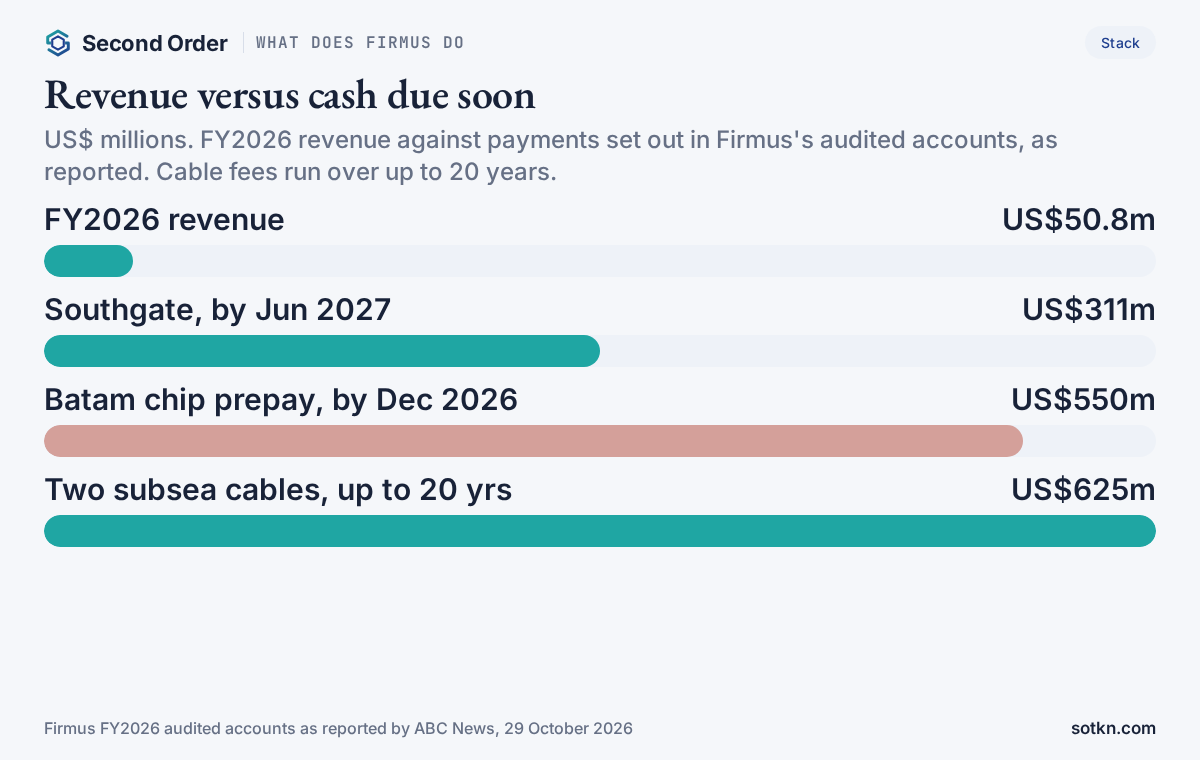
The audited accounts for the year to June 2026, lodged with ASIC on 28 October and reported by the ABC the next day, show what is coming due. Up to US$550 million of prepayments is due by December as part of a US$8.3 billion commitment to buy chips for Batam. About US$311 million is due by June 2027 for the Australian projects, known as Project Southgate. Firmus has also committed US$625 million in payments and fees for two submarine cable projects over periods of up to 20 years.
On our arithmetic, the December prepayments alone are more than ten times last year's revenue, and the Batam commitment is about 160 times it. The accounts say the forecasts behind them assumed the float, alongside new loans, would help pay for the Batam chips. Those forecasts were signed off in August, before the float failed. The accounts do not show how much of the Batam deposits and advance rent has already been paid, or whether the timetable has since moved.
There is a second clock. Some investors are entitled to extra shares if Firmus has not completed a qualifying float by 30 November 2026, the accounts show. That does not cost cash, but it means existing holders are diluted if the listing slips, which it now has.
Firmus says the Australian side is covered. The accounts state that construction of the Melbourne, Launceston and Wesley Vale projects and their chips is funded and that revenue will be enough to meet loan repayments; three contracted sites were expected to start earning revenue from March 2027. At the inquiry on 10 November, co-chief executive Tim Rosenfield said the failed float did not change the company's growth plans, "not one bit". Our explainer on prepayments covers why buyers pay suppliers before delivery in a tight market.
Who gets paid first?
- Nvidia. Nvidia designs the rack-scale systems the chip deposits buy, and owns about 7% of Firmus. On our read the chip chain is paid first and most: the Batam chip commitment alone is US$8.3 billion, with prepayments due before delivery. Our explainer on the Nvidia cloud partner programme shows how Nvidia backs the clouds that buy its chips.
- Landlords and builders. Five of the seven contracted sites sit in other companies' buildings, so DayOne in Batam, CDC in Melbourne and the Kuala Lumpur owners collect rent, and the accounts mention advance rent at Batam. In Tasmania, the construction firm Hansen Yuncken is building the Launceston site for Firmus. Our Markets piece on DayOne's financing in Malaysia shows the landlord's side of the bargain.
- Cable and power suppliers. The two submarine cable commitments run for up to 20 years, and power is bought as the halls switch on.
- Firmus, last. Its customers pay for reserved capacity once each site is live, from March 2027 for the first three, if the timetable holds. Only after chips, rent, power, staff and interest does Firmus keep a margin.
This is the usual order on the neocloud layer, and it is why financing matters so much. Our explainer on who finances GPU clusters lays out the lenders, vendors and equity holders who fill the gap between ordering chips and earning on them.
What is the stuck step?
Cash for chips. Not customers, on Firmus's account, and not halls: the Launceston building is up, and the first Batam hall has been handed over for fit-out. What is missing is confirmed money to pay for the chips that go inside before the contracts start paying.
The timing is the problem. Prepayments for Batam fall due by December 2026; the first contracted revenue was expected from March 2027. Firmus has to bridge that gap with equity or debt, and the float that was meant to provide the equity has gone. Lenders to neoclouds have also turned cautious. Our Analysis on neocloud debt near 1,000 basis points shows how expensive that bridge has become.
There is a second, smaller gate in Tasmania. The Long Reach approval came with a condition that its 276 backup diesel generators run only in emergencies, maintenance and testing. Firmus is appealing it, and the Wesley Vale site is still seeking approval. Neither affects Batam, where most of the forecast earnings sit.
Our read on the stuck step: until Firmus shows how the December prepayments are paid, through a private round, vendor terms or a loan, the Batam build waits on funding rather than on chips or customers. We mark the status Tightening, because the main source of that funding fell away in October and the payment dates are close.
Who else does this?
The closest models are other neoclouds that rent Nvidia capacity on long contracts. CoreWeave is the largest and listed; Nebius builds its own sites; Nscale builds its own in Europe, while Fluidstack leans on partners' halls. Lambda has raised money ahead of a planned listing. Our Wire on Nscale's delayed site and float plans is a useful comparison.
Firmus is unusual in where it builds. Its growth is in Southeast Asia, near the landlords and power of Batam, Johor and Kuala Lumpur, rather than in the US. Our Markets coverage of DayOne in Singapore and of Australian AI data center funding follows that region. Our explainer on neoclouds versus hyperscalers explains why companies like Meta rent from Firmus at all.
What would change this view?
- Easing: Firmus confirms a private round of US$2 billion or more, or a loan or vendor financing that covers the Batam prepayments, or Batam and Launceston start earning on time in 2027.
- Tightening: prepayments slip or are renegotiated, bonus shares are issued after 30 November with no new money, or a named customer cuts or delays capacity.
- A model shift: Nvidia or a customer takes on more of the chip cost directly, which would ease Firmus's cash needs but leave it a thinner slice of the margin.
What should you watch next?
Three things. First, any announcement of private funding, with the amount and who provided it. Second, whether the December Batam prepayments are made, moved or restructured; the next accounts will show it. Third, the first revenue from Launceston, Batam and Kuala Lumpur in 2027, and any Nasdaq filing, which would give the first full public set of numbers. Our explainer on revenue backlog versus RPO is a guide to reading those contract numbers when they arrive.
Practical takeaways
Read Firmus as a renter of Nvidia chips with famous customers and a funding gap between ordering and earning. The customers and halls came first; the cash to fill the halls must follow. Our Analysis on where cash sticks when halls come first shows the same squeeze from the landlord's side.
FAQ
What does Firmus do?
Firmus Technologies is a Sydney-based neocloud: it rents GPU computing to AI companies. It installs Nvidia systems in its own or leased data halls and sells the capacity on multi-year contracts. It runs about 46 MW in Melbourne and Singapore and is building in Tasmania, Batam in Indonesia and Kuala Lumpur.
Who are Firmus's customers?
Firmus does not name customers site by site. Reports on its offer documents name Meta at the Melbourne site and at Batam, Fireworks at Batam, and OpenAI as anchor customer for two Kuala Lumpur projects. Nvidia is a shareholder and supplier.
Why did the Firmus IPO fail?
Firmus withdrew its planned ASX float on 9 October 2026, saying the offer terms did not reflect the strength of its business. Reports said demand at the A$11 offer price had faded, with investors questioning a valuation near A$44 billion for a company with about US$51 million of annual revenue.
How much does Firmus owe for chips?
Its audited accounts for the year to June 2026, as reported by the ABC, show a US$8.3 billion commitment to buy chips for the Batam project, with up to US$550 million of prepayments due by December 2026. The accounts do not say how much has already been paid.
Is Firmus listed on the stock market?
No. It pulled its ASX float in October 2026 and said it would seek private capital. Reports say it is talking to existing investors about raising US$2 billion to US$3 billion and plans to try a Nasdaq listing in 2027.
Is this a recommendation to invest in Firmus?
No. This page explains how Firmus makes money and where it can get stuck. It gives no buy or sell calls. Not investment advice. Do your own research.
Keep reading on the map
Layer: Neoclouds on The Stack. Also on the layer: Crusoe and ChronoScale. Explained: what a neocloud is and take-or-pay versus purchase commitments. Wire: Nvidia's neocloud commitments.
Get the Wire — short daily notes when compute, chips and GPU financing move.
Not investment advice. Do your own research.
How we check this
Firmus is a private company and has not published a prospectus, so this page rests on press reports of its audited FY2026 accounts filed with ASIC, of its draft offer documents and broker summaries, and of its public statements, all read on 15 November 2026. Where reports disagree we say so: contracted revenue appears as US$19.4 billion in the directors' letter and US$72.8 billion in the offer document, and the float valuation is reported as both about US$30.6 billion and about A$44 billion. The accounts do not show how much of the Batam prepayments has been paid or whether the schedule has changed, and Firmus has not named its customers site by site. Sums and ratios are our arithmetic and are labelled as ours. Who gets paid and the stuck step are our read. The featured image is a graded photograph of generic boxed server parts, not Firmus hardware. This page explains a business. It gives no buy or sell calls. Not investment advice. Do your own research.
Last reviewed: 15 Nov 2026 · Next review: after Firmus confirms a private funding round or the December Batam prepayments, and no later than its first-half 2027 accounts
Spot an error? Tell us and we will correct it and note the change here.
References
- ABC News — Firmus's AI data centre commitments in doubt due to failed float, documents show (29 Oct 2026) — FY2026 audited accounts: US$8.3bn Batam chip commitment, US$550m due by December, US$311m Southgate payments, 30 November bonus-share date
- Startup Daily — Firmus will spend $4.4 billion on servers and deployment from ASX raise (Oct 2026) — use of IPO proceeds; 46 MW operating, 865 MW in five projects; customers by site; server budgets; project margins
- The Nightly — Firmus $43.1b ASX listing: fund managers warn over valuation (Oct 2026) — FY2026 revenue and loss; US$72.8bn contracted revenue claim; 2029 targets; build cost per MW; Nvidia and Blackstone stakes
- CNBC — Nvidia-backed Aussie AI firm Firmus withdraws historic IPO (9 Oct 2026) — withdrawal statement; August US$2bn round and US$10.5bn valuation; Meta capacity agreements
- ABC News — How Firmus's plans for the biggest IPO in three decades fell over (10 Oct 2026) — A$11 offer price reportedly cut to A$8.25; plan to list then borrow; Nasdaq attempt planned
- Bloomberg, via Bloomberg Law — Firmus explores $3 billion private round after IPO flop (9 Oct 2026) — talks with existing investors on a US$2bn to US$3bn private round
- ABC News — Firmus questioned at inquiry over use of diesel generators (10 Nov 2026) — Tasmanian inquiry: growth plans unchanged, customers not named, Long Reach generator appeal
- Hansen Yuncken — Project Southgate, St Leonards AI Factory (project page) — 84 MW planned critical IT load; Hansen Yuncken as builder for Firmus
- DCD — Firmus tops out data center building in Tasmania (7 Oct 2026) — first 42 MW Launceston hall topped out; first Batam hall handed over; DayOne partner