What Does Hanmi's Price Assume About the Memory Stuck Step?
Hanmi Semiconductor sits at the memory stuck step with the bonders every HBM stack needs. At roughly ₩22 trillion, the question is what growth and margin that price already assumes.
ANALYSIS · MEMBERS CONTINUE · 3 min free / 12 min full · Data as at 22 Sep 2026
Hanmi Semiconductor sits at the memory stuck step with the bonders every HBM stack needs. At roughly ₩22 trillion, the question is not whether the tools matter — it is what growth and margin that price already assumes.
In short
- The question: what is today's price for Hanmi already assuming about the HBM tooling cycle?
- The answer: roughly a path toward ₩1.0–1.3 trillion of revenue with margins still elevated — i.e. the memory stuck step keeping tool orders alive into 2027
- Why: tools are ordered before the capacity they enable; Hanmi holds about 71% of the global HBM thermo-compression (TC) bonder market
Behind the wall: three scenarios with the arithmetic · what the ₩22T multiple implies · six practical takeaways · Members' FAQ - What would break it: HBM "sold out" language ending before Wide TC and hybrid demand land — or a hyperscaler capex cut that empties the memory queue upstream
- Nothing here is a recommendation. This is a map of what the price requires, with the working shown
What's in this piece: the numbers that matter · why Hanmi sits at the stuck step · what the price implies in one line · members from here · who gets paid · three scenarios, arithmetic shown · our read · what would change the view · practical takeaways · FAQ · sources
The numbers that matter
| What | Figure | Date | What it tells us |
|---|---|---|---|
| Hanmi market cap | ₩22.39T (~₩236,000; ~95.3M shares) | Close 18 Sep 2026 | The number we work backwards from |
| Trailing P/E | ~101× | 18 Sep 2026 | Expensive unless the cycle extends |
| 2025 revenue | ₩576.7B (record); OP margin 43.6% | Company, 9 Feb 2026 | Baseline year |
| Q2 2026 revenue / OP | ₩251.1B (+39.5% YoY) / ₩130.3B (+51%); margin 51.9% | Company, 14 Jul 2026 | Run-rate and peak margin |
| HBM TC bonder share | 71.2% global (1st); SEMES 13.1%; ASMPT 5.6% | TechInsights via MK, 22 Dec 2025 (as of Q3 2025) | Who owns the stuck-step tool |
| Hanmi TC sales YTD Q3 2025 | $247.7M (~₩366B) | Same TechInsights report | TC is the majority of the franchise |
| TC bonder market CAGR | ~13% through 2030 | TechInsights, cited Feb/Dec 2025–26 | Market grows even after a pause |
| Consensus revenue path | ~₩761B (2026E) → ~₩1.14T (2027E) | Stockopedia consensus table | What "the street" already models |
| Product clock | TC Bonder 4 (HBM4) shipping; Wide TC H1 2027; hybrid prototype late 2026; hybrid fab ~₩100B | SED / MK, Feb–Jul 2026 | How long the tool cycle can extend |
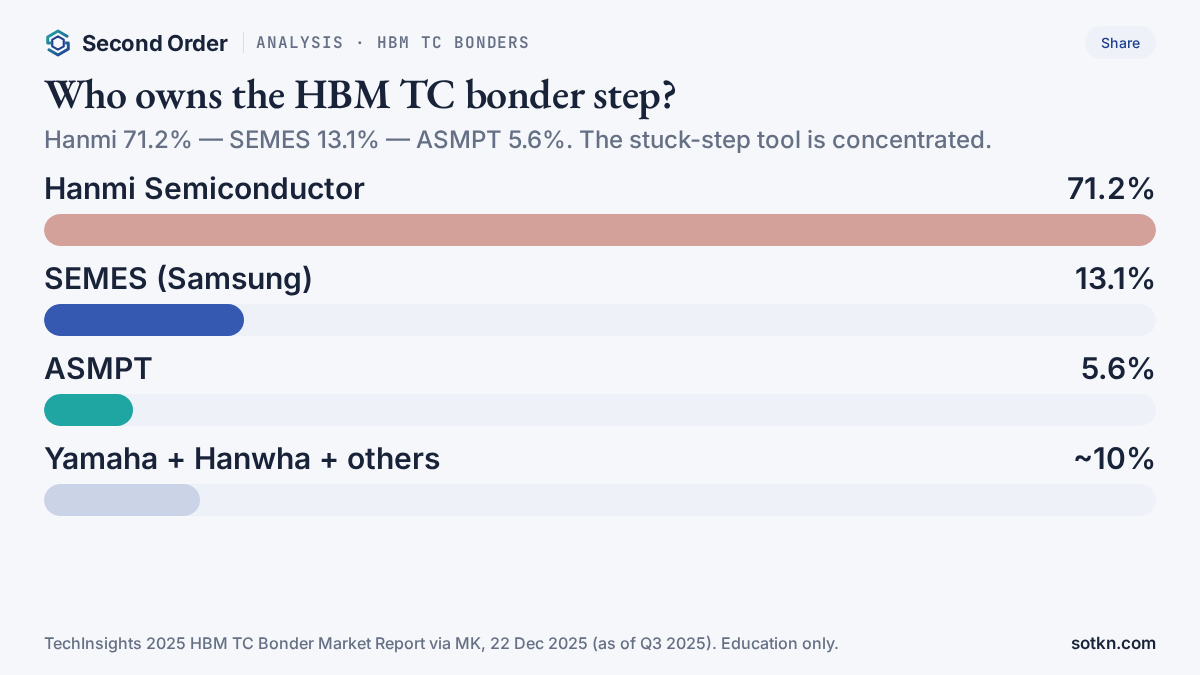
Chart 1 — Who owns the HBM TC bonder step. Source: TechInsights 2025 HBM TC Bonder Market Report via Maeil Business, 22 Dec 2025 (as of Q3 2025).
Why does Hanmi sit at the memory stuck step?
The Semiconductors layer has a short step that every finished AI accelerator still waits on: high-bandwidth memory. HBM vs GDDR is the mechanism; the money question is who gets paid while stacks stay scarce.
A stack is not a wafer alone. It is DRAM dies bonded under heat and pressure — thermo-compression — then inspected and placed. That bonding tool is the TC bonder. Hanmi, listed in Korea (KRX:042700), has held the leading share of that niche since it shipped the first HBM TSV dual-stacking TC bonder in the mid-2010s. TechInsights put its global HBM TC bonder share at 71.2% as of the third quarter of 2025, with SEMES (Samsung's equipment arm) second at 13.1% and ASMPT third at 5.6% (Maeil Business, 22 Dec 2025, citing TechInsights).
That is why Hanmi belongs in a company-at-stuck-step Analysis rather than a results Wire. The prior map piece — where the stuck step moves — argued memory binds in quarters, and that the durable pay-out of a memory squeeze is often the toolmakers, because tools are ordered ahead of the capacity they enable. Hanmi is that toolmaker for the bonding step. Korea's Markets desk already tracks the same clock: Korea HBM memory pulse and Samsung HBM4 yield.
What does ₩22 trillion already assume?
Work backwards from the close. At ₩22.39 trillion on 18 September 2026, against 2025 revenue of ₩576.7 billion, the trailing sales multiple is about 39×. Against a consensus 2027 revenue path near ₩1.14 trillion, it is about 20× forward sales. Q2 alone annualises near ₩1.0 trillion if that pace held for a full year — which equipment businesses rarely do smoothly, but it shows the run-rate the market is watching.
Our read, in one line: the price assumes the HBM tooling cycle does not end when packaging eases — it assumes bonders keep shipping into 2027 at elevated margins. The three scenarios and the arithmetic are below.
The free preview ends here.
—— Still to read · ~8 of 12 minutes ——
MEMBERS CONTINUE HERE
- Three scenarios with the arithmetic
- What ₩22T requires in revenue and margin
- Six practical takeaways
- Members' FAQ