A $300 Million Loan With Strings: Who Gets Paid While Applied Digital’s Louisiana Campus Waits for a Power Vote
On 23 November Applied Digital closed a $300 million bridge loan for Delta Forge 1 in Louisiana. The cash can be drawn only as conditions are met, and one is state commission approval of electrical rates. The hearing on the power deal is in late January. That vote is the stuck step.
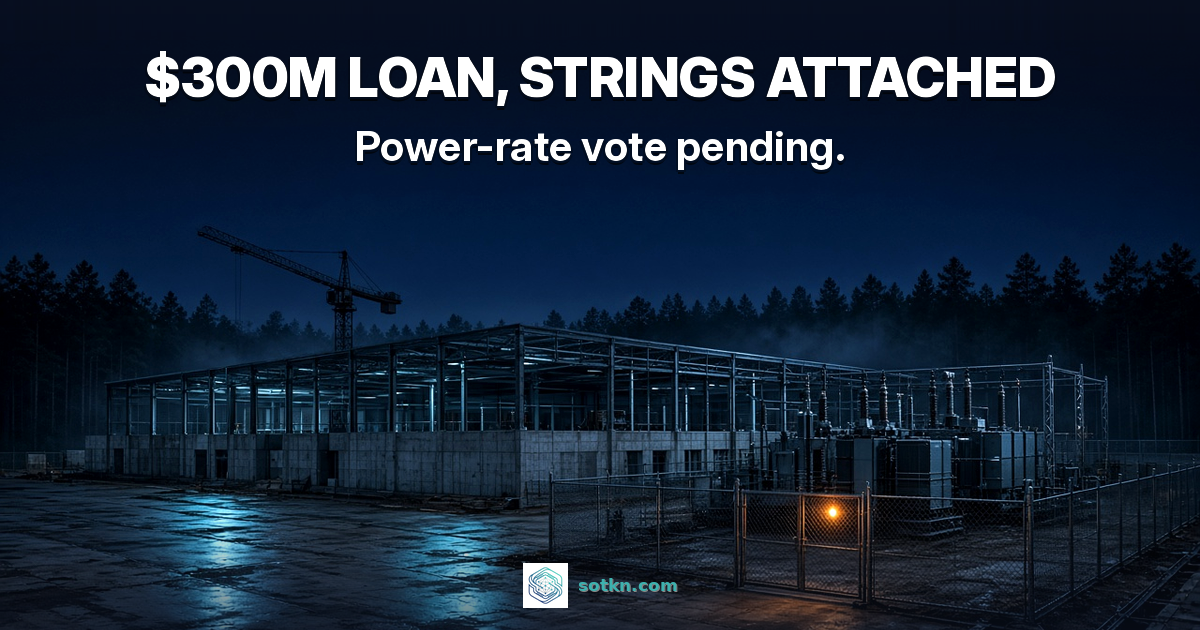
On Monday 23 November, Applied Digital said it had closed a $300 million bridge loan to keep building its Louisiana campus. Fifteen minutes later it announced a new $5.4 billion lease. The lease got the headlines. Read the loan release instead. The money can be drawn only as conditions are met, and one of them is state commission approval of electrical rates. In Louisiana, that approval is still to come. The hearing is in late January. The vote is due by March. So the hall has a tenant, a loan and a plan. What it waits for is a vote on its power. That is the stuck step.
US PULSE · AI DATA CENTERS · Data as at 26 Nov 2026 (Applied Digital releases of 23 Nov and 8-K of 24 Nov; 10-Q for the quarter to 31 Aug; Louisiana PSC docket U-38035) · Next update: the 26–27 Jan 2027 hearing and the commission vote due by March 2027
Affects: AI Data Centers — Markets: US
Education only, not advice to buy or sell any security. MW (megawatt) here is the power a data centre is built to use. A bridge loan is a short loan that carries a project until longer funding arrives (bridge facility, explained). On 24 November we covered the lease itself as a Catalyst (the 150 MW lease). This note is about the loan and the gate that sits on it.
The numbers that matter this week
Bridge loan, 23 Nov
$300M
Delayed-draw · 364 days · SOFR + 300bp
NewDelta Forge 1
300 MW
Two halls under construction · Louisiana
BuildingFirst ready-for-service
1H 2027
Full capacity early 2028 (10-Q, 7 Oct)
PlannedCommission hearing
26–27 Jan 2027
Decision due no later than March 2027
WaitingNew lease (same day)
150 MW · $5.4bn
18-year base term · delivery from 1H 2028
NewThe gate
Rate approval
A named draw condition · not yet given
Stuck stepApplied Digital releases, 23 Nov 2026; 10-Q for the quarter to 31 Aug 2026; Louisiana PSC order U-38035 and hearing schedule. Status chips are Second Order’s read.
On this page: Why it matters · What happened · What is a bridge loan? · The draw conditions · The Louisiana case · The clocks · Funding · The new lease · Who gets paid · What is stuck? · Dates next · FAQ
Why does a bridge loan in Louisiana matter?
Picture a family building a house. The builder is on site. The bank has agreed to lend. But the loan comes in stages, and one stage only opens when the town signs off on the power connection. The family has the land, the plans and the lender. It still cannot draw every dollar until the town says yes.
That is the picture in Louisiana this week. Applied Digital builds big halls for hyperscalers. It says Delta Forge 1 is backed by a long lease with a top-rated US hyperscaler. It has just arranged $300 million to keep building. But the release says draws are subject to conditions, and it lists them. One is state commission approval of electrical rates.
It also fits a pattern we have followed all month. In Kentucky, a one-gigawatt campus waits two years on borrowed power for a gas plant (Kentucky’s gas plant bridge). In New England, the grid operator wants new data centres to bring their own capacity (bring your own capacity). In each case the building is the easy part to see. The approvals and the power are the parts that set the date.
What did Applied Digital announce?
Applied Digital put out two releases on the morning of Monday 23 November, fifteen minutes apart. Then it filed an 8-K on Tuesday. Here is what they say, in order.
- 7:45 a.m. New York time: an indirect subsidiary closed a $300 million senior secured bridge loan, led by what the release calls a leading global financial institution. The lender is not named.
- The loan is a delayed-draw term loan. It matures in 364 days. It pays interest at SOFR plus 300 basis points (3 percentage points). It can be repaid at any time without a fee. It is secured on the assets of the project.
- The money is for the development and construction of Delta Forge 1, the Louisiana AI campus. The company says it expects to seek more financing to finish construction.
- Draws are subject to conditions, including but not limited to construction milestones, regulatory approvals (including state commission approval of electrical rates), lender consents and certain financial covenants.
- 8:00 a.m.: a new 18-year lease for 150 MW of critical IT capacity with an investment-grade hyperscaler. About $5.4 billion over the base term, or about $12.7 billion over 33 years if every renewal is used. Delivery is expected to start in the first half of 2028, subject to development milestones, utility arrangements and regulatory approvals.
- Portfolio totals now: more than $41 billion of contracted base-term lease revenue, over 1.6 GW of contracted critical IT load and 2.2 GW of grid-connected peak load. About 75% of the base-term revenue comes from investment-grade customers.
- The CFO said the remaining project finance for Delta Forge 1 and Polaris Forge 3 should close in the first calendar quarter of 2027, and for Delta Forge 2 in the second quarter. First-in equity comes from the balance sheet and a $5 billion programmatic equity partnership with Macquarie Asset Management.
- In the 8-K, filed 24 November, the company raised its Series G convertible preferred commitment from $2.0 billion to $2.5 billion, leaving $1.035 billion available to draw.
What the releases did not say is as useful. They did not name the lender. They did not name the commission or the rates. They did not name the tenant on the new lease or the campus that will host it. They did not say whether the new lease is with the same customer as Delta Forge 1. And the loan agreement itself was not filed. The 8-K attaches only the preferred-equity letter and the two releases.
The market read the lease first. According to Mugglehead, as relayed by DataCenterFeed, Applied Digital shares rose about 27% to $14.59 by 10:37 a.m. New York time on Monday. We did not check the close. A share price is not cash. The cash is in the loan, and the loan has strings.
What is a bridge loan, in plain words?
A bridge loan is a short loan that gets a project from where it is to where long-term money can take over. Think of crossing a river on a temporary bridge while the permanent one is built. The temporary bridge has to hold until you reach the other side. If the permanent one is late, you may need to pay to keep the temporary one standing.
Here the other side is project finance. That is a large, longer loan secured on one project and repaid from what the customer pays. The CFO said this should arrive for Delta Forge 1 in the first calendar quarter of 2027. The bridge exists to carry construction until then. For the basics, see data centre financing, explained.
Two things make a bridge loan different from a plain loan. First, it is short. This one runs 364 days from closing. Our arithmetic: that points to about late November 2027. Second, it is delayed-draw. The lender does not hand over $300 million on day one. The borrower asks for money in pieces, and each piece has to meet the conditions. That protects the lender. It also means the headline number is a ceiling, not cash in the bank.
The price is stated. SOFR is the main short-term US dollar benchmark rate. The loan pays SOFR plus 3 percentage points. We do not give a dollar interest figure because we do not know how much will be drawn or when. Our arithmetic gives a feel for the scale: on $300 million, each full percentage point of interest is $3 million a year, and the 3-point spread alone is $9 million a year if the whole loan is drawn.
This is not Applied Digital’s first bridge. In its 10-Q, the company says that on 16 June 2026 a subsidiary refinanced an earlier bridge facility with a $1.59 billion issue of 7.000% senior secured notes due 2031, with a completion guarantee from the parent. So the pattern is known: bridge first, then longer, cheaper-per-year money once the project is further along and the customer is locked in. The question this time is how fast the conditions can be met.
What are the strings on the $300 million?
The release lists four kinds of condition, and says the list is not complete (“including but not limited to”). Here they are in plain words, with our read of which are in the company’s hands and which are not.
Named in the release
In the company’s hands
Not in its hands
Applied Digital bridge loan release, 23 Nov 2026. The “in its hands” split is Second Order’s read, not the company’s.
Most of these are things a builder can work on. A crew can hit a milestone. A finance team can keep its ratios. A lender can be asked for consent. But a commission vote is different. The company can file papers and bring witnesses. It cannot choose the day, and it cannot choose the answer.
One thing we do not know is how the conditions apply. They may apply to every draw. They may apply only to later draws, with early money flowing for site work. They may be waived by the lenders. The loan agreement would tell us, and it is not public. So we do not say the whole $300 million is frozen. We say the release makes approval of rates a named condition, and that the approval has not been given.
This also fits what the company says about its own cash. At 31 August 2026 it reported $2.9 billion of unrestricted cash and $728.0 million of restricted cash. So Applied Digital is not waiting on this loan to pay its next bill. The point is narrower. The bridge is the financing meant for this campus, and its tap has a lock on it.
Which commission, and what is it deciding?
The release says only “state commission approval of electrical rates.” It does not say which state or which commission. As DataCenterFeed noted, the release does not say which commission or which rates. But Delta Forge 1 is in Louisiana, and there is one open case at the Louisiana Public Service Commission (LPSC) that ties straight to it. That is our read, and we label it so.
The case is docket U-38035. On 1 July 2026, Cleco Power, the local electric utility, asked the commission to approve a package: its electricity service agreement with Applied Digital, a site-specific contract; certification of a new combined-cycle gas turbine plant; treatment for transmission links; and waivers under the commission’s “Lightning Initiative.” The commission’s order describes the customer’s project as a hyperscale data centre in Rapides Parish with load expected to reach about 430 MW by 2028.
Two measures are easy to mix up here, so we keep them apart. Applied Digital says Delta Forge 1 is 300 MW of critical IT load. That is the power for the computers. Cleco’s 430 MW is the electricity load the utility expects to serve, which includes cooling and other building needs. They are different measures of the same site. Do not add them.
What is the Lightning Initiative? It is a commission fast lane. A utility can ask to skip the normal competitive-bidding step for new generation if three things are shown: a signed long-term service agreement, a proven capacity need, and customer revenue that covers at least half the fixed costs of the new capacity. The policy aims for a vote within eight months of filing. Our arithmetic: eight months from 1 July 2026 is about 1 March 2027. That matches the March 2027 target in the order.
Cleco has said the customer will fund project-specific infrastructure directly, and that revenue from the customer will help pay system costs. Others are not sure. A candidate for the commission told the 16 September meeting that if the plant is meant to be a system resource paid for mainly by ratepayers, competitive bidding should not be waived. Cleco’s argument, as reported, is that the plant would be needed regardless of Applied Digital.
Who else is in the room? Interveners include Packaging Corporation of America, International Paper, the Alliance for Affordable Energy and the Sierra Club. Packaging Corporation of America, for one, runs a mill served by Cleco. Big power users like that have reason to read the cost-sharing closely.
On 16 September the commission voted to clear an expedited path. It did not approve the application. Local press was careful to say so, and so is the commission’s order. It ordered a full evidence record and took the case itself, without a recommendation from an administrative judge, with a decision no later than its March 2027 session.
Why is this a state matter at all? Because the big federal rulemaking this month does not reach it. Six regional grid operators filed large-load plans with FERC between 13 and 20 November. Law firm Holland & Knight notes that FERC left retail service, siting and rate decisions to the states. Electric rates for one campus in Rapides Parish are exactly that kind of decision. We covered the New England filing in bring your own capacity. Louisiana’s gate is a different one, and it has its own calendar.
What do the clocks say?
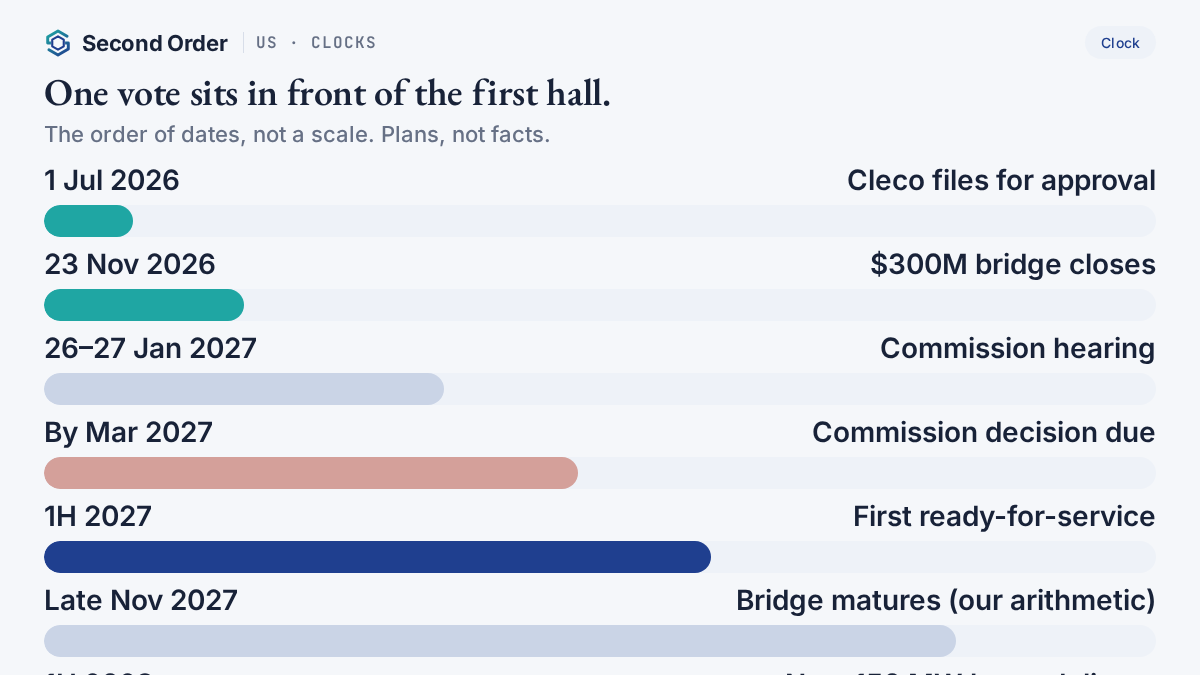
A project is a set of clocks. Put them side by side and the pressure shows. Here are the ones we can date, in order.
- 1 July 2026: Cleco files for approval of the Applied Digital package.
- 16 September 2026: the commission sets an evidence-based process, to decide no later than March 2027.
- 20 November 2026: deadline for commission staff and interveners to file their direct testimony. We did not read it.
- 23 November 2026: the bridge loan closes. Draws need conditions, including rate approval.
- 21 December 2026: cross-answering testimony due. 5 January 2027: Cleco’s rebuttal.
- 26–27 January 2027: the hearing, in Baton Rouge.
- First calendar quarter of 2027: the CFO expects the remaining project finance for Delta Forge 1.
- No later than March 2027: the commission’s decision.
- 1 June 2027: the start of the 2027–2028 MISO planning year, when Cleco’s capacity agreement with Tenaska begins; it runs to 31 May 2037.
- First half of 2027: first ready-for-service at Delta Forge 1, per the 10-Q. Full capacity early 2028.
- About late November 2027: the bridge matures, 364 days after closing (our arithmetic).
Louisiana PSC order and schedule, Sep 2026; Applied Digital releases, 23 Nov 2026; 10-Q for the quarter to 31 Aug 2026. Plans and procedure, not approvals.
Now read them against each other. The latest the commission is due to vote is March 2027. The first part of the campus is planned to be ready for service in the first half of 2027, which ends on 30 June. Our arithmetic: if the vote lands at the end of March, that leaves about three months before the end of that window. Cleco’s own testimony, as the Louisiana AI Hub summarised it, pointed to service in mid-2027, subject to satisfactory regulatory approvals.
That is tight, but not broken. Many things can run in parallel, and a hall is not powered in one day. Power usually arrives in steps. We are not saying the date will slip. We are saying the first-half-2027 date has almost no cushion on the approval side, and that only one of these clocks is in the company’s hands.
The bridge clock runs the other way. It matures about a year after closing. If project finance arrives in the first quarter of 2027 as the CFO expects, the bridge is repaid with room to spare. If lenders for the longer loan also want the commission’s answer first, the two clocks lean on the same vote. That is why we call it the stuck step. Several things wait behind one decision.
How is the campus being paid for?
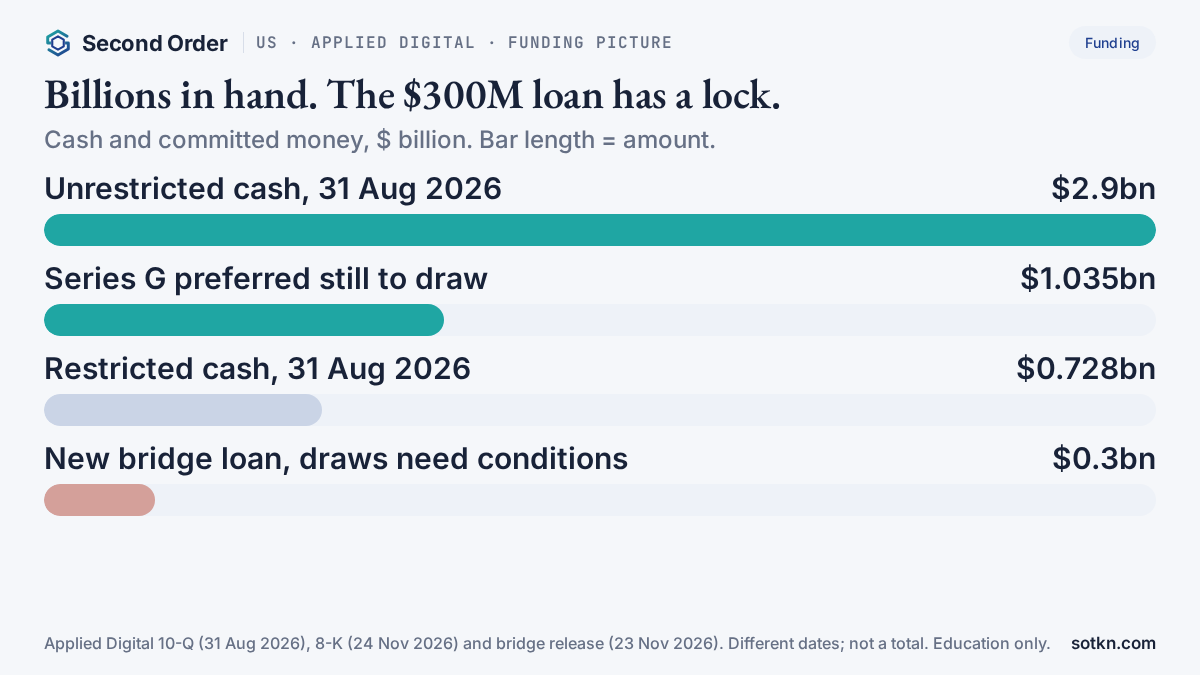
A quick look at the company’s money helps keep the bridge in proportion. We use only filed numbers and the new release.
Cash, 31 Aug 2026
Still to come
Spent in the quarter
Applied Digital 10-Q for the quarter to 31 Aug 2026; 8-K filed 24 Nov 2026; bridge loan release, 23 Nov 2026.
In the quarter to 31 August the company spent $2.1 billion on investing activities, mostly construction at its campuses, and took in $1.5 billion from financing, most of it the 2031 notes. It also reported total revenue of $341.9 million, of which $262.8 million was services and other revenue and $79.1 million was data centre rental and other revenue. Our arithmetic: the services line includes about $157.2 million more of tenant fit-out work than a year before, which is work done for customers rather than rent.
Put simply, the company builds first and is paid by tenants later. It funds the first stretch from its own cash, preferred stock and a Macquarie partnership. Then it adds project debt on top once a lease is signed. The $300 million bridge is a middle layer for one campus. It is small next to the cash, but it is the piece with the commission condition written into it.
For a plain-English look at what happens when a lease is signed but the hall is not yet handed over, see leases not yet commenced, explained.
What does the new 150 MW lease change?
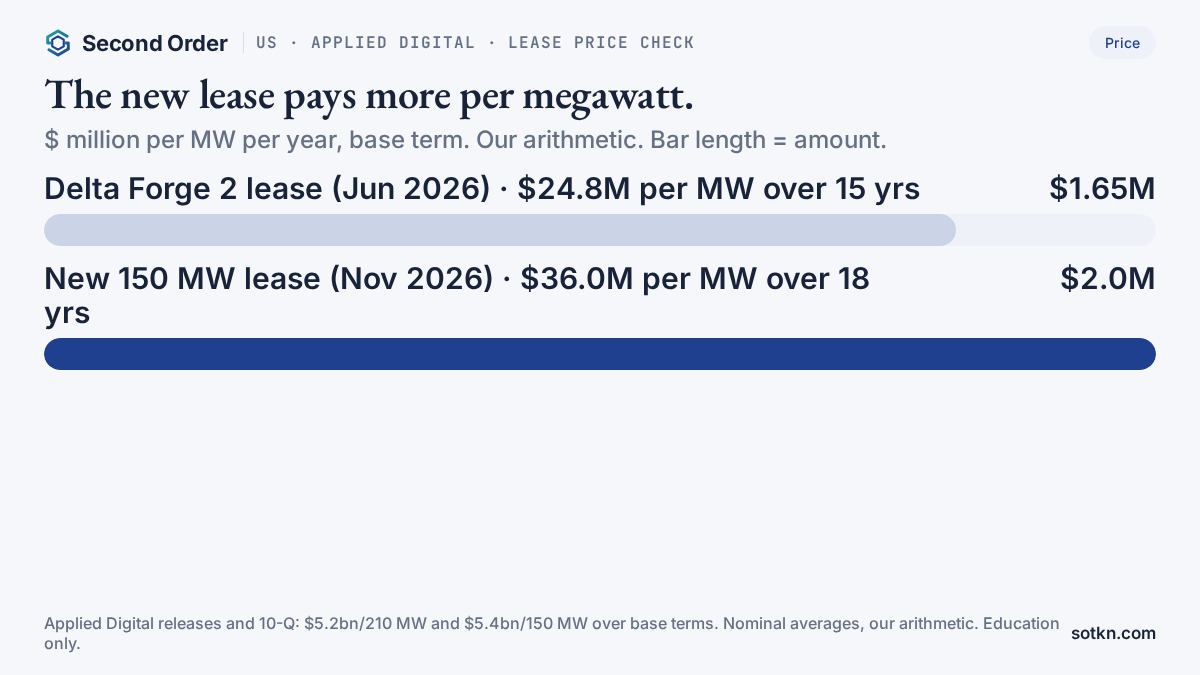
The lease is real news, and it is the other half of the day. It adds about $5.4 billion of base-term revenue. It also carries the company’s claim that terms improved, including higher pricing. The company gave no price per megawatt. So let us check the claim with arithmetic and clearly labelled sums.
Our arithmetic: $5.4 billion over 150 MW is about $36.0 million per MW over 18 years, or about $2.0 million per MW per year. The Delta Forge 2 lease from 5 June 2026 was about $5.2 billion for 210 MW over about 15 years. That is about $24.8 million per MW over the base term, or about $1.65 million per MW per year. The new lease works out about 21% higher per MW per year. That is consistent with the company’s word “higher pricing.” These are plain averages of nominal dollars. We do not know the payment schedule, so treat them as a rough read only.
The lease also tells us what it does not. It names no tenant and no campus. Applied Digital says only that delivery begins in the first half of 2028, subject to development milestones, utility arrangements and regulatory approvals. DataCenterFeed notes that the 10-Q gives the same first-half-2028 delivery for Delta Forge 2. Matching dates do not prove a site, and we do not assign it to one.
Why does this belong in a note about the bridge? Because it shows what the lenders are lending against. A top-rated customer on an 18-year term is the thing that makes both the bridge and the later project loan possible. About 75% of contracted base-term revenue now comes from investment-grade customers, the company says. That is the strength of the story. The weak joint is the date power arrives. For how one large customer can carry a whole project, see customer concentration, explained. For the buildings that house such customers, see colocation, explained.
Who gets paid while the draws wait?
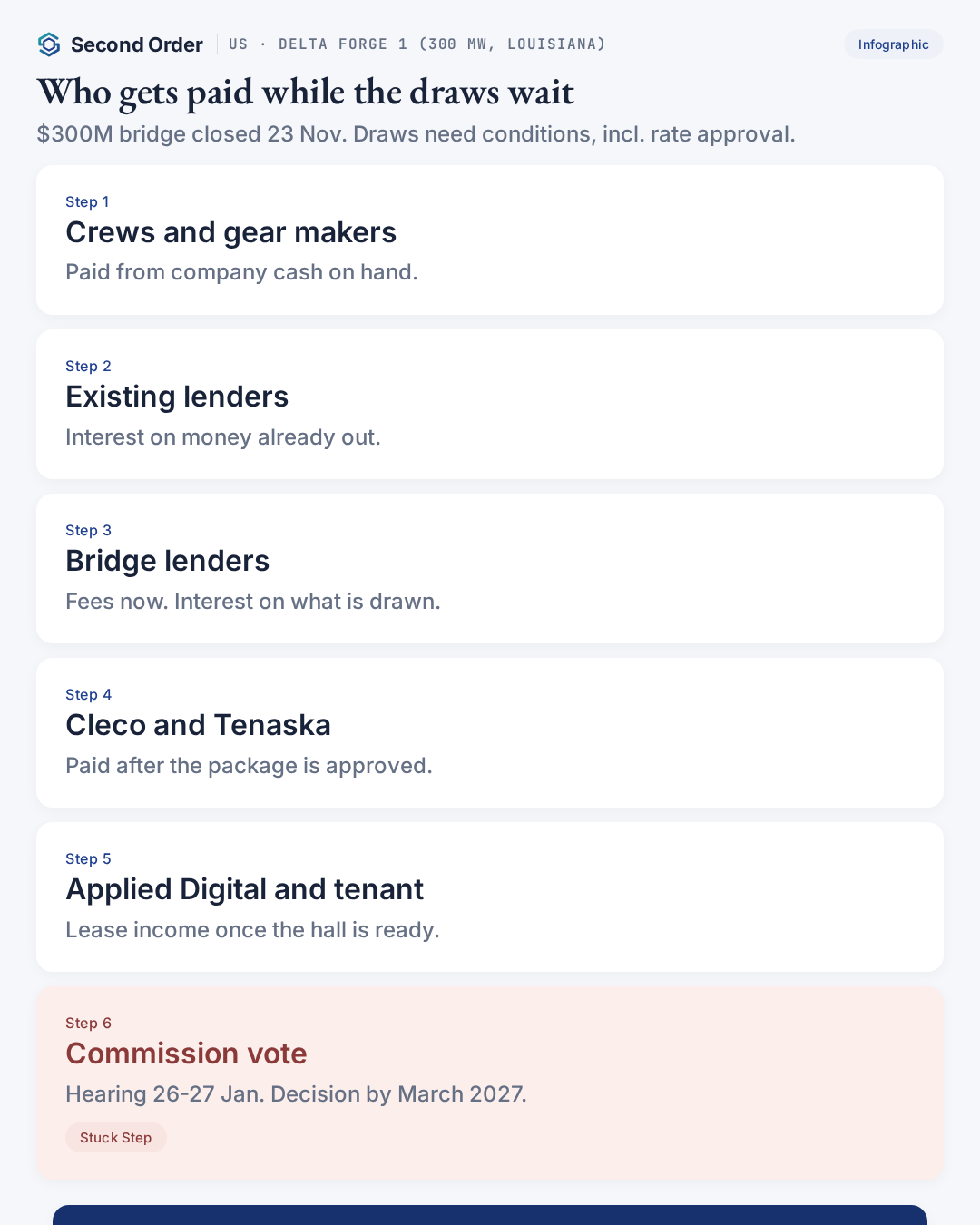
Most of the money in this story has not moved, or has moved on other tracks. Here is the split as we read it.
Paid now or already
Paid as conditions clear
Waits longer
Second Order’s read of the Applied Digital releases, the 10-Q and the Louisiana PSC order. We have not seen the loan agreement or the Cleco and Tenaska contracts.
The steadiest earners today are the people already on site and the lenders with money already out. They are paid from cash the company already holds. That is why we do not call this a cash crisis. It is not one.
The bridge lenders sit in the middle. Delayed-draw loans normally pay the lender a fee for standing ready. We do not know the fee here, so we do not state it. Interest is paid on what is drawn. The better the project moves, the more is drawn and the more interest is earned. A stalled gate means less drawn.
Cleco is paid when the commission approves the package and the plant and links are built. Tenaska, which supplies temporary capacity under a ten-year agreement that starts on 1 June 2027, is paid under a contract the commission is also reviewing. We have not seen the terms. Both depend on the same vote.
What is stuck, and what would change our read?
The stuck step is the commission vote on the Cleco package, if our read of the release is right. It is not power in the ground, because Cleco has a plan and a capacity agreement. It is not the customer, because the lease is signed. It is not the cash, because the company holds billions. It is a public decision on a date the company does not set.
After the vote, the stuck step moves. First to construction milestones, which unlock the later draws. Then to the longer project loan the CFO expects in the first quarter of 2027. Then to energising the first hall in the first half of 2027. Each of those is closer to the company’s own control than a commission vote.
What would make us more positive? A commission approval on or before March 2027. Applied Digital naming the lender and saying how much has been drawn. The project loan closing in the first quarter as the CFO says. Staff and interveners reaching a settlement before the hearing, which would shorten the path. A named tenant on the new lease and the campus that hosts it.
What would make us more cautious? A hearing that runs past January. A decision pushed beyond March. Interveners winning cost-sharing terms that change the economics. A first ready-for-service date moved out of the first half of 2027. Or draws showing up in a filing as unavailable for months. Any of these would move the stuck step from the commission to the cash.
We are careful about two things. First, a draw condition is common in construction loans and does not mean a project will fail. It means the money follows the milestones. Second, we are reading one pending case as the likely match for a condition the release did not explain. If the company says the condition is about something else, our read changes.
For how the stuck step tends to move from one link to the next, see where the stuck step moves. For a company with a very different build story, see our note on ChronoScale’s Odessa deal (power is firm, GPU money is not).
What dates test this next?
- 26–27 January 2027 — the hearing in Baton Rouge (cross-answering testimony 21 December, Cleco rebuttal 5 January).
- First calendar quarter of 2027 — project finance for Delta Forge 1 and Polaris Forge 3, per the CFO.
- No later than the March 2027 session — the commission’s decision.
- First half of 2027 — first ready-for-service at Delta Forge 1.
- About late November 2027 — bridge maturity (our arithmetic).
Louisiana PSC schedule and order, Sep 2026; Applied Digital releases, 23 Nov 2026; 10-Q for the quarter to 31 Aug 2026. Plans and procedure, not approvals.
How does this fit the rest of our notes?
If you are new to how a hall makes money, start with the AI factory, explained. All our US notes are on US Markets.
How we check this. The loan terms, lease terms and portfolio totals come from Applied Digital’s own press releases of 23 November 2026 and its 8-K filed 24 November. Campus status, cash and quarterly numbers come from its 10-Q for the quarter ended 31 August 2026. The Louisiana case facts come from the commission’s own order and hearing schedule, with local reporting for the chronology. The company did not name the commission, the lender, the tenant or the campus for the new lease; where we link the loan to the Cleco case, we say it is our read. We have not seen the loan agreement. Every per-megawatt figure, month count and date sum is labelled “our arithmetic”. The references we used are listed at the end. Our editorial standards →
FAQ
What did Applied Digital announce on 23 November?
Two things, 15 minutes apart. At 7:45 a.m. New York time it said it had closed a $300 million bridge loan for Delta Forge 1, its Louisiana campus. At 8:00 a.m. it announced a new 150 MW, 18-year lease with an investment-grade hyperscaler, about $5.4 billion over the base term. The tenant and the campus for the new lease were not named.
Why can’t Applied Digital just take the $300 million?
It is a delayed-draw loan. The company can draw only as conditions are met. The release lists construction milestones, regulatory approvals including state commission approval of electrical rates, lender consents and certain financial covenants. We have not seen the loan agreement, so we do not know which draws need which condition.
Which commission is it?
The release does not say. The only pending Louisiana commission case we found that ties to Delta Forge 1 is the Louisiana Public Service Commission docket U-38035, where Cleco Power asks to approve its electricity deal with Applied Digital. That match is our read, not the company’s statement.
When will the commission decide?
The commission said it will consider the case no later than its March 2027 session. A hearing is set for 26–27 January 2027. Nothing has been approved yet.
How does this tie to the new 150 MW lease?
The company did not link them. The lease says delivery begins in the first half of 2028, subject to development milestones, utility arrangements and regulatory approvals. The bridge loan is about the campus that is already being built.
Is this investment advice?
No. Education only. It maps who gets paid and which step is stuck. It is not a recommendation to buy or sell any security, and we leave out price targets and ratings on purpose.
References
Outbound links below are nofollow. We list only the sources actually used. Internal sotkn.com links in the body are separate.
- Applied Digital Corporation (Nasdaq: APLD), press release: Applied Digital Announces $300 Million Senior Secured Bridge Facility, 23 Nov 2026. ir.applieddigital.com — the $300 million delayed-draw term loan, the 364-day maturity, SOFR plus 300 basis points, project-asset security, prepayment without premium, and the draw conditions including state commission approval of electrical rates.
- Applied Digital Corporation, press release: Applied Digital Secures New 150 MW, 18-Year Lease with Tier-One Investment-Grade Hyperscaler, 23 Nov 2026. ir.applieddigital.com — the 150 MW lease, about $5.4 billion base-term revenue, the 33-year renewal case, portfolio totals, the financing plan and timing, and delivery from the first half of 2028.
- Applied Digital Corporation, Form 8-K (Items 1.01, 3.02, 7.01), SEC EDGAR, Filed 24 Nov 2026. sec.gov — the Series G preferred commitment rising from $2.0 billion to $2.5 billion with $1.035 billion left to draw, and that an indirect subsidiary closed the bridge loan.
- Applied Digital Corporation, Form 10-Q for the quarter ended 31 Aug 2026, SEC EDGAR, Filed 7 Oct 2026. sec.gov — campus status (Delta Forge 1 at 300 MW with first ready-for-service in the first half of 2027), the Delta Forge 2 lease, cash, restricted cash, quarterly revenue, cash used in investing and the 2031 notes that refinanced an earlier bridge.
- Louisiana Public Service Commission, Order U-38035 (Cleco Power LLC, ex parte), decided at the 16 Sep 2026 session, 16 Sep 2026. lpscpubvalence.lpsc.louisiana.gov — the Cleco application of 1 July 2026, the Applied Digital project in Rapides Parish, about 430 MW of load by 2028, the Tenaska capacity agreement from 1 June 2027, the interveners and the March 2027 target for a decision.
- Louisiana Public Service Commission, Administrative Hearings Division, ruling establishing the procedural schedule, Docket U-38035, Sep 2026. lpscpubvalence.lpsc.louisiana.gov — the testimony, rebuttal and discovery dates and the 26–27 January 2027 hearing.
- Louisiana AI Hub, LPSC U-38035: Cleco and Delta Forge 1, 8 Sep 2026 (updated through Oct 2026). louisianaaihub.com — the chronology of the executed electricity service agreement, the mid-2027 service date in Cleco testimony and the distinction between 430 MW of utility load and 300 MW of critical IT load.
- American Press, LPSC clears expedited path for Cleco power plan tied to data center, 17 Sep 2026. americanpress.com — the Lightning Initiative conditions, the eight-month target, the point that the vote was procedural and not an approval, and Cleco’s statement that the customer funds project-specific infrastructure.
- DataCenterFeed, Applied Digital Signs 150-MW, 18-Year Hyperscaler Lease Worth $5.4 Billion and Closes a $300 Million Bridge Loan for Delta Forge 1, Nov 2026. datacenterfeed.com — what the releases did not say (tenant, campus, lender, commission), the 27% share move reported by Mugglehead and the campus status list.
- Holland & Knight, RTOs/ISOs Answer FERC’s Large-Load Orders, 24 Nov 2026. hklaw.com — that the six grid-operator filings leave retail service, siting and rate decisions to the states.
Not investment advice. Do your own research. Education only. Map of who gets paid and which step is stuck — not a buy list.
More on this desk: US Markets · AI Data Centers · all Markets.