If Scanner Supply Stays Short Through 2028, Where Does Cash Stick?
ASML said planned 2027 and 2028 scanner supply will not fully meet demand. Halls can be signed. Watts in China can be cheap. Leading-edge wafers still wait on a slot.

ANALYSIS · MEMBERS CONTINUE · 5 min free / 14 min full · Data as at 14 Oct 2026
The only company that makes EUV scanners said this morning that the tools it can build in 2027 and 2028 will not fully meet customer demand. Some chipmakers are already asking about 2029 and 2030. This piece maps where the cash sits when the stuck step is ASML's own factory — not packaging, not a hall, and not a missing customer.
In short
- The question: if scanner supply stays short through 2028, where does the cash stick?
- The answer: Scenario B. ASML is paid on every tool it can actually build, and on productivity upgrades for the tools fabs already own. Optics and light-source suppliers get paid if 2028 capacity is added. Foundries, DRAM makers, GPU buyers and the halls waiting for those chips wait on a slot that does not exist yet
- Why: on 14 October 2026 ASML printed Q3 sales of €11.662 billion, 121 systems, and Installed Base Management of €3.289 billion. Christophe Fouquet said supply as currently planned for both 2027 and 2028 will not fully meet demand, and that ASML is investigating 2028 capacity beyond the 30% step set out in July
- The size of the planned extra: 2026 Low-NA EUV capacity of about 65 plus 30% is 84.5 tools in 2027; another 30% is 109.85 in 2028 (ours). DUV immersion of about 130 becomes 169, then 219.7. That is still, in ASML's words, not enough
- The contrast: today's China Pulse shows device makers already invoicing — storage CPI +46.7% — while factory electricity is still −3.9%. Today's Fluidstack Stack shows 735 MW of halls leased, not live. Halls can be signed. Watts in China can be cheap. Leading-edge wafers still wait on a scanner
- What would break it: a dated 2028 capacity number that actually meets demand (A), or a named fab cutting 2027–28 tools (C)
- Nothing here is a recommendation. Arithmetic shown below the wall
The numbers that matter
| What | Figure | Date | What it tells us |
|---|---|---|---|
| Q3 total net sales | €11,662 million, gross margin 57.5% | ASML, 14 Oct 2026 | Record quarter, high end of the old guide |
| Of which Installed Base | €3,289 million (service + field options) | Same | Upgrades are the relief valve |
| Systems sold | 121 (113 new, 8 used) vs 72 a year earlier | Same, US GAAP pack | Build rate, not bookings |
| Q4 / full-year guide | €14.2–15.2 billion / €44–45 billion, GM ~57% / ~56% | Same | Floor raised from €43 billion |
| 2026 Low-NA / DUV immersion capacity | ~65 / ~130 systems | Q2 release, 15 Jul 2026 | The base the 30% sits on |
| 2027 / 2028 plan | +30% in 2027; a further +30% investigated for 2028 | Q2, restated as footnote 2 today | Still "will not fully meet" |
| 2029–30 | Some customers expressing an interest in orders | Q3 CEO statement | Interest, not a bookings figure |
| China | About 20% of the business | CNBC, 14 Oct 2026, from ASML | DUV-heavy. Not the EUV slot |
| Non-current contract liabilities | €9.301 billion vs €3.366 billion at 31 Dec 2025 | US GAAP pack | Customer cash already parked |
| Fluidstack halls, leased | 735 MW critical IT (360 + 207 + 168) | TeraWulf / Cipher filings | Signed. Not live |
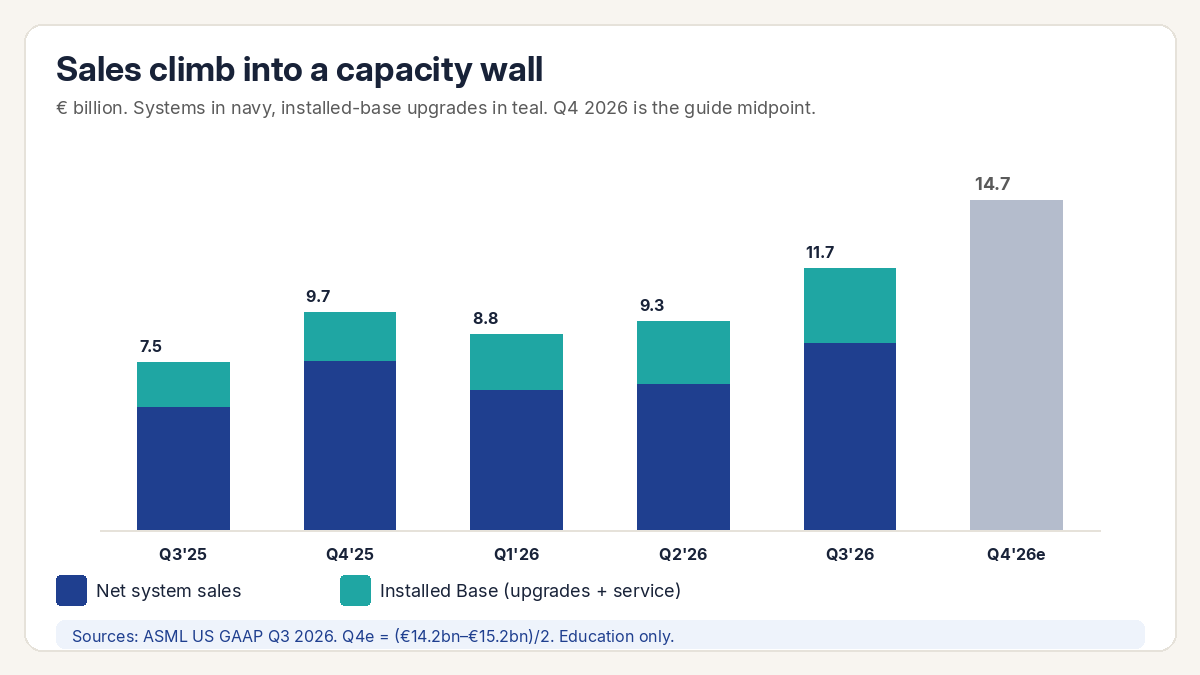
Chart 1 — Quarterly net sales. Navy is systems. Teal is Installed Base Management. Q4 2026e is the guide midpoint. Sources: ASML US GAAP Q3 2026. Education only.
Why is the scanner slot the stuck step?
A leading-edge AI accelerator still needs a packaged die, high-bandwidth memory, and the EUV layers that print both. Packaging has a timetable — where the stuck step moves. Memory has a wafer-pool timetable. Power has a years-long timetable. Today the only maker of EUV machines said the tool that prints those layers will itself be short in 2027 and 2028.
That is a different question from 29 September, when tools and halls were already being paid and CoWoS was still the join. It is not a company-price piece. What Does ASML Do? is the free Stack read. Today's Wire gave the news. This map asks: when the factory cannot meet two years of demand, who is paid on the tools that ship, and who waits on the tools that do not?
Three clocks around it are not the bind here. Demand is rising — customers are lifting tool forecasts on the size and duration of AI spend; 2029–30 is still only "expressing an interest," and there is no bookings figure. Halls can be signed anyway: Fluidstack's Google-backstopped leases are about 735 MW of critical IT, cash from handover, not from the lease. China's power price is still minus: storage CPI +46.7%, electricity PPI −3.9%. ASML's China ~20% is DUV and used tools, not the 2027 Low-NA slot.
What is left is build rate. July: add 30% to 2026 Low-NA of around 65 for 2027, investigate another 30% for 2028, same shape on DUV immersion of around 130. Today's footnote 2 points at that sentence. Today's new sentence is that even that plan does not fully meet demand in either year. See who makes EUV machines and EUV vs DUV. The stuck step is the scanner slot.
What does the map already assume?
Three answers compete: 2028 capacity is raised far enough that supply meets demand (A); the planned 30% then 30% still leaves both years short, so ASML is paid on what it can build and fabs pay to squeeze the tools they already own (B); or AI spend slows, 2029–30 interest does not convert, and fabs cut tools (C). A tip sheet would pick a stock. Analysis asks which answer today's release already needs.
Our read, in one line: the map already assumes Scenario B. Supply as currently planned for 2027 and 2028 does not fully meet demand. ASML is paid first. Installed-base upgrades are the relief valve — €3.289 billion this quarter, 28.2% of sales, up 68% from a year earlier (ours). The extra Low-NA slots in the 2027 plan are 19.5 tools; at the ~$200 million Reuters print that is about $3.9 billion of 2027 Low-NA list versus 2026 (ours, not an ASML euro figure). Demand is still larger than that. The stuck step is the factory, not the order pad. The scenarios and the arithmetic are below.
The free preview ends here.
—— Still to read · ~9 of 14 minutes ——
MEMBERS CONTINUE HERE
- Who gets paid, in order, and who waits
- Three scenarios with the arithmetic
- What +30% then +30% actually adds
- Six practical takeaways
- Members' FAQ