
1.5% of the Build: Who Gets Paid When Wagga Wagga Puts a Price on AI Data Centres
Wagga Wagga's council voted 7-0 on 16 November for a benchmark of 1.5% of capital cost from data centres. CDC's $15 billion Gregadoo plan already matches it; IREN's Redbank offer is not signed. The stuck step is the agreement before NSW decides.
Wagga Wagga's council has put a price on hosting a data centre: 1.5% of the project's total estimated capital cost, split between the council and community funds, with the first payment due before construction starts. It adopted the benchmark 7 votes to 0 on 16 November 2026. CDC's $15 billion Gregadoo plan already matches it, at $225 million. IREN has not agreed for its Redbank plan. Neither project has a signed planning agreement, and the NSW Government, not the council, decides whether either is built. The stuck step is that signed agreement.
AUSTRALIA · AI DATA CENTERS · Council meeting 16 Nov 2026 · Next update: Council's early policy review, due by 30 June 2027
Affects: AI Data Centers — Markets: Australia · Malaysia · Singapore
Education only, not advice to buy or sell any security. Figures are as published by the council and companies named, or as reported where stated, unless labelled as our arithmetic. Dollar figures are as published; IREN's page does not state a currency.
The numbers that matter this week
Data centre benchmark, POL 114
1.5%
Of total estimated capital cost · adopted 7-0 on 16 Nov
PricedCouncil share of that
1.0%
Capital infrastructure · stands in for the s7.12 levy
CouncilCDC Gregadoo, estimated cost
$15B
Up to 1.4 GW · package up to $225M · not yet signed
OfferedIREN Redbank, offer on its page
$200M+
Over 30 years, incl. rates · 900 MW · 2029 target
OfferedSigned planning agreements
0
Neither company has one; NSW is the consent authority
UnsignedEarly policy review due
30 Jun 2027
Council resolved to report back with any changes
ReviewFigures from Wagga Wagga City Council (16 Nov 2026), IREN (community page) and CDC (13 Oct 2026). Status chips are Second Order’s read.
On this page: What Council decided · The rate · Who gets paid · CDC · IREN · Our math · What is stuck? · Who decides · Dates next · Elsewhere · What would change this · FAQ
What did Wagga Wagga decide, and why does it matter for AI data centres?
On Monday 16 November 2026 Wagga Wagga City Council, in regional New South Wales, adopted an amended Community Benefit Sharing Policy, known as POL 114. The vote was 7 to 0. The policy covers major energy and technology projects, and for data centres it sets a benchmark, a number the council says it will ordinarily seek. The council published its own summary the next day.
It matters because two very large data centre plans are lined up on the same transmission-rich land west of Wagga Wagga, at Gregadoo. CDC, an Australian operator, has proposed a hyperscale campus there. IREN, the Nasdaq-listed AI cloud company, has proposed a 900 MW campus called Redbank nearby. For both, the question after “will the grid connect?” is “what does the host town get, and when?” Until this month Wagga Wagga had no adopted general policy on the question. Now it does.
We covered IREN's Redbank plan when it was announced, in our Redbank Catalyst, and the company itself in What does IREN do?. This note is about the price the host town has now put on that kind of project, and about who is paid when it is met.
What exactly does a data centre have to pay under POL 114?
The data centre line in the policy reads: a contribution of 1.5% of the project's total estimated capital cost, including the building, the fit-out, and machinery, plant and equipment. It is made up of three parts. The first, 1.0%, is a Council contribution, paid to and run by Council to fund capital infrastructure for a public purpose. The policy says it satisfies any section 7.12 requirement, which is the standard NSW levy on development. The other two parts are a jointly governed community benefit fund and a contribution the developer administers itself. Together those two make up the remaining 0.5%.
The draft the council put on exhibition in late August was lower. It set the data centre rate at 1% of capital investment. Six submissions came in by 9 October. One asked the council to count only the building, not the equipment inside. Staff did not support that, saying machinery, plant and equipment are a significant share of data centre investment and the contribution should reflect the full scale of the development. That choice is what makes the rate bite on an AI hall, where the equipment bill is large.
The council also considered, and did not adopt, an extra yearly payment tied to a data centre's approved power use. Its report said the NSW Data Centre Guidelines do not set such a benchmark, and a second method on top of the capital-cost one might produce a total that is not demonstrably proportionate. It said the policy should be reviewed if the state sets guidance. So the benchmark is a payment on the capital spent, not a running charge on the megawatts used.
The rules around the number matter as much as the number:
- The cost is certified. The planning agreement must carry a capital cost estimate certified by an independent quantity surveyor when it is signed, and the council may review it at the developer's cost.
- Payment starts early. The first payment falls due before construction begins, then annually on a fixed date, with payments indexed to the Sydney consumer price index from the date of the agreement.
- There is security. The agreement is to include security such as a bank or parent company guarantee, bind successors, and adjust pro rata for staged commissioning.
- Council's costs come on top. The developer also pays the council's costs of negotiating and enforcing the agreement, and the council says it will seek an administration contribution that must not reduce the community money.
- Timing is aimed at consent. The council will seek to sign the agreement before development consent, and will ordinarily ask the Minister or the Independent Planning Commission to hold back consent until it is signed.
One loose end. Staff proposed dropping a 25% extra loading the draft had for projects outside a designated Renewable Energy Zone, which Wagga Wagga is not in, and recovering administration costs through the planning agreement instead. The policy text attached to the agenda still carries marked-up wording on a loading, so we do not state a final loading rate. The 1.5% is the figure that is clear.
Who gets paid, and in what order?
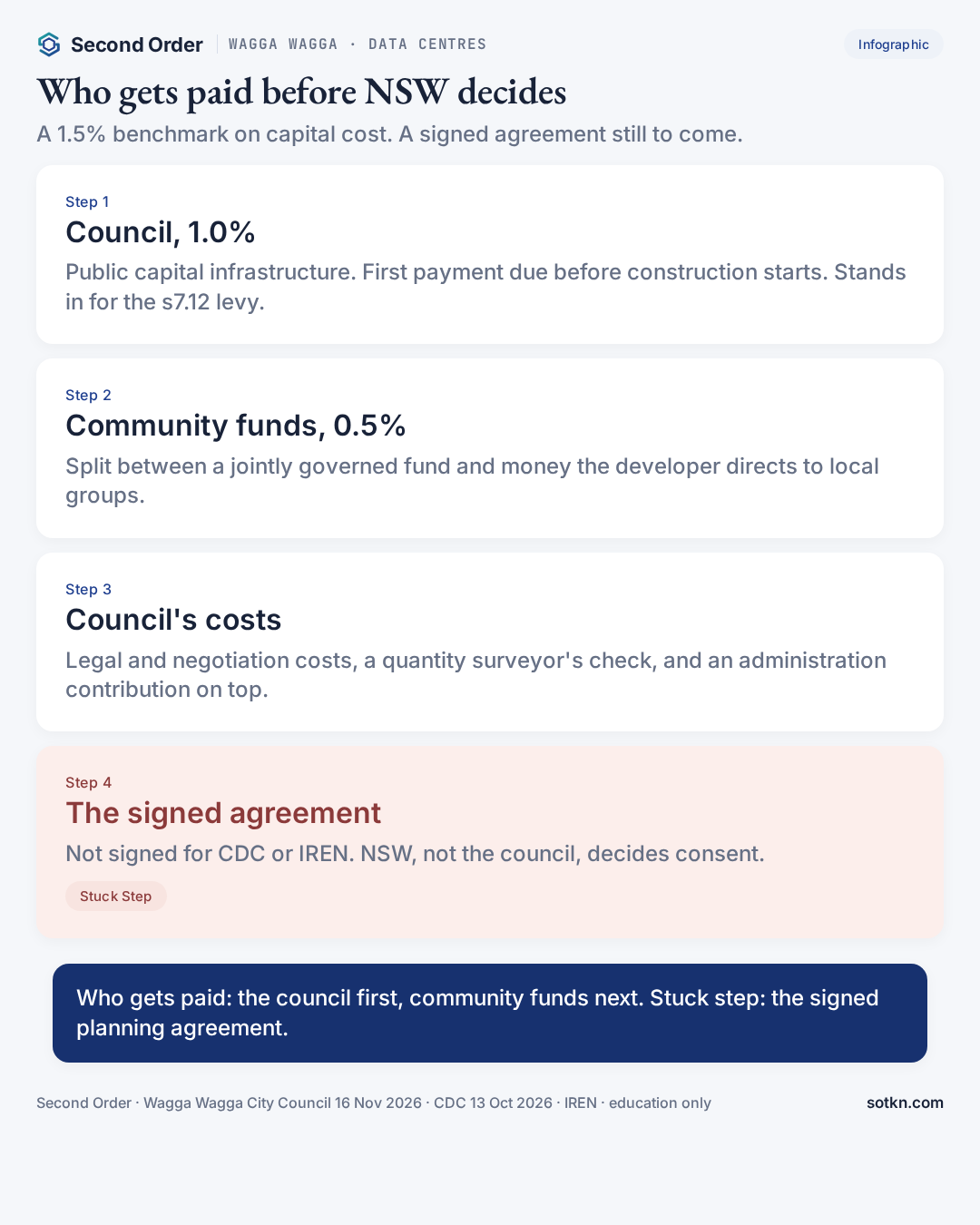
First, the council. The 1.0% share goes to Council to build public capital infrastructure, and the first payment falls due before a spade is in the ground. That makes the council one of the few parties paid before the project can earn anything. The policy also says the money must go to a public purpose, and any planning agreement the council proposes has to be publicly exhibited before it is finalised.
Second, the community funds. The 0.5% is split between a jointly governed fund for strategic community projects and money the developer directs to local organisations. The policy bars the developer-run part from paying for things the council would have to maintain. The split between the two is left open: the policy gives each as a “share of the 0.5%”.
Third, the people who turn the estimate into a number: the quantity surveyor, and the council's advisers and lawyers, whose costs the developer covers.
Last, everyone who is paid only once the project is approved: builders, power-equipment suppliers and, later, the tenants' own suppliers. For who those builders are, see who builds AI data centers. They sit behind the same consent decision.
One-line rule: in Wagga Wagga the council is paid first and before construction, community funds next, and everyone else only if NSW says yes. The stuck step is the signed agreement.
Where does CDC's Gregadoo plan sit against the benchmark?
On the benchmark, exactly on it, on our arithmetic. The council's report on the same agenda describes CDC's proposal at 232 Ashfords Road, Gregadoo: four single-storey data centre buildings on about 103.8 hectares, about 189,326 square metres of floor area, an estimated development cost of about $15 billion, and ultimate electricity demand of up to 1.4 GW. CDC is progressing its grid connection through Lumea, Transgrid's commercial infrastructure business.
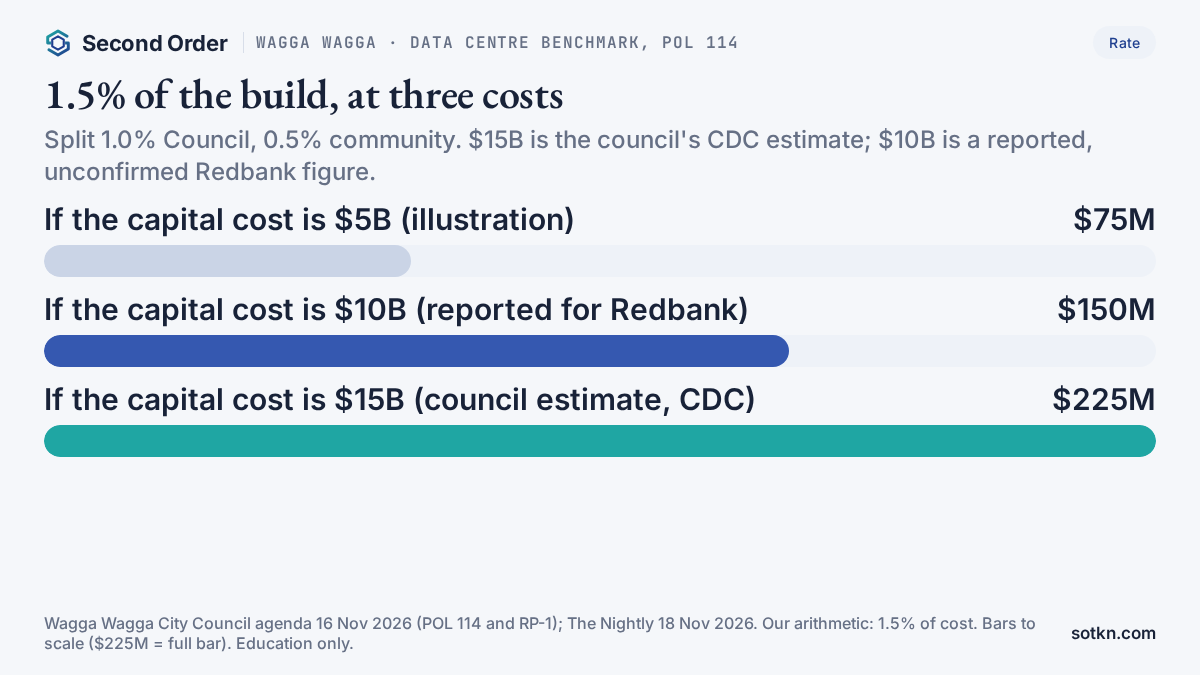
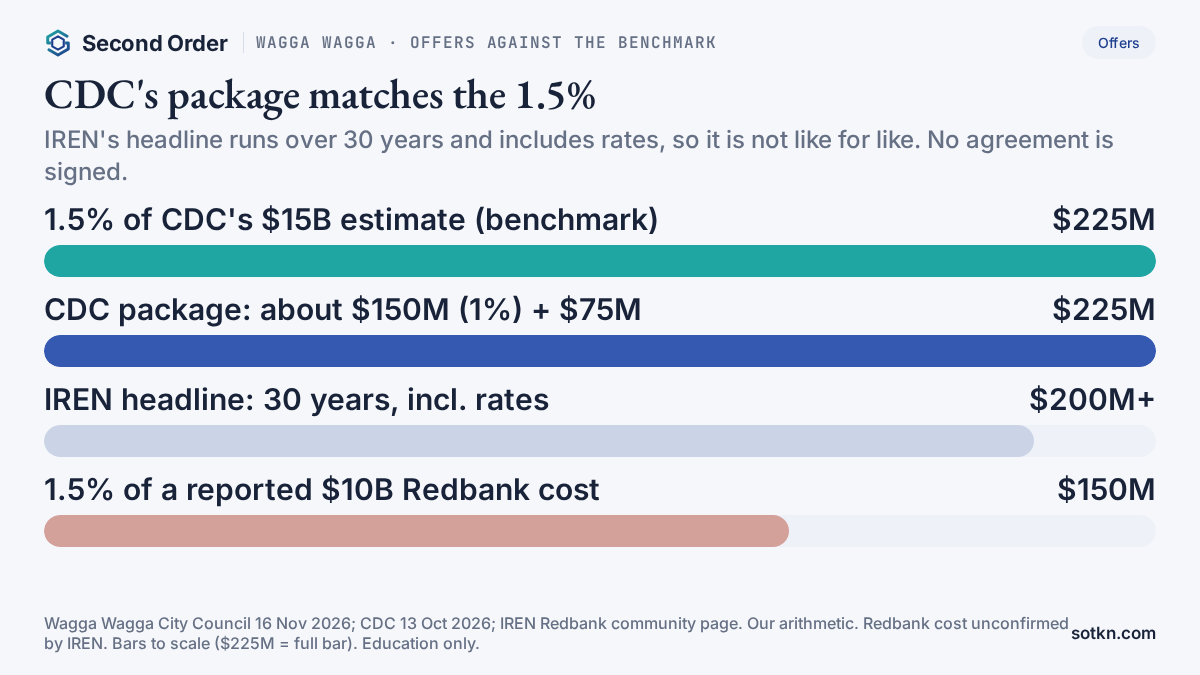
CDC announced a package worth up to $225 million on 13 October. It is a proposed planning agreement worth at least 1% of development cost, plus a further $75 million for community initiatives, all subject to the project being approved. At its meeting on 12 October the council had resolved that its first binding agreement with CDC must be worth at least the section 7.12 amount on the estimated cost, which the report puts at about $150 million at $15 billion. Add $75 million and you reach $225 million, or 1.5% of $15 billion. CDC's package is, in effect, the new benchmark.
Two cautions. The report says the governance and delivery arrangements for these commitments are still being developed. And the council's sale of the Ashfords Road land to CDC is a commercial deal that, in the report's words, is not a development approval. The report also describes the planning agreement as a future step: Council authorised negotiation of an initial binding instrument and then a Voluntary Planning Agreement. The state planning process is separate. The NSW Government issued the project's assessment requirements on 15 October, and CDC is now preparing its environmental impact statement, which will be publicly exhibited once lodged.
Where does IREN's Redbank offer sit?
Unproven. IREN's community page for Redbank lists 900 MW of total planned capacity and 2029 as the target for initial energisation. It says IREN expects to pay more than $200 million to Wagga Wagga City Council over 30 years, towards the community benefit fund, infrastructure projects and council rates, and that the project will fund its own network connection. It lists more than 500 construction jobs and more than 200 operations jobs.
IREN has not published a capital cost for Redbank, so the 1.5% cannot be turned into a dollar figure from the company's own materials. The Nightly reported on 18 November that IREN did not respond to a request for comment, that it has not signalled it would agree to the council's terms, and that the council general manager said the policy provides a consistent basis for negotiations with individual proponents. The council said it will keep talking with IREN.
One more difference. IREN's $200 million is described as covering rates as well as community money, and is spread over 30 years. The policy's contribution is calculated on capital cost and may be paid upfront, as annual payments, or a mix. The two are not the same shape, so we do not call IREN's offer higher or lower than the benchmark.
For how the 900 MW plan fits with the grid problem in Sydney, see our Sydney data centre power-lease Pulse.
What does our arithmetic show?
The benchmark on CDC's estimate
IREN and the unit sums
Three caveats. First, the $15 billion is the council's estimate of CDC's development cost, not an audited figure; the policy requires a certified estimate only when a planning agreement is signed. Second, IREN's cost has not been confirmed by the company. Figures up to $10 billion have been reported, and The Nightly says so too, so the $150 million and $13.3 billion lines are sensitivities, not forecasts. Third, a benchmark is not a bill: the policy says the council will ordinarily seek it, and the amount is set in a negotiated agreement.
For why the equipment inside the building dominates the cost, see how much it costs to build an AI data center, and for what a hall of this size draws from the grid, how much power an AI data center uses.
So what is the stuck step?
The signed, publicly exhibited planning agreement, sitting in front of a state consent decision that has no date. It is not demand: IREN and CDC are both pressing ahead. Grid connection is a separate track: CDC is working through Lumea and IREN says it will fund its own connection. The stuck step is the paper that turns a benchmark into a cheque. Three things keep that step tight:
- Nothing is signed. CDC's package is a proposal and its governance is still being developed. IREN has not been reported as agreeing. A benchmark is something the council will ordinarily seek, not something either company has promised.
- The council does not decide. It is not the consent authority. It can ask the Minister to wait for an agreement, and it voted not to ask for a moratorium, but the NSW Government decides both projects.
- The number is not final. The policy is to be reviewed early, and sooner if the state sets its own data centre benchmark. A review by 30 June 2027 could move the rate before either project is consented.
So-what: in Wagga Wagga the scarce thing is not a megawatt or a buyer. It is a signed agreement the town can enforce. Until one exists, the cash that is certain is only the council's own costs and the first, pre-construction payment, and neither is due until a project is approved.
Who decides, and what did the council vote on the same night?
The NSW Government. The council's report says the CDC proposal is State Significant Development, assessed by the state's planning department, and that Council is a stakeholder and technical referral body, not the consent authority. The council will make its own formal submission once the environmental impact statement is exhibited.
The same meeting dealt with two petitions on Gregadoo, one received on 27 October asking the council to seek a moratorium on the state assessment, and one received on 3 November asking it to support assessment without delay. An amendment to ask the Minister for Planning to impose a moratorium on assessing data centres at Gregadoo lost, 5 votes to 2. The council then noted the report and the petitions, 6 votes to 1. In short, the council chose to price the projects and monitor them, not to ask the state to pause them.
Which dates test this read next?
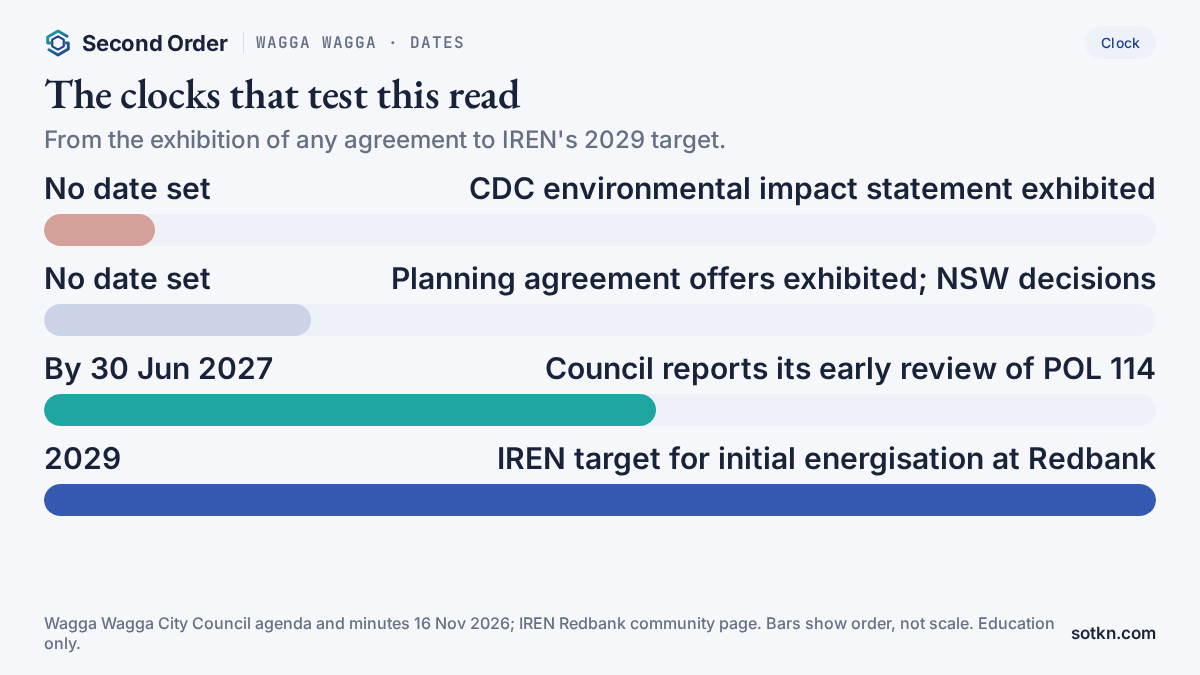
- No date set — CDC lodges its environmental impact statement and it goes on public exhibition through the NSW Planning Portal. The test: whether the cost estimate and the community package appear in it.
- No date set — any planning agreement offer from CDC or IREN is publicly exhibited before it is finalised. The test: whether either lands at or above 1.5%.
- No date set — the NSW Government's decisions on the two projects, and its separate review of how data centres pay for network connection. The test: whether the state sets a benchmark that overrides Wagga Wagga's.
- By 30 June 2027 — Council reports back on its early review of POL 114. The test: whether the data centre rate or the loading changes.
- 2029 — IREN's target for initial energisation at Redbank. The test: whether the first payment before construction has been settled well before then.
How does this compare with the rest of Australia, Malaysia and Singapore?
Elsewhere in New South Wales the state has been making data centres pay for the wires. Our Kurri Kurri grid-fee Pulse followed a proposed per-megawatt upgrade fee, and our Sydney power-condition Pulse followed approvals that wait on power. Wagga Wagga adds a third price: a share of the capital cost for the host town.
Malaysia is turning held-but-unused power into a cost, as our Malaysia booked-power Pulse showed. Singapore rations megawatts by tender and then fits them out in phases, as our Equinix SG6 Pulse showed. Wagga Wagga prices something else: not the power but the permission to build the hall.
What would change this view?
- IREN signs, or publicly offers, a planning agreement at or above 1.5% — the stuck step would be down to the state decision alone.
- CDC's package is cut below 1.5% or its governance stalls — the match with the benchmark would have been a headline, not a deal.
- The NSW Government sets its own data centre benchmark — Wagga Wagga's number would give way to a state one.
- The early review changes the rate or restores a loading — the cost of hosting would be higher or lower than today.
- NSW consents a project without a signed agreement — the council's lever would be gone.
Practical takeaways
- Wagga Wagga adopted POL 114 on 16 November 2026, 7-0; data centre rate 1.5% of total estimated capital cost
- Split: 1.0% Council contribution (public capital infrastructure, satisfies s7.12) and 0.5% community benefit
- Cost certified by a quantity surveyor; first payment before construction; CPI-indexed; security; consent timing
- CDC Gregadoo: about $15 billion, up to 1.4 GW; package up to $225 million equals 1.5% on our arithmetic
- IREN Redbank: 900 MW, 2029 target, more than $200 million over 30 years offered; no agreement reported
- NSW Government is the consent authority; Council review of the policy due by 30 June 2027
- Council is paid first. Stuck step: the signed planning agreement
FAQ
What did Wagga Wagga Council decide about data centres on 16 November 2026?
It adopted an amended Community Benefit Sharing Policy, known as POL 114, by 7 votes to 0. For a data centre, the policy sets a benchmark of 1.5% of the project's total estimated capital cost, counting the building, fit-out, machinery, plant and equipment. Of that, 1.0% is a Council contribution for public capital infrastructure and 0.5% is a community benefit contribution. Council also resolved to review the policy early and report by 30 June 2027.
How much would that be for CDC's Gregadoo campus?
CDC's concept has an estimated development cost of about $15 billion, according to the council report. On our arithmetic, 1.5% of that is $225 million. CDC announced a package of up to $225 million on 13 October: a proposed planning agreement worth at least 1% of development cost, about $150 million at that cost, plus a further $75 million. The two figures line up, though CDC's package is subject to approval and a planning agreement is not yet signed.
Has IREN agreed to pay 1.5% for its Redbank data centre?
No. The Nightly reported on 18 November that IREN did not respond and has not signalled it would agree. IREN's own community page says it expects to pay more than $200 million to Wagga Wagga City Council over 30 years, towards a community benefit fund, infrastructure projects and council rates. IREN has not published a capital cost, so the 1.5% benchmark cannot be turned into a dollar figure for Redbank from its own materials.
Who decides whether the data centres are built?
The NSW Government. Both proposals are assessed as State Significant Development, and the council report says Council is not the consent authority. The policy says Council will ordinarily ask the Minister or the Independent Planning Commission to withhold consent until a planning agreement covering the community contributions is signed.
Who gets paid, and what is the stuck step?
On our map: Council first, for infrastructure, with community funds and developer-directed local spending behind it, plus Council's own costs. The first payment falls due before construction starts. The stuck step is the signed, publicly exhibited planning agreement, which neither company has yet reached, ahead of a NSW decision that has no date.
Is this investment advice?
No. Education only. It maps who gets paid and which step is stuck. It is not a recommendation to buy or sell any security, and we leave out share prices, valuations, broker ratings and price targets on purpose.
Keep reading on the map
- Australia Markets hub — country page
- IREN Redbank Catalyst · What does IREN do?
- Sydney power-lease Pulse · Kurri Kurri grid-fee Pulse · Australia pipeline Pulse · Australia funding Pulse
- Malaysia booked-power Pulse · Equinix SG6 Pulse
- AI Data Centers on the Stack
- What is an AI data center? · Where AI data centers are located · Contracted power · Hyperscale vs colocation · How long a build takes
- All Markets doors — Taiwan, Korea, US, China, Singapore, Australia, Malaysia
How we check this. Policy terms, votes, dates and the CDC concept (cost, size, power, process) come from Wagga Wagga City Council's agenda and minutes for its 16 November 2026 meeting, including the draft and amended Community Benefit Sharing Policy (POL 114) attached to the agenda, and the council's own meeting summary of 17 November. IREN's offer comes from its Redbank community information page. CDC's package comes from its 13 October 2026 release. The report that IREN has not signalled agreement is from The Nightly on 18 November. We did not use any figure we could not trace to those documents. Anything we worked out ourselves is labelled “our arithmetic”. Dollar figures are shown as published; the council's are Australian dollars and IREN's page does not state a currency. Share prices, valuations, broker ratings and price targets are left out on purpose. The references we used are listed at the end. Our editorial standards →
Not investment advice. Do your own research.
References
- Wagga Wagga City Council, Ordinary Meeting agenda, items RP-4 (Community Benefit Sharing Policy, POL 114, with Attachment 1) and RP-1 (Ashfords Road data centre), 16 Nov 2026. meetings.wagga.nsw.gov.au — data centre rate of 1.5% of total estimated capital cost split 1.0% Council contribution and 0.5% community benefit; capital cost certified by a quantity surveyor; first payment before construction; CPI indexation; consent-timing request; CDC concept of about $15 billion, up to 1.4 GW, 103.8 hectares; SEARs issued 15 October; Council not the consent authority.
- Wagga Wagga City Council, Minutes of the Ordinary Meeting (resolutions 26/400 and 26/402), 16 Nov 2026. meetings.wagga.nsw.gov.au — POL 114 adopted 7-0 with an early review by 30 June 2027; moratorium amendment lost; petitions noted.
- Wagga Wagga City Council, Summary of Council’s 16 November 2026 Ordinary Meeting, 17 Nov 2026. news.wagga.nsw.gov.au — Council statement that POL 114 covers major developments including renewable energy projects and data centres, adopted with amendments.
- Wagga Wagga City Council, Draft Community Benefit Sharing Policy (POL 114), public exhibition page, Aug–Oct 2026. haveyoursay.wagga.nsw.gov.au — draft exhibited from 29 August to 25 September with submissions to 9 October; draft data centre rate of 1% of capital investment.
- IREN, Redbank Data Centre community information page, Nov 2026. iren.com — 900 MW total planned capacity; 2029 target initial energisation; more than $200 million to Wagga Wagga City Council over 30 years towards the community benefit fund, infrastructure projects and council rates; self-funded network connection.
- CDC, Wagga Wagga community set to receive $225m in benefits from CDC data centre investment, 13 Oct 2026. cdc.com.au — package worth up to $225 million: a proposed planning agreement equal to at least 1% of development cost plus $75 million; subject to approval.
- The Nightly, IREN tax: Wagga Wagga demands 1.5 per cent community levy from data centre giant, 18 Nov 2026. thenightly.com.au — IREN did not respond and has not signalled it would agree; council general manager on a consistent basis for negotiations.