What Does Ibiden Do? The Prepaid Substrate Model
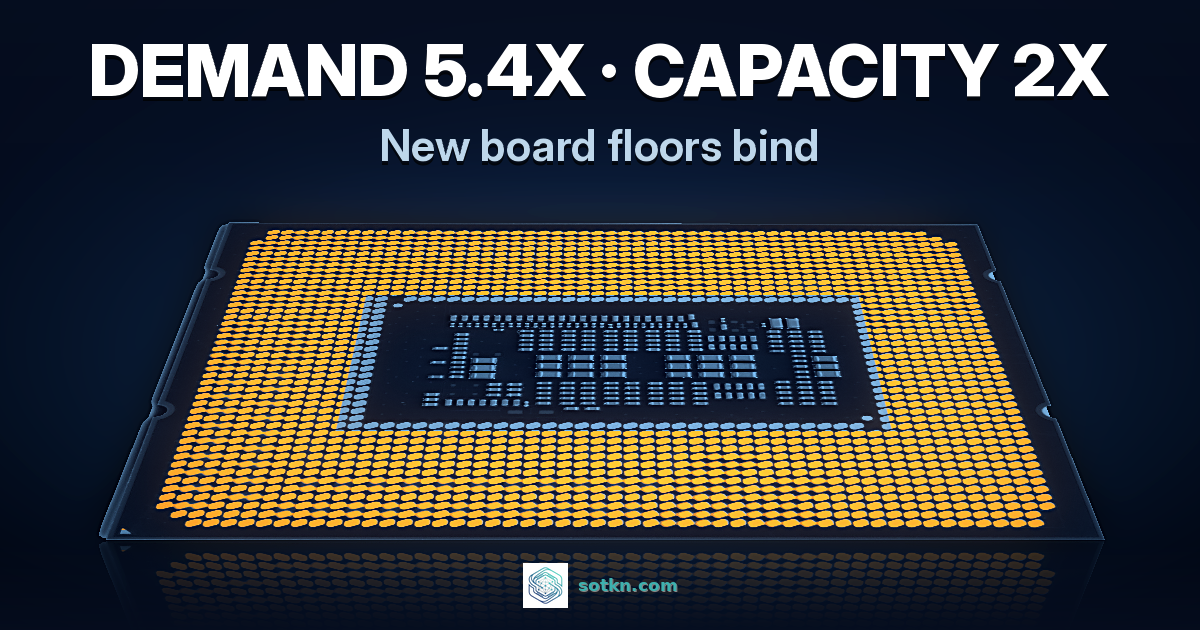
Ibiden makes the package substrate, the layered board that every big AI chip sits on. Customers paid it ¥199.7 billion in advance by September. It says demand for top-grade boards could grow 5.4 times by 2030, while its own capacity only doubles. New factory floors are the stuck step.
STACK · Semiconductors · Status: Tightening · Last reviewed: 22 Nov 2026
Every big AI chip sits on a board. Not the server board, but a small, thick, many-layered one that carries power in and signals out. Ibiden is one of very few companies that can make the best of these boards in volume. Right now its customers are paying it in advance, because there are not enough to go round.
In short. Ibiden is a Japanese company that makes IC package substrates, the layered boards that big chips sit on. Its best boards go under AI GPUs, custom AI chips, server CPUs and switch chips. Business is at a record. Sales in the six months to September were ¥262.5 billion and operating profit ¥60.1 billion. Customers are now paying ahead: advances received reached ¥199.7 billion at the end of September, up from ¥81.0 billion in March. Our read: the chip buyers pay first and wait longest, the tool and material makers get paid as Ibiden builds, and Ibiden earns once new lines ship. The stuck step is new factory floor for top-grade boards. Ibiden says demand for that kind of board could grow 5.4 times by 2030 while its own capacity only doubles.
Why an investor cares: when people talk about the AI chip shortage, they mean the wafer, the memory or the packaging. Ibiden shows a quieter limit underneath all three. If the board is short, the chip does not ship. If you are new to this part, start with IC substrates and ABF explained. This page is about how Ibiden makes money, who gets paid before it, and where its chain is stuck today.
Numbers that matter
| Number | What it is | Why it matters |
|---|---|---|
| ¥262.5bn | Sales, six months to 30 September 2026, up 34.3% from a year earlier | A record half, led by AI substrates |
| ¥50.0bn | Electronics segment profit in the half, on ¥172.5bn of sales | About 29% margin on our arithmetic; this is the substrate business |
| ¥199.7bn | Advances received at 30 September, up from ¥81.0bn at 31 March | Customers paying ahead for capacity that is not built yet |
| 5.4x vs about 2x | Growth in substrate area needed for AI chips, 2026 to 2030, against Ibiden's capacity plan | Demand runs well ahead of what can be built |
| Q1 2028 | When Nvidia says new capacity at Ibiden's Ono plant starts to ramp | The prepaid output arrives years after the cash |
| ¥210bn → ¥350bn | Capital spending, year to March 2027, then year to March 2028 (plan) | The build bill rises before the new lines earn |
Ibiden's financial year runs from April to March; it calls the year to March 2027 "FY2026". Figures are listed at the end of the page. Sums and ratios are our arithmetic from those filings.
What does Ibiden actually do?
It makes IC package substrates. A chip die is tiny and its connections are very fine. A server board is large and its connections are coarse. The substrate sits between the two. It spreads thousands of fine connections out to a pattern the server board can use, and it feeds the chip power. Our explainer on who makes IC substrates names the handful of firms in this trade.
The top-grade boards are made with a method called the semi-additive process, or SAP. Thin layers of insulating film are built up one on another, and copper wiring is plated onto each layer. The more layers, and the bigger the board, the more factory time each board takes.
Ibiden's own roadmap shows how fast that is changing. Its presentation of 30 October puts a typical top board at 80 by 80 millimetres in 2025 and 90 by 90 in 2026. It expects 110 by 110 in 2028 and 130 by 130 or more from 2030. Layer counts rise too, from about 9 build-up layers on each side to about 14. The chips on top grow from about 3.5 times the size of the largest single exposure on a wafer to more than 9 times.
That growth comes from chiplets: one package now holds several chip dies and memory stacks side by side. Our explainers on chiplets and interposers show how those parts are joined. The substrate is the floor they all stand on.
Ibiden was founded in 1912 as a hydroelectric power company. Today electronics makes the substrates, and ceramics makes exhaust filters and other parts for cars and machines.
How does Ibiden make money?
Mostly by selling substrates, and mostly the expensive kind. In the six months to 30 September 2026, electronics sales were ¥172.5 billion, up from ¥113.5 billion a year earlier. That is a 52% rise on our arithmetic. Segment profit almost doubled, from ¥25.4 billion to ¥50.0 billion. That is a margin of about 29%.
Ceramics is smaller and slower. It sold ¥46.2 billion in the half and made ¥5.4 billion. Ibiden says the car market is still weak. For the whole group, half-year sales were ¥262.5 billion, up 34.3%. Operating profit was ¥60.1 billion, up 84.6%. Net profit was ¥38.6 billion. All three are records, the company says.
The second half is meant to be bigger again. For the year to March 2027 Ibiden now forecasts sales of ¥565 billion and operating profit of ¥133 billion. Its presentation puts electronics at ¥385 billion of sales and ¥114 billion of operating profit for the year. The chief executive, Koji Kawashima, said electronics margins should come close to 30% this year.
Why so profitable? Kawashima told analysts that pricing and AI demand drove the jump. He also said the market's focus is capacity, not price, and that suppliers are in the stronger position for now.
The longer plan is large. Ibiden targets sales of ¥650 billion and operating profit of ¥165 billion in the year to March 2028. For the year to March 2031 it targets more than ¥1 trillion of sales and more than ¥300 billion of operating profit. Kawashima said electronics margins could reach about 35% around 2030.
Why are customers paying in advance?
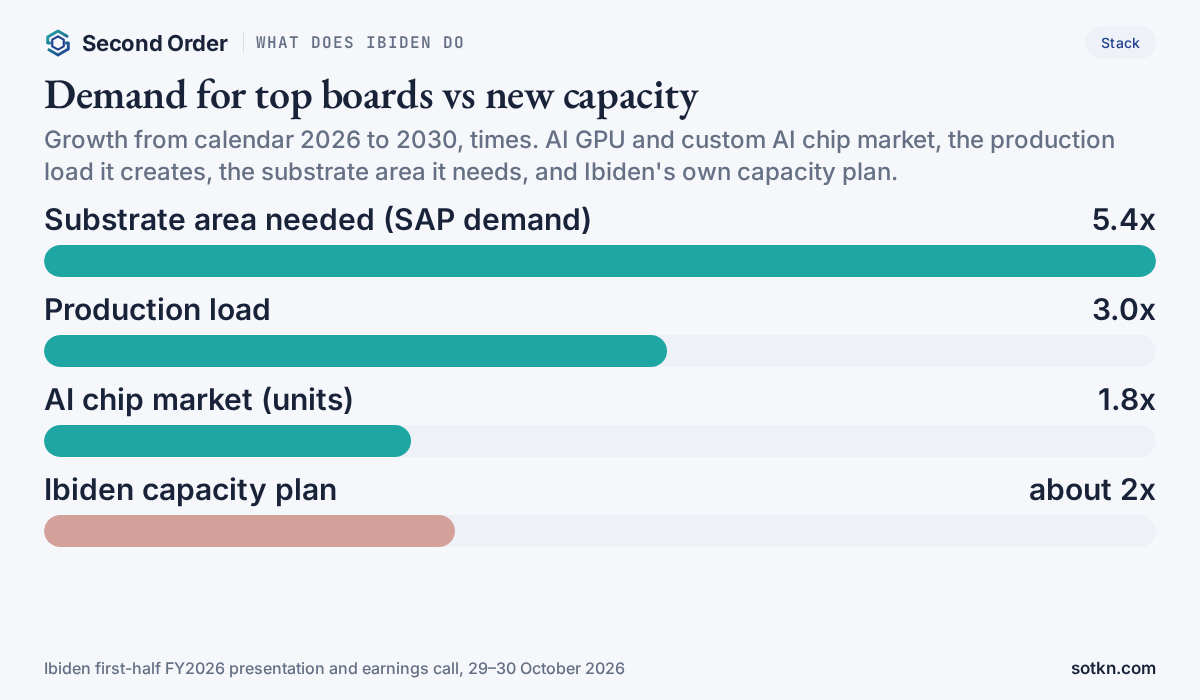
Because the gap between demand and supply is wide, and it is getting wider. Ibiden's presentation sets out the maths. From calendar 2026 to 2030, it expects the market for AI GPUs and custom AI chips to grow 1.8 times in units. Because each chip needs a bigger board with more layers, the production load grows 3.0 times. The board area needed from the SAP process grows 5.4 times. For general server CPUs the same three steps are 1.3, 1.9 and 2.5 times.
Against that, Kawashima said Ibiden plans to double its capacity by 2030. In his words, it really needs four to five times more, but it is already expanding as fast as it can. Divide 5.4 by 2: by 2030 the board area needed grows about 2.7 times more than Ibiden's own capacity, on our arithmetic. He expects supply to stay tight.
When something is that short, buyers pay to jump the queue. Ibiden's balance sheet shows it. Advances received, money customers pay before they get the goods, were ¥81.0 billion at 31 March 2026. By 30 September they were ¥199.7 billion. That is a rise of ¥118.8 billion in six months. Our explainer on prepayments covers how this kind of cash works on both sides.
Ibiden does not say who paid it. But Nvidia said on 21 October that it is giving Ibiden a multibillion-dollar capacity reservation advance to support its Ono plant, under an agreement Ibiden had announced earlier in the year. The expansion aims to take that plant to three times its current capacity, with new output starting to ramp in the first quarter of 2028. Our read: Nvidia's advance fits much of the jump. See our Catalyst on Nvidia's October supply deals.
Operating cash flow in the half was ¥193.2 billion. Of that, ¥118.8 billion was the rise in advances received. Without it, operating cash flow would have been about ¥74 billion, on our arithmetic. Cash and deposits rose to ¥420.5 billion at 30 September, from ¥295.7 billion in March. So the customer, not Ibiden's lenders, is funding much of the build.
Who gets paid first?
- Tool and material makers. They are paid as Ibiden builds. Ibiden plans ¥210 billion of capital spending in the year to March 2027, ¥200 billion of it in electronics, and ¥350 billion the year after. Kawashima said spending should top ¥400 billion in the year to March 2029. The money buys lasers, laminators, plating lines and buildings. Film and glass cloth makers sell the materials that go into every layer; our Markets piece on glass cloth and board materials covers that step.
- Builders and staff. New buildings go up first, and Ibiden has to hire and train the people who run them.
- Ibiden, in two stages. It gets cash early through advances, then earns profit when boards ship. Advances sit on the balance sheet as a liability until they are worked off, usually against later deliveries.
- The chip buyer, last. Nvidia and other chip designers pay before the new factory exists, then wait. The extra Ono output starts to ramp in early 2028, more than a year after the cash went in.
This is the reverse of the usual order. Normally the buyer pays on delivery and the supplier carries the build. Here the buyer carries part of it. We have seen the same move at Amkor, where advances funded new packaging lines, and our Analysis on Amkor's advances explains what that does to risk. Our explainer on take-or-pay versus purchase commitments shows the other contract shapes buyers use.
What is the stuck step?
New factory floor for top-grade boards. Not demand: Ibiden says demand exceeds what it can make. Not cash: customers are paying ahead and Ibiden held ¥420.5 billion. The missing piece is finished, staffed, tooled floor space that can run the SAP process at scale. Our Analysis on what happens if substrates stay short to 2028 sets out where the cash sticks when this step binds.
The dates show how slow that floor is. Ibiden's Ono plant building, called Cell8, carries ¥280 billion of announced investment for AI GPU substrates. It starts operations in stages from the year beginning April 2027. Kawashima said part of Cell6 and Cell8 comes online in 2027 and most of it in 2028. Nvidia's own date for the Ono ramp is the first quarter of 2028.
The Gama plant building, called Cell6, carries ¥220 billion already announced. On 29 October Ibiden added about ¥151 billion more, at Gama and an overseas plant, to fill the rest of the building. The notice says the new money is mainly for CPU substrates, as AI moves from training to inference and agents. Mass production starts in stages from the year beginning April 2029. Kawashima said the real ramp is late in that year, so it adds meaningful sales only in the year to March 2031.
Two more sites, called Cell7 and Cell9, sit next to the existing buildings. Ibiden is still discussing them with customers and aims to decide within the year to March 2027. Kawashima said that even if Ibiden decided now, they would take at least about four years to ramp. So they matter after 2030.
He named three reasons the floor is slow. First, people: staff are the biggest risk, because Ibiden must ramp existing plants first and then move trained people to new ones. Second, tools: lasers, laminators and plating equipment all have longer lead times. Ibiden thinks it can get what current plans need, but long lead times could hit new cells. Third, yields on the newest products, covered below.
Our read on the stuck step: cash has arrived early, and the floor arrives late. Demand for board area grows about 5.4 times by 2030 on Ibiden's numbers, while new floor lands mostly in 2028 and after. We mark the status Tightening. The gap is widening on Ibiden's own forecasts, the Cell6 top-up adds nothing until 2029, and tool lead times are getting longer. It would ease if new lines start on time and rivals add floor faster. Our gold explainer where does the stuck step move shows how a bind passes from one step to the next.
Why is EMIB-T a second test?
EMIB-T is a way of joining chiplets with small silicon bridges set into the substrate, rather than one large silicon interposer. It comes from Intel. Our explainer on CoWoS versus EMIB compares the two. Ibiden says a little over half of Cell6 is for EMIB-T boards, and that this capacity is ramping now.
It is hard to make. Kawashima said the hard part is the connections on the back side. He called Ibiden's yields pretty challenging, about the same as its Japanese peers, and doubted talk of a rival above 50%. Asked about mass production from the second half of next year, he said the timing has not changed.
He expects EMIB-T to be a little over 10% of Ibiden's sales in 2030. Demand for EMIB-T and for regular CPU boards is strong at the same time, he said, so the customer must choose which comes first. In plain words: two kinds of demand are queuing for the same floor.
Who else does this?
At the top end, Ibiden named its main rival as a company in Taiwan, and said a Korean maker has now joined, making three. Nvidia's 21 October release fits that picture: it named Ibiden, Samsung Electro-Mechanics and Unimicron, and said together those deals would lift substrate capacity for its products 2.5 times over three years. Our Korea Markets piece and our Wire on Samsung Electro-Mechanics' substrate lines cover the Korean side.
The dates line up close together. Nvidia says Unimicron adds capacity from the second quarter of 2027 and reaches full capacity by mid-2028. On 17 November it added Kinsus, another Taiwanese maker, which plans to lift capacity dedicated to Nvidia more than 3.5 times, starting in the second half of 2027 and reaching the target in the third quarter of 2028. Our Catalyst on Kinsus has the detail.
Kawashima does not expect to lose share. Even all suppliers' capacity added up is far below demand, he said, and rivals cannot triple capacity overnight either. For CPU boards he noted that Shinko, a Japanese rival, has bought a factory from Japan Display. Ibiden looked at buying a plant and judged it not much quicker than building.
Further up the chain, the boards meet the packaging step. TSMC makes the GPU dies and the CoWoS packages, and ASE and Amkor assemble and test them. Our explainers on CoWoS and who makes advanced packaging map that layer. A substrate shortage caps all of them at once.
What could go wrong for Ibiden?
Three things, on our read. First, price. Kawashima said it would be too optimistic to assume today's prices last for ever, and Ibiden already assumes lower selling prices from 2027 to 2030 than it gets now. More capacity from Korea and Taiwan from 2027 is the obvious source of pressure.
Second, cost timing. Depreciation is forecast at ¥81 billion this year and ¥90 billion next year, and capital spending runs well ahead of it. If new lines start late, the buildings and tools still cost money while they wait. Our explainer on capex versus depreciation shows how that gap moves through profit.
Third, a new technology. Kawashima said nothing available today can replace these boards for large chiplets. Glass cores need more time, and panel-level packaging is not progressing well, he said. That is a long-run risk, not a 2027 one.
What would change this view?
- Easing: Ono's new lines start on schedule in the year from April 2027 and ramp in early 2028; Unimicron and Kinsus add capacity on their 2027 dates; Ibiden commits to Cell7 or Cell9 by March 2027 with customer money behind it.
- Tightening: tool deliveries slip, staff shortages slow the Ono ramp, EMIB-T yields stay low into the second half of 2027, or chip sizes grow faster than Ibiden's roadmap.
- A model shift: AI chip demand cools and customers stop paying ahead. Watch the advances line: if it starts to fall faster than boards are delivered, the buyer is stepping back.
What should you watch next?
Four things. First, the advances received line in Ibiden's next quarterly results: does it keep rising past ¥199.7 billion? Second, the decision on Cell7 and Cell9, promised within the year to March 2027. Third, rival dates: Unimicron from the second quarter of 2027 and Kinsus from the second half. Fourth, any change to Nvidia's first-quarter 2028 date for Ono. Nvidia's own filings help here; our Analysis on what Nvidia still owes suppliers reads its supply commitments.
Practical takeaways
Read Ibiden as a toll on board area. Each new AI chip uses more of it, customers pay in advance to reserve it, and new floor takes years. The question to 2028 is not demand. It is whether Ono and its rivals bring floor online on their dates. Our Markets piece on SMIC's tool lead times shows the same tool queue from the wafer side.
FAQ
What does Ibiden do?
Ibiden is a Japanese company, listed in Tokyo and Nagoya, that makes IC package substrates: the thin, many-layered boards that a chip is mounted on so it can connect to a server board. Its top-grade boards go under AI GPUs, custom AI chips, server CPUs and network switch chips. It also has a smaller ceramics business for car exhaust filters and other parts.
Who are Ibiden's customers?
Ibiden does not name them in its results. Nvidia said in October 2026 that it is giving Ibiden a multibillion-dollar advance for its Ono plant. Ibiden also makes substrates for EMIB-T, an Intel packaging method, and for server CPUs.
How much money does Ibiden make?
In the six months to 30 September 2026, sales were ¥262.5 billion and operating profit ¥60.1 billion, both records. For the year to March 2027 it forecasts sales of ¥565 billion and operating profit of ¥133 billion. The electronics business, which makes the substrates, earned ¥50.0 billion of segment profit on ¥172.5 billion of sales in the half.
Why do customers pay Ibiden in advance?
Because top-grade substrate capacity is short and takes years to add. A customer that pays ahead secures a share of a new factory's output. Ibiden's advances received rose from ¥81.0 billion in March to ¥199.7 billion at the end of September 2026.
What is the stuck step for Ibiden?
New factory floor for top-grade boards. Ibiden says demand for that kind of board for AI chips could grow 5.4 times from 2026 to 2030, but it can only about double its capacity. New floors need buildings, long-lead tools such as lasers, laminators and plating lines, and trained staff. Its Ono plant adds output from 2027, mostly in 2028.
Is this a recommendation to invest in Ibiden?
No. This page explains how Ibiden makes money and where its chain can get stuck. It gives no buy or sell calls. Not investment advice. Do your own research.
Keep reading on the map
Layer: Semiconductors on The Stack. Also on the layer: UMC and ASM International. Explained: foundry and advanced packaging. Wire: the advanced packaging spending race.
Get the Wire — short daily notes when compute, chips and GPU financing move.
Not investment advice. Do your own research.
How we check this
This page rests on Ibiden's own documents, all read on 22 November 2026: its results for the half to 30 September 2026 and its capital investment notice, both dated 29 October, its results presentation of 30 October, and the transcript of its 29 October earnings call. Nvidia's press releases of 21 October and 17 November give the Ono advance and the dates for rival substrate makers. Ibiden does not name its customers, and it does not say who paid the advances on its balance sheet; linking the jump to Nvidia's advance is our read. Demand forecasts are Ibiden's, based on customer information and an outside research firm. Future dates, capital spending and the 2030 targets are company plans. Sums and ratios are our arithmetic and are labelled as ours. Who gets paid and the stuck step are our read. The featured image is a graded photograph of a processor package substrate, not an Ibiden product. This page explains a business. It gives no buy or sell calls. Not investment advice. Do your own research.
Last reviewed: 22 Nov 2026 · Next review: after Ibiden's third-quarter results, or sooner if it announces its decision on the Cell7 and Cell9 sites (promised within the year to March 2027)
Spot an error? Tell us and we will correct it and note the change here.
References
- IBIDEN — Consolidated Financial Results for the Second Quarter Ended September 30, 2026 (29 Oct 2026) — half-year sales and profit; segment results; full-year forecast; cash, advances received, construction in progress; cash flow
- IBIDEN — Financial Results of the 1st Half of FY2026, presentation (30 Oct 2026) — segment forecasts; demand forecast for package substrates to 2030; Cell6 and Cell8 investments and start dates; capex and depreciation; substrate size and layer roadmap; mid-term targets
- IBIDEN — Notice Regarding Capital Investment for High-Performance IC Package Substrates (29 Oct 2026) — about ¥151bn at Gama and an overseas plant, mass production from the year to March 2030, aimed at CPU substrates
- IBIDEN — first-half FY2026 earnings call transcript, 29 Oct 2026 (via Exa) — capacity to double versus 4–5x need; Cell8 timing; people and equipment lead times; competitors; EMIB-T yields; price assumptions
- NVIDIA — NVIDIA and Supply Chain Partners Expand Capacity to Accelerate AI Infrastructure Buildout (21 Oct 2026) — multibillion-dollar capacity reservation advance for IBIDEN's Ono plant; 3x plant capacity; ramp from Q1 2028; 2.5x substrate capacity over three years
- NVIDIA — NVIDIA Expands Commitments With Supply Chain Partners to Support AI Infrastructure Buildout (17 Nov 2026) — Kinsus 3.5x dedicated capacity from 2H 2027; Samsung Electro-Mechanics amendment; IBIDEN chief executive quote on the Ono expansion