
Federal OK in Two Months: Who Gets Paid While Queensland’s Biggest Data Centre Waits for Its Council
Australia's environment regulator said on 25 November that the 1.44 GW Western Downs Digital Park needs no further federal assessment. Anthropic has signed for stage one. The council decision has no deadline. Paid first: halls already approved. Stuck step: the council.
Australia's biggest proposed data centre cleared its federal environment check in about two months. On 25 November the national environment regulator said the Western Downs Digital Park near Dalby in Queensland, planned at about 1.44 GW with Anthropic signed for stage one, needs no further federal assessment. That is one gate, not the build. Money for now flows to halls that are already approved. The stuck step is the local council's decision, which has no deadline.
AUSTRALIA · AI DATA CENTRES · APPROVALS · Data as at 26 Nov 2026 (EPBC decision 25 Nov; referral from 28 Sep; Dexus ASX 16 Sep; council notification closed 11 Nov; ABS capex 26 Nov; RBA 9 Nov) · Next update: when Western Downs Regional Council decides the application, or the Anthropic lease conditions are met
Affects: AI Data Centers — Markets: Australia · US · Singapore
Education only, not advice to buy or sell any security. A$ is the Australian dollar. The EPBC Act is Australia's national environment law: big projects are “referred” to the federal regulator, which decides whether they need a full federal assessment. MW and GW measure how much power the computers in a data centre can draw. For the basics, see what is an AI data center. Our own sums are labelled.
The numbers that matter this week
Planned IT capacity, four buildings
1.44 GW
About 360 MW per building (our arithmetic) · developer's EPBC referral
PlannedFederal check, referral to decision
58 days
28 Sep to 25 Nov 2026 (our arithmetic) · not a controlled action
ClearedCouncil application, lodged to today
102 days
Received 16 Aug 2026 · still under assessment on 26 Nov (our arithmetic)
WaitingPublic submissions on the application
598
Lock the Gate's count, as reported · notification closed 11 Nov 2026
PushbackComm. and media equipment capex, Sep qtr
+183.5%
Quarter on quarter, seasonally adjusted · ABS, 26 Nov 2026
PaidWestern Downs Regional Council decision
The vote
No deadline, the mayor says · Anthropic hopes to start in 2027
Stuck stepFigures from the EPBC Act Public Portal and referral, PlanningAlerts (council register), Queensland Country Life (26 Nov 2026) and the ABS (26 Nov 2026). Status chips are Second Order’s read.
On this page: What happened · The project · Why so fast · What the council decides · Who gets paid · Our math · What is stuck? · Where the money goes now · The wider map · Dates next · What would change this · FAQ
What happened, and why does it matter?
On Wednesday 25 November 2026 Australia's National Environmental Protection Agency made a referral decision on the Western Downs Digital Park, project number EPBC 2026/10667. It decided the project is not a controlled action. That is the federal way of saying the project is unlikely to have a significant impact on the things the national environment law protects, such as threatened species and listed wetlands. So the project needs no further federal environment assessment.
The speed is the news. The referral started on 28 September. The decision came on 25 November. On our arithmetic that is 58 days. A federal spokesperson told ABC News it was a “quick decision” because of the project's design and site selection. ABC also reported that a Queensland Productivity Commission report released this week puts the average length of federal approvals in Queensland at more than three years.
It matters because this is the largest data centre proposed in Australia, and because it already has a tenant. In September the developers signed lease papers with the Australian arm of Anthropic, the AI company behind the Claude models. Anthropic hopes to start using the site in 2027, ABC reported. Every month the paperwork takes is a month that target gets tighter.
But the federal tick is not the main gate. The project still needs a development approval from Western Downs Regional Council, plus state referrals and other permits. The council has not decided. Its mayor says there is no deadline. For how long each step of a build usually takes, see how long it takes to build an AI data center.
What is the Western Downs Digital Park?
The developer's own referral to the federal regulator lays it out. The project is a large data centre campus about 37 km north-west of Dalby and 15 km south-east of Kogan, on Queensland's Western Downs. The site covers about 801.3 hectares across six farm lots. The part that would be cleared and built on is about 178.7 hectares.
What would be built
Power and site
Who and when
The site was chosen for power. The referral says the land sits next to the Braemar substation, the Braemar 1 and 2 power stations, the Darling Downs power station and the Darling Downs solar farm. It says a site without that existing high-capacity transmission would need much more new infrastructure. The project's website says the Western Downs region already hosts about 5.4 GW of generation and storage.
The electricity would come from the national grid, not a private power plant. The project says it will buy from a mix of existing Queensland generators and new generation, and that it is working with Powerlink, the state's transmission company, and the Queensland Government on how its demand can help the grid. The campus would have a battery-backed power conditioning system on site to smooth sudden jumps in demand. For how these supply deals are written, see power purchase agreements explained; for how much a campus like this draws, see how much power an AI data center uses.
The tenant tells you something too. A model maker leasing a whole stage of a campus is buying room to run its AI for users at scale. For what that everyday running of AI looks like, see AI inference explained; for how it differs from training, see AI training versus inference.
Why did the federal check take only two months?
Because of what the regulator was asked to check. The federal law looks at a narrow list of “matters of national environmental significance”. It is not a general planning approval. The referral argued that the campus avoids almost all of the valuable habitat on the site.
The numbers in the referral are small. It says about 95% of the project area is non-remnant vegetation, mostly pasture. It says surveys found no listed threatened ecological communities and no listed threatened plants. One threatened animal, the koala, was judged likely to occur, and nine others possibly. The direct loss it lists is about 3.0 hectares of koala habitat, similar areas for a black cockatoo, a bat and a finch, and about 0.7 hectares of possible wetland habitat around farm dams. On our arithmetic, the built footprint is about 22% of the site.
The referral was open for public comment from 7 to 21 October. The federal spokesperson told ABC News there were no public comments in that phase. With little habitat at stake and no objections lodged in the federal process, a short decision is what the law's design produces. That does not settle the local questions people care most about: traffic, jobs, housing, water and power prices. Those sit with the council and the state.
Water is a good example. The project says its halls would be fully air-cooled and that the first building would need about 21,000 litres a day, mostly for people on site, met mainly by harvested rainwater. Those figures come from the developer and may change as design goes on. For why water became a planning issue for data centres, see AI data center water usage.
What does the council still have to decide?
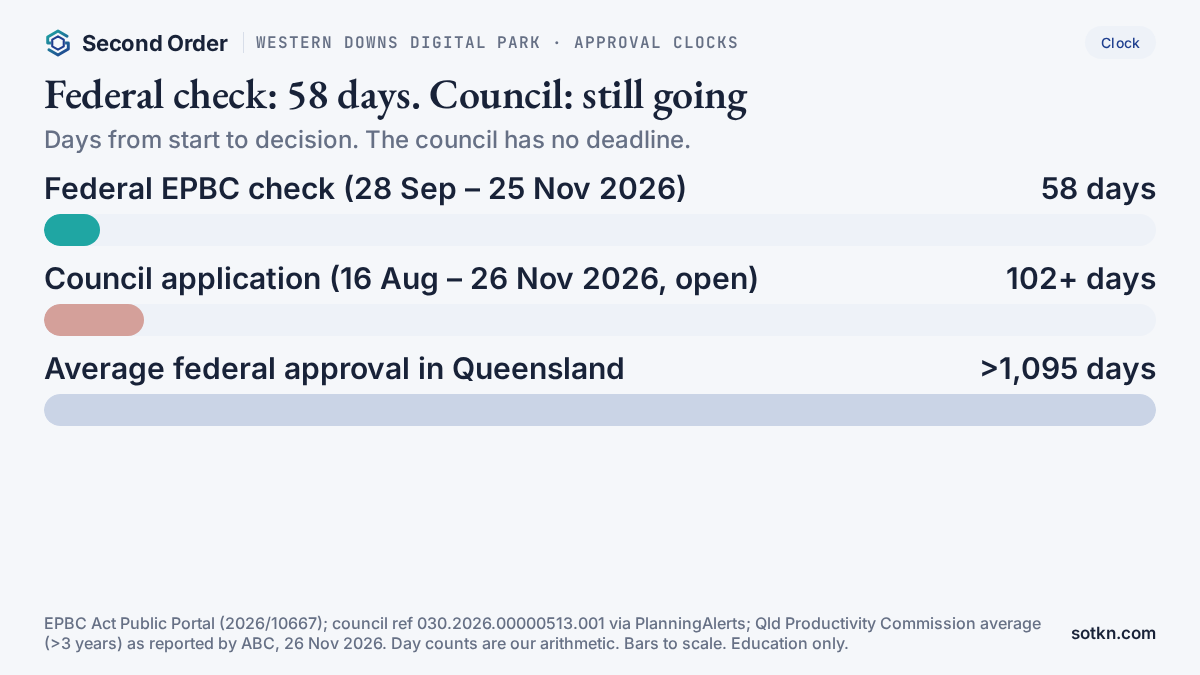
The main approval is local. Western Downs Regional Council received the development application on 16 August 2026, under reference 030.2026.00000513.001. It asks for a material change of use for workforce accommodation, research and technology industry and high impact industry at 1933 Dalby-Kogan Road, Kogan.
The referral explains why this takes longer. The application is “impact assessable” under Queensland's Planning Act 2016. That means it had to be advertised, with notices, signs and a public comment period, and the council must weigh the submissions. It also triggers referrals to the state's assessment agency on roads and other state interests, and touches state vegetation, nature and environmental protection laws.
The public comment period on the council application closed on 11 November, the project's website says. Queensland Country Life reported that the anti-development group Lock the Gate counted 598 public submissions. It said two were neutral and one was in favour. On our arithmetic that leaves 595 against or seeking delay, about 99.5%. Lock the Gate is a campaign group and its count has not been confirmed by the council.
The mayor, Andrew Smith, told the paper that the council's decision is about ticking the boxes of the application, that community concerns will be considered, and that there is no deadline. A council spokesperson said it would weigh all the material, including the submissions.
There is one more state path. The referral says the developer is seeking to have the campus declared a “prescribed project” under Queensland's State Development and Public Works Organisation Act 1971. That can let the state's Coordinator-General step in to coordinate approvals. It has not been declared on what we have seen. ABC also reported, citing the council, that Queensland is moving data centre approvals from councils to the state, but that this campus is the exception and stays with the council.
Who gets paid now?
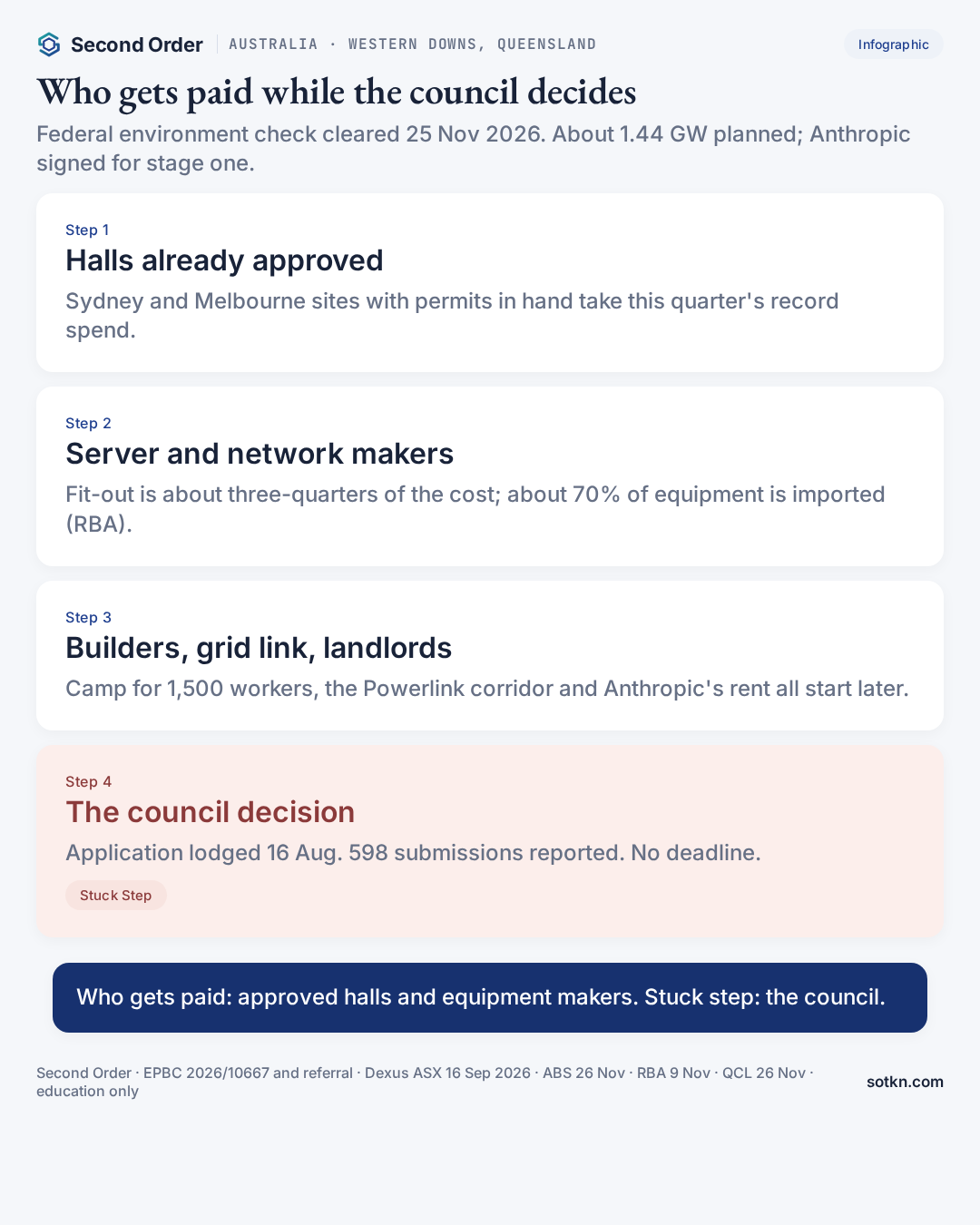
Halls that already have approval
Who: Data centre owners in Sydney and Melbourne with permits in hand
Paid: Paid now. The RBA says most existing and planned Australian data centres sit in those two cities, and the ABS says Victoria and NSW carry the bulk of data centre investment this quarter
Server and network makers
Who: Mostly overseas suppliers of the machines that fill the halls
Paid: Paid as halls are fitted out. The RBA puts fit-out at about three-quarters of data centre spending and assumes about 70% of the equipment is imported
Builders, trades and the grid link
Who: Construction crews for a camp of up to 1,500 workers, and the high-voltage corridor to the Powerlink substation
Paid: Paid only once works start. The referral's estimated start date is 28 November 2026, but that needs the council approval first
Landlords and their backers
Who: Zerra DC, Australian Data Centres (85% Dexus) and Macquarie Capital
Paid: Rent from Anthropic starts only when halls are delivered. Australian Data Centres is raising money, and its funding of each stage needs Dexus board approval
The council decision
Who: Western Downs Regional Council, application 030.2026.00000513.001
Paid: No deadline. Until it decides, nothing on site can start and the 2027 target gets tighter
The map is simple once you line it up. The federal tick moved one gate, but it did not release any money. On the Western Downs, every party that would be paid — the builders, the grid link, the generators that would sell the power and the landlords that would collect rent — sits behind the same council decision.
Meanwhile, the money that is moving in Australia this quarter is going to places that cleared their approvals earlier. That is why the same week brought a record jump in data centre equipment spending and a still-pending decision on the country's largest proposed campus. For who does the building once it starts, see who builds AI data centers; for how a signed lease turns into rent, see leases not yet commenced.
One detail on ownership. Dexus told the ASX that it holds 85% of Australian Data Centres, which holds 25% of the consortium. On our arithmetic, Dexus's look-through share of the consortium is about 21%. Dexus also said Australian Data Centres is raising capital to bring in more partners, that Dexus may or may not join, and that funding of the first and later stages is subject to approvals including its own board. So the money for stage one is not fully lined up either, on what has been published.
Our arithmetic: what the numbers say
- Federal clock. Referral started 28 September, decision 25 November. Our arithmetic: 58 days.
- Council clock. Application received 16 August, still under assessment on 26 November. Our arithmetic: 102 days so far, and counting.
- The usual federal wait. More than three years on average in Queensland, as ABC reported from the Productivity Commission. Our arithmetic: over 1,095 days, so this check took under a twentieth of the average.
- Building size. About 1.44 GW across four buildings. Our arithmetic: about 360 MW each.
- Footprint. 178.7 hectares disturbed out of 801.3 hectares. Our arithmetic: about 22% of the site.
- Submissions. 598 counted by Lock the Gate, two neutral and one in favour. Our arithmetic: 595, or about 99.5%, against or seeking delay.
- Ownership. 85% of 25%. Our arithmetic: Dexus's look-through share of the consortium is about 21%.
- Equipment surge. Communications and media equipment capex, seasonally adjusted chain volume: about A$8.1 billion in the September 2026 quarter against about A$2.9 billion in June. Our arithmetic: about 2.8 times in one quarter, and about 3.1 times a year earlier.
- Where a dollar goes. Using the RBA's shares — about a quarter on the building, three-quarters on fit-out, about 70% of equipment imported — our arithmetic: roughly half of each dollar spent on a data centre goes on imported machines.
None of this tells us the lease size, the rent, or the price Anthropic will pay for power. Nobody has published those. For what a campus like this might cost to build, see how much it costs to build an AI data center.
What is the stuck step? The council decision
The stuck step is not power this time. The referral says the site was picked because high-capacity transmission is already next door; the campus needs only its own corridor to an existing substation. It is not the federal environment law either; that gate is now open. It is the local planning decision. Three things make it slow.
- There is no clock. The mayor says the council has no deadline. An impact-assessable application can go back and forth with requests for more information before a decision.
- The pushback is loud. Hundreds of submissions, a local group called Western Downs Says Pause, and a national campaign group are now focused on this one council. Every concern has to be weighed on the record.
- A decision can be tested. In Queensland, people who make proper submissions on an impact-assessable application generally have appeal rights. A fast approval is not the same as a final one.
Behind the council sit two smaller gates. Anthropic's lease is subject to customary approvals, Dexus said. And the consortium's funding for each stage still needs to be lined up. Neither is dated.
Until the council decides, the cost shows up as time. The referral lists 28 November 2026 as the estimated start date. Anthropic hopes to use the site in 2027. Each month of waiting moves the first rent and the first power bill further out. For how developers pay for a build before rent starts, see data center financing explained.
Where is Australia's data centre money going right now?
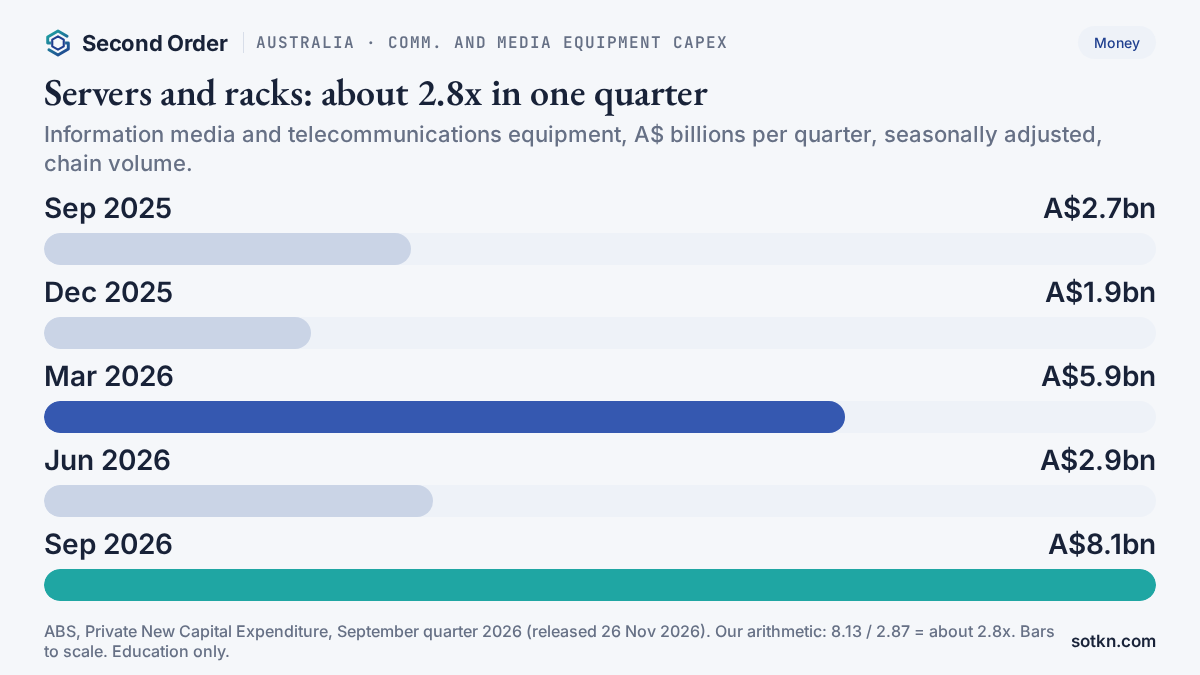
Into equipment for halls that already exist or are already approved. The Australian Bureau of Statistics said on 26 November that private new capital spending rose 12.2% in the September 2026 quarter, the biggest rise since the September quarter of 2011, during the mining boom. It said the information media and telecommunications industry rose 86.7% to a record, and that equipment for that industry rose 183.5%.
The ABS's own words: businesses are “buying large quantities of server racks and processing equipment”. Building and structures spending in the same industry also rose 8.9% to a record. The ABS said Victoria, up 31.0%, and New South Wales, up 9.6%, continue to record the bulk of data centre investment. Businesses also lifted their plans for 2026–27 spending by 11.8% since their last estimate.
The Reserve Bank's November note helps you read that. It says data centre investment in Australia has grown around 10-fold over three years. It says the building is about a quarter of the cost and the fit-out — servers, storage and networking — about three-quarters, much of it imported from Asian economies including Taiwan and South Korea. It assumes about 70% of that equipment is imported. So a big jump in spending lifts imports as much as it lifts local work. For the money side of AI building, see our note on Australian AI data centre funding.
Put the two releases next to the Western Downs news and the pattern is clear. Australia is spending at a record pace on data centres, but almost all of it is landing where approvals and power were sorted earlier, mostly in Sydney and Melbourne. The new, bigger campuses out in the regions are still at the permit stage. For why data centres cluster where they do, see where AI data centers are located.
How does this fit the rest of Australia's approvals map?
It is the same stuck step showing up in a new state. In New South Wales, councils and the state are setting their own terms for very large campuses. Wagga Wagga's council adopted a policy asking data centres to pay 1.5% of their build cost to the community before construction; we covered that in Wagga Wagga's community benefit policy. At Kurri Kurri the fight is about grid fees and power supply, covered in the NSW grid fee and AirTrunk's Kurri Kurri wind deal.
In Melbourne, the stuck step for NEXTDC's M3 was a 66 kV power connection, not a planning permit; see NEXTDC's AGM and the M3 power link. And our earlier read of the national pipeline found that permits, not demand, sort which projects get built: Australia's data centre pipeline.
Western Downs is the mirror image of Melbourne. There, the site had approval but waited for power. Here, the power is next door, but the site waits for approval. The lesson for the whole market is that an AI campus needs both gates open at the same time, and the slowest one sets the date. In October, press reports named Anthropic as the customer for most of DigiCo's SYD1 hall in Sydney, a site with both gates already open; see the Sydney power lease. For the listed Australian hall owners, see what NEXTDC does and what Macquarie Technology does; for an Australian-run AI cloud building its own campuses, see what IREN does.
There is also a wider point about the tenant. Anthropic is a model maker, not a cloud company. Signing for a whole stage of a campus is the kind of demand that used to come mainly from the largest cloud providers. For the difference between the two kinds of buyer, see hyperscale versus colocation; for how such leases are written, see data center leases explained. The rest of the layer is on AI Data Centers on the Stack.
Which dates test this read?
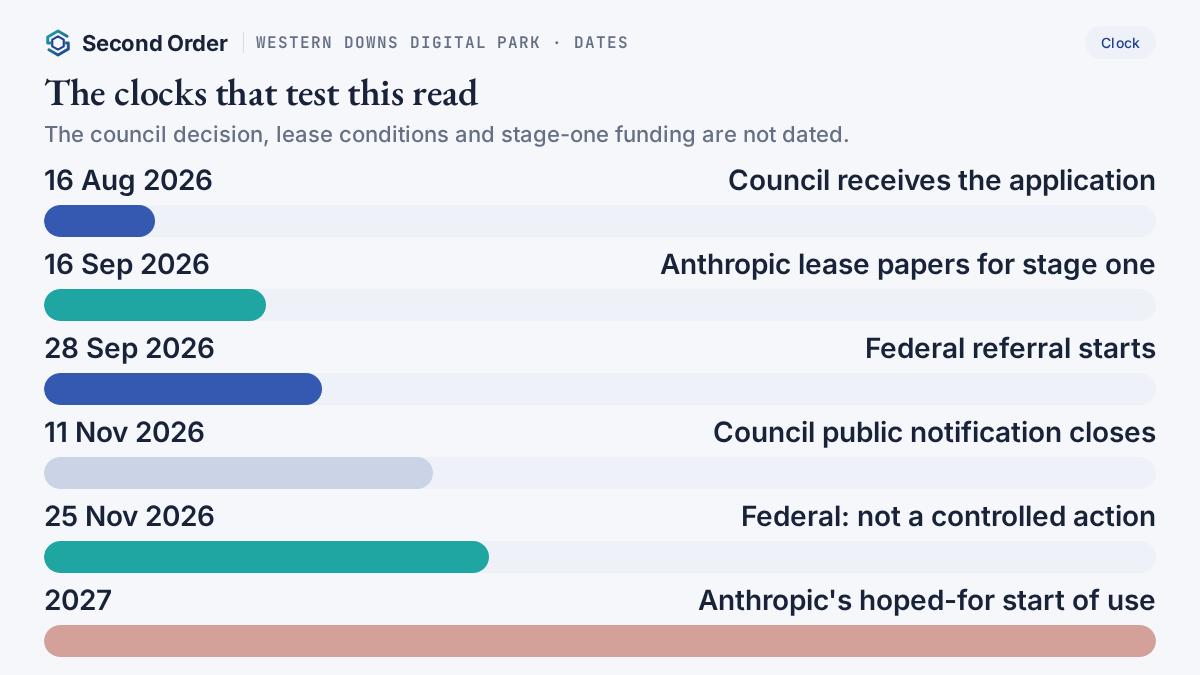
- 16 Aug 2026: Western Downs Regional Council receives the development application.
- 16 Sep 2026: Dexus tells the ASX that lease papers with Anthropic's Australian arm are signed for stage one, subject to approvals.
- 28 Sep 2026: Federal EPBC referral starts; public comment on it runs 7–21 October.
- 11 Nov 2026: Public notification of the council application closes.
- 25 Nov 2026: Federal decision: not a controlled action.
- 28 Nov 2026: The referral's estimated start date — not possible without council approval.
- Not dated: The council decision, any prescribed project declaration, the lease conditions and stage-one funding.
- 2027: Anthropic's hoped-for start of use, as reported.
What would change this view?
- The council approves with workable conditions — the stuck step would move to the grid connection works and stage-one funding.
- The council asks for much more information, or refuses — the 2027 target would slip, and an appeal could follow either way.
- The state declares a prescribed project — the Coordinator-General could speed coordination, and the clock would shorten.
- Australian Data Centres names new capital partners and Dexus commits — the money behind stage one would be in place.
- Anthropic confirms the stage-one size or start date — we could put a first number on rent and power.
Practical takeaways
- The Western Downs Digital Park cleared its federal environment check on 25 November 2026, 58 days after referral
- It is planned at about 1.44 GW across four buildings near Dalby, next to the Braemar substation
- Zerra DC, Australian Data Centres (85% Dexus) and Macquarie Capital are behind it; Anthropic signed for stage one
- The council application, lodged in August, is still being assessed with no deadline and 598 submissions reported
- Australia's data centre money is flowing now to halls already approved, and largely to imported equipment
- Paid first: approved halls and equipment makers. Stuck step: the council decision
FAQ
What did the federal government decide about the Western Downs Digital Park?
On 25 November 2026 Australia's National Environmental Protection Agency decided the Western Downs Digital Park, a proposed data centre campus near Dalby in Queensland, is not a controlled action under the national environment law (the EPBC Act). In plain words, it found the project unlikely to have a significant impact on matters of national environmental significance, so no further federal environment assessment is needed. The referral, EPBC 2026/10667, started on 28 September.
Does that mean the data centre is approved?
No. The federal decision clears one gate. The project still needs a development approval from Western Downs Regional Council, which is assessing an impact-assessable application (reference 030.2026.00000513.001), plus state referrals and other permits. The mayor has said there is no deadline for the council's decision. Anthropic's lease for stage one is also subject to customary approvals.
How big is the Western Downs Digital Park?
The developer's referral describes four data centre buildings with about 1.44 GW of IT capacity in total, built in four stages, on an 801.3 hectare site 37 km north-west of Dalby. On our arithmetic that is about 360 MW per building. It would connect by a high-voltage corridor to an existing Powerlink substation; the developer points to Braemar, next to several power stations.
Who is behind it, and who is the tenant?
Zerra DC develops and will operate it. Australian Data Centres, 85% owned by Dexus, holds 25% of the consortium with Zerra DC and Macquarie Capital. Dexus told the ASX on 16 September that the consortium signed lease documentation with Anthropic's Australian subsidiary for the first stage, subject to customary approvals. Anthropic hopes to start using the site in 2027.
Who gets paid, and what is the stuck step?
On our map: right now Australian data centre money is flowing to sites that already have approval, mostly in Sydney and Melbourne, and to the mostly overseas makers of the servers that fill them. At Western Downs, the builders, the grid connection, the generators and the landlords are all paid later, and all wait on the same thing. The stuck step is the council's decision on the development application.
Is this investment advice?
No. Education only. It maps who gets paid and which step is stuck. It is not a recommendation to buy or sell any security, and we leave out share prices, valuations, broker ratings and price targets on purpose.
Keep reading on the map
- Australia Markets hub — country page
- Wagga Wagga community benefit policy · NEXTDC's M3 power link · The permit-sorted pipeline
- NSW grid fee · AirTrunk's Kurri Kurri wind · The Sydney power lease
- AI Data Centers on the Stack · NEXTDC · Macquarie Technology · IREN · Equinix
- What is an AI data center? · AI inference explained · How long it takes to build one
- All Markets doors — Taiwan, Korea, US, China, Singapore, Australia, Malaysia
How we check this. The referral number, its start date and the decision status come from the EPBC Act Public Portal. The project's size, stages, site area, grid corridor, worker camp, planning path and estimated dates come from the developer's own EPBC referral. The ownership chain and the Anthropic lease come from Dexus's ASX release of 16 September 2026. The planning status, power plans and job estimates come from the project's website and Zerra DC's project page. The council reference and lodgement date come from PlanningAlerts, which copies the council's register. The federal spokesperson's words, the 2027 target and the Queensland Productivity Commission figure are as reported by ABC News on 26 November; the decision date, the submissions count (Lock the Gate's figure) and the mayor's words are as reported by Queensland Country Life. National investment figures are from the ABS release of 26 November and the RBA's Insight of 9 November. Anything we worked out ourselves is labelled “our arithmetic”. We do not know the lease size, the rent or the power price, and we do not guess. Share prices, valuations, broker ratings and price targets are left out on purpose. The references we used are listed at the end. Our editorial standards →
Not investment advice. Do your own research.
References
- National Environmental Protection Agency, EPBC Act Public Portal, Western Downs Digital Park, EPBC 2026/10667, project decision page, referral started 28 Sep 2026; decision made 25 Nov 2026. epbcpublicportal.environment.gov.au — referral number, start date and status: referral decision made.
- Western Downs Digital Park Asset Nominee 1 Pty Ltd, EPBC Act referral, Western Downs Digital Park (application 03631), lodged Sep 2026. epbcpublicportal.environment.gov.au — four buildings, about 1.44 GW of IT capacity, stages 1A to 2B; 801.3 ha site, 178.7 ha disturbance; high-voltage corridor to a Powerlink substation; camp for up to 1,500 workers; impact-assessable council application; prescribed project request; estimated start 28 Nov 2026, end 30 Dec 2046.
- Dexus, Australian Data Centres – Western Downs Digital Park (ASX release), 16 Sep 2026. announcements.asx.com.au — Dexus holds 85% of Australian Data Centres, which holds 25% of the consortium with Zerra DC and Macquarie Capital; lease documentation with Anthropic's Australian subsidiary for stage one, subject to customary approvals; capital raising; funding subject to Dexus board approval.
- Western Downs Digital Park, project website, accessed 26 Nov 2026. westerndownsdigitalpark.com.au — public notification closed 11 Nov 2026 and council now assessing; developed and operated by Zerra DC with Australian Data Centres and Macquarie Capital as investors; power from the national market; working with Powerlink; on-site battery-backed power conditioning; job estimates.
- Zerra DC, Western Downs Digital Park project page, accessed 26 Nov 2026. zerradc.com — up to 1.44 GW across four stages, anchored by a long-term lease commitment from Anthropic; status: development application under assessment.
- PlanningAlerts, 1933 Dalby-Kogan Road Kogan QLD, Western Downs Regional Council reference 030.2026.00000513.001, received 16 Aug 2026. planningalerts.org.au — material change of use for workforce accommodation, research and technology industry and high impact industry; council reference number and lodgement date.
- ABC News, Government gives environmental green light to Western Downs Digital Park, 26 Nov 2026. abc.net.au — federal spokesperson's words; no public comments in the referral phase; Anthropic hopes to start using the site in 2027; Queensland Productivity Commission average federal approval time; council and state approvals still needed.
- Queensland Country Life, Western Downs council to decide on $32bn data centre park, 26 Nov 2026. queenslandcountrylife.com.au — decision dated 25 Nov; 598 public submissions on the application per Lock the Gate; mayor says no deadline for the council decision.
- Australian Bureau of Statistics, Data centre investment continues to drive new capital expenditure, 26 Nov 2026. abs.gov.au — private capex up 12.2% in the September quarter 2026; information media and telecommunications up 86.7%; equipment for that industry up 183.5%; quarterly building and equipment series.
- Reserve Bank of Australia, Data Centre Investment in Australia (Insight 2026-11), 9 Nov 2026. rba.gov.au — investment up around 10-fold in three years; building about a quarter and fit-out about three-quarters of spend; around 70% of machinery and equipment imported.