US$5 Billion IPO on Hold: Who Gets Paid While Singapore’s DayOne Waits for Its Next Wave of Money
On 20 November Bloomberg reported that Singapore-based DayOne has put its US IPO of up to US$5 billion on hold. Its filing says the 2.3 GW already booked is funded. What waits is the money for the next wave. That is the stuck step.
DayOne is a Singapore-based builder of big data centres. In October it filed to list in New York. The plan was to raise up to US$5 billion. On 20 November Bloomberg reported that the listing is on hold. The halls DayOne has already sold still get built, on its own filing’s words. What waits is the money for the next wave. That is the stuck step.
SINGAPORE PULSE · AI DATA CENTERS · FUNDING · Data as at 21 Nov 2026 (press reports of 20 Nov; F-1 of 5 Oct with data to 30 Jun and 20 Sep 2026) · Next update: an F-1 amendment, a withdrawal, or DayOne’s first Singapore hall going live (due Q1 2027)
Affects: AI Data Centers · GDS — Markets: Singapore · Malaysia
Education only, not advice to buy or sell any security. Money is in US dollars unless marked. A megawatt (MW) is a measure of how much power a data hall can feed to servers; a gigawatt (GW) is 1,000 MW. In DayOne’s words, a Booking is capacity a customer has signed for; Billings is the part already charging; a Reservation is a customer’s right to take more later, which may never be used. Company figures are as reported. Our earlier notes covered DayOne’s Johor loans and grid hook-ups (RM30 billion lent) and its Singapore power trial (the SG1 virtual power plant). This note covers what the paused listing changes.
The numbers that matter this week
IPO size, as planned
Up to US$5bn
On hold, per Bloomberg 20 Nov · maybe 2027
WaitsBooked capacity
2,281 MW
20 Sep 2026 · delivery by end-2028
FundedLeft to spend on it
US$11.4bn
After spend to 30 Jun 2026 · F-1 says funded
FundedIn service
962 MW
99.1% used · 953 MW billing
PaidLargest customer
69.2%
Share of revenue, first half 2026
RiskThe gate
New money
For 1.1 GW of Reservations and new sites
Stuck stepBloomberg News and The Straits Times, 20 Nov 2026; DayOne F-1, 5 Oct 2026. Status chips are Second Order’s read. “Funded” is DayOne’s own statement, not our audit.
On this page: Why it matters · What happened · The filing · The money · Our math · Singapore · Who gets paid · The customer · What is stuck? · Dates next · FAQ
Why does a paused listing matter if the booked halls are funded?
Picture a builder putting up apartment blocks. Every flat in the first three blocks is sold. The bank has lent the money to finish them. Then the builder plans a share sale to fund blocks four to ten. The share sale is put off. The first three blocks still go up. The cranes for the later blocks wait.
That is DayOne today. Its filing says the halls customers have already signed for are paid for, using cash and loans it already has. Those halls are where today’s money flows: to lenders, builders, equipment makers and the power grid. The listing was the money for what comes after. That is where the wait now sits.
This matters for Singapore for two reasons. DayOne is headquartered here, and Structure Research, cited in its filing, puts its share of Bookings in the Singapore–Johor–Batam market at 33%. And its next steps include a Singapore hall that, in its own filing, had no customer Booking yet.
So the useful questions are simple. Who gets paid while the listing waits? Who waits with it? And what would let the next wave move again?
What was reported on 20 November?
Bloomberg News reported, citing people familiar with the matter, that DayOne Data Centers has put its multibillion-dollar US IPO on hold. The people said investors are questioning how long high prices for AI infrastructure assets can last.
- DayOne had been aiming to raise as much as US$5 billion, as soon as the fourth quarter of 2026, Bloomberg had reported earlier.
- It began to weigh options, including a delay or a smaller listing, as data centre and AI shares swung more.
- It may still list in 2027 if conditions and sentiment improve. Talks are ongoing and no final decision has been made.
- The banks working on the deal are Morgan Stanley, JPMorgan Chase, Bank of America, Citigroup and BNP Paribas.
- Backers named in the reports include Coatue, Hillhouse, GDS Holdings, SoftBank Vision Fund and Citadel founder Ken Griffin.
- DayOne declined to comment to Bloomberg and to Lianhe Zaobao.
The timing fits a rough month for the sector. The Straits Times noted that the Nasdaq 100 had fallen more than 6% in November, on course for its worst November since 2008. Lianhe Zaobao reported that on 20 November, by mid-afternoon Singapore time, the Tokyo and Seoul markets were each down more than 5% and Taiwan’s was down 6.23%.
Not every listing is shut. Anthropic, the AI lab, raised a record US$107.3 billion in its IPO and private placement and rose 17% on its first day of trading on 19 November, The Straits Times reported. The window is open for some names. It is not open, at the price wanted, for data centre builders right now.
What did DayOne’s October filing show?
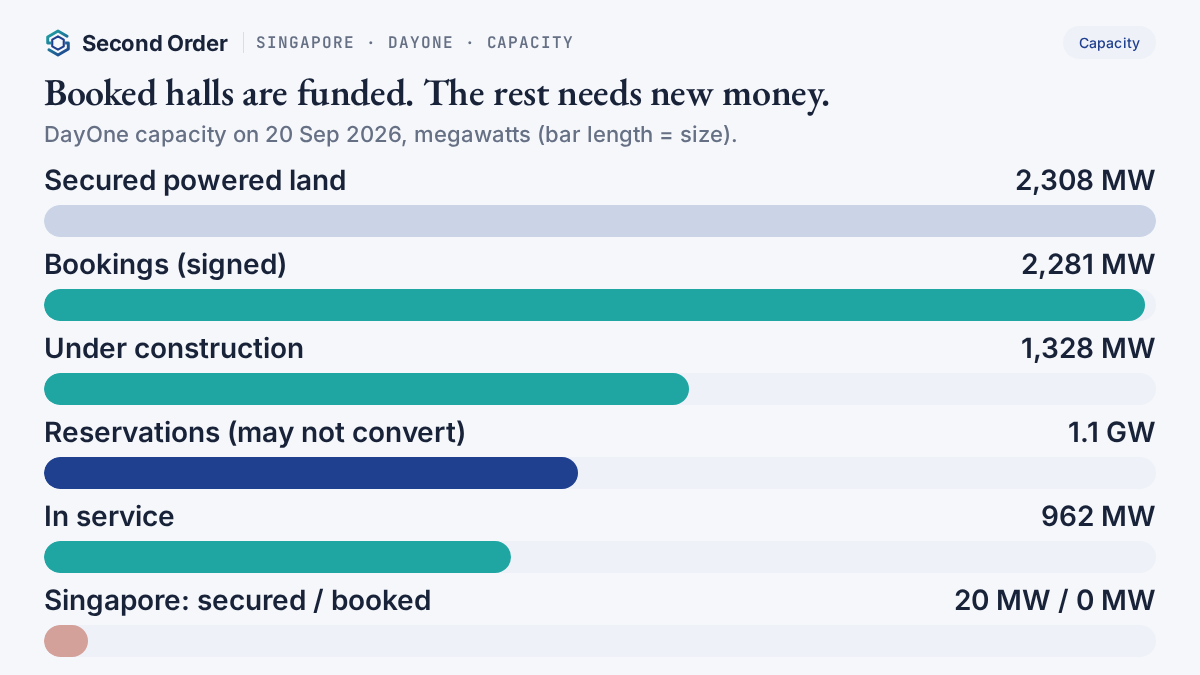
DayOne filed its F-1, the US listing document for a foreign company, with the SEC on 5 October 2026. The price range and share count were left blank. The operating numbers were filled in. These are the ones that matter for the pause.
- Bookings of 2,281 MW on 20 September 2026, up from 1,250 MW at the end of 2025.
- Capacity in service of 962 MW, with a utilisation rate of 99.1%. Billings, the part already charging customers, were 953 MW.
- Capacity under construction of 1,328 MW, with a pre-commitment rate of 99.3%. Almost everything being built is already signed for.
- Reservations of 1.1 GW on top of Bookings. DayOne warns these may never turn into Bookings or revenue.
- Secured powered land of 2,308 MW and a further 1.3 GW powered land pipeline.
- An estimated cost to complete its Bookings of about US$11.4 billion, after what it had spent to 30 June 2026.
- Substantially all Bookings expected to be delivered by 31 December 2028.
Then the line that frames the pause. The filing says: “We believe that our currently available capital resources will be sufficient to fully fund our current Bookings.” The next sentences say DayOne plans to keep expanding, and that “as we win new Bookings, we expect that we will need to raise additional funds through equity or debt financings.”
In plain terms: the booked 2.3 GW is meant to be paid for already. The listing was for growth past that. The filing also says most of the money raised would go to building new data centre projects, with the rest for working capital. The exact split was left blank.
The money side of the business in the first half of 2026 looked like this. Revenue was US$512.0 million, against US$151.5 million a year earlier. Adjusted EBITDA, a profit measure before interest, tax, depreciation and some one-off items, was US$205.9 million, a 40.2% margin. The net loss was US$77.2 million. That loss included a one-time US$62.0 million fee for ending a services agreement and US$40.4 million of share-based pay.
Where does the money come from now?
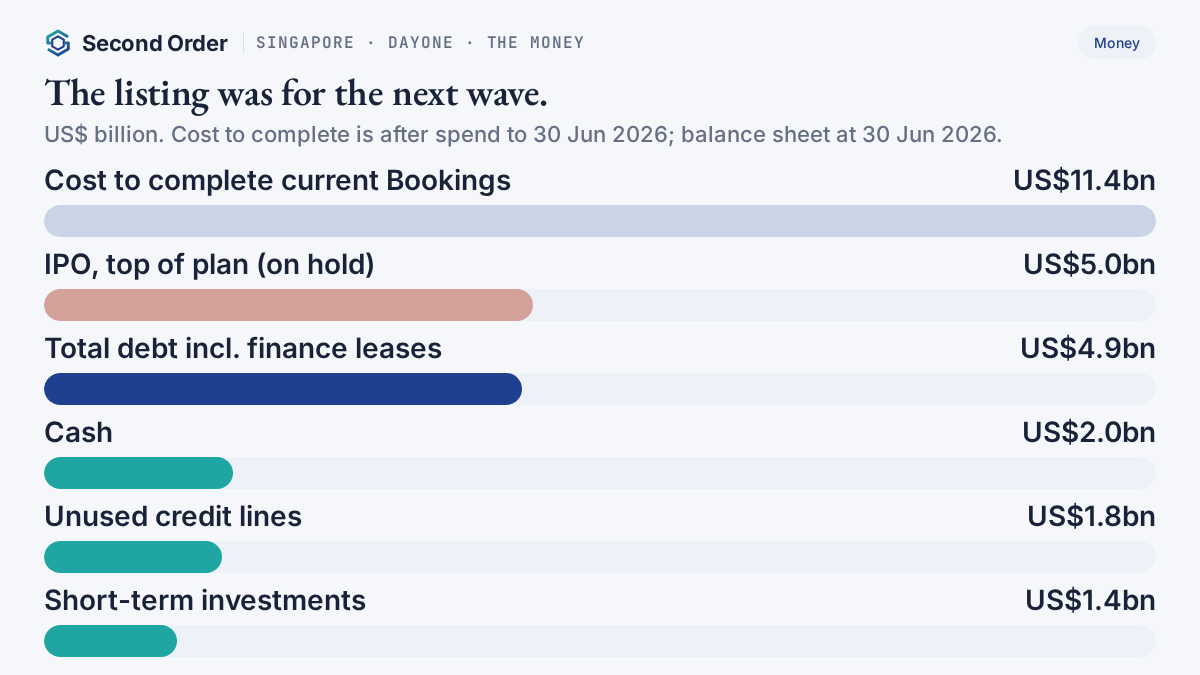
On 30 June 2026 DayOne had US$1,981.6 million in cash and US$1,400.0 million in short-term investments. It had total borrowings of US$4,426.5 million; with finance leases, total debt was US$4.9 billion. It also had US$1,821.4 million of credit lines it had not yet drawn.
Its loans are not cheap. The filing lists a ringgit term loan at KLIBOR plus 2.40%, with an effective rate of 6.5%, and a US dollar term loan at SOFR plus 2.20%, with an effective rate of 7.5%, both maturing in 2030. Total interest cost in the first half of 2026 was US$145.4 million. Of that, US$83.1 million was added to the cost of halls being built rather than charged to profit.
Lending has kept coming since June. In October, seven banks doubled DayOne’s Johor loan package to RM30 billion, as covered in our note at the time (RM30 billion lent). In August, DBS, OCBC and UOB agreed a four-year S$530 million green loan for its first Singapore hall. Debt is available for booked halls. Equity is the part that has stalled.
Why does that difference matter? Banks lend against signed contracts and finished buildings. They are much less keen to lend against land with no customer yet. That early, riskier stage is usually paid for with shareholders’ money. For how the layers of data centre money stack up, see data center financing explained.
What does the arithmetic say?
All of the sums below are our arithmetic on DayOne’s filed numbers. They mix dates (30 June for money, 20 September for megawatts), so treat them as rough sizes, not precise figures.
Money on hand vs left to spend
The listing in proportion
Growth and its cost (first half 2026)
Where the Bookings sit
The largest customer
Our arithmetic on the DayOne F-1, 5 Oct 2026. Run-rate doubles first-half adjusted EBITDA (US$205.9m) and is crude. The US$6.2bn gap is not a funding hole the company admits: it says current resources are enough, which we read as including future operating cash and committed loans such as the October Johor top-up.
Three things stand out. First, the listing was big next to the build: up to about 44% of what is left to spend on booked halls. Second, interest is already a large cost: close to three dollars of every ten in revenue. Third, the business is concentrated in one place and one customer. That is not unusual for a young builder. It is what new shareholders were being asked to price.
Booked is not the same as billing. DayOne had 953 MW billing against 2,281 MW booked. The rest earns only as each hall is handed over. We looked at the same gap for an Australian builder in NEXTDC: signed, not billing, and the general idea in revenue backlog vs RPO.
What does this mean for Singapore itself?
DayOne is headquartered at Suntec Tower 5 in Singapore. Most of its halls are not here. Singapore is short of power and land. DayOne’s filing describes the city as the anchor of a three-part market it calls SIJORI: Singapore, Johor and Batam. Johor and Batam carry most of the megawatts; Singapore holds the customers’ network hubs.
- DayOne won about 20 MW in Singapore’s first Data Centre Call for Application. The filing says 80 MW was on offer, more than 70 applicants competed, and DayOne got 25% of it.
- That 20 MW hall broke ground in July 2025. The lending banks say it is due to start operating by the first quarter of 2027.
- In the F-1 table, Singapore shows 20 MW of secured powered land, and zero MW in service, under construction, billing or booked, as of 20 September 2026.
- The filing cites Structure Research: about 1.3 GW in service in Singapore, 99% used, with little new supply expected before 2028.
A hall that is being built but shows no Booking is a classic waiting step. The building can be ready before the customer is. We covered the hall’s power trial earlier (SG1 virtual power plant). The new point is the money. DayOne’s booked halls in Johor are funded. A Singapore hall with no customer in the filing is exactly the kind of step that equity, not bank debt, normally carries until a customer signs.
There is a wider Singapore read too. On 20 November, The Business Times reported that CGS International analysts believe the build-out of the second Data Centre Call for Application, which allocated 200 MW to four operators in August, and the planned data centre park on Jurong Island “could be deferred”. They cited a possible souring of sentiment and demand after the US chip rule of 16 November.
Other analysts were milder. Macquarie Capital’s Foo Zhiwei expects “a slowdown, not a halt”. DBS Group Research counted about 5.5 GW of operating data centre capacity in the five countries named by the US rule, roughly 7% to 9% of the world total. We set out what that rule means for halls in Singapore earlier (same hall, two rulebooks). We do not repeat that here.
And DayOne is not the only stalled listing tied to Singapore. Blackstone-backed AirTrunk is delaying its planned Singapore data centre REIT until 2027, The Straits Times noted (the REIT door stays shut). In October, Firmus Grid abandoned an attempt at one of Australia’s biggest IPOs. Two big data centre listings aimed at this region are now pointed at 2027.
Who gets paid, and who waits?
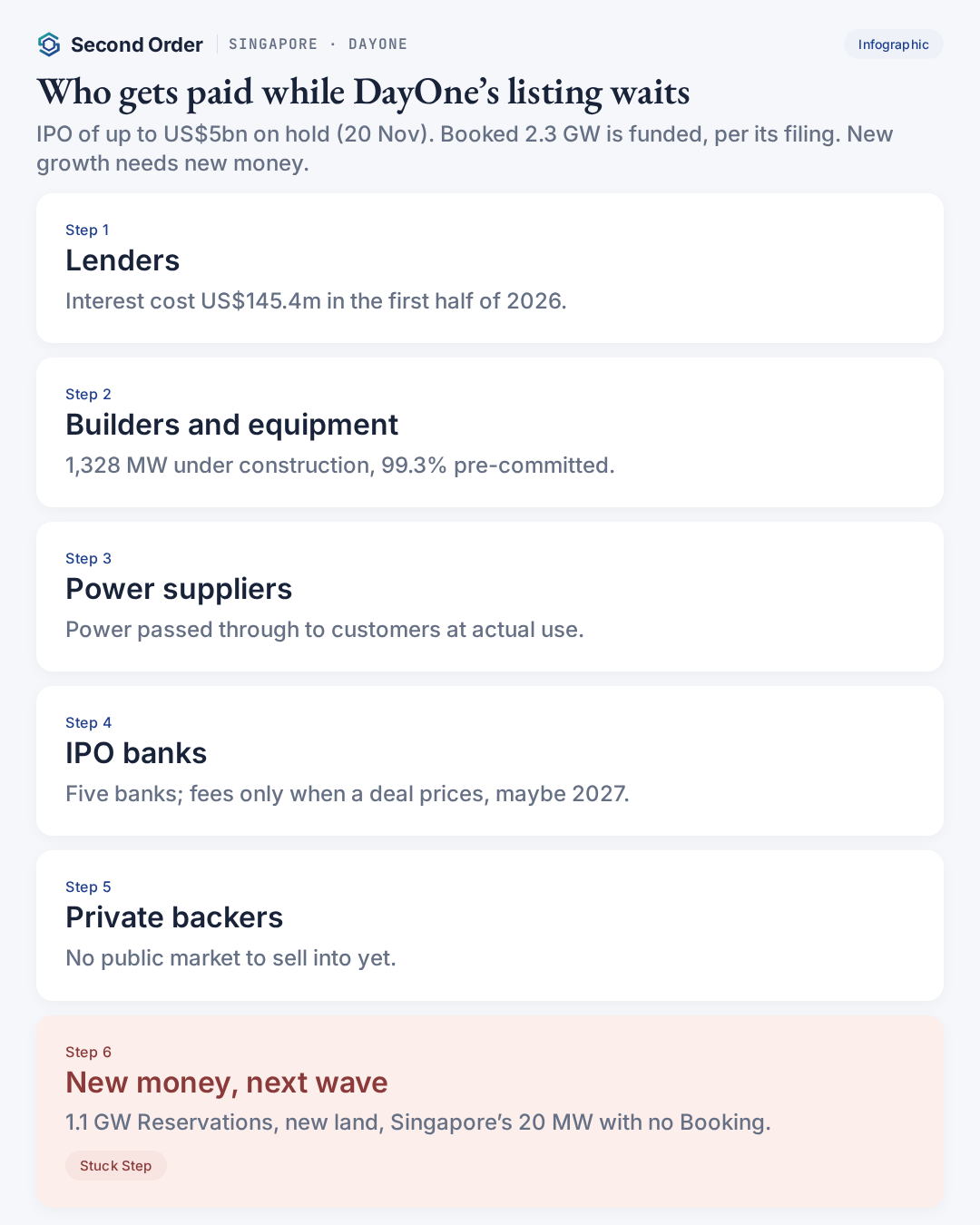
1 · Lenders
Who: Malaysian, Singapore and global banks
Paid: Interest cost US$145.4m in the first half of 2026; loans at KLIBOR +2.40% and SOFR +2.20%
2 · Builders and equipment makers
Who: Contractors, power and cooling gear
Paid: 1,328 MW under construction, 99.3% pre-committed; the filing says it is funded
3 · Power suppliers
Who: Grid and power sellers in Johor, Batam and beyond
Paid: Power is charged to customers at actual use, on a pass-through basis
4 · IPO banks
Who: Morgan Stanley, JPMorgan, BofA, Citi, BNP Paribas
Paid: Fees come only when a deal prices; maybe 2027
5 · Private backers
Who: Coatue, Hillhouse, GDS, SoftBank Vision Fund, Ken Griffin
Paid: No public market to sell into yet; value marked privately
6 · New money for the next wave
Who: Equity for Reservations, new land, Singapore’s 20 MW
Paid: Sets when 1.1 GW of Reservations and unbooked sites can start
DayOne F-1, 5 Oct 2026; Bloomberg News and The Straits Times, 20 Nov 2026. Status chips are Second Order’s read.
Read the chain from the top. Lenders are paid first and every quarter, whether or not the listing happens. Builders are paid as each stage of a booked hall is finished. Power suppliers are paid as halls draw power, and that cost is passed on to the customer. None of those three needs the IPO.
The ones who wait are the people who needed the listing itself. The banks running the deal earn fees only when it prices. The private backers, including GDS, which lent DayOne US$240.8 million in 2022 and 2023 (repaid in 2024), cannot sell shares in a public market until one exists. For more on GDS, see what GDS does.
Customers mostly do not wait. Their halls are booked and funded. Their contracts are long: the filing says most run 10 to 15 years, with renewal options of usually five years, and are mainly take-or-pay, meaning the customer pays for the capacity whether or not it uses all of it. See take-or-pay contracts explained. The customers who might wait are the ones holding Reservations, or looking at a site DayOne has not yet built.
Why does the biggest customer matter so much?
The filing does not name its largest customer. It calls it “a global technology company with a leading short-form video platform serving a worldwide audience.” Bloomberg and The Straits Times name it as ByteDance, the Chinese owner of TikTok. That customer was 69.4% of DayOne’s revenue in 2025 and 69.2% in the first half of 2026.
DayOne flagged the risk itself. Its filing says geopolitical tensions could affect the business of its largest customer. It says it does not believe those tensions would affect existing contracts, but that they could affect future deployments. It adds that if that customer became subject to export controls or other restrictions, demand for DayOne’s services could fall.
That is the same split again. Existing contracts are what the booked, funded halls rest on. Future deployments are the next wave. The US rule of 16 November, which we covered when it came out (offshore chips need a license), lands on the second part far more than the first. The Straits Times listed it as an added risk alongside the pause. Bloomberg’s sources pointed to valuations and market swings. We cannot tell from outside how much weight each reason carries.
One more detail from the filing. The majority of DayOne’s in-service capacity and Bookings sit at two campuses in the same market. Its two Johor campuses are at Nusajaya Tech Park and Kempas Tech Park. Malaysia was 87.0% of revenue in the first half of 2026. A new shareholder would be buying a young company with one big customer and one main location, which is why price matters so much in a nervous market.
What is stuck, exactly?
Not the booked halls. On DayOne’s own statement, they are funded. Not demand for capacity in the region, which every analyst quoted above still calls strong. The stuck step is new equity: the money that turns land and Reservations into the next round of Bookings.
- 1.1 GW of Reservations. Customers have the right to take more. DayOne needs money ready to build when they do.
- 1,320 MW of secured powered land in Kuala Lumpur, with 128 MW under construction so far.
- Land in Kyushu (160 MW), Tokyo (60 MW) and Zaragoza, Spain (304 MW), with nothing yet under construction.
- The 20 MW Singapore hall, due by the first quarter of 2027, with no Booking shown in the F-1.
This is the pattern we keep finding across AI infrastructure. The step that binds moves. For some builders it is chips. In Johor it was the high-voltage hook-up (the local grid connection). For DayOne’s next wave, for now, it is the listing window. For the general idea, see where does the stuck step move.
It is also not the first time a data centre listing in this cycle has slipped. Nscale’s IPO plans sat beside a hall running six months late (Nscale Glomfjord). The lesson is the same: lenders fund what is signed; shareholders fund what is hoped for, and they set the price.
What would change this read?
- An F-1 amendment with a price range. That would mean the pause is over. A smaller size would tell us how much the next wave shrinks.
- A formal withdrawal of the F-1. That would push the next-wave money to private equity or more debt, likely at a higher cost.
- A Booking for the Singapore hall before it opens. That would turn a waiting step into a paid one.
- Reservations turning into Bookings. If they do while the listing is paused, the funding gap for new growth gets bigger and more urgent.
- New US licence detail. Clear, workable licensing for Singapore and Malaysian halls would ease the future-deployment risk the filing flags.
- A large private round or a stake sale. That would fill the equity gap without a listing, at a price we would then see.
There are honest reasons for caution. The pause is reported by unnamed sources, and DayOne has not confirmed it. “No final decision” means it could still list this year, at a smaller size. The funding statement is the company’s own; we have not audited it, and our US$6.2 billion gap ignores future cash flow and loans signed after June. The F-1 numbers are now months old. And Bookings are contracts, not cash: they pay only as halls are handed over.
Which dates test the read?
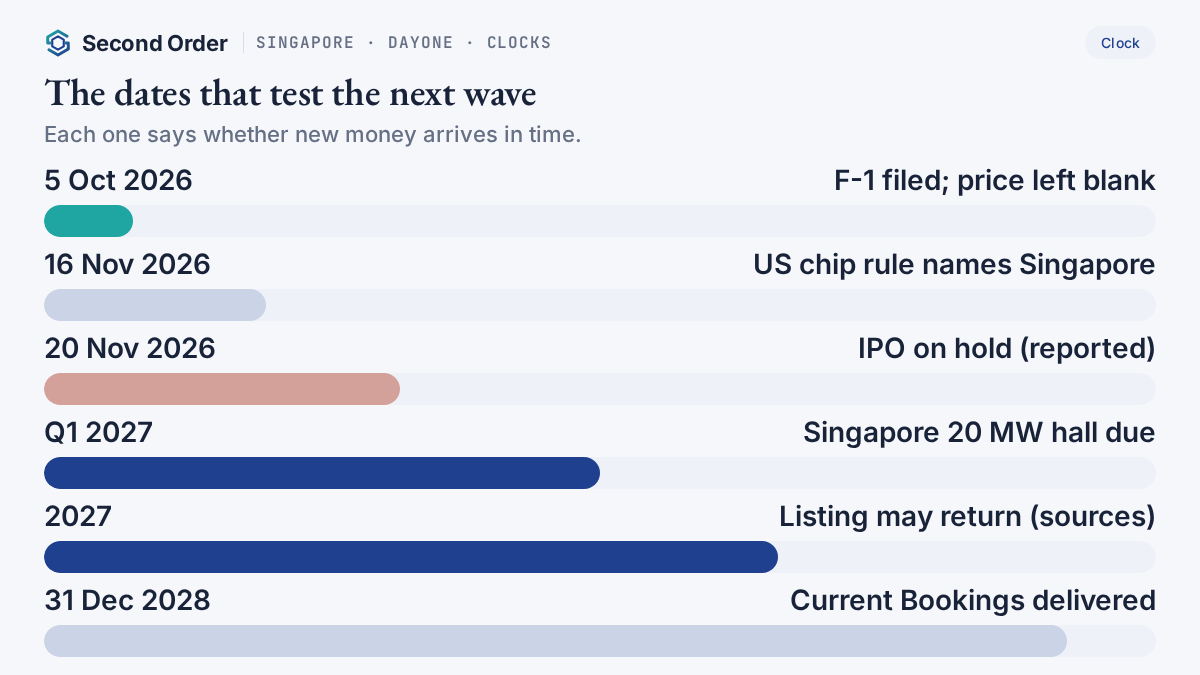
- 5 October 2026 — DayOne filed its F-1 with the SEC; price range left blank.
- 16 November 2026 — the US chip rule naming Singapore, Malaysia, Indonesia, Thailand and Brazil.
- 20 November 2026 — Bloomberg reported the IPO is on hold; DayOne declined to comment.
- First quarter 2027 — DayOne’s first Singapore hall (20 MW) due to start operating, per its lenders.
- 2027 — the earliest the listing may return, per Bloomberg’s sources; not a company date.
- 31 December 2028 — substantially all current Bookings due to be delivered, per the F-1.
Dates from the DayOne F-1 (5 Oct 2026), the lenders’ release (18 Aug 2026) and press reports of 20 Nov 2026. Plans, not facts.
How does this fit the rest of our Singapore notes?
It joins a set of Singapore notes on who waits for what. The first new hall under Singapore’s stricter rules opened in November with its first 8 MW phase (Equinix SG6). The listed data centre trusts are covered on our Stack pages, for example what Keppel DC REIT does. The licensing rules for new halls are in our October note (Singapore’s data centre licence). For the difference between a hall built for one giant customer and a shared one, see hyperscale vs colocation, and for how the contracts work, data center leases explained. For all of our Singapore notes, see Singapore Markets.
How we check this. The IPO pause is a press report citing unnamed people; DayOne declined to comment, so we treat it as reported, not confirmed. Every capacity, cost, revenue, debt, cash, interest and customer figure for DayOne comes from its F-1 registration statement filed with the US SEC on 5 October 2026, which we read directly; EDGAR shows no amendment since. Singapore hall details come from the lending banks’ release of 18 August 2026. Analyst views come from a press report of 20 November. Every sum we worked out is labelled “our arithmetic”. Plans and dates are company plans, not facts yet. The references we used are listed at the end. Our editorial standards →
FAQ
What happened on 20 November?
Bloomberg News reported, citing people familiar with the matter, that DayOne Data Centers has put its planned US initial public offering on hold. DayOne had aimed to raise as much as US$5 billion as soon as the fourth quarter. The people said it may still list in 2027 if the market improves, and that no final decision has been made. DayOne declined to comment.
Who is DayOne?
A data centre builder and operator headquartered in Singapore and incorporated in the Cayman Islands. It builds large halls for big tech customers, mostly in Johor in Malaysia and Batam in Indonesia, with a 20 MW site under development in Singapore and projects in Thailand, Kuala Lumpur, Japan, Hong Kong, Finland and Spain. Its F-1 says it had 962 MW in service on 20 September 2026.
Does the pause stop the halls being built?
Not on DayOne’s own words. Its 5 October filing says its currently available capital resources will be enough to fully fund its current Bookings of about 2.3 GW, which it expects to deliver by 31 December 2028. It also says that as it wins new Bookings it expects to need more money from equity or debt. The pause hits that next wave, not the booked one.
What is the stuck step?
New equity for growth beyond what is already booked. That covers 1.1 GW of customer Reservations, large blocks of powered land such as 1,320 MW in Kuala Lumpur, and DayOne’s 20 MW Singapore site, which showed no Booking in the F-1 table. Until fresh money arrives, by listing or other means, those steps wait.
Who gets paid while the listing waits?
Lenders, who earn interest every quarter (US$145.4 million of interest cost in the first half of 2026); builders and equipment makers on the 1,328 MW under construction; and power suppliers, since power is passed through to customers. The banks running the IPO, the private backers waiting to sell, and the next sites wait.
Is this investment advice?
No. Education only. It maps who gets paid and which step is stuck. It is not a recommendation to buy or sell any security, and we leave out price targets and ratings on purpose.
References
Outbound links below are nofollow. We list only the sources actually used. Internal sotkn.com links in the body are separate.
- Bloomberg News (via Bloomberg Law), DayOne Is Said to Pause US IPO on Data Center, Market Concerns, 20 Nov 2026. news.bloomberglaw.com — the report that the IPO is on hold, the earlier plan to raise up to US$5 billion as soon as the fourth quarter, and the largest customer.
- The Straits Times, Singapore-based DayOne to pause US IPO plans on data centre, market concerns: Sources, 20 Nov 2026. straitstimes.com — the possible 2027 return, the five banks on the deal, the backers, the Nasdaq 100 fall, the Anthropic debut and the other stalled data centre listings.
- Lianhe Zaobao, DayOne reportedly pauses US IPO plans as AI sector remains under pressure, 20 Nov 2026. zaobao.com.sg — the 6 October filing announcement, DayOne declining to comment, and the 20 November moves in Tokyo, Seoul and Taiwan.
- DayOne Data Centers Limited, Form F-1 Registration Statement (US SEC), 5 Oct 2026. sec.gov — Bookings, Billings, capacity by market (including Singapore), cost to complete, funding statement, revenue, losses, debt, cash, interest and customer concentration.
- UOB, DBS and OCBC, DayOne secures S$530 million green loan for its first Singapore data centre, 18 Aug 2026. uobgroup.com — the four-year S$530 million loan, the 20 MW size, the July 2025 groundbreaking and the Q1 2027 operating date.
- The Business Times, ‘Chilling effect’: US chips curb could slow down Asean data centre expansion, Malaysia and Thailand at higher risk, say analysts, 20 Nov 2026. businesstimes.com.sg — the DBS 5.5 GW count, the CGSI view that DC-CFA2 and the Jurong Island park could be deferred, and the Macquarie and White & Case comments.
- EDB and IMDA, Four data centre proposals selected as part of DC-CFA2, 21 Aug 2026. edb.gov.sg — the 200 MW allocated in Singapore’s second data centre call for application.
Not investment advice. Do your own research. Education only. Map of who gets paid and which step is stuck — not a buy list.
More on this desk: Singapore Markets · AI Data Centers · DayOne’s Johor loans · data center financing explained · all Markets.