S$500 Million for an 8 MW Hall: Who Gets Paid While Racks Central’s Back-Door Listing Waits for a Valuer
On 18 November Heptamax agreed to buy Racks Central, a Singapore data centre with about 8 MW, for S$500 million in new shares. Racks Central’s owner would end up with about 95% of the listed company. First an outside valuer must put the business at S$425 million or more. That is the stuck step.
A small Singapore data centre wants to join the stock market by the side door. On 18 November, Heptamax International, an SGX company worth about S$6 million, agreed to buy Racks Central for S$500 million. It will pay in new shares, not cash. Racks Central runs one hall in Tai Seng with about 8 MW of IT power. Its owner would end up with about 95% of the listed company. But nothing moves until an outside valuer says the business is worth at least S$425 million, and shareholders vote. The valuer is not named yet. That is the stuck step.
SINGAPORE PULSE · AI DATA CENTERS · Data as at 24 Nov 2026 (Heptamax SGX announcement of 18 Nov; Racks Central and ESR releases of June 2026; SGX price of 24 Nov) · Next update: the independent valuation and the shareholder circular
Affects: AI Data Centers — Markets: Singapore · Malaysia
Education only, not advice to buy or sell any security. S$ is the Singapore dollar. MW (megawatt) here means IT power: the power the servers themselves can draw. EBITDA is profit before interest, tax and the cost of wearing out buildings and machines. Our own sums are labelled. On 21 November we wrote about DayOne putting its US$5 billion US listing on hold (US$5 billion IPO on hold). This note is about a much smaller Singapore operator taking another road onto a stock market, and the step that road still has to pass.
The numbers that matter this week
Starting price, SPA 18 Nov
S$500m
Paid only in new shares at S$0.612
NewWhat is being sold
~8 MW
One hall, 23 Tai Seng Drive, open since 2014
Running2025 results
S$36.9m / S$1.45m
Revenue / profit before tax, audited
SmallJan–Sep 2026 profit before tax
~S$18.8m
Unaudited · about S$16.5m in Q3 alone*
JumpSeller after completion
~94.66%
Of the enlarged company, before a float placement
ControlThe gate
S$425m floor
Independent valuer not yet named · vote not set
Stuck stepHeptamax International SGX announcement, 18 Nov 2026. *Our arithmetic: nine-month profit before tax less the first-half figure in the same filing. Status chips are Second Order’s read.
On this page: Why it matters · What happened · Reverse takeover? · What is sold · The profit jump · The price · Who owns what · The Johor option · Who gets paid · What is stuck? · Dates next · FAQ
Why does one small Tai Seng hall matter?
Think of a busy coffee shop in a town where the council almost never lets anyone open a new one. The shop is small. But because new shops are so hard to get, people will pay a lot for one that already has its licence, its tables and its customers. The price is not just about this year’s takings. It is about the right to keep trading in a place where new space is scarce.
Singapore data centres work a bit like that. The government paused new data centres from 2019 to 2022. Since then it has handed out new capacity in small, contested rounds. In August 2026 the second round gave 200 MW in total, 50 MW each, to Digital Realty, Equinix, Keppel Data Centres and ST Telemedia Global Data Centres, all on Jurong Island. More than 20 proposals went in. Racks Central was not one of the four winners. EDB and IMDA said they would look at whether to run another round in 18 to 24 months.
So a hall that is already built, powered and full of customers is rare. Our note on the first tender hall to open, Equinix SG6, showed how long new Singapore capacity takes: about 40 months from award to first opening. That scarcity is the backdrop for a S$500 million price tag on a building with about 8 MW inside.
It also matters because of how the deal reaches the stock market. Big operators have found the front door hard this year. DayOne paused its US listing, and AirTrunk’s planned Singapore REIT slipped to 2027 (the October note). Racks Central is trying a different door: buying its way into a company that is already listed. That route has its own gates, and they are the subject of this note.
What happened this week?
On 18 November 2026 Heptamax International Limited, listed on the SGX Mainboard under the code 8A1, announced a sale and purchase agreement with Racks Central Holdings Pte. Ltd. Heptamax will buy all of Racks Central Pte. Ltd., the company that runs the Tai Seng data centre. The starting price is S$500 million. It may move after an independent valuation.
Heptamax will not pay cash. It will issue up to 816,993,464 new shares at S$0.612 each. That price assumes Heptamax first merges every two of its shares into one. Because the new shares swamp the old ones, SGX treats the deal as a reverse takeover. It needs shareholder approval at a special general meeting and SGX approval.
- 18 November: Heptamax signs the agreement and announces it on SGX the same evening.
- 19 November: trade press picks up the filing and the links between the seller, property group ESR and a China-ASEAN fund.
- 20 November: more coverage puts the deal at about US$388 million.
- 24 November: Heptamax shares trade at S$0.131, about where they were before the deal.
- Next: the parties jointly appoint an independent valuer. Heptamax then sends shareholders a circular and calls the vote.
If it all goes through, Heptamax will drop its old automation and advisory work, change its main business to data centres and rename itself Racks Central Limited. Heptamax reported revenue of about S$307,000 for 2025. Racks Central reported S$36.9 million.
What is a reverse takeover, in plain words?
In a normal takeover, a big company buys a small one. In a reverse takeover it looks the other way round on paper. A small listed company “buys” a much bigger private one and pays in its own new shares. So many new shares are issued that the private company’s owner ends up in control of the listed one.
The result is a back-door listing. The private business gets onto the exchange without a fresh public offer. It skips some of the work of an IPO, but not all of it. SGX still has to approve. An independent valuation is required. Shareholders still vote. And because the seller will end up with more than 30% of the company, Singapore’s takeover code would normally force it to offer to buy everyone else out.
That last rule is why the word “whitewash” appears in the filing. A whitewash waiver lets the seller skip that buy-out offer. The Securities Industry Council must grant it, and the independent shareholders must agree by majority vote at the meeting. If either says no, the deal as written cannot complete.
How big is the gap? Heptamax had 49,099,999 shares, worth about S$6.28 million at its last trade before the deal. The filing says the price plus the earn-out is 9,149% of that market value, and the shares to be issued are 3,827% of the shares already out. Those are SGX’s own tests. Anything over 100% makes it a reverse takeover.
What exactly is Racks Central selling?
One company with one main asset: a Tier III, carrier-neutral data centre at 23 Tai Seng Drive, in operation since 2014. Tier III means the hall is built so parts can be fixed without switching it off. Carrier-neutral means customers can pick from many network providers inside (carrier-neutral data centres, explained). Racks Central rents space, power and cooling to many customers: that is colocation. The company also earns from data centre development and management work.
How big is the hall? The filing says about 8 MW of IT capacity. Racks Central’s own materials and ESR’s June release said 12 MW. We use the filing’s number, because it is the one the board signed off. The gap may be built versus planned capacity; the filing does not say.
Racks Central does not own the building. It leases it from AIMS APAC REIT, a Singapore-listed industrial REIT. AIMS valued the six-storey building at about S$49 million in 2026, and Racks Central was its eighth-largest tenant at the half year. Trade press, reading the REIT’s annual report, put about four years left on the lease. For how these leases work, see data center leases, explained.
Income (S$, audited)
Balance sheet, 31 Dec 2025 (S$)
2026 so far (S$)
Heptamax SGX announcement, 18 Nov 2026 (pro forma statements based on Racks Central’s audited accounts; first-half figure from the Rule 1006 note). *Our arithmetic.
Two things stand out. Revenue has grown steadily, about 29% over two years, our arithmetic. And the balance sheet is mostly debt-funded: of S$145 million in assets, S$123 million is owed. Assets jumped by about S$41 million in 2025 and long-term liabilities by about S$43 million, our arithmetic. The filing does not break out what was added. One more oddity: profit after tax in 2025 was higher than profit before tax, which usually means a tax credit. The filing does not explain that either.
Why does one quarter carry most of the profit?
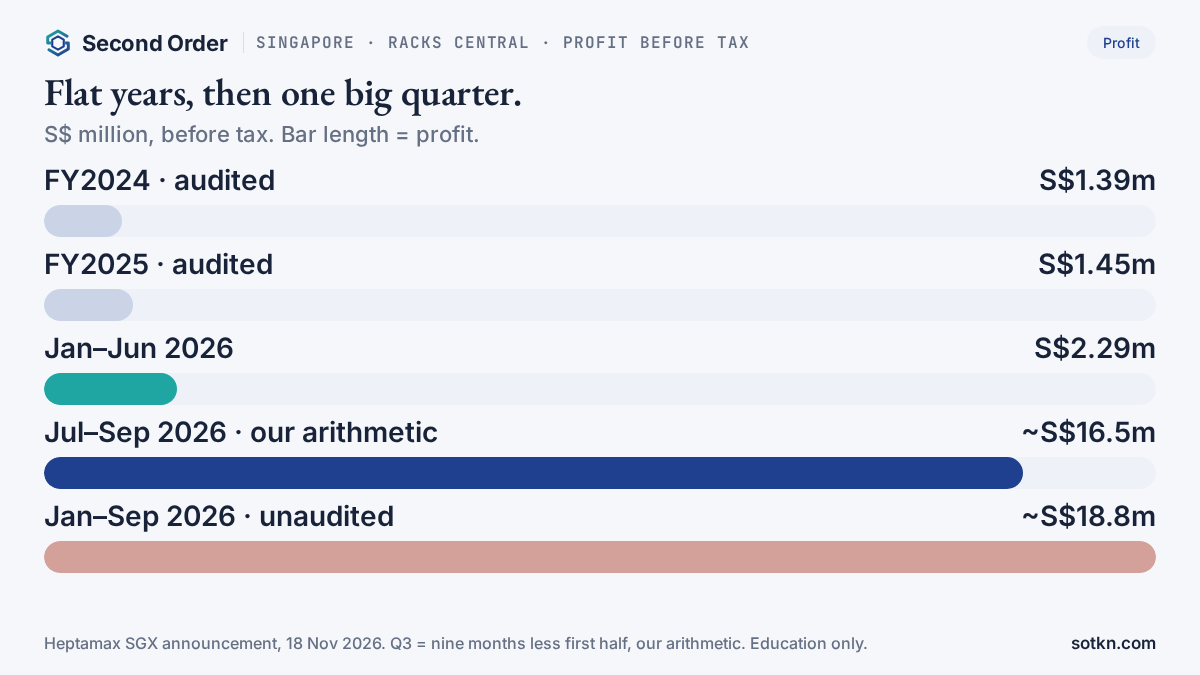
For three years Racks Central earned between S$1.26 million and S$1.45 million a year before tax. In the first half of 2026 it earned S$2.29 million. Then the nine-month figure is about S$18.8 million. Take one from the other and roughly S$16.5 million came in July to September alone, our arithmetic. That is about 88% of the nine-month profit in one quarter.
Both numbers come from the same filing and both are before tax, so the gap is real on the page. What the filing does not say is why. The nine-month number is from unaudited management accounts. Racks Central also earns fees for developing and managing data centres, and its owner is building a large campus in Johor. A one-off fee, a gain or a change in accounting would all produce a jump like this. So would a big new contract. We cannot tell which from the announcement, and we do not guess.
It matters because the price and the earn-out lean on profit. The S$500 million was worked out from Racks Central’s 2025 EBITDA, a number the filing does not print. The extra S$75 million earn-out needs EBITDA of at least S$70 million in 2027. Our arithmetic: even the strong 2026 run rate, about S$25 million a year before tax if you simply scale up nine months, is a long way from S$70 million of EBITDA. EBITDA is a bigger number than pre-tax profit, because it adds back interest and wear on assets, but that gap would need to be very large, or the business would need to change shape.
The circular is where this should get answered. It must carry the valuation report, and normally audited figures and an explanation of the business. Until then, the jump is a question mark, not a fact to build on.
How is S$500 million worked out, and what can move it?
The filing says the price was agreed at arm’s length, based on 2025 EBITDA and the deal’s benefits. To see how full it is, here are a few simple yardsticks. They are our arithmetic, not anyone’s valuation.
S$500m against the business (our arithmetic)
S$0.612 against the market (our arithmetic)
Heptamax SGX announcement, 18 Nov 2026; price on 24 Nov from market data. Ratios are our arithmetic.
A per-MW price is a crude tool. The buyer here does not own the building, and the lease runs for only a few more years. Compare it with Digital Core REIT’s SIN12, which we covered on 31 October (S$3.5 billion for 42 MW). Different asset, different rights, so treat the comparison as a sense check only.
Now the moving parts. The two sides will jointly appoint an independent valuer. Its number sets how much of the price survives:
- Valuation of S$500 million or more: the price stays S$500 million and the S$75 million earn-out stays open.
- Valuation short by up to S$75 million: the price still stays S$500 million, but the earn-out shrinks dollar for dollar.
- Valuation short by more than S$75 million: the deal can only go ahead if the S$425 million floor is waived. The price then drops by the shortfall above S$75 million, and the earn-out goes to zero.
- Valuation under S$425 million: a condition fails. Unless it is waived, the deal stops.
In plain words, the seller has put the first S$75 million of any valuation gap on its own future bonus, not on the price. That protects the S$500 million headline. It also means the earn-out is the first thing to go if the valuer is cautious.
Who owns the listed company afterwards?
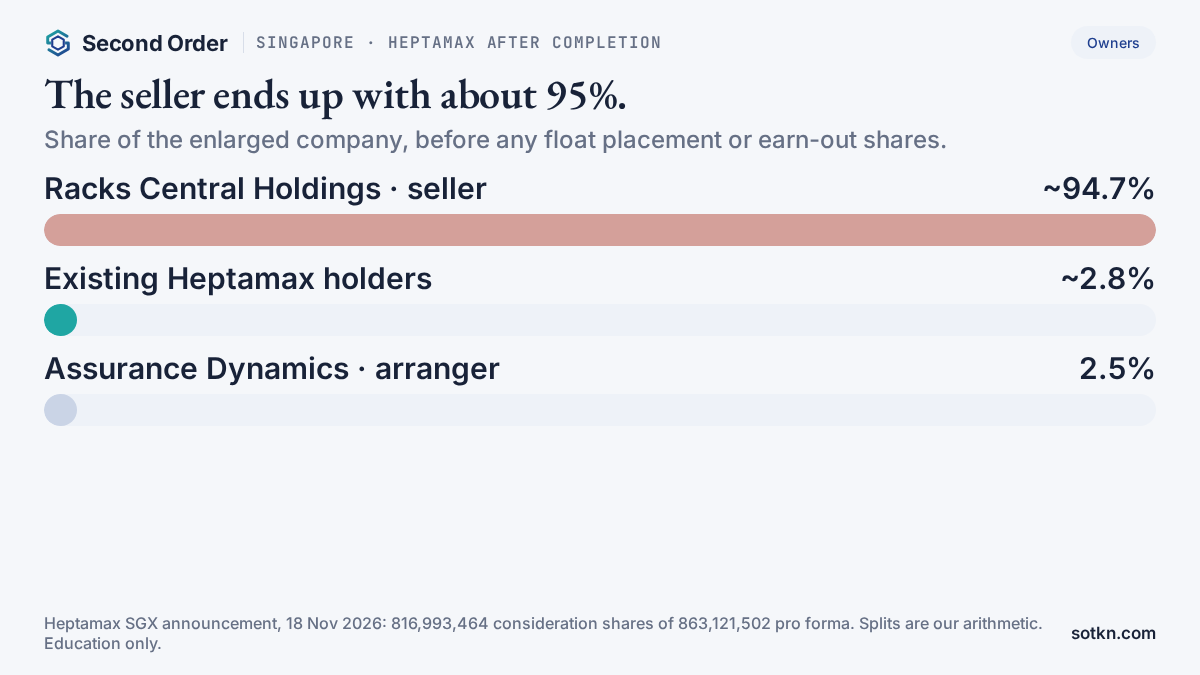
After the two-for-one merger of shares, Heptamax’s existing holders own 24,549,999 shares. The seller would get up to 816,993,464. The arranger that introduced the two sides, Assurance Dynamics, gets shares worth 0.5% of the enlarged company as a base fee and up to 2.0% more as an incentive fee. The filing’s pro forma share count is 863,121,502.
On those numbers the seller holds about 94.66%, existing holders about 2.8% and the arranger 2.5%, our arithmetic on the filing’s counts. At the S$0.612 issue price, the arranger’s roughly 21.6 million shares would be worth about S$13.2 million, also our arithmetic. If the earn-out is paid, up to 122,549,019 more shares go to the seller by the later of 30 April 2028 and ten business days after the number is settled.
A company that is 95% owned by one holder cannot stay listed as it is. SGX needs a minimum public float. So the deal includes a “compliance placement” after completion: new shares or some of the seller’s shares are sold to the public to restore the float. Its size and price are not set yet. That placement, not this agreement, is where outside money would first come in.
Heptamax’s two largest disclosed holders at 20 March were its chairman Goh Kui Lian, with 24.73%, and executive director Tan Wai Hong, with 9.54%. Heptamax will try to get both to promise to vote yes. For the whitewash vote, they can only be counted if the Securities Industry Council agrees they are independent. Mr Goh has also lent, or will lend, Heptamax up to S$1.3 million, which can stay outstanding after completion up to that cap.
What can the listed company buy in Johor, and when?
This is the part most headlines lean on. Racks Central’s group is building a campus at Pasir Gudang in Johor, planned for up to 510 MW across four buildings. The first phase, RCJM1, was fully committed on 30 June, with early access in December 2026 and ready-for-service targeted for the first quarter of 2027. Racks Central’s release said 70 MW for that phase; ESR’s June release said 90 MW. The group also plans a 95 MW site on Batam in Indonesia. For the Johor power queue these sites join, see Johor’s grid connection wait and TNB’s 9,000 MW plant plan.
But the Johor campus is not in the company being sold. It sits in Racks Central (M) Pte. Ltd., held by the seller. What Heptamax gets is a set of options:
Call option 1
Call option 2
First refusal
Heptamax SGX announcement, 18 Nov 2026. *Our arithmetic from the option price only; not a valuation of the Johor business.
The trigger matters. Option 1 can only be used after the Johor arm has received its first payment from a customer under a binding contract. A signed contract is not enough; cash has to arrive. That is the same line we draw across this site between a booking and a bill (leases not yet commenced, explained). So the listed company’s first step into Johor waits on a Johor hall being finished, energised and used.
Everything beyond that 10% is at a price still to be agreed. So the listed company is not buying the Johor growth today. It is buying the right to negotiate for it later, with a fixed price only on the first slice.
Who gets paid while the deal waits?
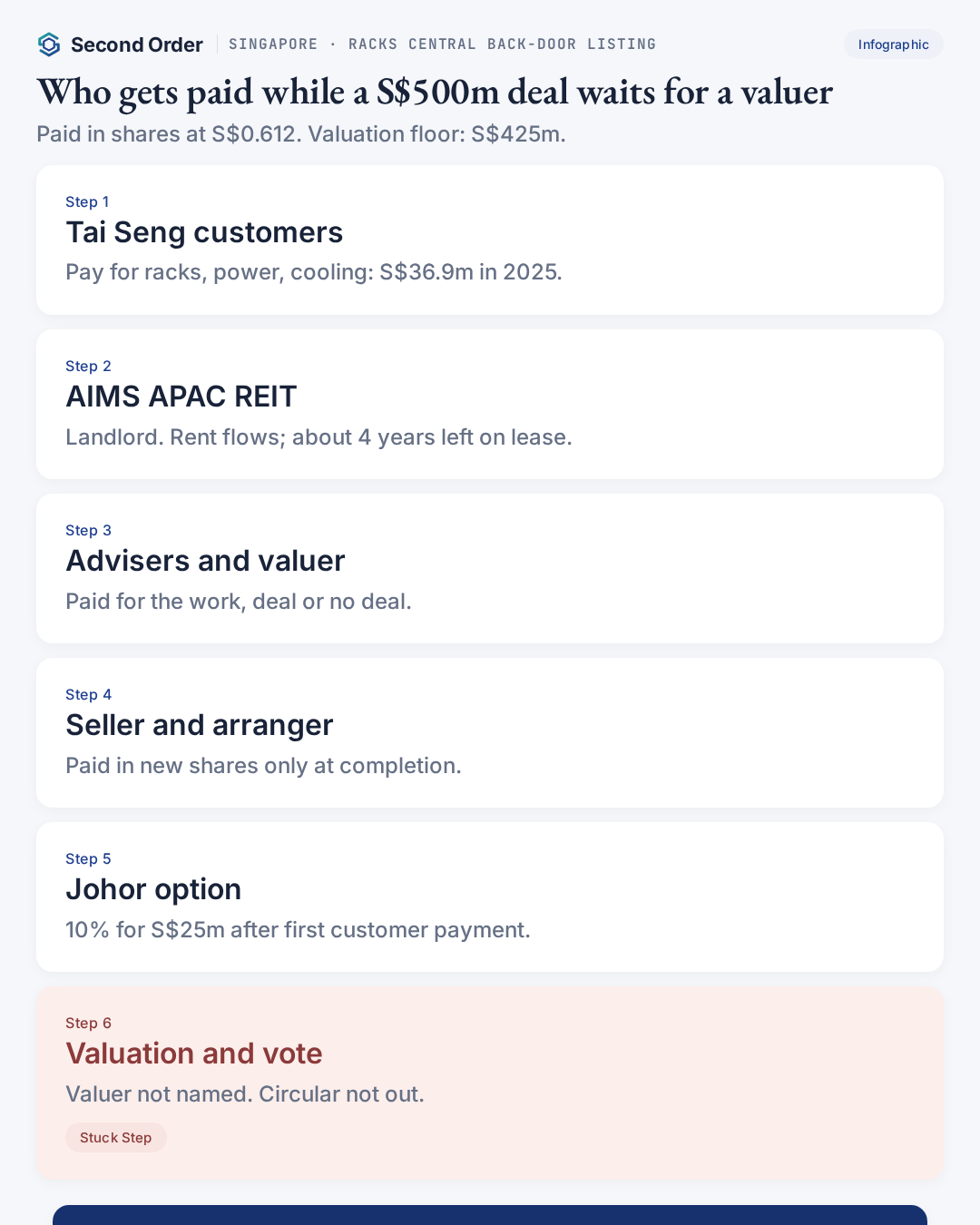
Most of the S$500 million is paper. It changes who owns what. Real cash in this story still comes from one place: customers paying for racks, power and cooling in Tai Seng.
Gets paid now, in cash
Gets paid on completion, mostly in shares
Waits
Second Order’s read of the Heptamax SGX announcement of 18 Nov 2026 and the AIMS APAC REIT lease details as reported by trade press.
The landlord is the steadiest earner. AIMS APAC REIT collects rent on the building whatever happens to the deal. The flip side is the lease clock. With about four years left, renewal terms will matter more to the listed company’s value than to the REIT’s, because the building is a small part of a large REIT.
The valuer, the lawyers, the issue manager and the independent financial adviser are paid for their work whether the deal closes or not. The arranger is paid only if it closes, and mostly in shares. The seller is paid entirely in shares, so its reward depends on what the listed company is worth after the placement, not on a cheque.
Who waits? Heptamax’s current shareholders, who are asked to give up almost all of their ownership in return for owning a slice of a data centre company. New outside investors, who come in only at the placement. And the Johor arm, whose first customer payment opens the first option. For how money flows through a hall in general, see data center financing, explained.
What is stuck, and what would change our read?
The stuck step is the independent valuation and the votes it unlocks. Nothing else in the chain can move first. The valuer is not named. Without its report there is no final price, no circular, no meeting and no SGX decision. The filing gives Heptamax 60 business days to finish its checks on Racks Central, which our count puts around mid-February 2027. The seller has 40 business days for its checks on Heptamax, around mid-January.
After that, the stuck step moves to the whitewash waiver and the vote, then to the placement. And for the Johor option, it moves to a finished hall and a first customer payment. The long-stop date is 15 months after signing, so about 18 February 2028, our arithmetic, and the filing says neither side should unreasonably refuse to extend it while approvals are pending.
What would make us more positive? A named valuer and a valuation at or above S$500 million. Audited 2026 numbers that explain the third-quarter jump. A clear statement of 2025 EBITDA. A lease renewal or extension at Tai Seng. And Johor reporting early access in December and service in the first quarter of 2027, followed by that first customer payment.
What would make us more cautious? A valuation below S$500 million, which eats the earn-out, or below S$425 million, which puts the deal itself in doubt. A circular that shows the jump came from one-off items. A whitewash waiver that is refused or heavily conditioned. A long delay that pushes toward the long-stop date. Or a slip in the Johor timetable, which would push back the first option.
There is also the backdrop. Washington’s new licence rule for advanced AI chips shipped to Singapore and four other countries started on 19 November. Racks Central rents space rather than chips, but its customers’ plans may still be shaped by it (same hall, two rulebooks). For how the stuck step tends to move from one link to the next, see where the stuck step moves.
What dates test this next?
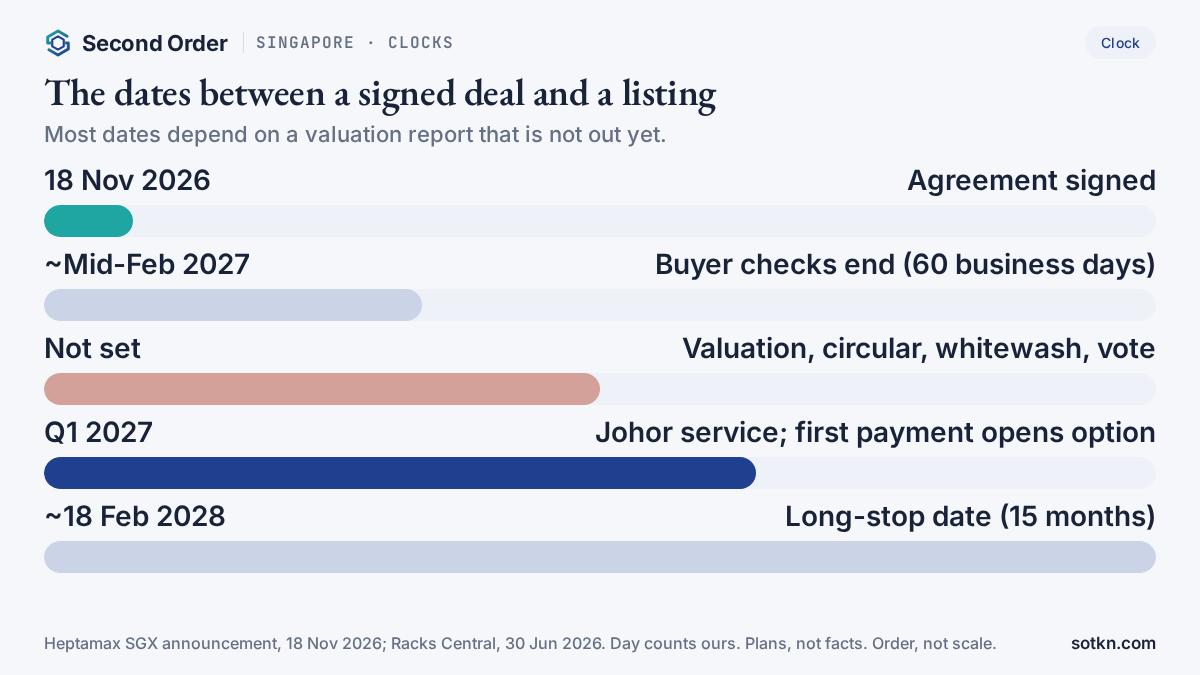
- 18 November 2026 — agreement signed and announced on SGX (done).
- December 2026 — early access at the first Johor phase, per Racks Central’s June release.
- Around mid-January 2027 — end of the seller’s 40-business-day check on Heptamax (our count).
- Around mid-February 2027 — end of Heptamax’s 60-business-day check on Racks Central (our count).
- First quarter 2027 — Johor first phase targeted ready-for-service; a first customer payment would open call option 1.
- Date not set — valuation report, circular, whitewash waiver, special general meeting and SGX approval.
- Financial year 2027 — the EBITDA test for the S$75 million earn-out: at least S$70 million.
- About 18 February 2028 — long-stop date, 15 months after signing, unless extended (our arithmetic).
- By 30 April 2028 at the earliest — earn-out shares, if earned.
Heptamax SGX announcement, 18 Nov 2026; Racks Central release, 30 Jun 2026. Business-day counts are ours and allow for Singapore public holidays. Plans, not facts.
How does this fit the rest of our notes?
It is the third Singapore listing story in two months, and each has hit a different gate. AirTrunk’s REIT waited on investor appetite (the REIT delay). DayOne waited on its next wave of money (the IPO pause). Racks Central waits on a valuer and a vote. On the supply side, Singapore’s power plan and the data centre licence rules explain why new halls are so slow to come. For a listed comparison, see Keppel DC REIT’s third quarter and our page on what Keppel DC REIT does. If the hall-or-campus difference is new to you, start with hyperscale vs colocation. All our Singapore notes are on Singapore Markets.
How we check this. The deal terms, share counts, conditions, dates and Racks Central’s accounts come from Heptamax’s own SGX announcement of 18 November 2026. Heptamax says the figures on Racks Central were supplied by the seller and have not yet been checked by Heptamax, and the nine-month profit is from unaudited management accounts. The landlord and lease details come from trade press that read AIMS APAC REIT’s reports. The Johor dates are Racks Central’s and ESR’s own. Every multiple, split and per-MW figure we give is labelled “our arithmetic”. The references we used are listed at the end. Our editorial standards →
FAQ
What did Heptamax agree on 18 November?
Heptamax International, a small company listed on the SGX Mainboard, signed a deal to buy all of Racks Central Pte. Ltd., which runs a data centre at 23 Tai Seng Drive in Singapore with about 8 MW of IT capacity. The starting price is S$500 million, paid only in new Heptamax shares at S$0.612 each after a two-for-one share consolidation.
Why is it called a reverse takeover or back-door listing?
Because the buyer is much smaller than what it buys. Heptamax was worth about S$6.3 million before the deal. After it, Racks Central’s owner would hold about 94.66% of the listed company and the company would be renamed Racks Central Limited. In effect, Racks Central gets onto the stock exchange through Heptamax’s listing.
Who gets cash from the deal?
Almost nobody, directly. The seller is paid in shares, and the arranger is paid in shares or cash. The cash in this story comes from the hall itself: customers pay Racks Central for space and power, and Racks Central pays rent to its landlord, AIMS APAC REIT.
What is the stuck step?
The independent valuation and the votes that follow. An outside valuer, not yet named, must value Racks Central. If it comes in under S$425 million the deal can stop unless that condition is waived. Then the circular goes out, the Securities Industry Council must grant a whitewash waiver, Heptamax shareholders must vote, and SGX must approve.
What does the Johor campus have to do with it?
Racks Central’s Johor campus sits with the seller, not in the company being sold. Heptamax gets an option to buy 10% of the Johor arm for S$25 million in shares, but only after that arm gets its first customer payment. The first 70 MW phase is due for service in the first quarter of 2027.
Is this investment advice?
No. Education only. It maps who gets paid and which step is stuck. It is not a recommendation to buy or sell any security, and we leave out price targets and ratings on purpose.
References
Outbound links below are nofollow. We list only the sources actually used. Internal sotkn.com links in the body are separate.
- Heptamax International Limited (SGX: 8A1), Proposed acquisition of the entire issued and paid-up share capital of Racks Central Pte. Ltd. (SGX announcement), 18 Nov 2026. links.sgx.com — the S$500 million price, the S$0.612 issue price and share counts, the S$425 million valuation floor, the earn-out, the whitewash, SGX and vote conditions, the due diligence windows, the 15-month long-stop date, the call options and first-refusal rights, Racks Central’s accounts and the pro forma figures.
- Mingtiandi, ESR-Linked Racks Central Eyes Singapore Data Centre Listing in $388M Reverse Takeover, 19 Nov 2026. mingtiandi.com — Heptamax’s history, 2025 revenue and largest shareholders, the seller’s directors, and AIMS APAC REIT’s valuation of 23 Tai Seng Drive.
- DCD (DatacenterDynamics), Singapore’s Racks Central to be acquired in reverse merger, 19 Nov 2026. datacenterdynamics.com — the lease from AIMS APAC REIT with about four years left, and the Johor and Batam plans.
- W.Media, Heptamax to acquire Singapore data center operator Racks Central in US$388 million reverse takeover, 20 Nov 2026. w.media — the US dollar value of the deal and the 12 MW figure used in the company’s own marketing.
- ESR, CAF II invests in Racks Central to advance Southeast Asia data centre corridor, 15 Jun 2026. esr.com — the China-ASEAN Investment Cooperation Fund II investment, the 12 MW Singapore figure and the 510 MW Johor plan.
- Racks Central, Racks Central celebrates milestone for Southeast Asia’s first AI factory campus in Johor, 30 Jun 2026. rackscentral.com — RCJM1’s 70 MW being fully committed, early access in December 2026 and ready-for-service in the first quarter of 2027.
- Singapore Economic Development Board and IMDA, Four data centre proposals selected as part of the second Data Centre – Call for Application (fact sheet), 21 Aug 2026. edb.gov.sg — the 200 MW split as 50 MW each to four operators on Jurong Island, and the 18–24 month review of another call.
- Dividends.sg, Heptamax International (SGX: 8A1) announcements and price, 24 Nov 2026. dividends.sg — the S$0.131 share price on 24 November and the filing list.
Not investment advice. Do your own research. Education only. Map of who gets paid and which step is stuck — not a buy list.
More on this desk: Singapore Markets · Malaysia Markets · AI Data Centers · all Markets.